A fellow MFA candidate, Madeleine Greenway, gave a wonderful artist talk last Sunday to accompany her show Propagation.
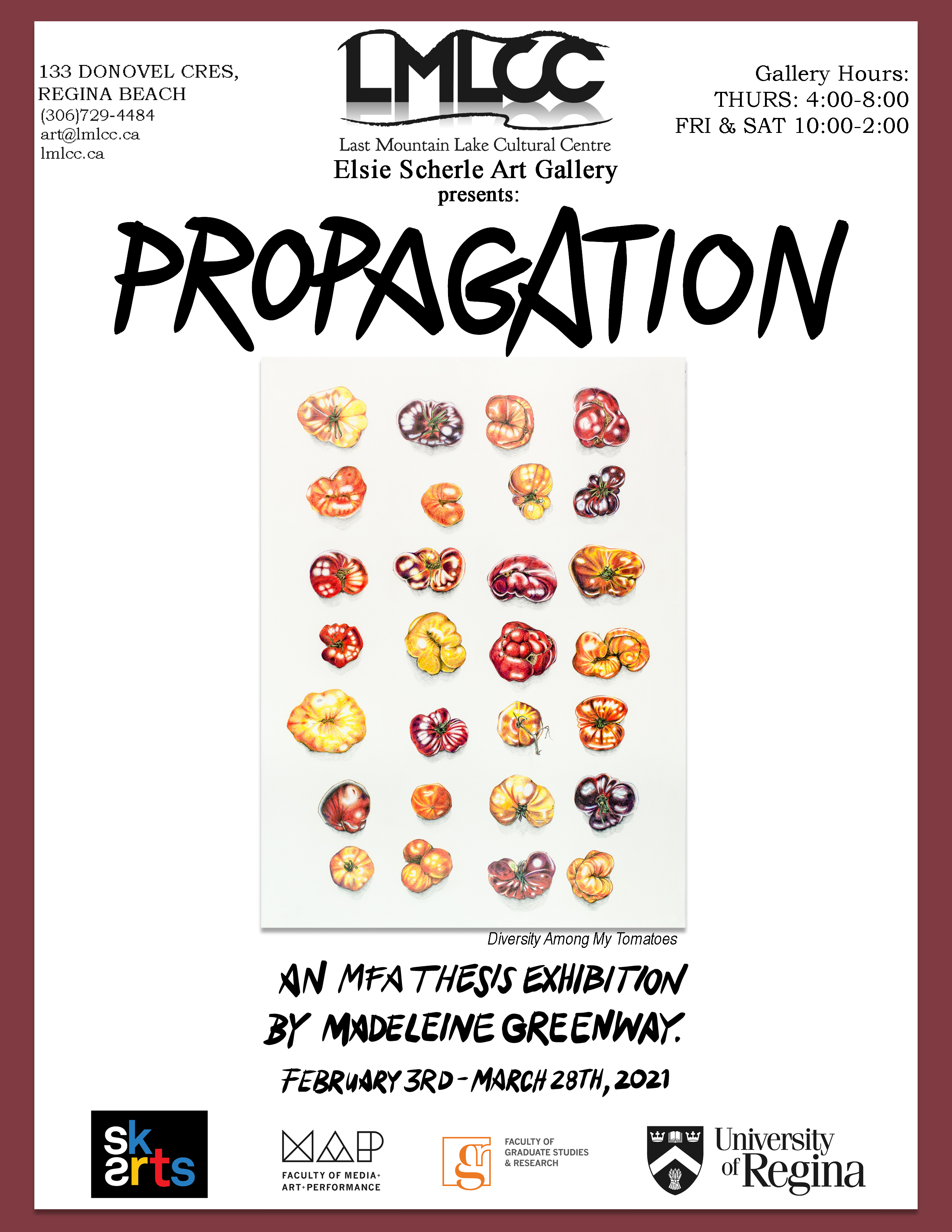
Madeleine began the talk by explaining the reason behind her choice of title. She said that the word “propagation” was an appropriate choice because it has several meanings that coincide with her work’s themes: “how plants reproduce; how people and animals reproduce in a biological sense; how we create families; how ideas can spread among groups of people and beyond – especially in this case the knowledge of women that’s been propagated, but also with a show I can propagate my own ideas.”
She went on to describe the ideas that she’s propagating with this show, largely that food is “meaningful, and it has value, and it deserves being invested in.” She spoke about not just the way our bodies are formed from the nourishment we gain from food, but also how many aspects of our lives revolve around, or should revolve around, the growing, harvesting, and consuming of food. Eating food, and especially growing one’s own food, is often a social act: “it’s obvious how meaningful and emotional food can be just in terms of how central it is to celebrations and how sharing food is such a universal human act.”
I really admire the way Madeleine engages her audience through her work. Her drawings and prints certainly do propagate the ideas that she wishes them to. At the same time, the work is visually stunning — full of voluptuous shapes and colours that attract viewers to spend time looking at these images of the items we often gloss over at our kitchen counter or table. We may realize that the produce we brng into our homes pales in comparison (and is literally paler) than the produce in these works, and we should consider that fact. What are we losing by allowing corporations to feed us what big-ag produces in the name of produce? As Barbara Kingsolver puts it in Animal, Vegetable, Miracle: A Year of Food Life, “How did supermarket vegetables lose their palatability, with so many of us right there watching?” (48). She points out elsewhere in the book that food—a requirement of life, something we take into our bodies at least three times a day— is now nearly completely outside of our control: most of us don’t grow it, we don’t even hardly know it. We don’t even know what could or could not grow from the soil and climate in which we live. The food we now eat is far removed from its source, not only geographically as is often the case (apples from Chile; kiwi from Greece) but also in terms of its nutritional value. The situation is quite insane. Madeleine’s prints and drawings convey it beautifully and simply in “Diversity Among My Tomatoes,” “My Sister’s Apples,” “Silverbeet Rainbow Chard, Red Leaf” and many works.
Propagation also includes a personal essay Madeleine printed out by hand on large sheets of paper that hang on the wall. It tells the story of her family’s next-door neighbours from when she was a child who tragically died in a house fire, their land then sold to Madeline’s parents who continue to garden on it to this day. This garden is an extension of as well as the source of her recent artistic practice. Madeleine’s love for this subject matter—these ideas she’s propagating—is clear. Hearing her read this essay out loud during her talk was remarkable. She opened herself up entirely to the audience. As David would describe this work of writing as well as her prints and drawings, she is entirely sincere.
I admire Madeleine for taking on subject matter that is so hugely important and responding to it through her work in such a deeply personal way. I asked her if she sees her work as activist in nature, to which she replied that it isn’t explicitly so, but she’s thinking she’ll explore more directly activist work in the future. I’ll be interested to see if/where she takes that, but to be honest, her current approach grounds me somehow; I take reassurance from her courage to convey so much important content through work that appears modest (in the positive sense, as in not vain, not didactic) as well as beautiful. Thank you, Madeleine.
Work cited:
Kingsolver, Barbara. Animal, Vegetable, Miracle: A Year of Food Life. Toronto: Harper Collins, 2007.
 Amy Snider
Thank you so much, Amy! What a beautiful review.
LikeLike