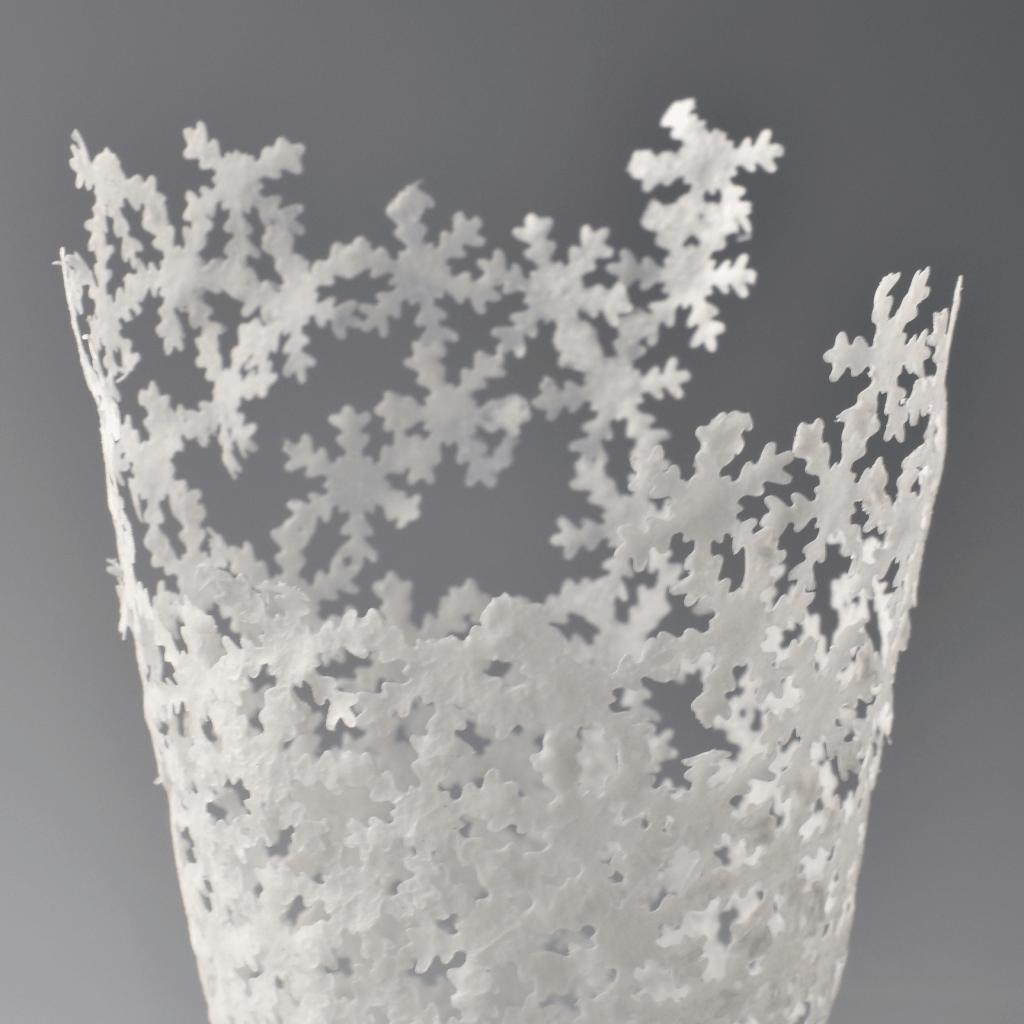
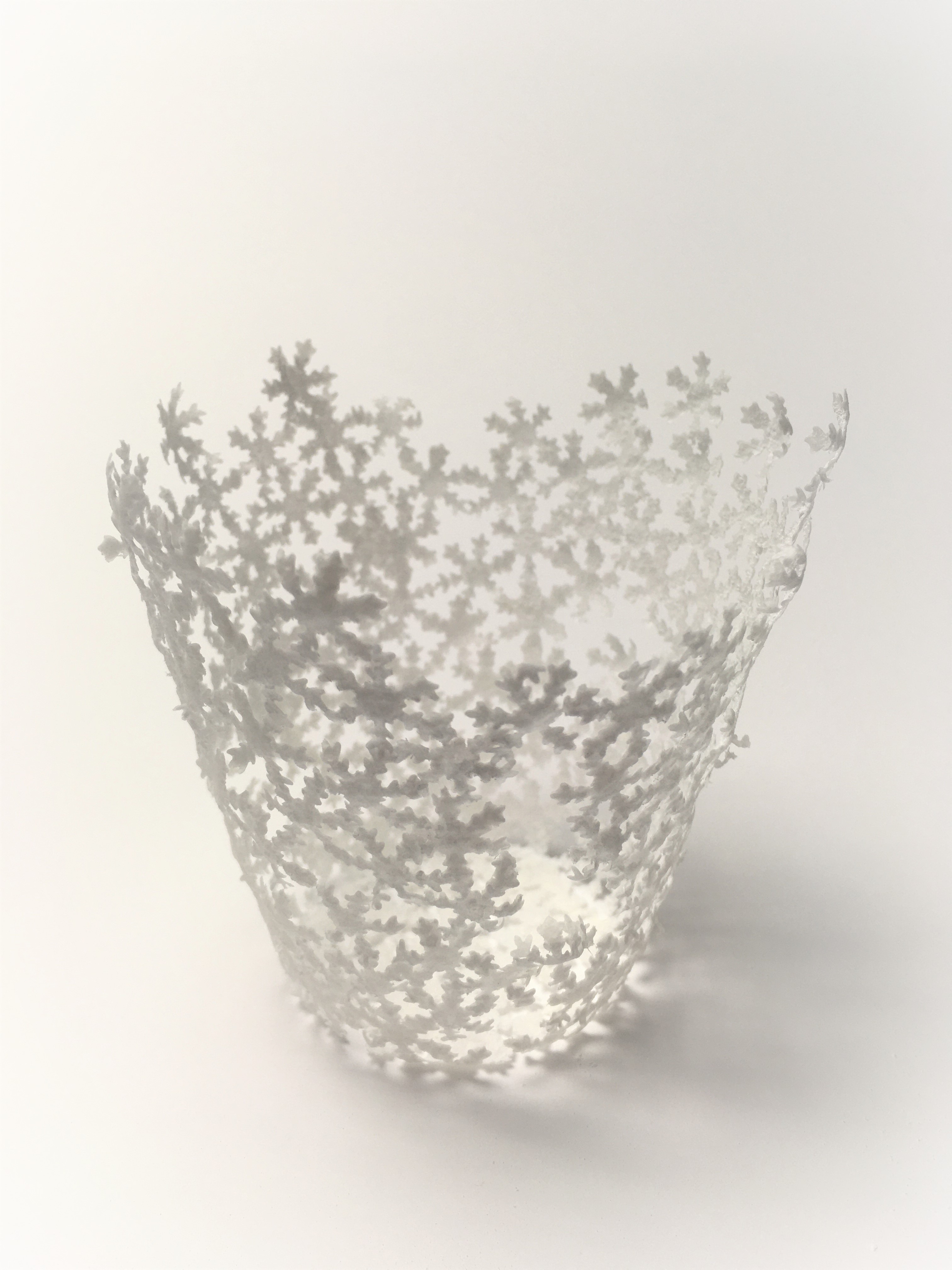
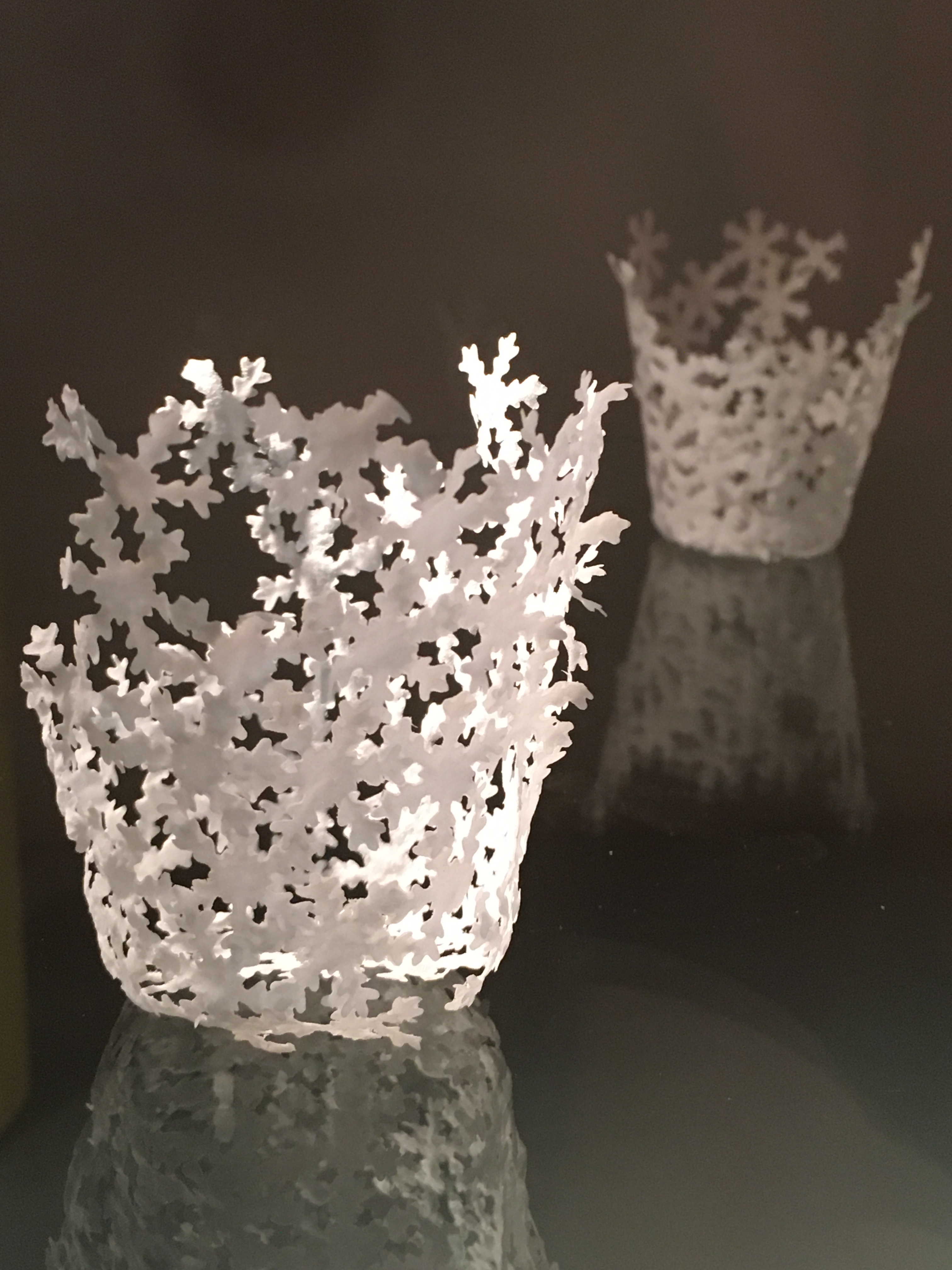
My work with the porcelain cup-shaped sculptures I’ve created is to represent the state of the world’s glaciers in the face of climate change: some of these pieces appear to be melting, others disintegrate in water while particles of clay “calve” off of them, and the ones in Saskatchewan Glacier are constructed of snowflake shapes barely holding together in the form of a cup. I’ve employed the archetype of the cup as it is a vessel associated with the act of drinking; nearly seventy percent of the world’s freshwater is currently held in ice, and some of the drinking water that runs from our taps where I live in the Canadian prairie is what geologists refer to as “glacial wastage,” a term that makes me morose. The Saskatchewan Glacier, a glacial “toe” of the Columbia Icefield in Alberta, Canada, contributes to the inflow of lakes and reservoirs, our water sources for agriculture, hydropower, and industrial and municipal uses. Besides the economic implications of their disappearance, I mourn the loss of the glaciers, ancient rivers of ice whose beauty and water sustain me, and this work is my tribute to them.
Using a medium that is geologically connected to them, my clay-based cups in Saskatchewan Glacier represent the fragility of the glaciers at this historical moment – the paper-thin branches of their porcelain snowflakes are barely touching one another, resulting in cups so fragile that a draft in a room could destroy them. Many of these cups do not survive firing, and needless to say, the ones that do don’t hold water. During installation, many break, and their destruction, resulting in porcelain “snowflakes” on the gallery floor, further indicates the ephemerality of the glaciers they represent. While I produce more of these pieces for each show, what lasts of each is only the documentation of its existence. Through these cups and the performance of their own inevitable collapse, I hope to elicit a response in others that will nudge them towards greater awareness of the urgency needed to mitigate climate change.
Source: National Snow and Ice Data Centre (U.S.), https://nsidc.org/learn/cryosphere-glossary
 Amy Snider