Reading: Brad Evan Taylor’s “Environment, Art, Ceramics, and Site Specificity”

Quotations from: Evan, Brad. “Environment, Art, Ceramics, and Site Specificity.” In The Ceramics Reader, edited by Andrew Livingstone & Kevin Petrie, 512-16. London: Bloomsbury, 2017.

Works which incorporate environment and site specificity have additional tools to inspire thought and emotion about connectivity.  (513)

Art, at least “good art” inspires contemplation, consideration, conversation, and sometimes debate. The intent is often to trigger thought or emotion which is not always explicable in rational, everyday language.  […] I hold the belief that the emotional transformation induced within a viewer, I am speaking about the inexplicable one, is the direct result of the artist’s ability to metasomatize [or transform] matter. The artist might be a painter, sculptor, or a ceramist. When an artist has the ability to seemingly transform matter in a magical way, the resulting art inherits some of this ability to communicate on an emotional level.  (513)

Ceramic materials have history as old as the earth. The rocks we use to make our work are bound to the history of the planet. (515)

Clay may very well turn out to be critical matter in the formation of life. It’s [sic] link to the history of life, and earth, and it’s [sic] natural ability to focus interaction on an atomic level, make it an idealistic choice for use in environmental works when one wishes to incorporate and utilize the intrinsic history of the material. Because of clay’s integral history, it has an ability to speak through eons. (515)

Reading: Claire Bishop’s Artificial Hells: Participatory Art and the Politics of Spectatorship

Quotations from: Bishop, Claire. Artificial Hells: Participatory Art and the Politics of Spectatorship. London: Verso, 2012.

This expanded field of post-studio practices currently goes under a variety of names: socially engaged art, community-based art, experimental communities, dialogic art, littoral art, interventionist art, participatory art, collaborative art, contextual art and (most recently) social practice. (1)

[…] to the extent that art always responds to its environment (even via negativa), what artist isn’t socially engaged? (1-2)

But regardless of the geographical location, the hallmark of an artistic orientation towards the social in the 1990s has been a shared set of desires to overturn the traditional relationship between the art object, the artist and the audience. To put it simply: the artist is conceived less as an individual producer of discrete objects than as a collaborator and producer of situations; the world of art as a finite, portable, commodifiable product is reconceived as an ongoing or long-term project with an unclear beginning or end; while the audience, previously conceived as a ‘viewer’ or ‘beholder’, is now repositioned as a co-producer or participant. (2)

“As the chapters that follow will make clear, these shifts are often more powerful as ideals than as actualised realities, but they all aim to place pressure on conventional modes of artistic production and consumption under capitalism.” (2)

From a Western European perspective, the social turn in contemporary art can be contextualised by two previous historical moments, both synonymous with political upheaval and movements for social change: the historic avant-garde in Europe circa 1917, and the so-called ‘neo’ avant-garde leading to 1968. The conspicuous resurgence of the participatory art in the 1990s leads me to posit the fall of communism in 1989 as a third point of transformation. Triangulated, these three dates form a narrative of the triumph, heroic last stand and collapse of a collectivist vision of society. Each phase has been accompanied by a utopian rethinking of art’s relationship to the social and of its political potential — manifested in a reconsideration of the ways in which art is produced, consumed and debated. (3)

Some of the key themes to emerge throughout these chapters are the tensions between quality and equality, singular and collective authorship, and the ongoing struggle to find artistic equivalents for political positions. (3)

One thing is clear: visual analyses fall short when confronted with the documentary material through which we are given to understand many of these practices. To grasp participatory art from images alone is almost impossible: casual photographs of people talking, eating, attending a workshop or screening or seminar tell us very little, almost nothing, about the concept and context of a given project. They rarely provide more than fragmentary evidence, and convey nothing of the affective dynamic that propels artists to make these projects and people to participate in them. (5)

Debord’s critique strikes to the heart of why participation is important as a project: it rehumanises a society rendered numb and fragmented by the repressive instrumentality of capitalist production. Given the market’s near total saturation of our image repertoire, so the argument goes, artistic practice can no longer revolve around the construction of objects to be consumed by a passive bystander. Instead, there must be an art of action, interfacing with reality, taking steps — however small — to repair the social bond. (11)

Instead of supplying the market with commodities, participatory art is perceived to channel art’s symbolic capital towards constructive social change. Given these avowed politics, and the commitment that mobilises this work, it is tempting to suggest that this art arguably forms what avant-guard we have today: artists devising social situations as a dematerialised, anti-market, politically engaged project to carry on the avant-garde call to make art a more vital part of life. […] While sympathetic to the latter ambition, I would argue that it is also crucial to discuss, analyse and compare this work critically as art, since this is the institutional field in which it is endorsed and disseminated, even while the category of art remains a persistent exclusion in debates about such projects. (13)

From I. Creativity and Cultural Policy

What emerges here is a problematic blurring of art and creativity: two overlapping terms that not only have different demographic connotations but also distinct discourses concerning their complexity, instrumentalisation and accessibility. (16)

Artists and works of art can operate in a space of antagonism or negation vis-a-vis society, a tension that the ideological discourse of creativity reduces to a unified context and instrumentalises for more efficacious profiteering. (16)

From II The Ethical Turn

All of this is not to denigrate participatory art and its supporters, but to draw attention to a series of critical operations in which the difficulty of describing the artistic value of participatory projects is resolved by resorting to ethical criteria. (19)

This emphasis on process over product — or, perhaps more accurately, on process as product — is justified on the straightforward basis of inverting capitalism’s predilection for the contrary. (19)

(On curator Maria Lind‘s judgement of Thomas Hirschhorn‘s and Oda Projesi‘s work) The visual, conceptual and experiential accomplishments of the respective projects are sidelined in favour of a judgement on the artists’ relationship with their collaborators. […] Hirschhorn’s (purportedly) exploitative relationship is compared negatively to Oda Projesi’s inclusive generosity. In other words, Lind downplays what might be interesting in Oda Projesi’s work as art — the achievements of making social dialogue as medium, the significance of dematerialising a work of art into social process, or the specific affective intensity of social exchange triggered by these neighbourhood experiences. Instead her criticism is dominated by ethical judgements on working procedures and intentionality. (22)

In Conversation Pieces, Grant Kester argues that consultative and ‘dialogic’ art necessitates a shift in our understanding of what art is — away from the visual and sensory (which are individual experiences) and towards ‘discursive exchange and negotiation’. (23)

At the centre of opposition to this trend have been the philosophers Alain Badiou, Jacques Ranciere and Slavoj Zizek who, in different ways, remain sceptical of the jargon of human rights and idenitarian politics. […] In insisting upon consensual dialogue, sensitivity to difference risks becoming a new kind of repressive norm — one in which artistic strategies of disruption, intervention or over-identification are immediately ruled out as ‘unethical’ because all forms of authorship are equated with authority and indicted as totalising. (25) — the politically correct.

Kester criticises Dada and Surrealism for seeking to ‘shock’ viewers into being more sensitive and receptive to the world — because for him, this position turns the artist into a privileged bearer of insights, patronisingly informing audiences as to ‘how things really are’. He also attacks post-structuralism for promulgating the idea that it is sufficient for art to reveal social conditions, rather than to change them. (26)

From III. The Aesthetic Regime

[…] a tension and a confusion between autonomy (the desire for art to be at one remove from means-ends relationships) and heteronomy (that is, the blurring of art and life). (27)

The aesthetic regime of art, as inaugurated by Schiller and the Romantics, is therefore premised on the paradox that ‘art is art to the extent that it is something else than art’: that it is a sphere both at one remove from politics and yet always already political because it contains the promise of a better world. (27)

(to be continued)

Reading: “Representing, Performing and Mitigating Climate Change in Contemporary Art Practice”

Quotations from: Giannachi, Gabriella. “Representing, Performing and Mitigating Climate Change in Contemporary Art Practice.” Leonardo (Oxford) 45, no. 2 (2012): 124-31.

This is a great article for me to read and return to later to consider. It introduces several artists and projects I should know about as well as a summary of a few approaches to responding to climate change in art.

While artists have dealt with the growing realization that our climate is changing in different ways, it is noticeable that, among the types of works analyzed in this article, artists have tended to adopt one or more of three strategies:

1. Representations – emphasizing visualization and communication

2. Performance environments – emphasizing immersion and experience

3. Interventions – emphasizing mitigation and behavioral change. (125)

I propose here that each of these strategies has so far led to important and efficacious works and that each of them is of aesthetic, social and political value. (125)

Cape Farewell, an organization aiming to communicate the realities of climate change within the artistic and educational contexts, tends to generate work belonging to the first category, although, as an organization, it also operates through the other two categories. Its primary objective is the communication of climate change through art (hence the title of their world-touring exhibition Art and Climate Change [2006]), which they achieve by organizing expeditions (emphasizing experience) (Fig. 1) intended to encourage interdisciplinary debate on climate change and to affect artists so that they may create inspiring work on this topic (emphasizing behavioral change). The organization states as its mission “to develop the production of art founded in scientific research,” “by exposing artists to the world’s climate tipping points” and incorporating scientific collaboration into artistic practice. (125)

Among the most interesting works generated through Cape Farewell was Antony Gormley’s Marker 1 (2005), an imposing ice statue with human contours, which brought together in one image the causes and effects of climate change [10]. The statue, which stood on the frozen sea of the Qord until it melted the following spring, was finally reclaimed by the sea. (125)

David Buckland’s video Sinking Ice (2004), showing the top of an iceberg hanging precariously over the ocean and finally sinking into it. The video, playing on the notion of the sublime, was watched, according to Julian Knebusch, for over 40 minutes by a number of visitors to the Cape Farewell touring exhibition, almost as if they were waiting for the accident and the catharsis it offered to the tragedy of climate change – to happen (2008). (125-26)

[…] German art collective artcircolo. The group, consisting of artists, technologists, curators and scientists, has worked for a number of years specifically on the theme of water, developing transdisciplinary research, talks involving the general public, commercial products and artwork. (126)

Participants in events curated by artcircolo are often encouraged to consider their behavior and to imagine change. This was particularly noticeable in work developed as part of their collaboration with Dutch artist Wapke Feenstra, who often transforms spectators into participants by asking them to reflect about local histories in an attempt to tie particular environments to the socioeconomic conditions that generated them. (126)

Other examples of works curated by artcircolo are German sound artist Kalle Laar’s Calling the Glacier (2007) (Fig. 5), an interactive installation that allowed people who dialed a given telephone number to listen live to the sound of a melting glacier, and Icelandic artist Rúrí’s gigantic video projections showing waterfalls in Iceland, such as Tortimi/Fall – Passage (2009), in which a metal framework supports a very long photograph of a waterfall on a roll, the end of which continually disappears into a machine to symbolize how waterfalls are vanishing from the Icelandic landscape. (127)

As is typical for artists curated by artcircolo, both Laar and Rúrí’s works focus on water, and both attempt to sonify and visualize the unfolding of environmental catastrophe. Laar’s work, which broadcasts a live phenomenon succeeds in bringing a remote occurrence close by, thus also dealing with one of the biggest difficulties in climate change communication: the rendering of something occurring over time, often in remote environments, to diverse and distributed audiences. (127)

YES — see Rob Nixon Slow Violence

Other examples of artworks belonging to the first category – art that facilitates communication on climate change – include dystopian works, often using shock, such as Petko Dourmana’s Post Global Warming Survival Kit (2008). (127)

[…] Chris Bodle ‘s The Watermarks Project (2009), a public art project visualizing the effects of climate change on the British coastline through a series of large- scale “flood marks” showing potential future high-water levels projected onto the facades of buildings across Bristol.

I’m confused: Eve S. Mosher’s Highwaterline project in Bristol did the same thing, basically.

While all these works variously engage the public in what climate change may mean to different communities around the globe, often utilizing icons of climate change in shocking ways, they tend to be grounded in representation and privilege visualization over a haptic, multi-sensory and performative experience. (127)

Examples of work belonging to the second category – art facilitating the experience of climate change – are numerous and often adopt performance strategies, as we have seen with artcircolo and Cape Farewell, to generate immersive environments, so that climate change may be experienced directly as well as analyzed. (128)

Andrea Polli ‘s powerful Sonic Antarctica project (2007-) (Article Frontispiece), a radio broadcast, live performance and sound and visual installation featuring recordings of the Antarctic soundscape made during Polli ‘s 7-week National Science Foundation residency in Antarctica. (128)

Crucially, Polli draws attention to one of the most important aspects of interdisciplinary work addressing climate change, namely, the translational work involved in presenting data to the public within an artistic context. (128)

Polli has been able to generate evocative and compelling works that operate as representations – effectively communicating climate change by translating dataas well as events, since the sonifications are reconstituted as performances and installations that allow for an immersive, multi-sensory experience. (128)

The third strategy entails works that encourage behavioral change. While all art may generate some level of change, these works operate by producing change in a particular community as part of the work (128).

(About Sustainable Bandung) This hybrid work entailed research, community work, the development of a new ecology and an artwork, operating ecologically, environmentally and aesthetically to effect change. (129)

(About a project by architect Uzman Haque) Among their numerous important projects is Natural Fuse (2008-), which “harnesses the carbon-sinking capabilities of plants to create a city-wide network of electronically assisted plants that act both as energy providers and as shared ‘carbon sink.'” (129)

As noted by Bruno Latour, contemporary environmental problems are “hybrid” and involve both nature and culture [20] . Culture therefore is not only a means to represent, perform and understand nature but also a way of changing nature. Likewise, nature is a fundamental axis for cultural change. A change in nature is a change in culture. (129)

To understand what this means more precisely, I return to Ingold and his definition of nature. For him nature is not opposed to landscape – although it is not the same either – and neither is it space, but rather “it is the world as it is known to those that dwell therein, who inhabit its places and journey along the paths connecting them” [21]. (129)

Look up Ingold, T. (2000), The Perception of the Environment: Essays in Livelihood, Dwelling and Skill, London and New York: Routledge, p. 41. Read what he says about “taskscapes”

The use of a taskscape as an artistic process, as is evident, for example, in Francisco’s Agua Benita and Iskandar’s Babakan Asih Water Story, which use performance as a task to effect environmental change, then becomes a direct engagement, or, to use Ingold’s words, a “mutual interlockingbetween humans and their environment. Environment here is not only seen but is experienced as process and encountered in its performance – with the participants, in the case of Babakan Asih Water Story, generating societal change.

We have seen how in order to address climate, and its encompassing of cultural and physical factors, some of the most interesting works in this area utilize inter- disciplinary methodologies, usually drawing from art and science. This has often generated aesthetically hybrid works. (130)

Furthermore, a number of works have simultaneously offered insight into climate change as a “natural” phenomenon (occurring in nature) and a “cultural” one (generated by and modifiable through cultural behavior) . This has frequently led to the simultaneous presentation of climate change in nature and in culture, which has required a repositioning of the viewer from spectator to participant, thinker, citizen scientist or even activist. (130)

Finally, a number of intertextual and intermedial forms are often utilized concurrently, pairing, for example, modernist uses of “shock” with romantic notions of the “sublime” and postmodernist discourses on trace and erasure. Some of the artists privilege representation, others generate performance environments and a few aim to effect behavioral change, at either an individual or a community level. A number of works utilize these strategies concurrently to provoke instinctive reactions and encourage analysis. (130)

Reflecting on the work of The Climate Project (TCP), Buontempo noted that their strategies can be read in conjunction with those discussed by Nassim Nicholas Taleb in The Black Swan (2007), where he describes two systems: (1) “the experiential” and (2) “the cognitive,” in which emotions fall within the former. System 1, for Taleb, is “effortless, automatic, fast, opaque (we don’t know that we are using it)” and constitutes an “intuition.” System 2, on the other hand, is what we call “thinking.” It is “slow, logical, serial, progressive, and self-aware.” Mistakes, Taleb notes, occur when we use System 1 when in fact we should use System 2 [28] . Buontempo suggests that to make decisions on scales (both spatial and temporal) that we cannot grasp directly, as is necessary in climate analysis, we need to switch off our emotional reaction and relay to the cognitive system, bringing into play System 2. The best way to bridge the gap, for him, in order to then communicate findings to the public, is to identify a narrative that is understood by System 1 in an instinctive way but can also convey the results obtained by System 2 while offering the opportunity for further analysis and debate. (130)

By juxtaposing Systems 1 and 2 through the identified strategies, a number of the artworks described in this article are able to capture attention and produce strong instinctive reactions while also being informative and generating important and possibly impactful debates on one of the most controversial and pressing imperatives of our time. (130)

Look up Carlo Buontempo, senior scientist at the Met Office Hadley Centre for Climate Prediction and Research (MOHC) and Nassim Nicholas Taleb‘s The Black Swan (2007)

(Aspirational) “Civilian” Artist Statement

After much revising (thank you, David), this is my “civilian” artist statement… aspirational as it may be. (Again, for our class, David asked us to write what he calls a “civilian artist statement,” by which he means “a clear, non-poetic, communication. It explains your art work and practice to an intelligent reader who knows nothing about your art and little about the art world or theory. It is the base for longer, specialized, and creative versions.”)

My artistic practice is an elegiac response to ecological devastation, an act of self-preservation, and a call to action. The work includes ceramic sculptures that document the effects of climate change, a pottery practice which sustains me and offers an alternative to our throwaway culture, and performances through which I express the sense of urgency needed in order to address this global emergency.

My recent conceptual ceramic work is a series of cup-shaped porcelain sculptures that represent glaciers facing climate change (2018-19). One set of these cups, “Athabasca Glacier 1918-2018,” appears to be melting. Another, “Calving,” comprises unfired cups that disintegrate in water while calving particles of clay. The third set, “Saskatchewan Glacier,” is constructed of snowflake shapes that barely hold together in the form of the cup. The pieces are so fragile that a draft could destroy them. Many break during installation. Their destruction results in porcelain snowflakes on the gallery floor, further indicating the ephemerality of the glaciers they represent. In this sense, these works are performances as much as they are physical objects: the care needed to prevent their demise replicates the present state of our glaciers. I mourn their loss, and this work is my tribute to them.

I also create ceramic functional ware for everyday use. While less explicitly conceptual, even this practice reflects a concern for ecology. The act of creating these works out of clay puts me in touch with the sustaining effect that being in places of natural beauty gives me, and the pieces communicate this reverence for nature through their soft, irregular, and organic forms and surface treatments. Handmade pots offer a counterbalance to our disposable culture, and the practice of creating them enables me to recoup the energy I need to continue responding to the crisis we are facing.

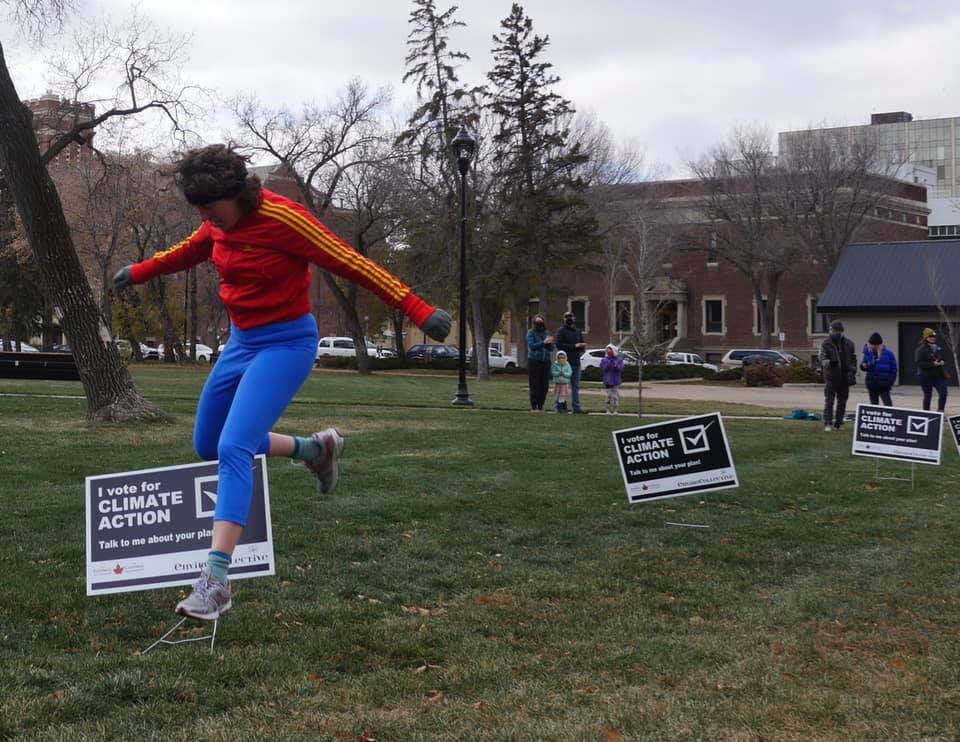
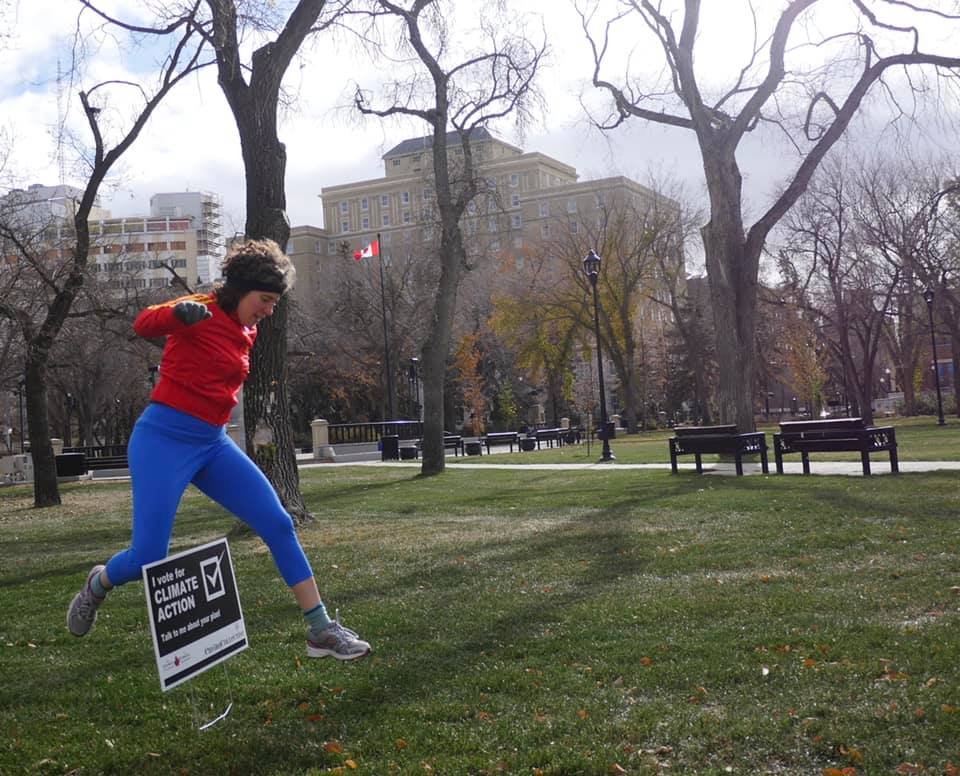
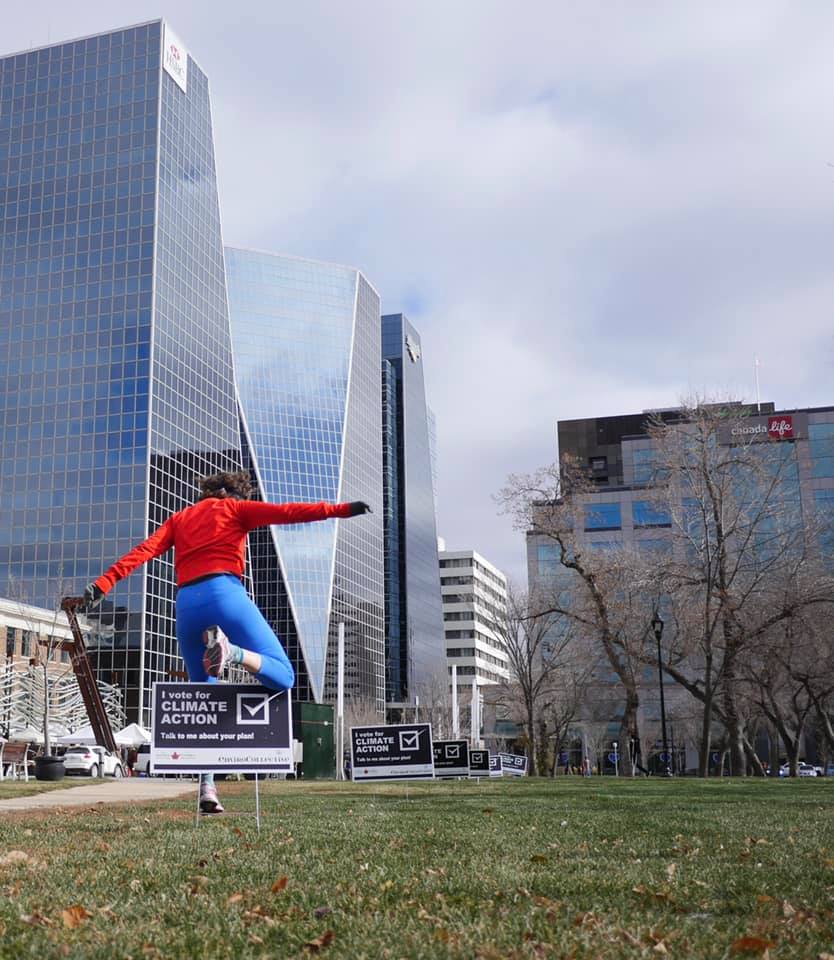
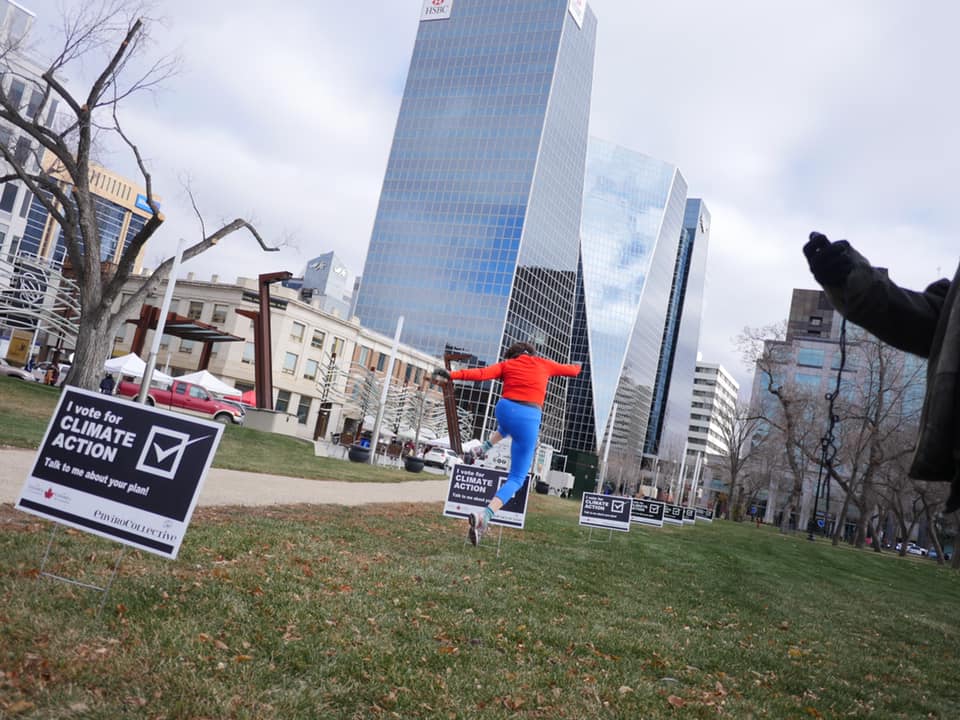
In my performance work, I explore ways to reach a broader audience. I choose to perform in public to draw attention to climate change by taking people by surprise in places they would not expect art. Apathy towards this issue has catastrophic consequences, and my work conveys this urgency while also offering ideas of how to take action to reduce the damage we are causing. Despair, detachment, and passivity can go hand in hand. To counter this, I often use humour. For instance, in Hurdles (17 Oct. 2020), I jumped over “I vote for climate action” lawn signs in a garish tracksuit in freezing weather. Other performances include participation that encourages meaningful engagements with the subject matter and exemplifies, via the cooperative nature of the events themselves, how we can work together to lessen and mitigate the coming challenges.

Climate change is the most complicated threat our species has encountered, and I feel the need to respond to it in a multifaceted way. In moving between the physicality of ceramics and the ephemerality of performance, between a quiet reflection on the beauty of nature and an outward communication of a sense of urgency to protect it, my practice explores how each medium can respond to my concern for our planet with such diverse methods and results.

Conversation: Taiwo Afolabi

Taiwo Afolabi is a new faculty member in the Theatre Department at the University. On his website, he describes his interests as including:

Taiwo’s research interests include Performance and Pedagogy; Socially-Engaged Arts; Applied Theatre; Devised Theatre; Creative Practice; Intercultural Communication; Ethics; African Theatre; Community-Based Practice, Participation, Decolonization; Film Studies, Art Management; and Cultural Entrepreneurship. Within these research areas, he has co-edited 1 volume (Lexington, forthcoming), and published over 7 book chapters and more than 15 refereed articles in journals such as Research in Drama Education, Applied Theatre Research,  African Performance Review etc.

Taiwo Afolabi – Research Interests

Ken Wilson gave me Taiwo’s name when we met, and I was grateful that he was able to make the time to meet with me on October 22nd. He’s very new to Regina, having just moved here with his wife and toddler.

The following are my notes from our meeting.

My question for Taiwo: What do you see as art’s role in contributing to social change? Should art try to teach people something or should it not?

It’s not “art for art’s sake” or “didactic art”; for Taiwo, it’s somewhere in between.

The art should challenge. It should leave room for both teaching/learning and aesthetics.

It’s a viable tool to create dialogue.

Look up “humanitarian performance” – using theatre to do something / intervention-based

Taiwo sees “participation” as a noun, not a verb: it’s being used by developed countries as a development discourse (to do something) in developing countries.

People have the capacity to engage – it’s an ability – a noun

Look up Linda Smith.

Defining participatory art is problematic because people have different ideas/definitions.

This is the beauty of it — it stretches the boundaries

The definition depends on WHO is defining it.

A key characteristic is leaving a space for others / a non-hierarchical space where people share the power

Artists can create techniques to do this, such as “breaking the fourth wall” (in theatre) or “immersion theatre”

Look up “Cardboard theatre” in the UK — used a technique to get people in

My question for Taiwo: What do I want people to get out of these engagements?

The point is for people to leave the room with a question in their head or with an idea or a conversation.

Always ask: what is the artist’s intention?

About incorporating First Nations’ culture… it’s not enough to incorporate it; one has to know it to make that incorporation meaningful. It’s about internalizing it. We should learn it to know it. Have a personal monologue with the knowledge.

My question for Taiwo: How to get attention if I’m just reading something out loud? How to get participation?

Taiwo: do something at the same time that gets people’s attention. He gave the example of having a table set up outside (downtown) where I could occasionally pretend to water an invisible plant. People would stop and stare and perhaps engage.

Idea: “Found Poems” – get several poems and select lines or words from them. Make a “found poem” that I and/or others can recite.

Look up Wangari Maathai, and African climate activist.

If I go with the Nicolle Flats reading out loud idea, make it a mini-documentary.

Taiwo would consider orchestrating a social engagement event with me.

Inventory of Posts for End of Semester Review (Fall 2020)

For the Fall 2020 semester, my first in the MFA program, I experimented with performance art. Below are links where you will find documentation and writing about three performances I made.

Photos and videos of performances:

Blog posts with reflexive writing about each of the three performances:

Personal Essay “On Clay”

Bibliography

Bibliography (in progress*)

*Works in bold are ones I read from this term, Fall 2020; others are ones I’ve read in the past or plan to read in the future.

On Art (theory and criticism) & Art and Politics

Art in the Anthropocene: Encounters Among Aesthetics, Politics, Environments and Epistemologies. Edited by Heather Davis and Etienne Turpin. Open Humanities Press, 2015.

Art of the Encounter: Antagonism and Relational Aesthetics. Claire Bishop Source: Circa, Winter, 2005, No. 114 (Winter, 2005), pp. 32-35 Published by: Circa Art Magazine

Bishop, Claire. Artificial Hells: Participatory Art and the Politics of Spectatorship. London: Verso, 2012.

Bourriaud, Nicolas. Relational Aesthetics. 1998. Trans. Simon Pleasance and Fronza Woods. Dijon: Les presses du reel, 2002.

Chambers, Ruth, Amy Gogarty & Mireille Perron, eds. Utopic Impulses: Contemporary Ceramics Practice. Vancouver: Ronsdale Press, 2008.

Dormer, Peter, ed. The Culture of Craft: Status and Future. Manchester: Manchester University Press, 1997.

Jelinek, Alana. This is Not Art: Activism and Other ‘Non-Art’. London: I. B. Tauris & Co Ltd, 2013.

Bishop, Claire. Introduction to Participation. Edited by Claire Bishop. Edited by Claire Bishop. London: Whitechapel Gallery, 2006.

Kwon, Miwon One Place After Another: Site-specific Art and Locational Identity. Massachusetts: MIT Press, 2004.

Letters and Responses / Author(s): Liam Gillick and Claire Bishop / Source: October , Winter, 2006, Vol. 115 (Winter, 2006), pp. 95-107 / Published by: The MIT Press

Livingstone, Andrew and Kevind Petrie, eds. The Ceramics Reader. London: Bloomsbury, 2017.

Loveless, Natalie. How to Make Art at the End of the World: A Manifesto for Research-Creation. Durham: Duke UP, 2019.

McKee,Yates. Strike Art: Contemporary Art and the Post-Occupy Condition. London: Verso, 2017.

Mesch, Claudia. Art and Politics: A Small History of Art for Social Change since 1945. New York: I. B. Tauris & Co. Ltd, 2013.

Stoneman, Rod. Seeing Is Believing: The Politics of the Visual. London: Black Dog Publishing Ltd, 2013. 

On Art and the Environment

Blanc, Nathalie and Barbara L. Benish. Form, Art and the Environment: Engaging in Sustainability. New York, Routledge, 2017.

Burtynsky, Edward, Jennifer Baichwal, & Nicholas De Pencer, eds. Anthropocene. Art Gallery of Ontario and Goose Lane Editions, 2018.

Davis, Heather & Etienne Turpin, eds. Art in the Anthropocene: Encounters Among Aesthetics, Politics, Environments and Epistemologies. London: Open Humanities Press, 2015.

Edwards, David. Creating Things that Matter: The Art and Science of Innovations that Last. New York: Henry Holt and Company, 2018.

Giannachi, Gabriella. “Representing, Performing and Mitigating Climate Change in Contemporary Art Practice.” Leonardo (Oxford) 45, no. 2 (2012): 124-31.

Mockler, Kathryn, ed. Watch Your Head: Writers and Artists Respond to the the Climate Crisis. Toronto: Coach House Books, 2020.

O’Neill, Saffron J., and Nicholas Smith. “Climate Change and Visual Imagery.” Wiley Interdisciplinary Reviews: Climate Change, vol. 5, no. 1, 2014, pp. 73–87.

Quarmby, Lynne. Watermelon Snow: Science, Art, and a Lone Polar Bear. Montreal: McGill-Queens UP, 2020.

Sandilands, Catriona ed. Rising Tides: Reflections for Climate Changing Times. Halfmoon Bay: Caitlin Press, 2019.

Sommer, L. K., and C. A. Klöckner. “Does Activist Art Have the Capacity to Raise Awareness in Audiences?—A Study on Climate Change Art at the ArtCOP21 Event in Paris.” Psychology of Aesthetics, Creativity, and the Arts. Advance online publication, July 1 2019, http://dx.doi.org/10.1037/aca0000247. Accessed 25 September 2020.

Tanahashi, Kazuaki. Painting Peace: Art in a Time of Global Crisis. Boulder: Shambhala, 2018.

Yusoff, Kathryn, and Jennifer Gabrys. “Climate Change and the Imagination.” Wiley Interdisciplinary Reviews: Climate Change, vol. 2, no. 4, 2011, pp. 516–534.

On the Environment

Hamilton, Clive. Requiem for a Species. Routledge, 2015.

Henson,Robert. The Thinking Person’s Guide to Climate Change. Boston: American Meteorological Society, 2014.

Latour, Bruno. Facing Gaia: Eight Lectures on the New Climate Regime. Medford: Polity Press, 2017.

Nixon, Rob. Slow Violence and the Environmentalism of the Poor. Cambridge: First Harvard UP, 2011.

McKenzie-Mohr, Doug and William Smith. Fostering Sustainable Behaviour: An Introduction to Community-Based Social Marketing. Gabriola Island: New Society Publishers, 1999.

Morton, Timothy. Hyperobjects: Philosophy and Ecology after the End of the World. Minneapolis: University of Minnesota Press, 2013.

Ripple, William J et al. “World Scientists’ Warning to Humanity: A Second Notice” Bioscience, December 2017, Vol. 67(12), pp.1026-1028.

 Scranton, Roy. Learning to Die in the Anthropocene: Reflections on the End of a Civilization. City Light Books, 2015.

Ibid. We’re Doomed. Now What?: Essays on War and Climate Change. Soho Press Inc., 2018.

Schlossberg, Tatiana. Inconspicuous Consumption: The Environmental Impact You Don’t Know You Have. Grand Central Publishing, 2019.

Thunberg, Greta. No One Is Too Small to Make a Difference. Penguin, 2019.

Theory

Benjamin, Walter. Reflections: Essays, Aphorisms, Autobiographical Writings. Edited by Peter Demetz Harcourt Brace Jovanovich Inc, 1978.

Haraway, Donna J.. Staying with the Trouble: Making Kin in the Chthulucene. Durham, Duke UP, 2016.

Psychology (Dr. Arbuthnott’s readings lists)

Science denial:

Bjornberg, K.E., Karlsson, M., Gilek, M., & Hansson, S.O. (2017). Climate and environmental science denial: A review of literature published in 1990-2015. Journal of Cleaner Production, 167, 229-241.

Motivated reasoning:

Hennes, E.P., Ruisch, B.C., Feygina, I., Monteiro, C.A. & Jost, J.T. (2016). Motivated recall in the service of the economic system: The case of anthropogenic climate change. Journal of Experimental Psychology: General, 145, 755-771.  Doi: 10.1037/xge0000148

Trust in science:

Hendriks, F., Kienhues, D., & Bromme, R. (2015). Measuring laypeople’s trust in experts in a digital age: The Muenster Epistemic Trustworthiness Inventory (METI). PLoS one 10(10): e0139309. Doi: 10.1371/journal.pone.0139309

Battiston, P., Kashyap, R., & Rotondi, V. (2020). Trust in experts during an epidemic. files.de-1.osf.io

Kraft, P.W., Lodge, Milton; Taber, C.S., 2015. Why people “don’t trust the evidence”: motivated reasoning and scientific beliefs. Ann. Am. Acad. Polit. Soc. Sci. 658 (1), 121e133.

Media use:

Stecula, D.A., Kuru, O., & Jamieson, K.H. (2020). How trust in experts and media use affect acceptance of common anti-vaccination claims. The Harvard Kennedy School Misinformation Review, 1(1). Doi: 10.37016/mr-2020-007

Huber, B., Barnidge, M., de Zuniga, H.G., & Liu, J. (2019). Fostering public trust in science: The role of social media. Public Understanding of Science, 28(7), 759-777

Strategies:

Chan, M.S., Jones, C.R., Jamieson, K.H., & Albarracin, D. (2017). Debunking: A meta-analysis of the psychological efficacy of messages countering misinformation. Psychological Science, 1-16. Doi: 10.1177/0956797617714579

Cook, J. (2017). Understanding and countering climate change denial. Journal & Proceedings of the Royal Society of New South Wales, 150, 207-219.

Schmid, P., & Betsch, C. (2015). Effective strategies for rebutting science denialism in public discussions. Nature Human Behaviour. Doi: 10.1038/s41562-019-0632-4

Wong-Parodi, Gabrielle & Feygina, Irina (2020). Understanding and countering the motivated roots of climate change denial. Current Opinion in Environment Sustainability, 42, 60-64.

Required text: Stoknes, P. E. (2015). What we think about when we try not to think about global warming: Toward a new psychology of climate action. White River Junction, VT: Chelsea Green Publishing

Other readings: 

Obradovick, N., Migliorini, R., Pulus, M.P., & Rahwan, I. (2018). Empirical evidence of mental health risk posed by climate change.  PNAS, 115 (43), 10953-10958. Doi: 10.1073/pnas.1801528115

Medimorec, S., & Pennycook, G. (2015). The language of denial: Text analysis reveals difference in language use between climate change proponents and skeptics. Climate Change, 133, 597-605.

Griskevicius, V., Cantu, S.M., & van Vugt, M. (2012). The evolutionary bases for sustainable behavior: Implications for marketing, policy, and social entrepreneurship. Journal of Public Policy and Marketing, 31, 115-128.

Arbuthnott, K.D., & Dolter, B. (2013). Escalation of commitment to fossil fuels. Ecological Economics, 89, 7-13. Doi: 10.1016/j.ecolecon.2013/02.004

Tam, K.-P., & Chan, H.-W. (2018). Generalized trust narrows the gap between environmental concern and pro-environmental behavior: Multilevel evidence.  Global Environmental Change, 48, 182-194. Doi: 10.1016/j.gloenvcha.2017.12.001

Swim, J.K., Gillis, A.J., & Hamaty, K.J. (2020). Gender bending and gender conformity: the social consequences of engaging in feminine and masculine pro-environmental behaviors. Sex Roles, 82, 363-385. Doi: 10;1007/s11199-019-01061-9

Nolan, J.M., Schultz, P.W., Cialdini, R.B., Goldwtein, N.J., & Griskevicius, V. (2008). Normative social influence is underdetected. Personality and Social Psychology Bulletin, 34, 913-923.

Capraro, V., Jagfeld, G., Klein, R., Mul, M., & van de Pol, I. (2019). Increasing altruistic and cooperative behaviour with simple moral nudges. Scientific Reports, 9:11880.  Doi: 10.1038/s41598-019-48094-4

Kuo, M., Barnes, M., & Jordan, C. (2019). Do experiences with nature promote learning? Converging evidence of a cause-and-effect relationship. Frontiers in Psychology, 10:305. Doi: 10.3389/fpsyg.2019.00305 

Bastian, B., Brewer, M., Duffy, J., & van Lange, P.A.M. (2019). From cash to crickets: the non-monetary value of a resource can promote human cooperation. Journal of Environmental Psychology, 61, 10-19. Doi: 10.1016/j.jenvy.2018.11.002

Cunsolo, A., & Ellis, N.R. (2018). Ecological grief as a mental health response to climate change-related los. Nature Climate Change, 8, 275-281.  Doi: 101038/s41558-018-0092-2

Marlon, J.R., Bloodhart, B., Ballew, M.T., Rolfe-Redding, J., Roser-Renouf, C., Leiserowitz, A., & Maibach, E. (2019). How hope and doubt affect climate change mobilization. Frontiers in Communication, 4: 20.  Doi: 10.3389/fcomm.2019.00020

Misc.

Cooper, David E.. Convergence with Nature: A Daoist Perspective. Totnes: Green Books, 2012.

Performance 3: Now What? (26 October 2020)

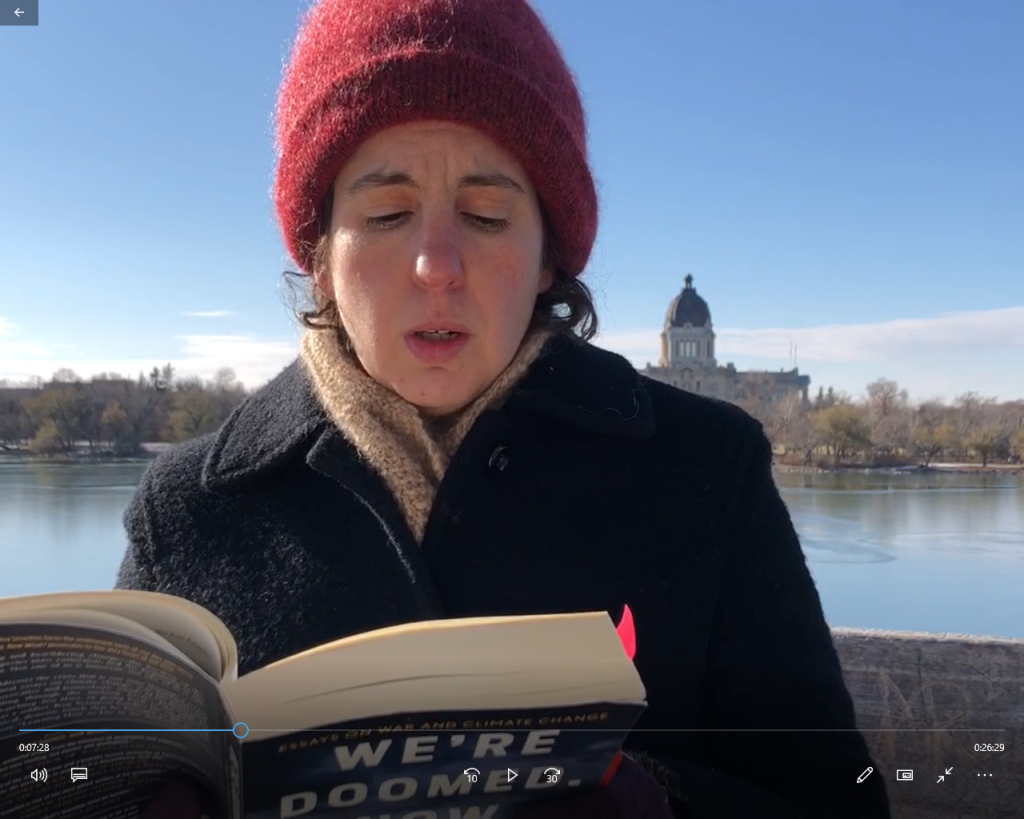
On October 26th 2020, still recovering from my October 17th performance (Hurdles), I decided to make a quiet gesture of my desperation. On that day, the people of the province in which I live were voting in a conservative government that would continue doing as little as possible to mitigate climate change. With Wascana Lake and the Legislative Building behind me, I read a chapter titled “Raising a Daughter in a Doomed World” from Ray Scranton’s book, We’re Doomed. Now What?: Essays on War and Climate Change. To read more about this performance, please see my post in which I reflect on how I felt about it the day that it took place.

Photo and video credits: Esperanza Sanchez Espitia

Performance 2: Hurdles (17 October 2020)

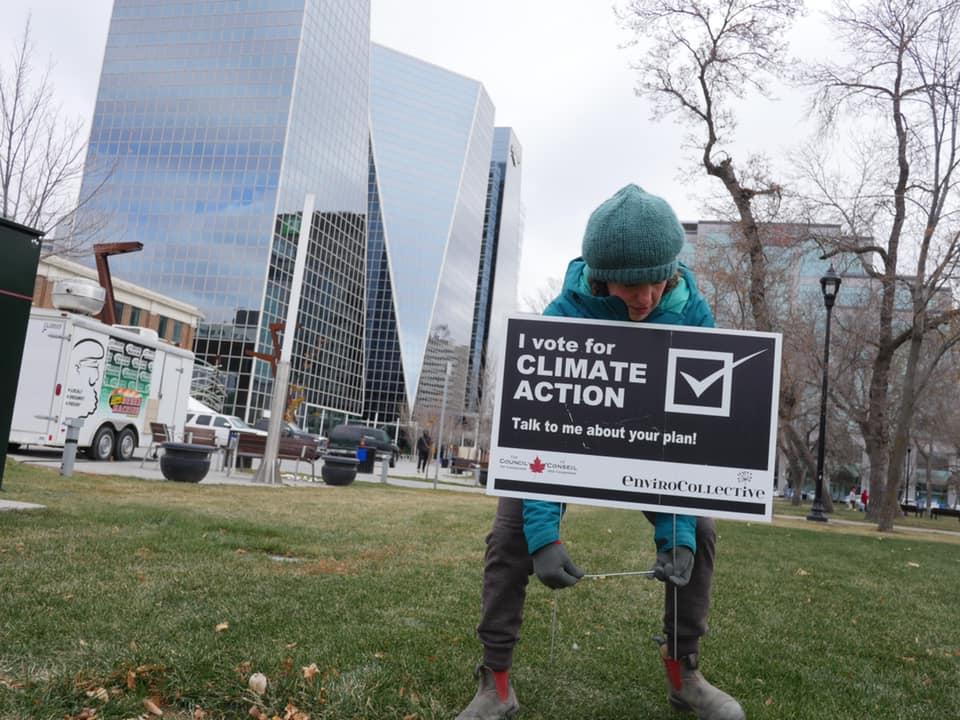
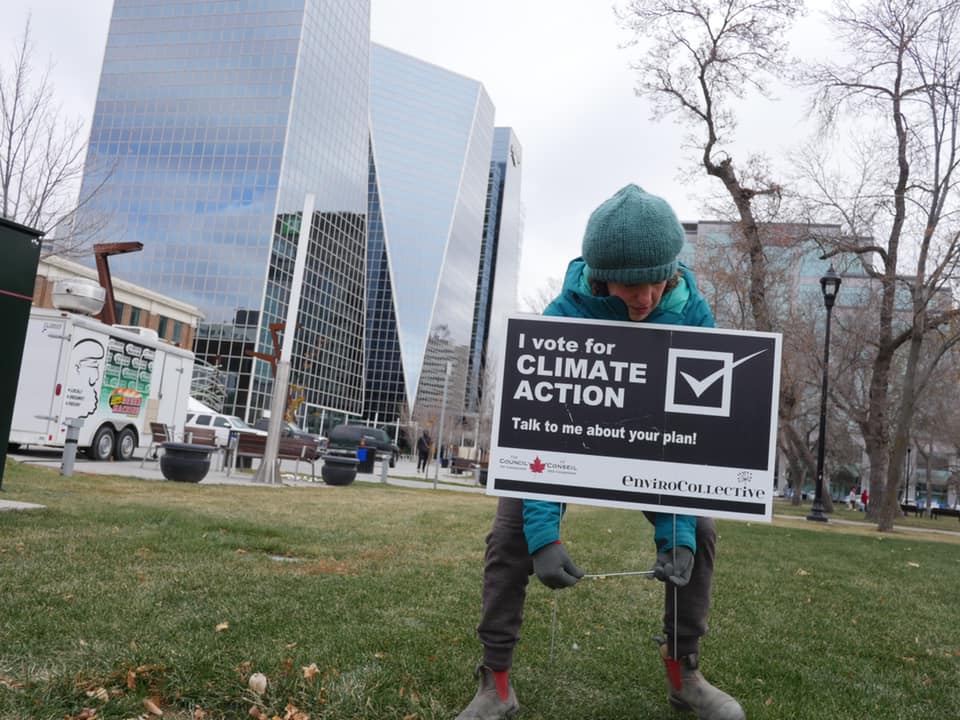
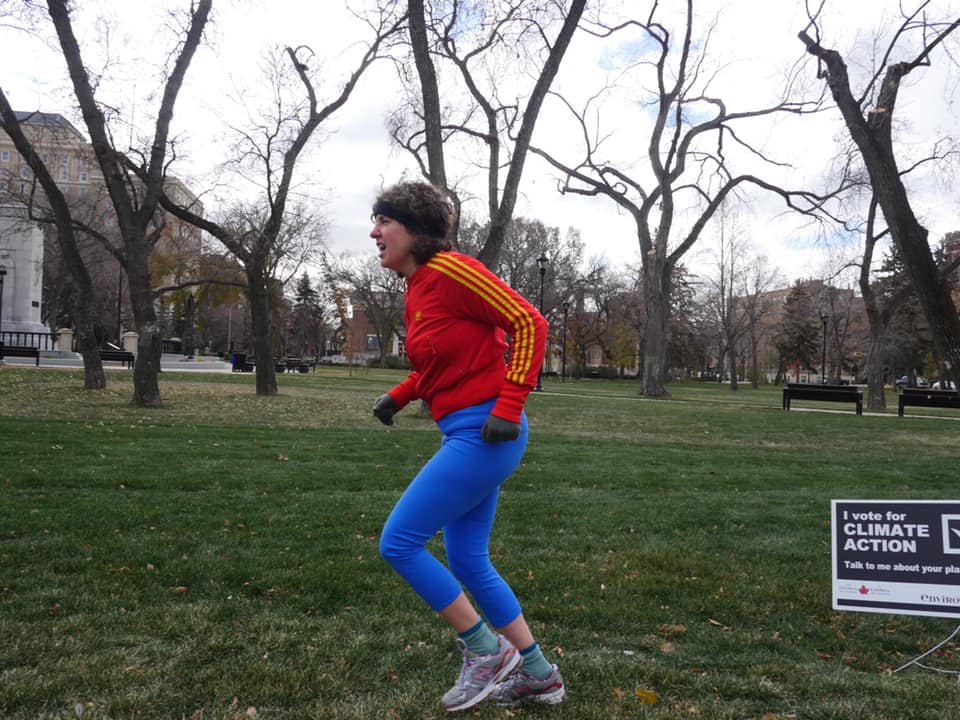
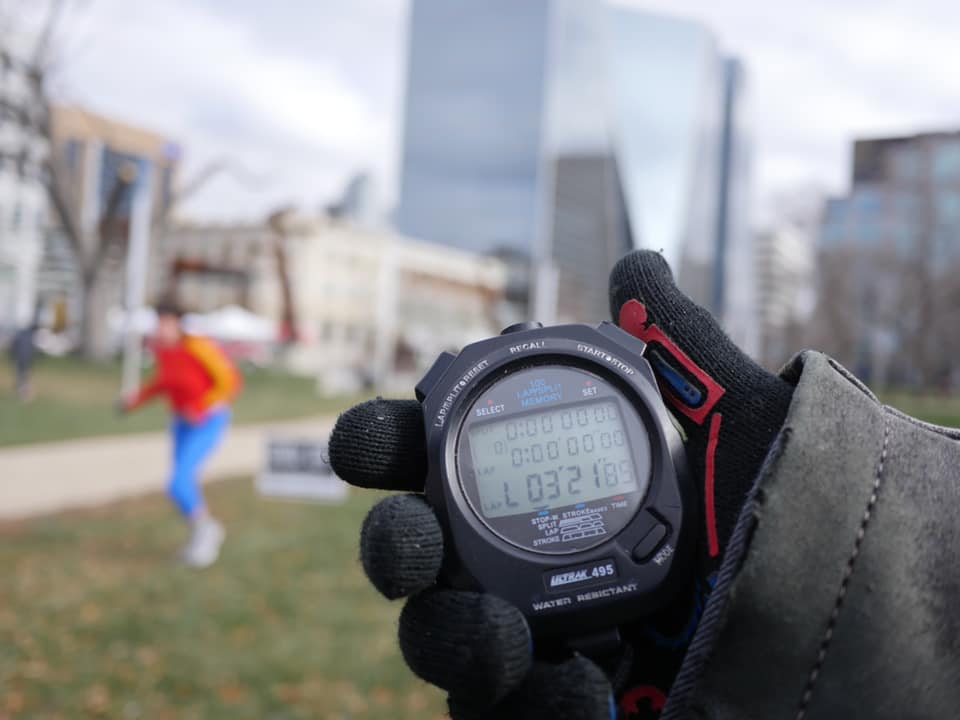
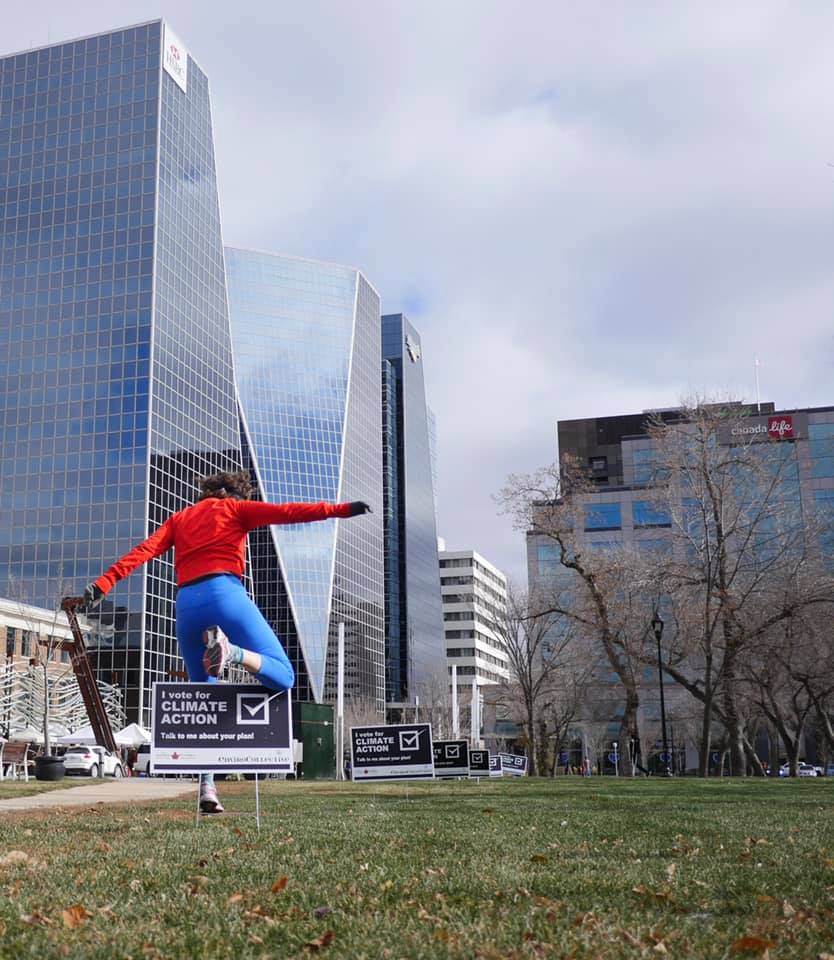
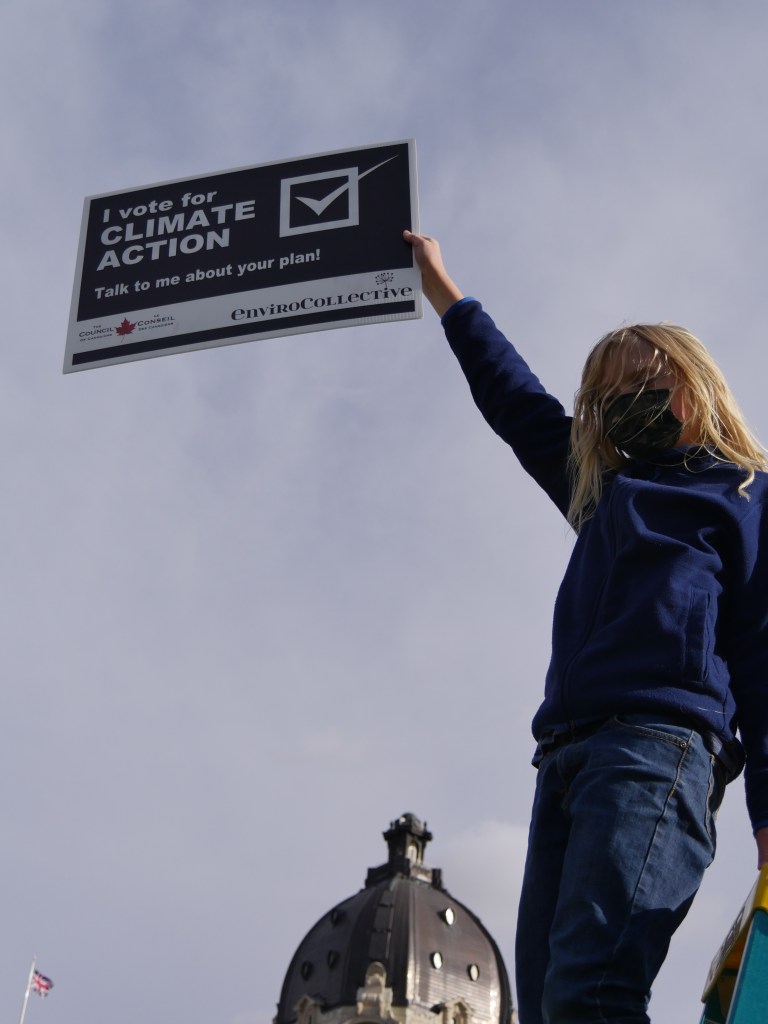
On October 17th 2020, I once again (see “House of Cards”) put on a performance involving EnviroCollective‘s “I vote for climate action: talk to me about your plan” election lawn signs. This time, I decided to set up a line of seven of the signs in Victoria Park, next to the Farmers’ Market, and jump over them for seven minutes straight. For more information about this performance, please see a post I made explaining it beforehand and a post I made with my reflections on it after it took place.

Photo and video credits: Esperanza Sanchez Espitia

Performance 1: House of Cards (11-12 October 2020)

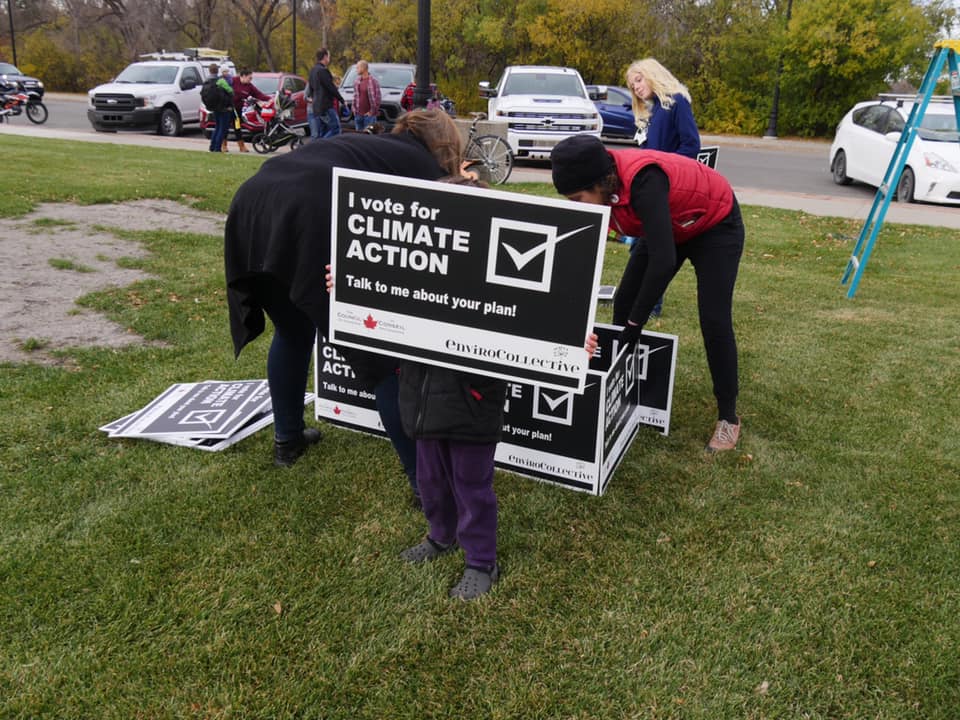
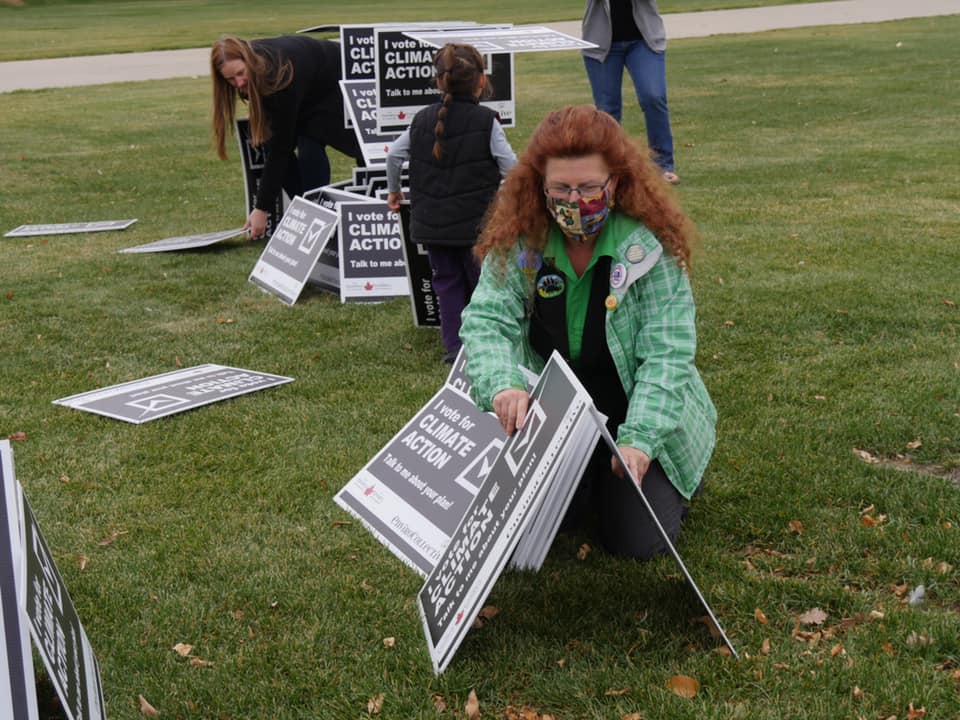
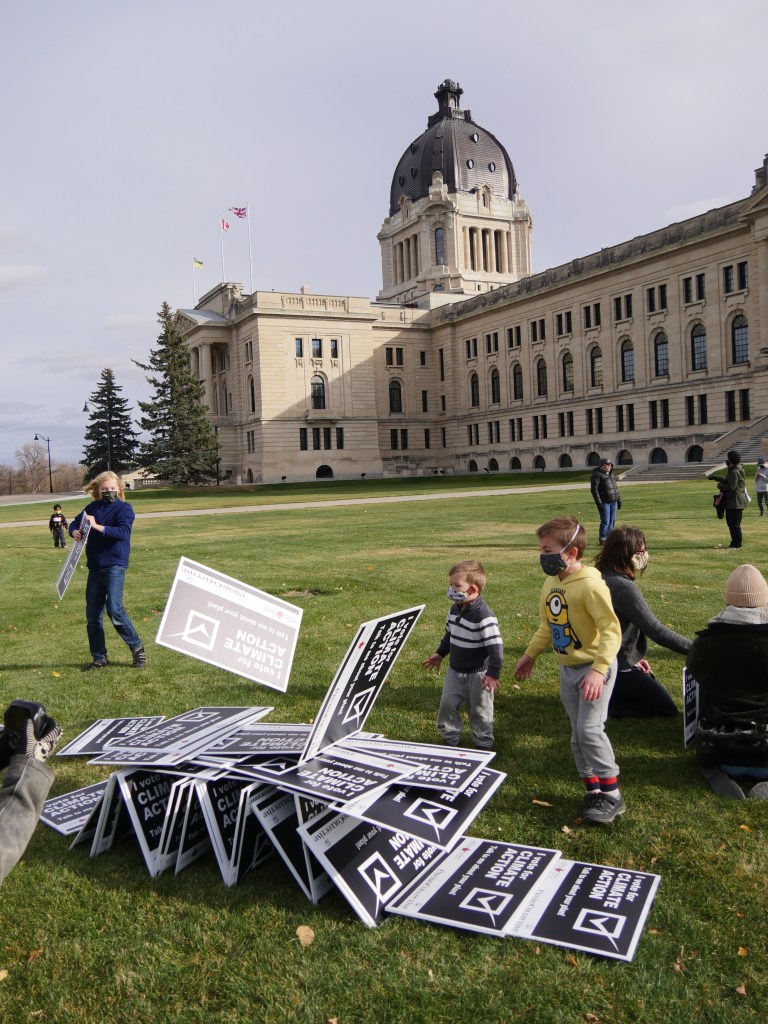
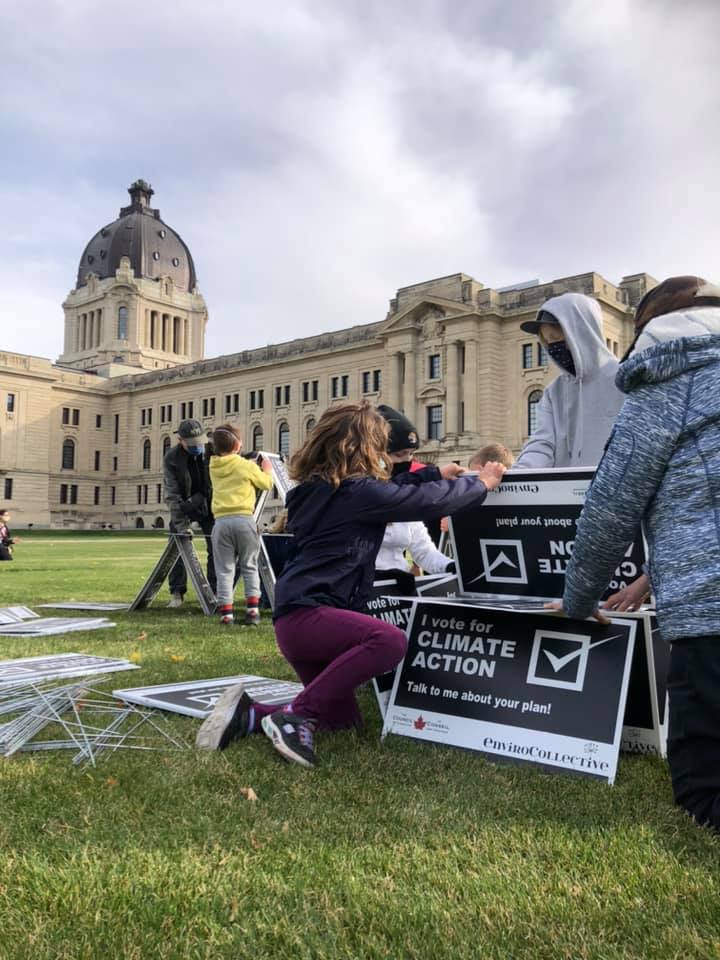
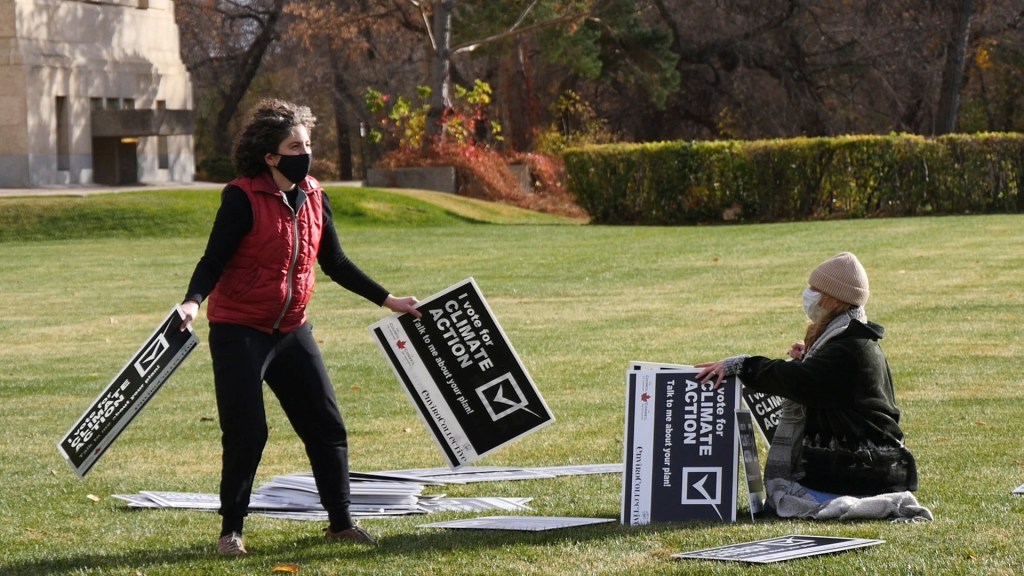
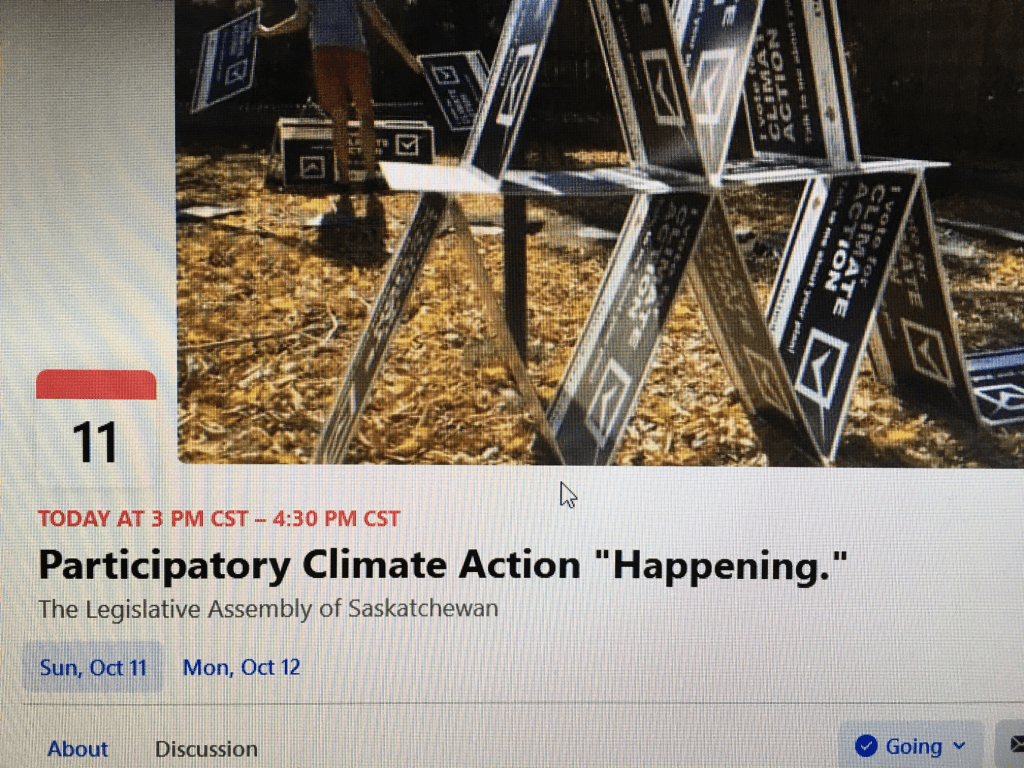
On October 11th and 12th 2020, I organized a participatory event on the lawn in front of the Legislative Building. Participants were invited to attempt to build the largest “house of cards” they could out of pre-made lawn signs that read “I vote for climate action: talk to me about your plan.” A local environmental organization that I volunteer for, EnviroCollective, ordered 1000 of these lawn signs ahead of the two elections we had here (provincial and municipal) this fall. The purpose of the signs was to get more people to consider climate change as an election issue. Candidates out door-knocking would also note that they had constituents who care about this issue. The signs were also meant as a way to spread knowledge of EnviroCollective, and they were supposed to be a fundraiser for this organization (as well as The Council for Canadians, who also contributed to their purchase).

Sign sales were disappointing. I decided to think of ways I could incorporate them into a performance. My goals were to get more people thinking about climate change and help EnviroCollective spread awareness of their lawn sign campaign. To know more about how the event went over the course of these two days, please see a posts I made before and after the first day it took place.

Photo and video credits: Esperanza Sanchez Espitia

My future artist statement?

This is a piece of writing I’ve just completed for my group studio class with David Garneau. He asked us to write what he calls a “civilian artist statement,” by which he means “a clear, non-poetic, communication. It explains your art work and practice to an intelligent reader who knows nothing about your art and little about the art world or theory. It is the base for longer, specialized, and creative versions.”

It was very difficult to write this statement because I have just barely scratched the surface of my exploration into “non-material” art making. For one thing, I am still struggling to know how to talk about the participatory work that I have experimented with, mostly because I’m still grappling with its definition. I’ve realized in the last week or so while reading Claire Bishop’s Participation (thanks for the recommendation, Risa) that my “house of cards” event wasn’t really an act of socially engaged art. It could be called participatory art, but even there, I’m not entirely sure. I called it a “happening,” but in fact it was likely more like a “situation.” I’m going to do more thinking (and blogging) about what I’ve been learning about participatory art, but for now I’ll just note that for this artist statement I decided against describing my practice as involving this type of work (socially engaged/participatory). I don’t think that’s what I want to make the focus of my work for now. Instead, I’ve chosen to use only the term “performance art” but explain that some of my performances include participation.

What also made it so hard to write about “my performance work” is that I’ve done barely any of it. It feels dishonest to say that “some of these performances include participation” when really, the “some” was “ONE” and the “these performances” is “THREE.” Yet, David gave us the impression that we need to sound confident in this statement and “avoid vagueness.” I couldn’t just kvetch about my struggles with searching for what I want to do. So, what I’ve ended up with is more of a statement of who I aspire to be as an artist, a “future artist statement” if anything at all. I’m looking forward to getting input on it during our class this Friday. Perhaps I’ll need to return to the drawing-board entirely. Who knows.

This exercise has been useful, though. A small breakthrough I’ve had in the last few days of working on it is that I may not need to choose between doing ceramics and doing “non-material” art (such as performance). Perhaps there is a way for me to be able to do both. This may involve incorporating clay or ceramics in performance work at times, but it could also mean that I carry on developing myself as ceramist (even one who does primarily functional ware) and as a performance artist. Is it possible to be good at more than one thing in life? I dunno. But perhaps I can give it a try.

“Civilian” Artist Statement for David’s Class

My artistic practice includes material and non-material work that is both an elegiac response to ecological devastation and a call to action. This work ranges from sculptural and functional ceramic pieces to performance works that encourage viewers and participants consider the issue of climate change in a different way.

My recent conceptual ceramic work is a series of porcelain cup-shaped sculptures that represent the state of the world’s glaciers in the face of climate change: some of these pieces appear to be melting, others disintegrate in water while particles of clay “calve” off of them, and other are constructed of snowflake shapes barely holding together in the form of a cup, resulting in pieces so fragile that a draft in a room could destroy them. I present these pieces as an installation, and during the install, many of them break. Their destruction, resulting in porcelain “snowflakes” on the gallery floor, further indicates the ephemerality of the glaciers they represent. In this sense, these works are performance pieces as much as they are physical objects: the care needed to prevent their demise replicates the state of our ecology at this moment in history.

Other ceramic work I make is functional; I create vessels for everyday use. Even this practice, however, reflects a concern for ecology. The act of creating this work out of clay puts me in touch with the sustaining effect that being in places of natural beauty gives me, and the pieces communicate this reverence for nature through their soft, irregular, and organic forms and surface treatments.

With my performance art, I explore ways to reach a broader audience. My performances take place in public spaces, allowing me to draw attention to the issue of climate change by taking people by surprise as they go about their day; apathy towards this issue will have catastrophic consequences, and my work attempts to convey the sense of urgency for dealing with this problem that needs to permeate every aspect of our daily lives. At the same time as conveying the seriousness of the situation, I often draw humor into these performances and leave people with ideas of how to take action. I am aware of how despair and passivity can go hand in hand. Some of these performances include participation that encourages meaningful engagements with the subject matter and exemplifies, via the cooperative nature of the events themselves, how we can work together to prepare for, and as much as possible lessen, the challenges that climate change will cause for us. The performances of artists such as Eva S. Mosher and Stein Henningsen informs this work.

In moving between the physicality of ceramics and the immaterial nature of performance, my practice explores how each medium can convey the same concern for our planet with such diverse methods and results. All of my work is an attempt at communicating this concern and inspiring action in as many ways and to as many people as I can.

Reading: “Immaterial Art” by Dina Ibrahim

Found online while searching for definitions of “immaterial art” (and I can’t find it in the library’s databases)

Ibrahim, Dina. “Immaterial Art.” Contemporary Art Practices. Accessed November 4, 2020, http://www.contemporarypractices.net/essays/volumex/immaterialart.pdf

Tino Sehgal. Visitors walking into the Guggenheim rotunda were immediately confronted by a man and a woman entwined in a changing, slow-motion, amorous embrace. Every so often, the performers struck recognisable erotic poses derived from Courbet, Rodin, Brancusi and Jeff Koons. This was a piece by Tino Sehgal called Kiss (2008). (62)

Sehgal experiments with the notion of immaterial art, art that does not manifest itself in any physical form, that rids itself completely of the material object. Sehgal’s work, despite being unique in its form and delivery in a contemporary art context, was preceded by the “situation art” of the 1960s and 1970s. However, before being too quick to dismiss Sehgal’s immaterial art as a derivative of the conceptual movement of the sixties, a closer analysis highlights fundamental differences that distinguish the two. (62)

The catalyst for such radical changes must have been prompted by the release of such publications as Michael Fried’s Art and Objecthood and Theodore Adorno’s Aesthetic Theory. In essence, Fried and Adorno share the same view on the inevitability of the ‘thinghood’ of artworks, and yet at the same time it is that which art must always turn against. In other words, the transcendence of objecthood can occur only in negativity. (62-3)

However, the unresolved contradiction in the methods of the 1960s and 1970s persisted because, apart from a few exceptions, there has never been a complete “dematerialization” of art. There are very few examples where material support (visual or written documentation) for the art work does not exist. Conceptual artists in the 1960s therefore did not destroy the object, but rather expanded its definition. By contrast, in Tino Sehgal’s work, there are no objects. Instead, his works are realised as actions (movement and talking) and the only material support they require is the human body. Sehgal does not allow visual documentation of his work in order to prevent the translation of situations into a two dimensional medium, thus preventing documentation from functioning as a kind of surrogate for the work. (63)

In Sehgal’s view art can therefore not be about somehow weakening the object, and definitely not about replacing it with a certificate of documentation, but rather about literally changing the material substance of a visual artwork, which has always followed the model of production of the transformation of natural resources. (63)

Sehgal believes it is essential that an artwork can be bought and sold. He works with galleries who sell the work’s rights and instructions to museums and collectors. There exists no material object in these transactions, not even a certificate as a material surrogate for the artwork. Buyer, dealer and artist meet in the office of a notary and agree to the terms of the contract orally. (63)

“Just because something is not material, doesn’t always mean that it doesn’t exist”, he explains. (Griffin 2005: 105). Museums such as the Guggenheim and MoMA in New York are indeed purchasing his work, which is proof enough of its existence as a commodity, but what gives it the status of visual art? Does the mere fact that it is in a museum make it art? Marcel Duchamp and his Fountain (1917) proved that anything can be art if the artist says it is. (63-4)

Firstly, Sehgal’s work follows the mode of presentation of a conventional visual artwork in that it is always present and can be viewed during any of the exhibition’s opening hours, from the first to the last day. Secondly, and of equal importance, is the fact that, although the work is a temporary artefact, it can be repeated in another venue, therefore it persists and can be transmitted over time. (64)

Thus the structure of the artwork always remains open and subject to modification although this does not imply an arbitrary enactment. (64)

On another note, the work is documented through reviews and publications such as this one, however they act as external factors to the artwork. (64)

Unlike sculpture, immaterial art resides in the bodies and voices of the people who execute it: in its reception, in memory, and in the time and space it occupies. It is more about dematerialisation than conceptual closure. It is close to dance, acting, speech, or song, and yet it is clearly concerned with the art context, with its modes of production, circulation/mediation and consumption, with art’s history and concepts. In a world where our endless search for authenticity is no longer found in the material object and social value increasingly becomes the new currency, immaterial art is on the rise. (65)

on clay

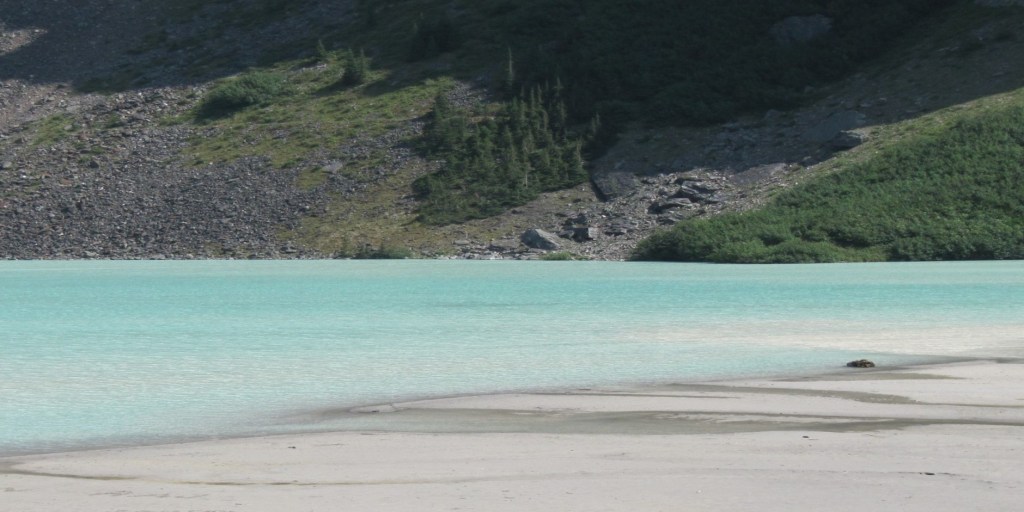
Clay takes me here, to this place of the blue chalcedony of cold water and glacial silt. Occasionally, when I’m on the wheel and the conditions are just right (I’m not in a rush to get anywhere; I’m alone in the studio), I experience the same sensation of peace I get when I am in the mountains, away from civilization. When the clay is centered and spinning under my hands, I pause and watch the slip build up between my fingers. My shoulders drop, my heartbeat slows, and I nearly stop breathing. I am transposed to the bottom of a glacial lake; I’m a million years old. The clay spins mega-annums over my hands, and the rest of me is taken in. For just these few moments, everything is fine. The busyness goes quiet. I am okay. The world is okay. All of us, all of our pain and all of the problems we’re causing, are gone.  

The rest of the time, I am acutely aware of the state of the world, and it’s not good. With a modicum of education on climate change, empathy for the world’s living creatures, and worry for my son’s future, I have a lot of anger and fear about climate change. I can direct much of the anger I have at the corporations who are largely at fault for this situation, but it is complicated: in the “developed” nations of the world, we are all implicated, and the story of how we got here started around 15,000 years ago when we realized we could “break the earth” (via agriculture) for our own sustenance. As Roy Scranton says, “not one of us is innocent, not one of us is safe.” In terms of the fear I have for our shared future, I try to keep it from seeping in, but this takes enormous energy. Anger and fear are always on my back, and I know I’m not alone in this. For those of us who are aware of the situation, we are holding our breath: will things work out? Will the life supporting systems of the planet, its weather systems, ecosystems, food chains everything we need to survive, remain intact?  

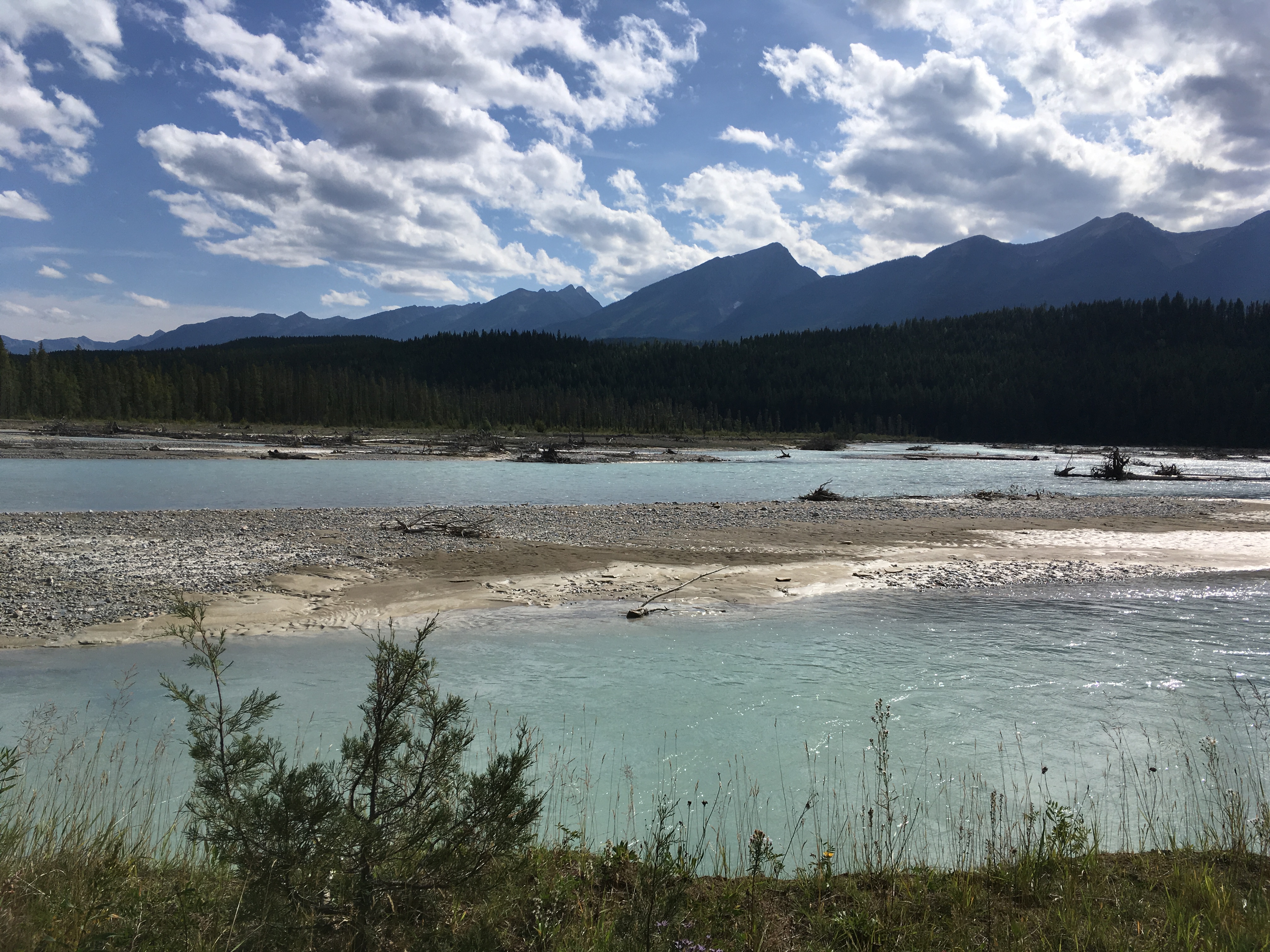
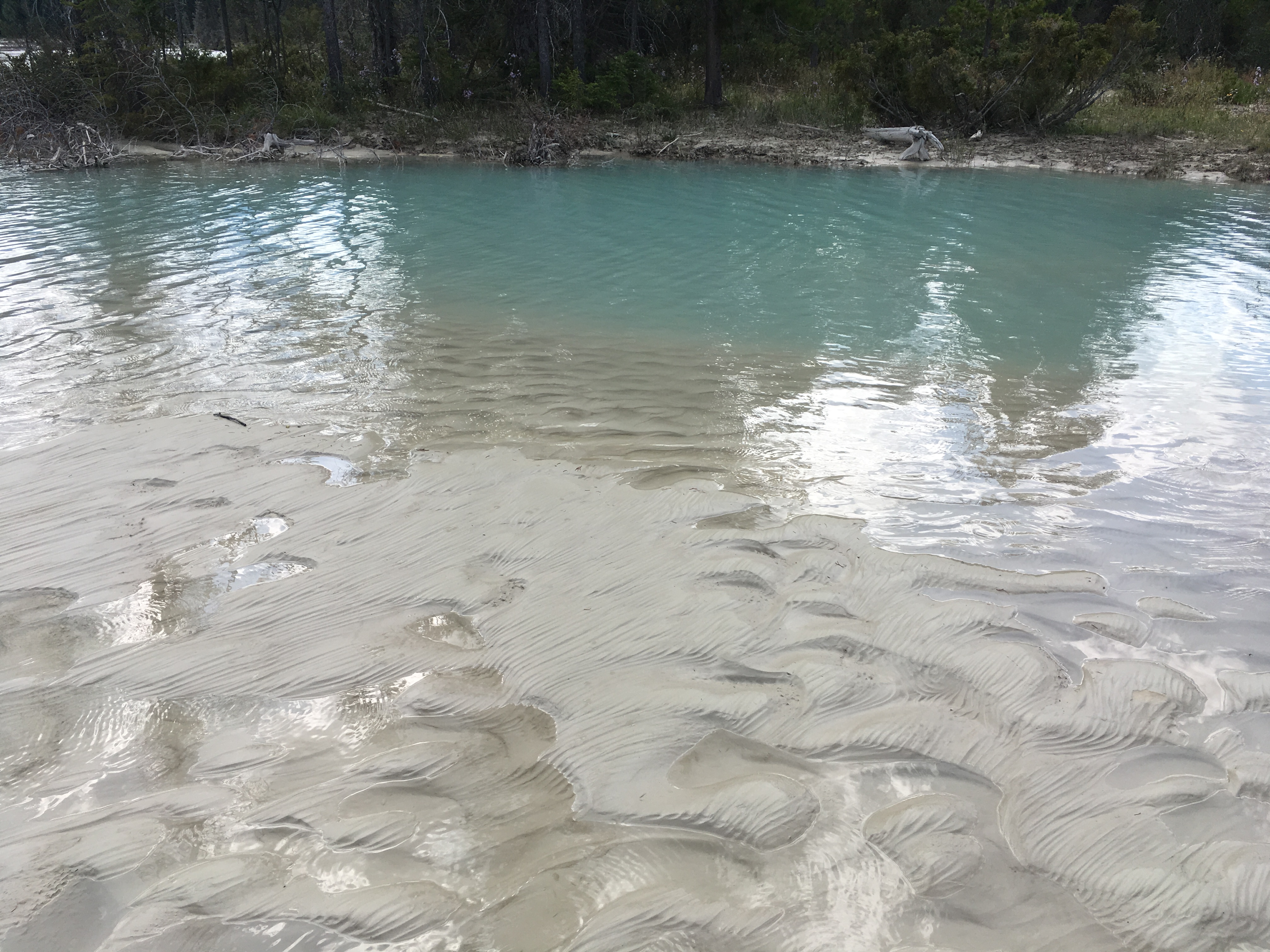
Clay is symbolically and literally a part of us: it is soil, food, life. The plants that we and our domesticated animals eat require the elements found in the earth, some of which are also found in clay. Soils damaged by our agricultural over-use can be remediated with a treatment of clay. I don’t go so far as to believe that by touching this substance I am imbibing its life-force, enriching my being, replenishing my elements. I’m too scientific for that. But touching this material, I can, for just that moment, imagine myself in another world; I can leave the Anthropocene for an altogether different time and space, one that existed before us. Through clay, I feel rivers and lakes, mountains covered in forest, flora and fauna, systems functioning the way they have for spans of time incomprehensible to us. Quartz and feldspar in the porcelain I love to throw take me to a place of glacial flour, also known as rock flour, the silty particles that erode from mountains and are carried in ice and water to lakes where they are released and stay so nearly weightless they are suspended, refracting light in such a way as to give these lakes their milky turquoise, blue, or green hues. Water in these colours is so beautiful that it brings me calm.  

I’ve tried to leave ceramics for other forms of artmaking that are less exploitive of the earth’s resources and carry a smaller carbon footprint. It’s been almost a year since I’ve last been on the wheel, and I’m now realizing all that working in clay gives me and how much I miss it. The pots I made in the past and use at home remind me of what I am now lacking each time I see them: a cup, a bowl, a plate are items I took for granted in the past. “Art,” I told myself, meant doing more than creating these simple objects of daily life.

Now, however, the items I made that live in my kitchen cupboards are becoming more precious with each day. They stand apart from the mass produced tableware I own. They signify something more than simply their function. I must not break that nearly perfect cup – that cup whose form and surface speak something to me in a language I can’t translate into words. The bowl that looks so beautiful with soup, or grapes, or anything really – the joy it gives me, and the reminder of the clay it came from, is more profound than I’d originally given it credit.

In addition to their connection to the natural world, I’m starting to see something else in these pots that makes them special. What does it mean that I created these objects that give me joy? What does it mean to be good at something? I think of Marge Piercy’s poem, “To Be of Use”:

The work of the world is common as mud.

Botched, it smears the hands, crumbles to dust.

But the thing worth doing well done

has a shape that satisfies, clean and evident.

Greek amphoras for wine or oil,

Hopi vases that held corn, are put in museums

but you know they were made to be used.

The pitcher cries for water to carry

and a person for work that is real.

(lines 18-26)

It’s obvious to me why Piercy chose to employ pottery in this poem. A simple vase. A simple pitcher. We strive to make a difference in this world in order to give our lives meaning. I know I’ve “cried” for “work that is real,” but I’ve never known entirely what that work would be. I’m starting to wonder if having a competency in something, to know how to do it well, must be at least a part of doing “real” work, even if that work is as “common as mud.” So be it. “Common” isn’t necessarily pejorative. Childbirth is the other example that I’ve experienced of this understanding that something can be both common and extraordinary. “Common” doesn’t need to imply any lack of importance, or magic. Common work, “worth doing well done,” is meaningful enough.  

In We’re Doomed: Now What?: Essays on War and Climate Change, Roy Scranton is upfront about “doom,” yet the book isn’t entirely focused on his own anger and fear. It’s not only about the “doom”; it’s also about the “now what?” Scranton writes that “[t]he human ability to make meaning is so versatile, so powerful, that it can make almost any existence tolerable, even a life of unending suffering, so long as that life is woven into a bigger story that makes it meaningful” (5). In this book about what may be inevitably at this point the beginning of end of human civilization, as we know it at least, Scranton offers something like hope, or at least a strategy for survival; he tells us that “we hold within ourselves the power to change our lives—wholly, utterly—by changing what our lives mean” (7).

I cannot do much to change the course of climate change beyond the time and money I give to environmental organizations. In fact, I feel like the busyness of participating in activism amid a day job, artmaking, and parenting is proving to be too much. With the urgency I know this crisis demands, and my urgency to raise as much awareness of the situation as I can, I’ve been missing something important – that sustainability must also involve the personal as well as the global. I need to be able to sustain myself, and recently, I’ve become attuned to a major lack in my life: joy. Without it, it’s hard to keep fighting for the future, for “[i]f we kill all pleasure in the actual processes of life, what sort of future are we preparing for ourselves?” (Orwell qtd in. Scranton 324).

Works Cited

Piercy, Marge. “To Be of Use.” To Be of Use. Doubleday, 1973.

Scranton, Roy. We’re Doomed. Now What?: Essays on War and Climate Change. Soho Press Inc., 2018. 

Now What?

It’s (fourteen minutes past) October 26th 2020, and today was the day of Saskatchewan’s Provincial election. For this week’s exploration of non-material art-making, I chose to read a chapter of Roy Scranton’s We’re Doomed. Now What? across from the Legislative Building across Wascana Lake.

Video still credit: Esperanza Sanchez Espitia

This chapter is titled “Raising a Daughter in a Doomed World,” and it spoke to me when I read it a few weeks ago. Scranton articulates a lot of what I’d like to say in this moment, on this day when the people I live among are locking in another term with the Sask Party, complete with their near Trump-like dismissal of climate change.

I also feel like reading a book like this is itself a performance these days; Rob Nixon puts it concisely in Slow Violence and the Environmentalism of the Poor:

one of the most pressing challenges of our age is how to adjust our rapidly eroding attention spans to the slow erosions of environmental injustice (8)

Who reads a book like Scranton’s today? Is anyone reading it who isn’t already converted? Would my reading this chapter out loud here in Regina actually invoke an interest in this topic in anyone who isn’t already interested? I doubt it. Meanwhile, the clock is ticking, the people are voting (literally as I read out loud) and honestly, it’s hard not to focus on the “we’re doomed” rather than the “now what?”

Once again, today was cold, and Wascana Park was sparsely populated. A few people went by. No one said anything to me, which was actually what I was expecting. I didn’t make eye contact, as I kept focused on reading the text; all I know is people passed in my peripheral view of the area in front of me. What they took from seeing me there will remain a mystery to me, but I know for certain that I didn’t invoke an urge in anyone to go to the polls and vote Green. The geese in the lake behind me got more out of this show than anyone else.

David asked me in class last Friday: “What are my goals? If my goals are to solve climate change, I’ll fail. If my goals are to engage participation…?”

What were my goals with today’s performance? (It wasn’t participatory, so there goes that goal). They weren’t really to convert anybody — I knew I wouldn’t. My goal was just to express how I was feeling today and in the lead-up to this election, and really, I knew ahead of time that this was a pointless objective.

I’m starting to feel a real crisis set in; I’m not enjoying what I’m doing, I don’t see much purpose in it, and I don’t know how to change these facts. Today was the third time I’ve tried to create non-material art for my work in this semester of my MFA, and I’m not very happy with any of these attempts. While I don’t feel I have the means to assess their success or failure, I know “in my gut” that they aren’t doing what I want them to be doing.

I’m grateful to Esperanza for documenting this attempt at doing something. She’s sent me the video she took of the entire 33+ minutes I stood there reading, and I’ll need to figure out if or what I’ll do with it. Is there any point in uploading it to the cyber-world? I don’t know if the one or two views it would get would be worth its carbon footprint, honestly. Should I turn the video into a documentary “film” of sorts? Esperanza and I wandered around the lake, and she photographed and videoed scenery, birds, a bunch of ducks telling a few good jokes. She’s offered to produce a short film using this material. I just don’t know at this point.

I have a lot of figuring out to do.

Now what?

tired, and having trouble breathing

Photo credit: Esperanza Sanchez Espitia

My first attempt at performance art took place on October 17th, and I’m not quite sure how to think about it.

One thing that surprised (and disappointed) me was the lack of people around. The farmers’ market was a ghost of its summer self with only a few diehard vendors and nearly no customers. Victoria Park, nearby the market, where I set up, was void of human life… I suppose I shouldn’t have expected to have an audience on a cold autumn day in Regina. Stil, it was disappointing that I didn’t give out (via Jakob — this was his role) any of the 120 small slips of paper I’d printed with information about the climate action signs on one side, and this on the other:

I’ll have to consider projects/events I plan for the near future and how integral having live viewers, or participants, should be. I can’t really do much indoors these days either due to Covid19. I really have to think about how these facts of my reality (winter; Covid) will impact my work over the next few weeks.

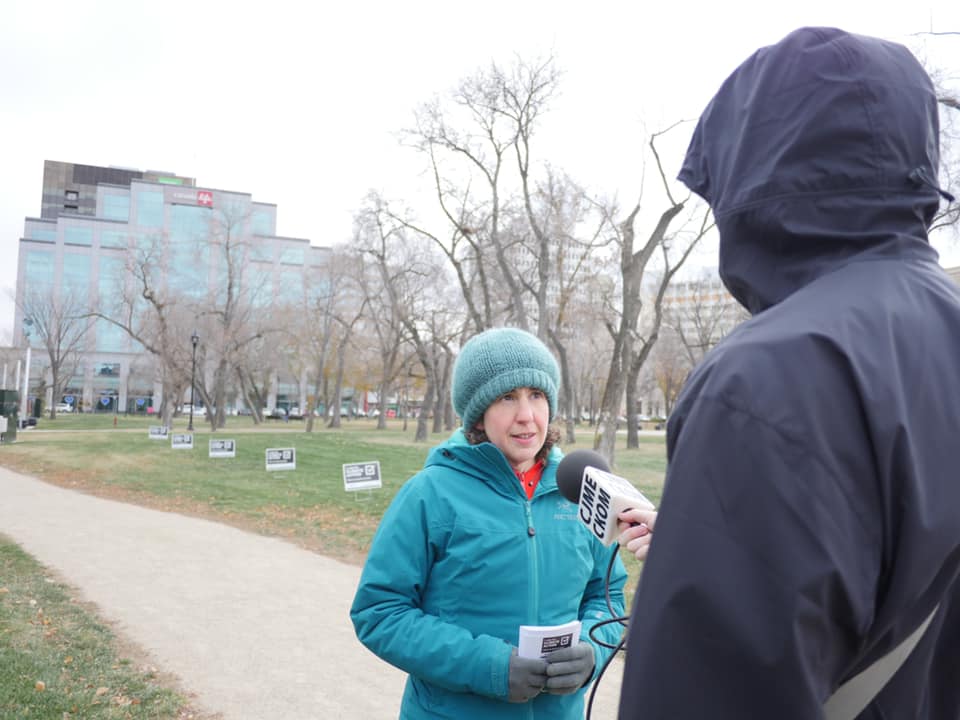
If no one was there to really observe or experience this event in person, at least it was “put out there” via the media. A local radio station, Regina 980 CJME was out to interview me, and I while I didn’t hear myself on the radio, I was pleased to see that they also printed a summery of it. I’m pretty okay with how the reporter presented was I was doing.

Photo credit: Esperanza Sanchez Espitia

Global TV also interviewed me, though again I didn’t get to see the interview when it happened on the 6pm and 10pm news that day. (I gather from friends that it was a decent interview). Like every other aspect of this new (for me) art practice, I need to think more about how to assess what I’m doing with the media. Do I consider it a good thing as far as my art work goes to get this type of attention? It has no real connection to the actual event itself — the immediacy the moment, the feeling it creates, is lost. I’ll have to ask Risa about this.

About the performance itself: it was hard. Physically hard. This was how I felt immediately after: tired and having trouble breathing.

I hadn’t really put much thought into what this performance would do to my body. As I read in the Marilyn Arsem’s “Some Thoughts on Teaching Performance Art in Five Parts,” after doing this work,

There are real consequences to every action in which one engages. Any action affects one both physically and psychologically. It is happening by and to one’s body, and its impact cannot be discounted simply because it is called art.

And in “This is Performance,” Arsem writes

Performance art requires risk.
The artists take physical risks using their bodies.
The artists take psychic risks as they confront their limits.

Physical risks: I had an asthma attack immediately after my seven minutes of jumping hurdles in -10 degrees. It was my first attach in over two decades, the thought hadn’t crossed my mind to bring the old (expired) Ventolin inhaler I keep at home for “just in case.” I had to rush home to take several puffs, and it took me three days before I was able to speak normally and a week before I wasn’t wheezing and hacking. Who would have thought that suddenly running in freezing temperatures without any warm-up would be such a shock to the lungs? Really! Also, in one particularly graceful hoist over a lawn sign, I snapped its metal stand, and in a subsequent effort to haul my 125 pounds over this object, I scraped my leg. That was no big deal; I didn’t even notice it until that evening. Still, these physical effects of the performance gave me a glimpse into just how unpredictable this type of work is.

Psychological risks: I’ll get to that in another blog post.


As far as getting feedback from viewers, there really isn’t a lot to report. My husband said that night as I wheezed and coughed, “Jakob saw, I saw, and God saw.” We’re devout atheists, so what he meant by the latter was really that I did something he considered a good thing to do. Period. Everyone else who’s said anything about this performance (feedback from friends after seeing my Facebook post or the radio/tv news about it) just said it was “amazing.” Of course, that’s what friends are for, right?

As an aside, I have received more feedback from the “happening” I organized for the previous weekend (the “house of cards” event). Naomi Hunter, leader of the Saskatchewan Green Party, told me that she felt rejuvenated for a week following the event. Florence Stratton, a well-know local activist, told me she felt great after participating too. A stranger who got in touch after reading the Leader Post article about what I was doing said, “your performance helps promote the environmental cause. Good job.”

Good job? I really don’t know. Overall, I’m feeling lost, and it’s hard to say if this is feeling is just a sign that I’m doing what Arsem says students of performance art must do (“I believe it is critical for artists to learn to assess the progress of their work, and challenge themselves to develop it further”), or if this type of work just isn’t me.

Photo credits: Esperanza Sanchez Espitia

I’ll end by quotoing from Arsem again (thanks for introducing me to her, Risa!):

Artists need to find ways to sustain their practice without becoming too reliant on validation by outside authority figures, who rarely have the same focus or agendas as the artist. The more clarity that one has about one’s goals, the clearer the avenues of options become.

This is what I really need the most: to have clarity about my goals.

hurdles

Tomorrow at noon, I will put on my first ever “performance art” piece.

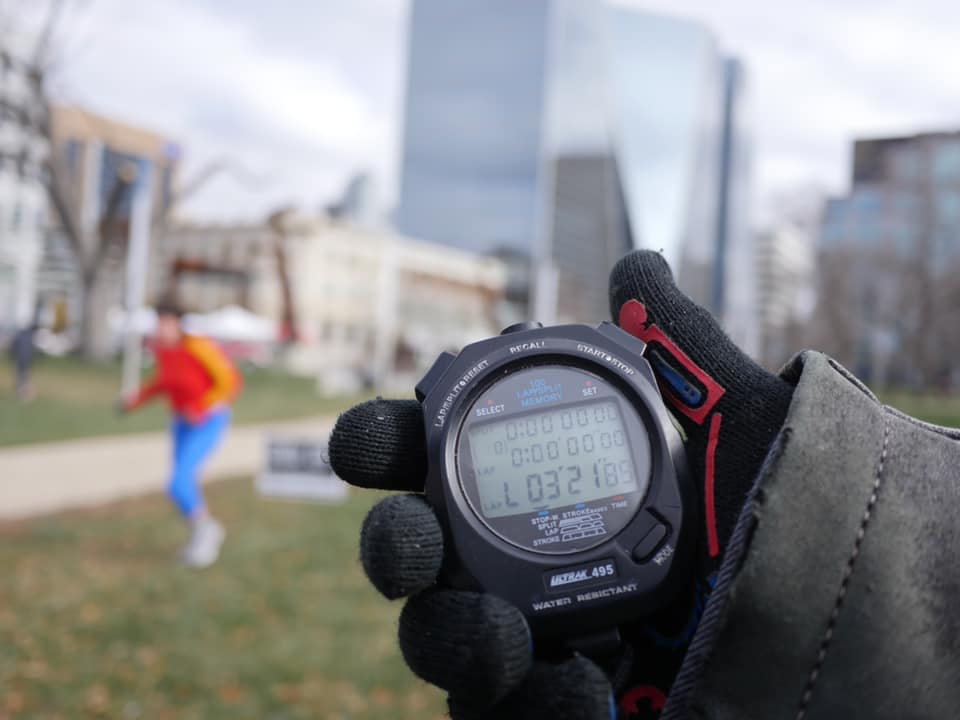
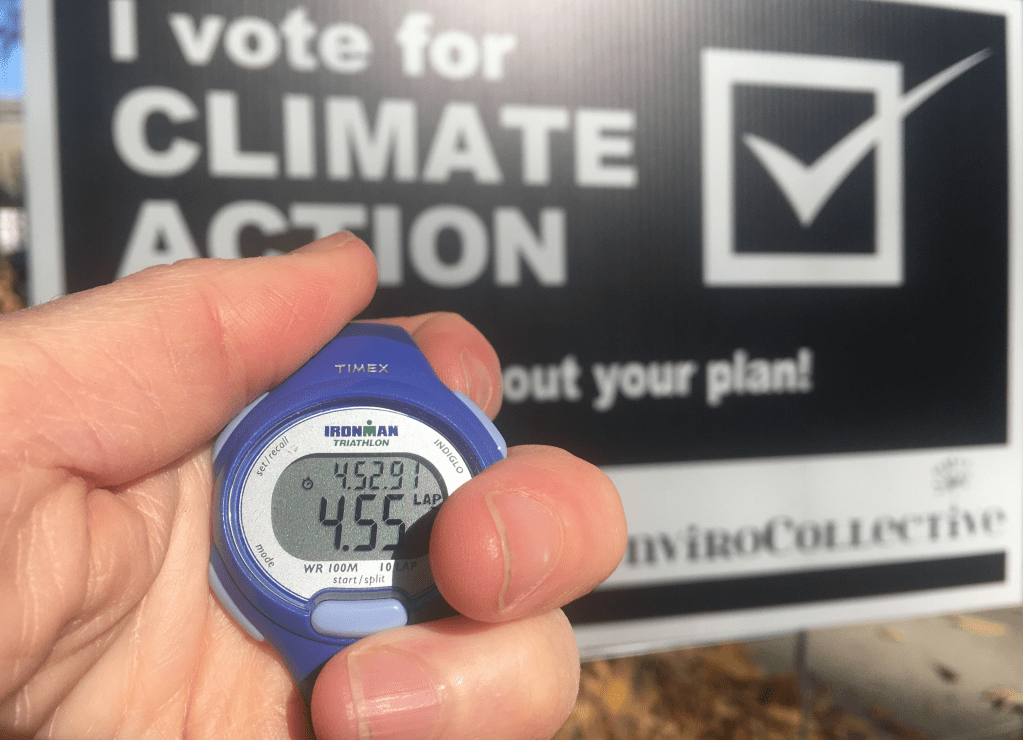
I will set up several of the “I vote for climate action: talk to me about your plan” lawn signs on the lawn near the Farmers’ Market in Victoria Park, downtown Regina. My husband will blow a whistle and start a stopwatch. Wearing an exceptionally bright red-orange and yellow tracksuit jacket and bright blue leggings I found at Value Village, I will run and jump (hurdle style) over the lawn signs for 7 minutes without stopping. My son will hand out small flyers to anyone who wanders by wanting to know what I’m doing. One side of the flyer will be EnviroCollective’s mission “to build networks and share resources to support environmental and climate action” and website (where people can order one of these signs).

The other side will say the following:

In 2018, the UN’s Intergovernmental Panel on Climate Change reported that we had 12 years remaining to make drastic reductions to our greenhouse gas emissions in order to maintain a global heating temperature increase of 1.5◦ Celsius. Global warming beyond that point would have catastrophic results.

Aligning with the IPCC’s data, Mercator Research Institute on Global Commons and Climate Change (in Berlin) keeps a running tally of how much time we have left before we will exceed 1.5◦ Celsius and 2◦ Celsius global warming. Due to increased emissions in the past two years, they now predict we have only a bit over 7 years and 2 months to make these radical cuts to greenhouse gas emissions (at current emission rates).

For 7 minutes, I will hurdle “I vote for climate action signs” to express the urgency of voting in candidates in this fall’s elections who will take climate change as seriously as it needs to be taken.

Search for the MCC Carbon Clock to see how much time we have left.

For some reason, I had the figure of eleven years in my head when this idea came to me. I knew the IPCC had reported on 12 years a while ago… I didn’t realize that it was 2018 when they came out with that figure. I’d also heard the figure of 7 years floating around, and in fact Tanya Dahms suggested I should use that figure instead. I wanted to stick with the IPCC’s number as they carry some clout (as they should…). However, looking into it further, I’ve learned what the situation is: In 2018, the IPCC based their prediction of when the world’s “carbon budget” to keep us at 1.5 degrees Celsius would run out. Two years ago, this window was 12 years.

Now, it is just over 7.

Mercator Research Institute on Global Commons and Climate Change keeps a running clock of how much time is remaining to keep to 1.5 and 2 degrees heating. As of this moment, we are passing:

This has convinced me that I should use the figure of 7 years in tomorrow’s performance.

I’m aware that as much as this figure is based on scientific research, it’s also a prediction. Mercator Research Institute on Global Commons and Climate Change’s Carbon Clock website explains that

“The Special Report of October 2018 presents new figures: The atmosphere can absorb, calculated from end-2017, no more than 420 gigatonnes (Gt) of CO2 if we are to stay below the 1.5°C threshold. However, since around 42 Gt of CO2 is emitted globally every year—the equivalent of 1332 tonnes per second—this budget is expected to be used up in just over nine years. The budget for staying below the 2°C threshold, for its part, of approximately 1170 Gt, will be exhausted in about 26 years.”

I have Tanya to thank for knowing about this resource. She sent me a message tonight saying “I think the installation piece in Manhattan is logging 7-8 years…”

I did a quick Google search for “Manhattan installation art climate change” and read about this piece in a New York Times article:

A New York Clock That Told Time Now Tells the Time Remaining

Metronome’s digital clock in Manhattan has been reprogrammed to illustrate a critical window for action to prevent the effects of global warming from becoming irreversible.

Metronome and its Climate Clock, soon after it was activated.

I’m in awe that such a piece exists — that artists created it, but also that it’s come to this.

And also, that life is going on as usual just below this 62′ wide clock that’s spelling out our doom.

The truth is, the “hurdle” I’m jumping tonight as I do some final preparations for tomorrow is dealing with my son. He hasn’t been sleeping well for months, predating Covid19. While my husband and I don’t talk a lot about climate change in front of him, and we certainly avoid the “doom and gloom,” he definitely knows more about it than the average ten year-old in Saskatchewan. He’s heard us say enough. He’s seen the books we have lying around (even though I try to hide the worst titles, such as We’re Doomed. Now What?). He’s been to the Fridays for Future climate strikes and other rallies. He’s heard people shout out really horrific things — “There’s no Planet B” and “You’ll die of old age. We’ll die of climate change.” He even participated in a “die in” in front of the Legislative Building last year. He’s smart, and he knows that we believe in science, and that the science says the shit is going to hit the fan. I wondered tonight, as he burst into tears when I pointed out that his (long) hair is tangled, how much climate-related anxiety he’s unconsciously experiencing. I wonder about this when he’s so upset because he can’t stick with a story idea long enough to write it (he’s a young writer). Why are his stories not worth writing to him? Is it at all connected to the overall anxiety that’s in the world right now about the ending of our own story? This really worries me.

How is a concerned parent supposed to act?

I want my son to know that I’m doing what I can to help the world realize that drastic change is needed for this drastic situation. At the same time, if he’s handing out flyers for me tomorrow, of course he’s going to read one. Do I change the wording to take off the edge? Perhaps remove the part that says, “Global warming beyond that point would have catastrophic results.” Do I try to add some level of “hope.” Apparently, “hope” and “solutions” is what sells people on the idea of making behavioural (and political?) change in the right direction.


I’ll have to give this some more thought tomorrow morning and when planning my following events. For now, the clock’s ticking, and I better get to bed to have the energy to face tomorrow.

It happened , so?

Thoughts from day one:

The CTV crew set up to interview me right at 3pm, and this threw me off. I hadn’t predicted them being there. In hindsight, maybe I should have ignored them or asked them to come back after 4:30 so as not to take up any time of the actual happening. I’m not sure.

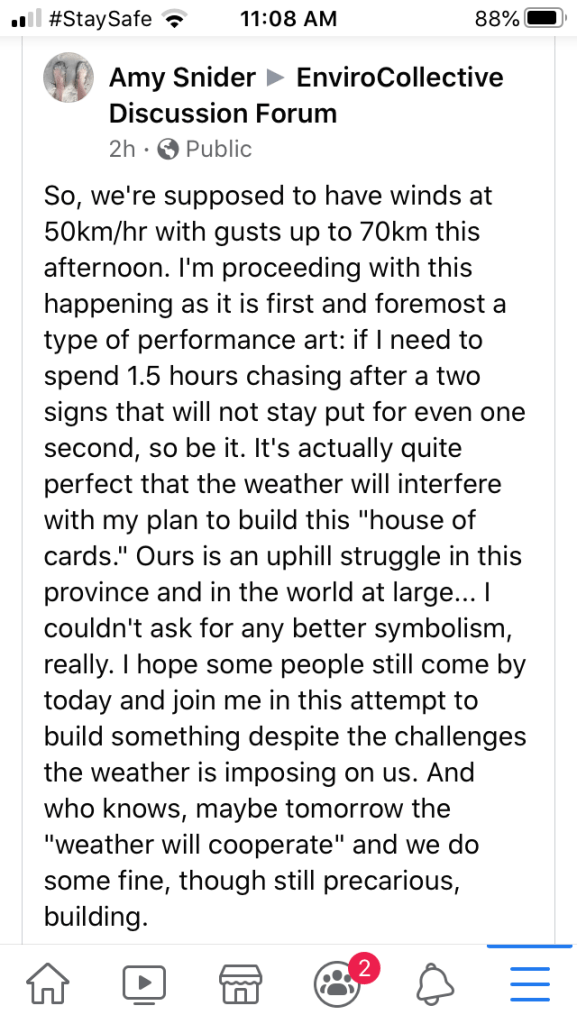
No one could build a “house” in 70km/hr winds, obviously. It didn’t seem like there was any real competition to do so, either. People just made an attempt for a while, stopped, tried again, and then left. There wasn’t any real opportunity to award anyone a free sign, of if there was, I missed it.

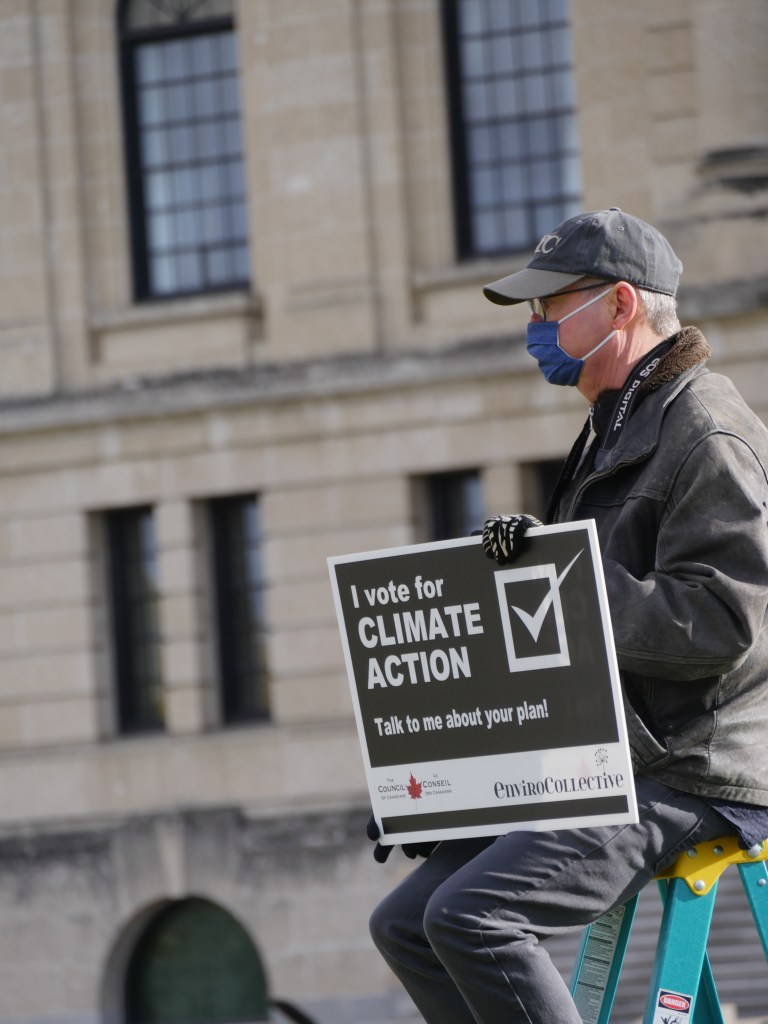
I’d brought a ladder as a prop, knowing that with the wind we wouldn’t need to use it. One of the best parts of the event was Mike sitting on it, holding a sign — that was a great performance.

Kids! I hadn’t really anticipated how having kids present would drastically affect the feeling/tone of the event. In some ways it was great having them there — they helped maintain a level of energy for building a house of cards despite the fact that it was clearly pointless. In other ways, though, it made the event feel more like a family event than I’d predicted it would be. There isn’t anything wrong with that per se, and in fact kids are a big part of why I’m doing what I’m doing. At the same time, it felt a bit like the adults were there to help the kids do an activity that was solely for their entertainment, and that’s just different from how I’d imagined things would feel.

Another way to put it is this: kids are used to doing things that may appear silly or pointless to grown-ups; to them, it’s fun and games. In a way, this was great, but in another way, I’d wanted the struggle we were going through to be serious at the same time as it was ridiculous, and I don’t feel like that came through. Maybe it did for others though.

I’m questioning what my position should be at an event like this. Should I have persisted on trying to build a house of cards alone instead of mostly with others? Should I have acted more theatrically? It was hard to know what my role was or how I should act, and I was aware of this through the event, which felt awkward. Then again, this is a new medium for me, so I guess it makes sense that I don’t feel confident about what I’m doing.

You know, thinking about it now, it actually felt like it didn’t matter what I was doing. People there were busy doing their own thing, and that was entirely fine. Great, actually. I wasn’t the happening, the participants were.

I had a number of brief exchanges with participants. People noted the metaphor of what we were trying to do… building a “house” despite the extreme challenges the environment around us (the weather) presented. I think one of the best moments was when one little boy said “we built it once, we can build it again!” after the wind collapsed a “house” we’d spent time building. Later he said “we can do this if we work together!” What a great attitude, dude!

I was too busy trying to build a house of cards (and running after signs) to really see if there were any passersby who stopped to ask about what was happening, but my guess is that there weren’t. It was a bit too blustery for many people to be out, and it was also many people’s Thanksgiving. So, it really felt like “my people” came out but no one else, and while I’m entirely grateful that they were there, I’ll have to think about how to change this for the next time if I want to attract the “unconverted.”

I didn’t get the chance to talk to anyone who was there to argue.

On the other hand, at least we were subjected to any violence.

Another EnviroCollective board member suggested that I hold upcoming happenings/performances in different locations, and I think that’s a great idea. I’ll try to pick places where there would be more people walking by. Perhaps I’ll set up in front of City Hall next time, and maybe on Friday afternoon when there’s more foot traffic. I just need to finalize what I’ll actually be doing …

We’ll see if things are any different tomorrow, and what else I can learn from this experience.

Again, I’m grateful to all the people who took time out of their Thanksgiving Sunday (including Risa), and I’m also grateful to Esperanza for playing the role of documentarian.

house of cards

Last night, as I was putting my ten year-old son, Jakob, to bed, he was telling me about the model Winnebago Cheiftain he’d just built in Minecraft. He knows a lot about RVs as dreaming about owning one is new “thing” these days, and he’s being doing research on all of the makes and models that are out there, new and used. We’re big on camping, but we’re all getting a bit tired of tenting, and owning an small camper van is moving from the realm of dream to ambition. Jakob’s research may inform this major decision that we could potentially be making in the next year or two.

In bed last night, we chatted about his recent Minecraft creation:

This is the RV that Jakob’s dad’s family had back in the 70s. (It also happens to be the same RV that the crew in The Walking Dead use to avoid zombies in the early seasons of the post-apocolyptic show.) We were talking about how un-aerodynamic its design was, and how much gas it must have burned. Being raised as a young environmentalist, fuel efficiency is one of the key considerations Jakob is making when doing this research into camper vans.

At this point in the conversation, Jakob said how he wishes he could be having a childhood “like Daddy’s.” Mike grew up in a small town, spent days “running wild” (Jakob’s words) through the woods that backed his family home, and spent weeks on the road in the family’s Winnebago without any knowledge of climate change.

I can’t express how sad I am that Jakob, and all the kids of his generation, have this existential problem looming over their childhood. It’s a real dilemma for me as I raise Jakob: part of me doesn’t want him to know anything at all about climate change; part of me wants him to know that his parents are doing what they can to spread awareness of the need for urgent action to mitigate and reduce its effects. Today will be an example of big a part of my life climate activism has become.

Today and tomorrow, I’m going to make my first attempt at performance art. I’m going to spend an hour and a half attempting to build a “house of cards” out of the “I vote for climate action: tell me about your plan” lawn signs that EnviroCollective, Regina’s environmental initiative “hub,” has produced.

These non-partisan lawn signs are meant to be a way to get more people thinking about climate change as they go to the polls for the upcoming provincial and municipal elections. EnviroCollective ordered 1000 of them. They are plastic, unfortunately, but they are completely reusable for future elections. We are selling them for just a bit more than cost as a fundraiser for EnviroCollective and a sponsor non-profit organization, The Council of Canadians.

As a board member of EnviroCollective, I’ve been trying to get these signs “out there.” We’d hoped to have a table at the Farmer’s Market, but this plan fell through. I’ve tried asking a few local and sustainability-minded shops to consign them for us, but most small business owners I’ve approached have politely declined. Our provincial election is just over two weeks away, and we’ve only sold about 100 signs.

Four days ago, disappointed at how slow our sales have been, I decided to find a way to use these signs in a performance art piece with the hopes of getting more publicity for this initiative, and to say something about the ridiculousness of the situation we’re in: that the most important issue of our time is not being treated seriously enough.

What immediately came to mind was the idea of trying to build a house of cards out of them on the lawn of the Legislative Building.

Looking at different types of performance art online, I came across the term “happening.” I read about how “Happenings were the forerunners of performance art and in turn emerged from the theatrical elements of dada and surrealism” (Tate). I read how Allan Kaprow coined the term in 1959, and how “Kaprow emphasized the importance of artist’s action and the process of creation above the finished work” (Widewalls).

Honestly, I wanted to get an event “out there” asap, and so I decided to post to Facebook that I would be putting on a “happening” today and tomorrow, attempting to build a “house of cards” out of these hundreds of “I vote for climate action” signs that we haven’t yet sold, even though I’m still trying to understand the semantics of the terms “happening,” “participatory art,” “social practice art,” “community-based art” and others that refer to art performances that involve the public in one way or another.

Jakob and I do a trial in our back yard in advance of today’s performance.

The event description is as follows: “Reginans: Join me on the lawn of the Legislative Building between 3:00-4:30pm this Sunday and Monday (Oct 11/12) for a participatory climate action “happening.” I will attempt to build the biggest “house of cards” possible out of these “I vote for climate action” signs, and I’m challenging supporters of this campaign as well as passersby to beat me. I’ll be giving away free signs to the winners! Masks are required.”

Amazingly, Ashley Martin of the local newspaper found out about this performance and EnviroCollective’s climate action sign initiative, and within two days of posting about my event, I was on the front page of Friday’s Regina Leader Post.

In a way, this means I’ve already achieved my objective of using my performance to gain attention to the fact that climate change needs to be considered a major election issue. Now, I’ll just see who shows up to participate in this event today and tomorrow. The Leader Post reaches a wide audience in what is a very conservative and “pro oil” town/province; I’m curious to know if anyone will show up wanting to pick a fight.

Somewhat ironically, the weather will be a major participant in today’s performance. I posted the following update to this event:

I’m looking forward to this performance and all of the unexpected situations it will produce. I hope a few people are out there chasing after climate action with me. And I hope we will all, but Jakob especially, get a laugh out of what is actually a very dismal situation.

Reading: Facing Gaia: Eight Lectures on the New Climate Regime

Quotations from: Latour, Bruno. Facing Gaia: Eight Lectures on the New Climate Regime. Medford: Polity Press, 2017.

“It doesn’t stop; every morning it begins all over again. One day, it’s rising water levels; the next, it’s soil erosion; by evening, it’s the glaciers melting faster and faster; on the 8 p.m. news, between two reports on war crimes, we learn that thousands of species are about to disappear before they have even been properly identified. Every month, the measurements of carbon dioxide in the atmosphere are even worse than the unemployment statistics. Every year we are told that it is the hottest since the first weather recording stations were set up; sea levels keep on rising; the coastline is increasingly threatened by spring storms; as for the ocean, every new study finds it more acidic than before. This is what the press calls living in the era of an ‘ecological crisis’.

Alas, talking about a ‘crisis’ would be just another way of reassuring ourselves, saying that ‘this too will pass,’ the crisis ‘will soon be behind us.’ If only it were just a crisis!” (7)

“But here we are: what could have been just a passing crisis has turned into a profound alteration of our relation to the world. It seems as though we have become the people who could have acted thirty or forty years ago — and who did nothing, or far too little.” (9)

“Just imagine: hidden behind the profusion of world wars, colonial wars, and nuclear threats, there was, in the twentieth century, that ‘classic century of war,’ another war, also worldwide, also total also colonial, that we lived through without experiencing it.” (9) (See Scranton’s “slow violence”)

“We can’t say that we didn’t know. It’s just that there are many ways of knowing and not knowing at the same time.” (9)

“This view is much more widespread in the world at large, however, in the form of a low-level madness that can be characterized as quietist, with reference to a religious tradition in which the faithful trusted in God to take care of their salvation. Climate quietists, like the others, live in a parallel universe, but, because they have disconnected all the alarms, no strident announcement forces them up from the soft pillow of doubt: We’ll wait and see. The climate has always varied. Humanity has always come through. We have other things to worry about. The important thing is to wait, and above all not to panic.’ A strange diagnosis: these people are crazy by dint of staying calm! Some of them don’t even hesitate to stand up in a political meeting and invoke the covenant in Genisis where God promises Noah that He will send no more floods…” (11)

“There is no cure for the condition of belonging to the world” (13)

(to be continued)

Reading: Slow Violence and the Environmentalism of the Poor

Quotations from: Nixon, Rob. Slow Violence and the Environmentalism of the Poor. Cambridge: First Harvard UP, 2011.

“By slow violence I mean a violence that occurs gradually and out of sight, a violence of delayed destruction that is dispersed across time and space, an attritional violence that is typically not viewed as violence at all. Violence is customarily conceived as an event or action that is immediate in time, explosive and spectacular in space, and as erupting into instant sensational visibility. We need, I believe, to engage a different kind of violence, a violence that is neither spectacular nor instantaneous, but rather incremental and accretive, its calamitous repercussions playing out across a range of temporal scales. In so doing, we also need to engage the representational, narrative, and strategic challenges posed by the relative invisibility of slow violence. Climate change, the thawing cryosphere, toxic drift, biomagnification, deforestation, the radioactive aftermaths of wars, acidifying oceans, and a host of other slowly unfolding environmental catastrophes present formidable representational obstacles that can hinder our efforts to mobilize and act decisively. The long dyings — the staggered and staggeringly discounted casualties, both human and ecological that result from war’s aftermath or climate change — are underrepresented in strategic planning as well as in human memory.” (2-3)

“Politically and emotionally, different kinds of disaster possess unequal heft. Falling bodies, burning towers, exploding heads, avalanches […] have a visceral, eye-catching and page-turning power that tales of slow violence, unfolding over years, decades, even centuries, cannot match.” (3)

“In an age when the media venerate the spectacular, when public policy is shaped primarily around perceived immediate need, a central question is strategic and representational: how can we convert into image and narrative the disasters that are slow moving and long in the making, disasters that are anonymous and that star nobody, disasters that are attritional and of indifferent interest to the sensation-driven technologies of our image-world? How can we turn the long emergencies of slow violence into stories dramatic enough to rouse public sentiment and warrant political intervention, these emergencies whose repercussions have given rise to some of the most critical challenges of our time.” (3)

How can I take this problem and turn it into a piece… how to represent the notion of “slow violence” in art?

“This book’s second, related focus concerns the environmentalism of the poor, for it is those people lacking resources who are the principle casualties of slow violence.” (4)

Yes, and After the Storm was able to draw attention to this tragic unfairness. It’s just so hard to represent this situation without risking being viewed as the “white saviour” or tourist.

“…this books’ third circulating concern — the complex, often vexed figure of the environmental writer-activist.” (5)

“In this book, I have sought to address our inattention to calamities that are slow and long lasting, calamities that patiently dispense their devastation while remaining outside our flickering attention spans—and outside the purview of a spectacle-driven corporate media. The insidious workings of slow violence derive largely form the unequal attention given to spectacular and unspectacular time. In an age that venerates instant spectacle, slow violence is deficient in the recognizable special effects that fill movie theaters and boost ratings on TV” (6)

“Consequently, one of the most pressing challenges of our age is how to adjust our rapidly eroding attention spans to the slow erosions of environmental injustice? (8)

~about how short-sighted politicians are, and the “yes, but not now, not yet” attitude. “How can leaders be goaded to avert catastrophe when the political rewards of their actions will not accrue to them but will be reaped on someone else’s watch decades, even centuries, from now?

Note: So true — reminds me of the conversation I just had with Conservative MP Warren Steinley.

We need to make the effects of climate change relevant to people today. How do we do this? Many use the “do it for your children” claim, but even that doesn’t work well. We are procrastinating ourselves to extinction. How can I show that to my viewers, and how can I do so with some level of “hope” built in as well?

“To address the challenges of slow violence is to confront the dilemma Rachel Carson faced almost half a century ago as she sought to dramatize what she eloquently called ‘death by indirection'” (9)

“Carson herself wrote of ‘a shadow that is no less ominous because it is formless and obscure'” (10)

It’s really time I read the Carson…

“So, too, feminist earth scientist Jill Schneiderman, one of our finest thinkers about environmental time, has written about the way in which environmental degradation may ‘masquerade as inevitable.'” (11)

“The explicitly temporal emphasis of slow violence allows us to keep front and center the representational challenges and imaginative dilemmas posed not just by imperceptible violence but by imperceptible change whereby violence is decoupled from its original causes by the workings of time.” (11)

Paul Crutzen (coined the term “Anthropocene”), Will Steffen, and John McNeill coined the term “The Great Acceleration, a second stage of the Anthropocene Age that they dated to the mid-twentieth century. [They] noted how ‘nearly three-quarters of the anthropogenically driven rise in CO2 concentration has occurred since 1950 (from about 310 to 380 ppm), and about half of the total rise (48 ppm) has occurred in just the last 30 years.'” (12)

So, since I was 13 years old, we’ve seen levels rise 48 ppm (actually more than half of the increase since 1950). People have caused this massive spike in my adulthood.

“If an awareness of the Great Acceleration is (to put it mildly) unevenly distributed, the experience of accelerated connectivity (and the paradoxical disconnects that can accompany it) is increasingly widespread. In an age of degraded attention spans it becomes doubly difficult yet increasingly urgent that we focus on the toll exacted, over time, by the slow violence of ecological degradation.” (13)

“So to render slow violence entails, among other things, redefining speed: we see such efforts in talk of accelerated species loss, rapid climate change, and in attempts to recast “glacial” — once a dead metaphor for “slow” — as a rousing, iconic image of unacceptably fast loss.” (13)

Yes! So how can I do that…?

“It is here that writers, filmmakers, and digital activists may play a mediating role in helping counter the layered invisibility that results from insidious threats, from temporal protractedness, and from the fact that the afflicted are the people whose quality of life — and often whose very existence — is of indifferent interest to the corporate media.” (16)

From “The Environmentalism of the Poor and Displacement in Place”:

official landscape vs. vernacular one

“More than material wealth is here at stake: imposed official landscapes typically discount spiritualized vernacular landscapes, severing webs of accumulated cultural meaning and treating the landscape as if it were uninhabited by the living, the unborn, and the animate deceased.” (17)

“I would argue, then, thaat the exponential upsurge in indigenous resource rebellions across the globe during the high age of neoliberalism has resulted largely from a clash of temporal perspectives between the short-termers who arrive (with their official landscape maps) to extract, despoil, and depart and the long-termers who must live inside the ecological aftermath and must therefore weigh wealth differently in time’s scales” (17)

“refugees in place” and “displacement without moving” (19)

“…the resistance posed by nature itself should not be overstated. The recent turn within environmental studies toward celebrating the creative resilience of ecosystems can be readily hijacked by politicians, lobbyists, and corporations who oppose regulatory controls and strive to minimize pollution liability. Coopting the ‘nature-and-time-will-heal’ argument has become integral to attempts to privatize profits while externalizing risk and cleanup, both of which can be delegated to ‘nature’s business.'” (21).

If I want to give a positive “spin” to the situation, I need to ensure I’m not in any way inadvertently furthering this “nature can heal itself” idea.

(to be continued)

Notes and quotes from: “Does Activist Art Have the Capacity to Raise Awareness in Audiences? — A Study on Climate Change Art at the ArtCOP21 Event in Paris”

Sommer, L. K., and C. A. Klöckner. “Does Activist Art Have the Capacity to Raise Awareness in Audiences?—A Study on Climate Change Art at the ArtCOP21 Event in Paris.” Psychology of Aesthetics, Creativity, and the Arts. Advance online publication, July 1 2019, http://dx.doi.org/10.1037/aca0000247. Accessed 25 September 2020.

In this post, I will contemplate this study’s findings and then post (for my own reference) citations from the article that I may wish to use in the future.

My thoughts on this study

How a piece of artwork dealing with climate change is likely to cause viewers is an essential consideration for me to take when I’m deciding what to create. I don’t want my work to make most people say “we’re fucked” and walk away. I want my work to raise people’s awareness of the seriousness of the climate crisis we’re facing, yes, but I also want them to take action to do something about the situation.

Therefore, when I came across this article, I was excited to find some concrete data on how climate change-related artwork affects viewers. However, before drawing too heavily form this study’s findings in any work or writing I’ll be doing this semester, it is important that I know a bit about the works that were the basis of the study (thanks, Risa, for making this point) and determine how relevant its findings really are to my own practice.

The following is a chart I’ve put together (via lots of copying and pasting from tables 1 and 5) of the 36 art pieces and their creators with hyperlinks to the artworks or the artists body of work added wherever I able to find them:

Cluster 1 (N=8)
The Comforting Utopia
Cluster 2 (N=12)
The Challenging Dystopia
Cluster 3 (N=13)
The Mediocre Mythology
Cluster 4 (N=3)
The Awesome Solution
Description:
Participatory
Playful
Topic: Dreams/visions/utopia
Colourful
Nonart locations
Description: Illustrating technical or artificial objects
Dystopian
Topic: Destruction and/or death or social oppression
Dark colors and use of metal
Mostly exhibited in art museum/gallery settings
Description: Illustrating interconnectedness
Depicting the world as a whole
Themes drawing on methodology
Colorful, mixed materials
Mostly exhibited in museum/gallery settings
Description: Showing solutions
Making cause and effect of human behavior visible
Depicting “sublime” nature
Colorful
Mostly exhibited outside
“Our Vision of the Future”
Participatory work, painted by spectators
“Bees of bees”
Matthew Brandt
“Climat l’etat d’urgence”
(not in table 1)
“Mur Vegetal”
Cicia Hartmann
“Oeuvre Ensemble”
Véronique Le Mouël
“From the New World”
Yang Yongliang
“Drowning World”
Gideon Mendel
“Honey Roads”
Eric Tourneret
“Ribbon Tree”
Participatory work, contributed by spectators
“Still Life”
Valerie Belin
“Crystal Ball”
Les Radiolaires
“Blue Whale”
Un Cadeau pour la Terre, Biome
“Act Responsible”
WWF
“Fridge Cube”
Les Radiolaires
“Nouveau Monde”
Alexis Tricoire
“Kiss Kiss Game”
Pixel Carre
“Cloudscapes”
Tetsuo Kondo
“Veolia”
Veolia, business
“Antarctica Passport Delivery Bureau”
Lucy and Jorge Orta
“Pacha Mama”
Mamoune The Artist

“Sky over Coney Island”
Spencer Finch
“Gaia”
Participatory artwork, created by spectators
“Manthan”
Manjiri Kanvinde
“Il etait une fois”
Chris Morin-Eitner
“Birdman/Dreams/Redemption”
Yelena Lezhen
“Ice Watch”
Olafur Eliasson
“Venus of the trash Isle”
Jave Yoshimoto
“Breaking the Surface”
Michael Pinsky
“Arctic Ice”
Lisa Goren
“Le Film Noir de Lampedusa”
Clay Apenouvon
“La Terre”
Jisook Min
“Exit”
Paul Virilio
(climate change)
“Stoves”
Sterling Ruby
“Unbearable”
Jens Galschiot
(climate change)
“Climate is on the Wall”
Care France Organisation
“Nervous Trees”
Arcangelo Sassolino

(Note: The 37th artwork, “Sertella Septentrionalis,” by Laura Sanchez Filomeno, is not included in table 5 because it “was always the last artwork added to a cluster, hence treated as an outlier and excluded from analysis” (6))

Looking at the sample artists, taking into consideration the limitations noted in the paper (below), I feel as though the “clusters” chosen for this study are sometimes ambiguous, or in other words, that the relation of the works to the these “clusters” is sometimes vague.

For instance, the works in “Cluster 3” are supposed to show/be: “Illustrating interconnectedness; Depicting the world as a whole; Themes drawing on methodology; Colorful, mixed materials.” However, when I look at a sample from this cluster, Gideon Mendel’s series of photographs titled “Drowning World,” I see work that seems to belong more to “Cluster 2: The Challenging Dystopia.”

This work consists of several photographs of people living in places that have experienced flooding as a result of climate change.

Similarly, I don’t see how Cicia Hartmann’s “Mur Vegetal” clearly depicts a “solution” (this work is in the “Awesome Solution” cluster). She’s taken what she claims to be found objects she is “upcycling” (I’m suspicious due to their uniformity and how many of the pieces are identical) and presented them as a relief mural of “flowers.”

What is the “awesome solution” here?

The authors of the study say that the works in this cluster were not “just depicting the problem, but by offering solutions to the participants as part of the artwork.” I wasn’t at this show in Paris, so I can’t know for certain if Hartmann had some sort of solution to the issue of climate change along with this work. I also can’t see how it depicted “the sublime beauty of certain animals, making cause and effect of human behavior visible” (12). Perhaps the actual work she showed was different from what I’ve been able to find.

Another issue that this article raises is the definition of “climate change art.” Many of these pieces used for this study do not directly connect to the issue of climate change per se, but simply “environmental issues.” For example, I don’t see how “Manthan” by Manjiri Kanvinde addresses climate change:

Manthan-Gujrat women empowermenmt Print by Manjiri Kanvinde

“A landscape painting inspired by the milk revolution of India. Where the women dairy farmers were able to sell the milk produced directly to the consumers without middlemen. By reducing malpractices, it had helped the women of gujrat to prosper, placing control of the resources they create in their own hands.” Source

detail of Bees of Bees 5  2012  gum bichromate print with honeybees on paper  59 x 100 in

These are great pieces by Matthew Brandt, but I don’t know how they specifically represent climate change either. Bee populations are declining, but largely this is due to agricultural practices such as the widespread the of neonicotinoids and crop monoculture (ex. almond). Image source

This raises the point of what exactly is or is not climate change related art. As another example of this issue, the “Blue Whale” piece that is listed as part of “Cluster 4: Awesome Solutions” is a life-size whale that, according to artcop21.com, represents biodiversity:

The blue whale, flagship of biodiversity

“The objective of the Blue Whale Project is to provide the keys to understanding the challenges facing the planet and act for the environment. The public can enter the bowels of the Blue Whale to discover a sensory multimedia exhibition. The voice of the Blue Whale, speaking on behalf of all living beings, alerts visitors to the deterioration of the oceans and more broadly our biodiversity. It will focus on the positive contributions and tracks used to save it. The focus will be on positive and concrete messages to everyone, recalling that it is primarily the addition of good behavior and eco-citizen gestures, multiplied by thousands, millions will be a blessing… for our planet. This project is the culmination of four years of work by many stakeholders involved in the preservation of biodiversity; it has the COP21 official label and part of the operation COP21 Solutions at the Grand Palais.” (source)

1509-LBB-01-Eiffel-1.jpg
Source

Yes, climate change is absolutely having an impact on ocean biodiversity, but so does over-fishing, pollution, and plastic. It seems like some of the works shown at the Cop21 event did not immediately concern climate change but rather a broader set of “environmental issues.”

As for the three works in the “Awesome Solution” cluster overall, I don’t really see how they live up to the author of this study’s description of works that are of “sublime nature,” are “hopeful,” “give viewers a sense of awe,” or would leave viewers “significantly more ‘inspired or hopeful'” (12). I just don’t get it. Maybe I had to be there?

So, these are a couple of the issues I’ve found with this study, and so I’m going to take its conclusions with a grain of salt.

This article aside, I’m looking forward to reading a few of the texts that Katherine Arbuthnott uses in her courses on the psychology of climate change. I know that this is an area of study that will be very relevant to how I proceed with art-making for this MFA. I’m grateful that Katherine shared her syllabi with me, and I’m looking forward to chatting with her about this topic in the near future.

Quotations —

Abstract

The goal of this study was to investigate whether activist art can have a stimulating psychological effect on its spectators. This question is examined in art specifically related to climate change. With the aim of inspiring public engagement and communicating environmental issues to spark a climate change movement, ArtCOP21 is a global festival that took place simultaneously to the United Nations climate change negotiations (Conference of the Parties [COP21]) 2015 in Paris. Eight hundred seventy-four spectators responded to a questionnaire on their perception of 37 selected artworks. In an explorative study using cluster analysis, characteristics of the artworks were connected with emotional and cognitive audience responses. The analysis of the artworks assigned them to four clusters: “the comforting utopia,” “the challenging dystopia,” “the mediocre mythology,” and “the awesome solution.” As suggested by the name, the “awesome solution” was the cluster of artworks that caused the highest emotional and cognitive activation. Artists and environmental campaigners can use the commonalities of the artworks in this cluster in their own creative work and contribute to our understanding of the impact of activist art. (1)

Environmental activism through art serves thus as a case of “activism through art” in this study, with which we aim to examine the effect activist art has on its audience. Environmental artists have risen to the challenge to address climate change. Nurmis (2016) outlines how climate change art has established itself as a genre that has developed alongside, but separate to, environmental activism. She makes the claim that such art can convey cultural meaning to global warming beyond the current reach of scientific discussions and political discourse. In the present paper, we propose that environmental psychological theory can assist in determining through which psychological mechanisms climate change art affects audiences, and guide artists who care about the impact of their work. (2)

[W]e aim to find commonalities in environmental artworks and relate them to emotional and cognitive variables that have been shown in environmental psychological research to be relevant as predictors of environmentally friendly behavior. (2)

There is much to be gained from such research, especially for campaigners against climate change, creative practitioners, and politicians interested in bringing change to their community. (2)

[W]e assume that emotional reactions can be key in making climate change personally relevant to people and may be an important driver of change. Emotions, such as happiness, have also shown to promote intrinsic motivation and interest, and thereby contribute to create engagement. (2)

Apart from emotions, cognitive responses can be triggered by art experiences (Silvia, 2005) and can become relevant as determinants for environmental behavior. Cognitions and emotions do not exist separate from each other and the order in which they are triggered is often hard to define.  (2)

In the case of art, a shocking piece of visual art can, for example, cause people to react with anxiety, anger, or guilt, dependent on their personal background and state. Thereby, emotions can be conceived as episodes, which change cognitive processing (“What does this artwork mean/tell me?”), motivational aspects (“Does the artwork motivate me to a certain action?”), physiological reactions (sweat, chest tightness, etc.), and maybe even actual behavior (“I will cycle to work tomorrow”). To conclude, we expect that emotions have a key role in the activating process. (3)

Climate change-related cognitions can be of many different kinds. Hulme (2009) argues that climate change is not just a physical entity that shapes our present and future weather conditions, but also holds meaning for culture. Making culture and climate interact “and mutually shape each other” thereby triggers contemplation and reflection in people. Art can, for example, make people aware of the impact of their own behavior (Marks et al., 2017) and reflect on their role within climate change (Curtis et al., 2014). (3)

Moreover, art can illustrate to people why environmental topics are relevant for them in their daily lives, without sounding “preachy” (Neal, 2015, p. 18). (3)

Moreover, art can illustrate to people why environmental topics are relevant for them in their daily lives, without sounding “preachy” (Neal, 2015, p. 18). (3)

His results were that art experiences help to:

(a) improve proenvironmental beliefs, values, and attitudes;

(b) raise awareness of the consequences of certain actions;

(c) form a proenvironmental self-concept;

(d) unfreeze ingrained habits;

(e) form proenvironmental social norms;

(f) build community involvement in proenvironmental activities;

(g) reduce some situational constraints and physical barriers to adopting pro- environmental behavior.

(3)

Research questions (3):

1. Do environmental artworks (as a case of activist art) trigger different profiles in emotional reactions by the audience, which can be grouped in homogeneous clusters?

2. Do these clusters also correspond to differences in climate change-related cognitions and artist perception?

3. To which emotional and cognitive patterns do different characteristics of activist artworks relate? (3)

Artworks in Cluster 1—“The Comforting Utopia” (7)

In order to name the clusters, we combined the emotional and cognitive reactions the participants showed, together with the common characteristics we could identify in the clusters.

Regarding the emotional variables, the “comforting utopia” shows, in comparison to the other clusters, positive emotions values ranging between the highest and lowest cluster, which means the artworks make people relatively “happy,” “hopeful,” and “inspired.” For the negative emotions, the comforting utopia displays the lowest scores, which means the artworks make people feel only a little “guilty,” “sad” and even less “angry” and “anxious.”

For the cognitive variables, the comforting utopia was rated lowest on the perceived quality of the artwork. Participants reported a low level of activation in nearly all cognitive variables, with lowest mean scores for the variables “confrontational,” “reflect,” and “awareness of impacts.” Furthermore, they think of the artists represented in this cluster as “expressing the view of the public,” more than in the other clusters.

Artworks in Cluster 2—“The Challenging Dystopia” (7)

The “challenging dystopia” is the cluster with the weakest positive and the strongest negative emotional reactions reported on average by the participants. Artworks in this cluster make participants the least happy and hopeful, but manage still to “surprise” them. They make the participants feel most guilty, “apathetic,” “sad and disappointed,” “angry,” and “anxious”.

Regarding the cognitive variables, the challenging dystopia was rated third on the perceived quality of the artwork. It stands out by reaching the highest value on the variable “confrontational and shocking,” which is in alignment with the negative emotions the artworks in this cluster are causing. It also reaches high mean values for “challenging social norms,” “art has something unusual and made me stop,” “relevance for daily life,” and “awareness of impact.” Regarding the perception of the artist, the challenging dystopia rated lowest or among the lowest for all the perception of the artist items, indicating that the participants did not identify with the values or intentions of the artists.

Artworks in Cluster 3 —“The Mediocre Mythology” (7-8)

The artwork in the “mediocre mythology” show a relatively “flat” emotional pattern, causing neither strong positive nor negative emotions. The highest mean values for emotional responses in the mediocre mythology are reached for the emotions “sense of

awe” and “sadness and disappointment,” but even these emotions remain second lowest among all clusters.

For the cognitive responses, the pattern is similar, meaning that artworks in the mediocre mythology do not seem to reach explicitly high or low values on any of the cognitive variables, even though the cluster was rated second on perceived quality of the artwork. The highest value was found for the variable “the art has something unusual and made me stop”, which is in alignment with the emotion “sense of awe”. In addition, “showing personal consequences of climate change” scored second highest among clusters, which could be connected to the emotion sadness and disappointment. Concerning the perception of the artist, “the artist has values similar to me” scored second highest among the clusters.

Artworks in Cluster 4—“The Awesome Solution” (8)

The emotional response pattern to the artworks in the “awesome solution” presents the highest values for all positive emotions, while at the same time showing negative emotions ranging between “the dystopian future” and the comforting utopia. The only exception is a peak in “sadness and disappointment”. Regarding the cognitive variables, the artworks in the awesome solution have the highest values for the variables “perceived quality of the artwork,” “the artwork has something unusual and made me stop,” “the artwork highlights personal consequences,” and “highlighting one’s own role within the climate situation.” For the variables describing the perception of the artist, artists behind the works in the awesome solution reach the highest values for “the artist is like me,” “the artist is thinking and living differently than most people,” and “the artist has similar values as me.” This indicates that participants in this cluster perceived themselves to be different from the general population, and similar to the artist.

Characteristics of Artworks
“In order to answer Research Question 3 (To which emotional and cognitive patterns do different characteristics of activist artworks relate?), we looked for similarities among the artworks that constitute the clusters in the final step of the analysis. In order to identify similarities, we used the artwork characteristics rated by the researchers when the survey was conducted. As a method to avoid identifying random characteristics that only one or two artworks in a cluster have, we decided that at least three artworks per cluster (2 in the case of Cluster 4, consisting of only 3 artworks) needed to exhibit a commonality in order to assign it to the cluster. Table 5 gives an overview of the artworks in the clusters and their commonalities.” (5)

Discussion

With this study, we aimed at identifying emotional reaction profiles triggered by activist environmental art and related cognitive responses. We grouped the artworks based on these profiles and studied the common characteristics within each cluster, which might have led to the psychological effects on its audience. We hope to uncover which aspects of activist artworks have the potential to motivate people (to act in a more climate friendly manner). (9)

Limitations of the Study and Further Research

“The selection of the clustering method is based on the resulting dendrograms and theoretical assumptions, and it can be argued that a different clustering method would lead to slightly different clusters. However, the differences between cluster solutions were not substantially different as, for example, artwork No. 25 (Sertella Septentrionalis) was an outlier across all methods. The other possible cluster solutions have been added as online supplementary material to this study (available online). We chose the clustering method, which had the most interpretable cluster solution according to the emotional reactions the participants had to the artworks.” (13)

“Moreover, the postclustering characterization of the artworks and the assignment of common attributes are also qualitative, even though we tried to reduce subjectivity through the standardized artwork characteristics sheet. In addition, the researchers and their assistants were more trained in psychology than in art or art history. Possibly, a description of the artworks by people from the art field could have led to a characterization based on art theory
and history of the artworks and the clusters. Future research should prefer such expert classification. Most research on the perception.” (13)

Conclusion

“Based on the clusters of artworks and, accordingly, the reactions of the participants, we suggest that activist art including environmental art should move away from a dystopian way of depicting the problems of climate change, toward offering solutions, and emphasizing the beauty and interconnectedness of nature. The use of dystopian elements to initially catch attention, but with the remaining solution focused and hopeful, may be even more promising in encouraging action. Moreover, it is important to move out of the institutional space of museums into the public, in order to reach out to a bigger audience, and to avoid the connotation that art is something reserved for the educated part of the population.” (14)

On the contrary, the fact that only three out of 37 artworks were grouped into the awesome solution deserves some attention. It is not easy to reach an audience, even if the intention of the artist and activist is to do so. It is not enough to simply show the problem in an aesthetic way, but according to characteristics of the awesome solution, it is essential to create a personal connection to the causes and consequences and offer solutions. “Painting things black” and inducing fear is also not the best way to go, since it induces more fear, which reduces motivation (O’Neill, Hulme, Turnpenny, & Screen, 2010). Artists can be positive and negative voices, which emphasize the creative or destructive potential of people and societies. We were able to identify similarities between artworks that can explain why an artwork engages its audience in a positive way. The commonalities of artworks, especially in the awesome solution, can be used by artists as guidelines for creating works, which have the potential to retell the stories of climate change in a way that activates the slumbering potential in our societies. Environmental psychology contributes by revealing the underlying emotional and cognitive mechanisms and helps to address environmental challenges, among them climate change. In order to do that, it is essential to bring together natural, social sciences and humanities, since “we cannot detach the stories we tell about climate [change] from the stories we tell about societies” (Hulme, 2009, p. 33).” (14)

Early Readings

Risa Question: What specific readings do you plan to do in this week and next (in advance of our next meeting)? What have you prioritized, and why?

The past two weeks have flown by, and to be honest, I haven’t done as much reading as I’d planned to. I graded my first batch of 80 English 100 essays in one week, but that meant that the week was pretty much a write-off for me.

This is what I’ve been reading when I’ve had the chance to read, usually from around 10pm to midnight:

1. Websites! I’ve done work updating a Google Doc with a list of websites that are relevant to my work for this stage of my MFA. I’ve read a few online articles and artists’ websites, and I’ve been amazed by the climate change-related work being done right now. I’ve also been bumping into potentially useful terms for me to know, such as: reception theory; The Society of the Spectacle/Situationists; affect theory.

2. Similarly, I’m trying to figure out what type of practice I wish to develop at this time, and so I’ve done a bit of reading to try and disambiguate the following terms: social practice (art); participatory art; interactive art; collaborative practice; socially engaged art; community art.

3. In addition, I read an incredibly relevant article (the kind where you’re tempted to highlight every single sentence): “Does Activist Art Have the Capacity to Raise Awareness in Audiences?—A Study on Climate Change Art at the ArtCOP21 Event in Paris.”

4. I also reread an article I discovered via the class I took with Sarah Abbott last winter, Engaging Climate Change: “Climate Change and the Imagination.”

5. To start getting a sense of conceptual art, I’ve been reading from Daniel Marzona’s Conceptual Art.

6. To brush up on my history of art and art theory/criticism, I’ve read a couple chapter introductions in Art and Interpretation: An Anthology of Readings in Aesthetics and the Philosophy of Art.

7. And finally, because of a quotation Mike (husband) remembered about how “the artist has no alibi,” I read “The Flight of Form: Auden, Bruegel, and the Turn to Abstraction in the 1940s.” It wouldn’t be clear how this essay is relevant to my work, but trust me, it is.

I am in the processes of typing out notes from the above works, and I hope to have a new page on this blog where I can place these quotations.

I’m having a hard time deciding how to prioritize my readings for this class/term. Honestly, the amount of reading I want to get done is overwhelming to the point of near paralysis. Where to begin?!? I believe that by reading the above, I’m covering a few bases: stuff about artistic work and climate change; stuff about conceptual art (as it’s clear I wish to produce some); about the history of art; theoretical stuff. Perhaps Risa will be able to help me sort out the best way to prioritize my reading for the upcoming weeks.

Bibliography

Art and Interpretation: An Anthology of Readings in Aesthetics and the Philosophy of Art. Edited by Eric Dayton. Broadview, 1998.

Marzona, Daniel. Conceptual Art. Taschen, 2005.

Nemerov, Alexander. “The Flight of Form: Auden, Bruegel, and the Turn to Abstraction in the 1940s.” Critical Inquiry. Vol. 31. No. 4, Summer 2005, pp 780-810.

Sommer, L. K., & Klöckner, C. A. (2019, July 1). Does Activist Art Have the Capacity to Raise Awareness in Audiences?—A Study on Climate Change Art at the ArtCOP21 Event in Paris. Psychology of Aesthetics, Creativity, and the Arts. Advance online publication. http://dx.doi.org/10.1037/aca0000247

Yusoff, Kathryn, and Jennifer Gabrys. “Climate Change and the Imagination.” Wiley Interdisciplinary Reviews: Climate Change, vol. 2, no. 4, 2011, pp. 516–534.

Early Conversations

Risa Question: What sorts of conversations do you aim to have with the folks you mention below, i.e. in what specific ways are these people sources of research or mentorship for you? Spell it out.

I’ve told Risa that I feel I need to do a lot of reading, thinking, and chatting with people in order to get a sense of what type of work I should aim to produce. I’ve listed a few people below from whom I believe I can glean some useful information. My hope is that these conversations will also create a spark of inspiration — that I’ll have an “aha!” moment when an idea pops into my head during or after these conversations.

I’m sure this list of folks will change with time; I’ve already removed one person from it and added two others. Here’s a brief summary of why I’d like to chat with each of these people.

Ken Wilson

Ken is a friend of mine and a colleague in the Department of English (also teaching two sections of English 100 this term, so we get to kvetch about students and grading). He’s on this list, however, because he’s taking an Interdisciplinary PhD at the U of R that works with the subject matter of Canada’s tragic colonial past and its continued impact on First Nations’ people. In other words, his work has a content matter that is connected to society and politics. For one of his MFA projects, he completed a 300km walk through the land of the Six Nations, raising money to help create a residential school museum and blogging about the experience in great detail. For his PhD, he continues to walk, and he again posts detailed observations of the land he covers in his blog Reading and Walking.

Ken Wilson, Reading and Walking

Ken’s writing is reminiscent of W. G. Sebald, a German writer whose work both Ken and I admire. My MA (English) research paper was titled: “‘On every new thing there lies already the shadow of annihilation:’ The Fragment and Photography in W. G. Sebald’s Fiction,” and I feel like I should review some of the work I did for that degree to see if I can carry anything from it into my MFA. Getting back to Ken, I get the sense that he and I have a few things in common, and I’d like to learn more about his practice.

We had an initial chat in his lovely garden this past Sunday afternoon, and he gave me a few things to think about, namely:

  1. Look into people on campus doing social practice in MAP at the U of R: Rebecca Cains and Taiwo Afolabi (a recent Canada Research Chair).

(I was pleased to hear Ken bring up social practice, as it’s something I just discovered a few weeks ago and believe could be useful to integrate into my work. Ken explained that in social practice, people often get to “take something with them” as a result of their participation. He gave an example of what this could mean in terms of my project (I’d shared my originally proposed idea with him): have people use cake icing to write the figure representing the CO2 in the atmosphere in the year they were born on a cookie that they can then take away with them, presumably to “consume.” Nice!)

2. Get in touch with Barbara Mineli. She conducted(?) a social practice piece a while ago where she put candy in a bowl in a public space for people to take (I didn’t catch what her intended message was, however).

3. Chat with Philip Charrier, history prof at the U of R and photographer (who also happens to be a friend of my husband), who has did one project that involved taking photographs of people living in the north-central area of Regina and then giving these people their portraits.

4. Look up Leah Decter.

It was a good start to our conversation, and I look forward to speaking more with Ken in the near future.

Tanya Dhalms:

Tanya is also someone I’ve recently begun developing a friend with, and I hope to speak with her about her role as an environmental activist. She and I are meeting with a Conservative MP two days from now in order to execute LeadNow’s campaign to pressure the government to create a “green recovery” post-Covid. I’d like to chat with her about her activism.

David Sauchyn

Dave is a prof of geography and environmental science, and a researcher in the are of climate change. According to his profile at the U of R, part of his work involves the “translation of climate change science for adaption decision making.” He has published on topics relating to the Canadian Prairies: “The Prairies; in From Impacts to Adaptation: Canada in a Changing Climate 2007”; “Climate Change Impacts on Agriculture in the Prairies Region.” If he will be willing to make some time to chat with me, I’m hoping to get a sense of what he believes are the key issues that we’ll be facing here in Saskatchewan as the effects of climate change become more severe. Knowing this may give me ideas for ways to present climate change in my art in a way that local people (around me) will be able to relate (i.e.: crop drought, not melting glaciers).

Robert Sandford

Bob is Chair in Water and Climate Security at the United Nations University Institute for Water, Environment and Health, and has published many books on climate change for the general public in addition to his scholarly work. I discovered him when I was looking for data on Athabasca Glacier for David’s Open Studio course I took in 2018; I came across his essay, “Water and Hope: Facing Fact and Inspiring Optimism in the Anthropocene” in The Source: Rethinking Water Through Contemporary Art.

After digging around online for a while, I found a contact phone number for Bob, and I was shocked and delighted that he picked up the phone — he was attending a conference Berlin at the time. He was extremely friendly despite my interruption to his day, and he told me how much he values the role artists is influencing positive change regarding environmental issues. He told me he’d have his colleague, Mike Demuth, email me the data I was looking, which he did. I enjoyed incorporating science into my work, and this is something I’d like to do more of.

Bob has come to be somewhat of a mentor to me. I went on to read a couple of his books and found that he writes in a nearly lyrical manner with a very clear passion for his subject… parts of them can almost bring me to tears. His ability to take scientific information and convey it in such a way that a lay person could have this response is something I admire and wish to emulate.

How fortunate we are to live on a planet so appropriately composed of just the right substances, enveloped in just the right atmosphere and located just the right distance from the sun to permit an abundance of water on its surface. Water is not only the stuff that composes most of the living tissue of life, it is the universal solvent in which all life’s nutrients dissolve and are distributed to even the most minute chains of being on earth. Life is an intelligent idea carried around in the mind of water. Water could be viewed as life’s way of getting itself around. (60)

I’m adding a couple of his other books to my reading list, such as North America in the Anthropoecne and The Hard Work of Hope: Climate Change in the Age of Trump.

I plan to reach out to him again asking to have a chat about his current work. Again, I hope that this will not only educate but also inspire me. His colleague, Demuth, is also someone I’d love to have the opportunity to chat with. His book, Becoming Water: Glaciers in a Warming World, is also both informative and personal.

Larissa Shasko

I met Larissa though my work as an activist in town, and I admire her drive and her accomplishments. In a post from last year about her receipt of a scholarshiop, the Johnson Shoyama Graduate School of Public Policy explained that Larissa was “a Master of Public Policy candidate at the school’s University of Regina campus and is the former Leader of the Green Party of Saskatchewan (2009-2011). In addition to being an exceptional student and environmental and political activist, Larissa is also a gifted artist, a dedicated volunteer, and a loving mother of two young children.”

Larissa is currently a PhD candidate in Public Policy, working with co-supervisors, Dr. Margo Hurlbert (U of R) and Dr. Jeremy Rayner (U of S). A brief description of her current project is that its aim is

“support and enable youth leaders to transition their generation to achieve the greenhouse gas emissions reduction targets established by the 2015 Paris Agreement and future agreements under the United Nations Framework Convention on Climate Change. The project will include an exploration of values systems and ideas for public engagement methods that may work to reach youth at various stages of transformation. Eco-anxiety is a growing concern for youth everywhere, yet when economic disparities exist among youth from different locations or cultures, these inequities add a further degree of importance to ensuring youth are brought into shared conversations about energy decisions that will shape their futures.”

Larissa Shasko

We will be setting up a time to chat in early October, and I’m hoping I will be able to glean some useful information on her “exploration of values systems and ideas for public engagement methods” relating to climate change.

Katherine Arbuthnott

Katherine is another fellow faculty member at the U of R, and I’ve bumped into her in a few committees over the years. I’ve contacted her to set up a time to chat about her work in environmental psychology as I believe this is a subject I must learn about. For instance, she has published on “The influence of goal-framing and autonomous motivation on pro-environmental behaviour.”

I have so much to learn!! I wish I had time to take several classes this term, including her grad class on “Environmental Psychology” (or more appropriately, I’d start out with her undergrad class: “Psychology and Environmental Change”).

Katherine has replied to my email in which I introduced my area of (art) work and why I’d love to chat with her. She wrote back with “I think that artists have a vital role to play in getting us all to turn our home-ship around, and I also talk about that a bit in my undergraduate conservation psych class” and said that she’d be “delighted to zoom-chat with [me] about our various work on this, as well as share resources (both directions).” We’re about to set something up.

Summary

This is just a beginning for me; I hope to have many conversations over the next few months/years that will inform and inspire my work. I’m grateful for everyone’s time and willingness to share what they’re doing.

A calling

Risa Question: How do you typically work: what is the relationship between making and doing, in your practice. Which comes first (do you fancy yourself a materialist, who develops ideas through making; a conceptualist, who develops ideas for making through reading (gardening, singing, walking, talking, looking etc.). How has this evolved over your years of practice, and how do you see this evolving at this early stage of your MFA?

For the last five years, I’ve been attached to clay. It’s been in me and on me and all that I wanted to do. I’m still in love with clay: I love its sensuality, and how the silky sensation of wet spinning porcelain on a potter’s wheel can bring me to my “happy place”: the silty beds of glacial-fed rivers and lakes of the Rocky Mountains.

I’d love to work with clay again, but what I need more than that right now is a project that will allow me to say something about climate change that I feel the need to say. The “something” is up in the air right now, as is everything about my art-making at the moment, but I just feel that there is something I want to share regarding this catastrophe we’re facing.

Under the very broad (I’m just learning) definition of “art,” I will do anything necessary to get my point across: I guess this means I fancy myself a conceptualist. I’m game to using any material, or non-material, as the concept requires.

In a series of photos The Guardian published in 2014, “When nature calls: 12 artists answering back to climate change – in pictures,” the piece that made me “wow” the most was “Vatnajökull” (the sound of) in which Katie Paterson “left a gallery empty apart from a telephone number on the wall. Visitors calling the number were connected to a microphone embedded in Europe’s largest glacier, which has been eroding since 1930. All callers could hear was the creak of ice and the trickle of melting water.”

This is a neat idea. I don’t know if I’d do it, but it does show me that there are infinite ways to “think outside the box,” and I’m looking forward to doing more of that for this degree.

My concern right now is twofold — understanding what I want my point to be, and then learning how to get it across most effectively using any materials or means necessary.

The Wrecking Ball

Risa Question: At what point are ideas in germination, unfixed and in flux (and, thus, worthy of exploration), and at what point are ideas so developed as to abandon them altogether? This question is about your ability and willingness to experiment and explore unencumbered by perfection; vs. being frozen (?) from doing/making with attempting an exploration?

It’s hard for me to answer this question in general terms at this stage in my development as an artist, as I’m just beginning to learn about my practice. Most of the work I’ve done until now was what I would call “low-stakes”: my projects have largely been series of ceramic functional wear pieces, and my learning curve with them only involved solving formal and technical challenges to get the “look” that I wanted these pieces to have. I didn’t need to deal with the extra layer of complexity that conceptual artwork entails.

Thin porcelain cups inspired by the vase sponge, callyspongia plicifera

The only other time that had an idea for a project that I dropped was for a Senior Undergrad Group Studio class I took with David in the winter of 2018, and it was also my first time attempting to do anything conceptual. This was my first time attempting to bring a topic (also climate change) into my practice. I spent most of the semester trying to make an idea work — this included trying very hard to understand David’s feedback on the piece that it wasn’t conveying what I wanted it to convey, and trying to find ways to justify to myself and do David/my classmates why it was a worthwhile idea to continue working on. It eventually got through to me that the core of the idea had problems that were likely irresolvable, and I was completely stressed out about what to do with my work for this class.

Feeling the melting glacier, anybody?

Yeah-no.

Luckily, I was able to take a break from focusing on this problem. Near the end of the term, I had the great fortune of going to Pittsburgh for a ceramics conference, NCECA. For three days in a row, I wandered around the city by foot, ignoring the free shuttles that conference attendees could make use of, opting instead to walk for hours each day from studio to studio across the city. I think that the combination of walking and viewing so many awesome examples of ceramic artwork was precisely what I needed at that moment.

Just after boarding my return flight, a idea just popped into my head, and I immediately started sketching it in my travel diary. I knew instantly that this idea would convey the meaning I wanted my work to convey in a much clearer way than my original idea. It was at that point that I ditched my original idea, and about two intense weeks later, I was very happy with what I had for that class’ final crit.

(The pieces above are titled “Calving” and “Athabasca Glacier, 1918-2018,” and they’re part of a series of pieces using a tool use to drink (the cup) to demonstrate glacial loss. In the crit, and subsequently in a show, I’ve been told that the pieces get my point across very clearly.)

I understand that project ideas often need tweaking or even larger-scale revisions. Thinking about this now, I realize that I’ve never been very good at doing the latter; when I used to fancy myself a writer, I found it very hard to make major revisions to any story or poem I’d written. The best feeling ever was when the idea for a piece came to me “out of the blue,” complete and just about ready to go. I could make minor revisions to it, but I’d quickly lose interest in an idea if it needed significant or structural changes in order for it to work. It was easier for me to just start again from scratch.

Is this something I need to work on? For how much time should an artist stick with an idea when she knows that it is fundamentally problematic? At what point is it best to return to the drawing board? These are great questions, and I don’t have any great answer for them. For my original project in Risa’s class this term, I can see parallels to the project idea I’d originally had in David’s class back in 2018: the work I was going to produce would not clearly convey what I wanted it to. In a way, a “seed” of the original idea helped me get to where I eventually ended up, but most of it had to go.

This reminds me of something Annie Dillard says in The Writing Life that was very important to me years ago when I was trying to become a writer. She writes about the way a writer needs to be ruthless at times with her writing, and not pause before destroying what must be destroyed for the project to reach fruition:

The line of words is a hammer. You hammer against the walls of your house. You tap the walls, lightly, everywhere. After giving many years’ attention to these things, you know what to listen for. Some of the walls are bearing walls; they have to stay, or everything will fall down. Other walls can go with impunity; you can hear the difference. Unfortunately, it is often a bearing wall that has to go. It cannot be helped. There is only one solution, which appalls you, but there it is. Knock it out. Duck.

Annie Dillard, The Writing Life

It seems clear to me right now that there is not much I can salvage from the idea I originally proposed to Risa. Perhaps some “brick” from it will become part of a future project, but I don’t want to feel tied down to building a building that I am already convinced isn’t the right one.

I don’t believe that this means I’m being “encumbered by perfection,” and I certainly have a “willingness to explore” in this early early stage in my MFA without any delusions of grandeur that I will produce a masterpiece in the next few months (or years… or ever ). I just feel at this stage that my original idea has already taught me what it can, and I’m ready to move onto exploring and learning from something else.