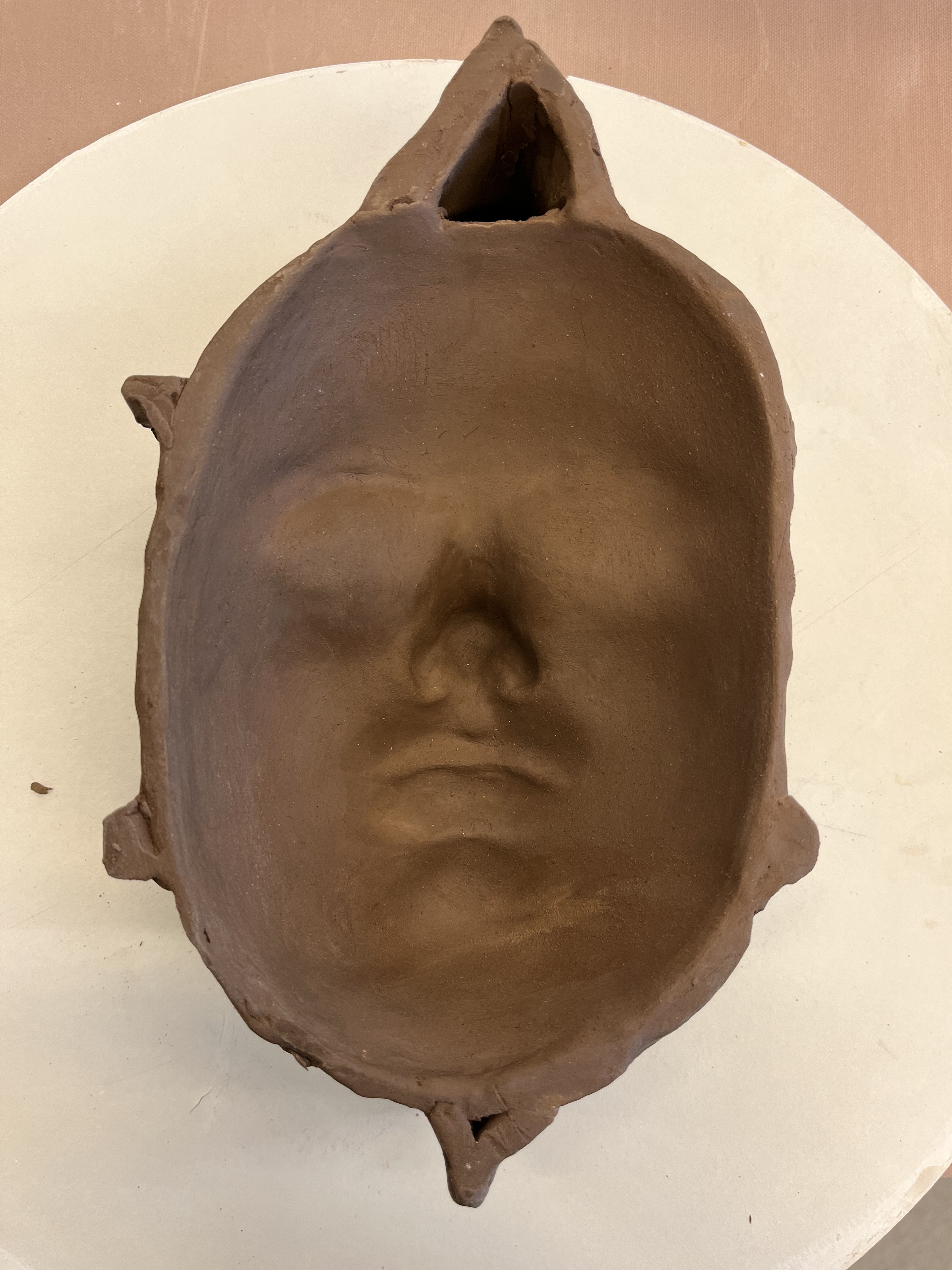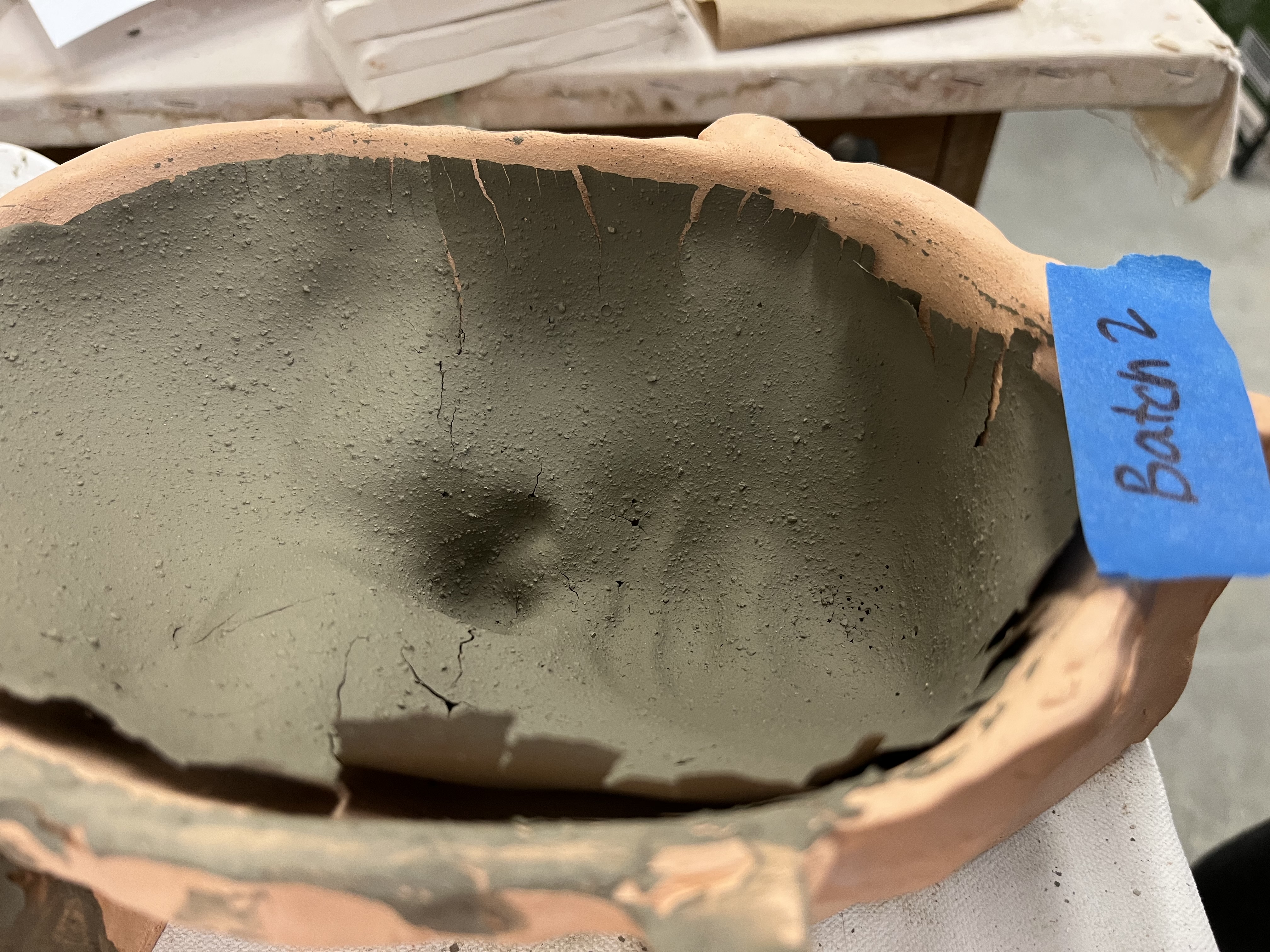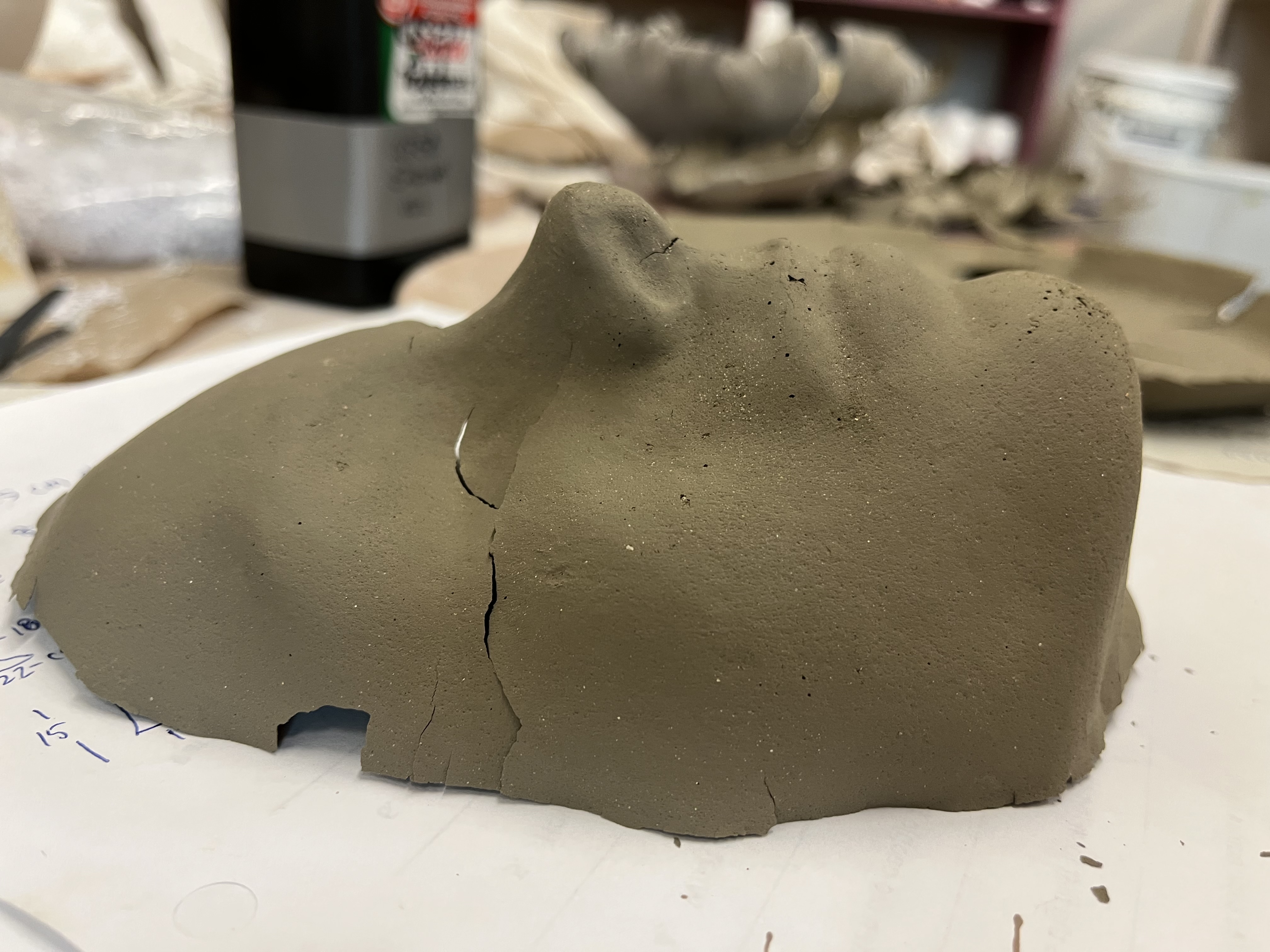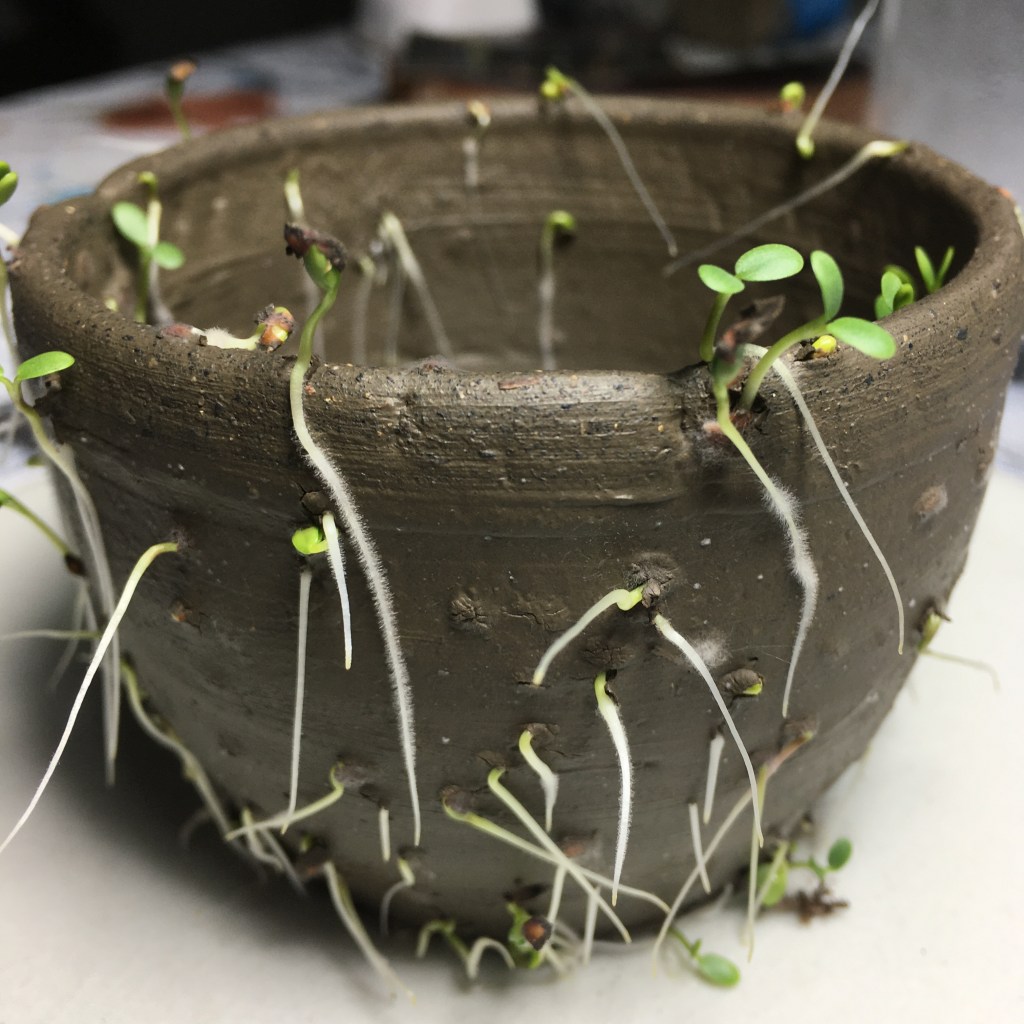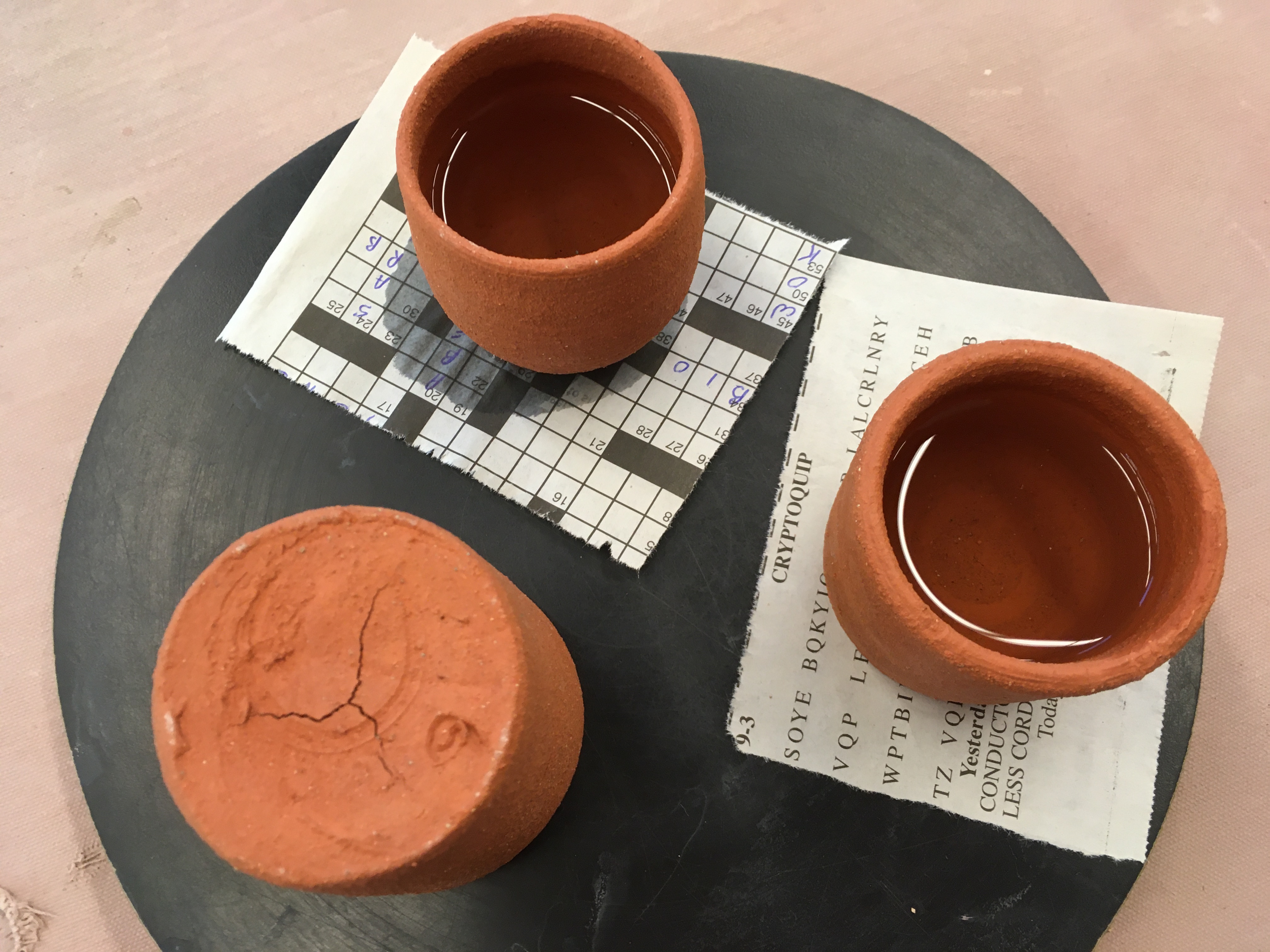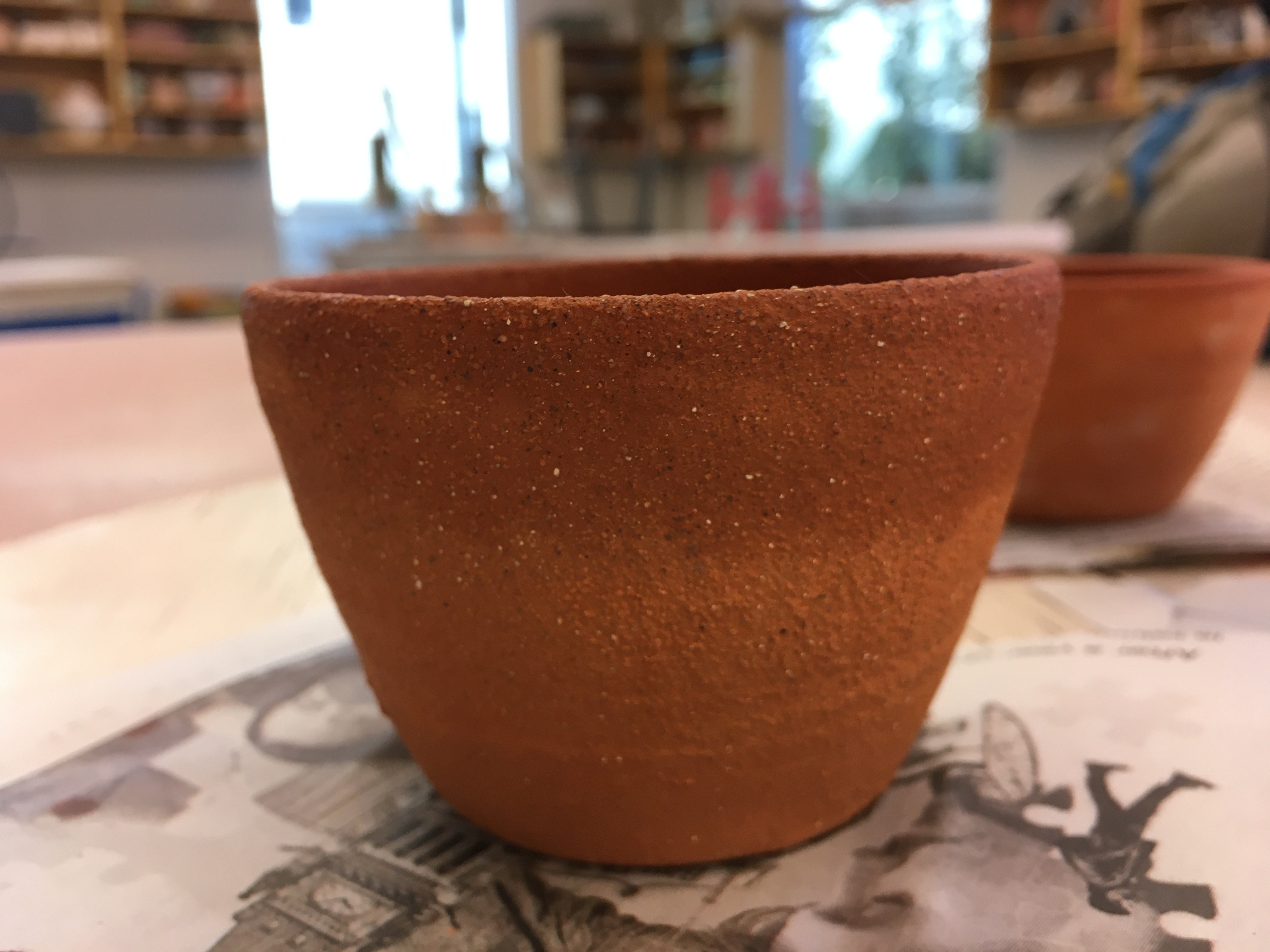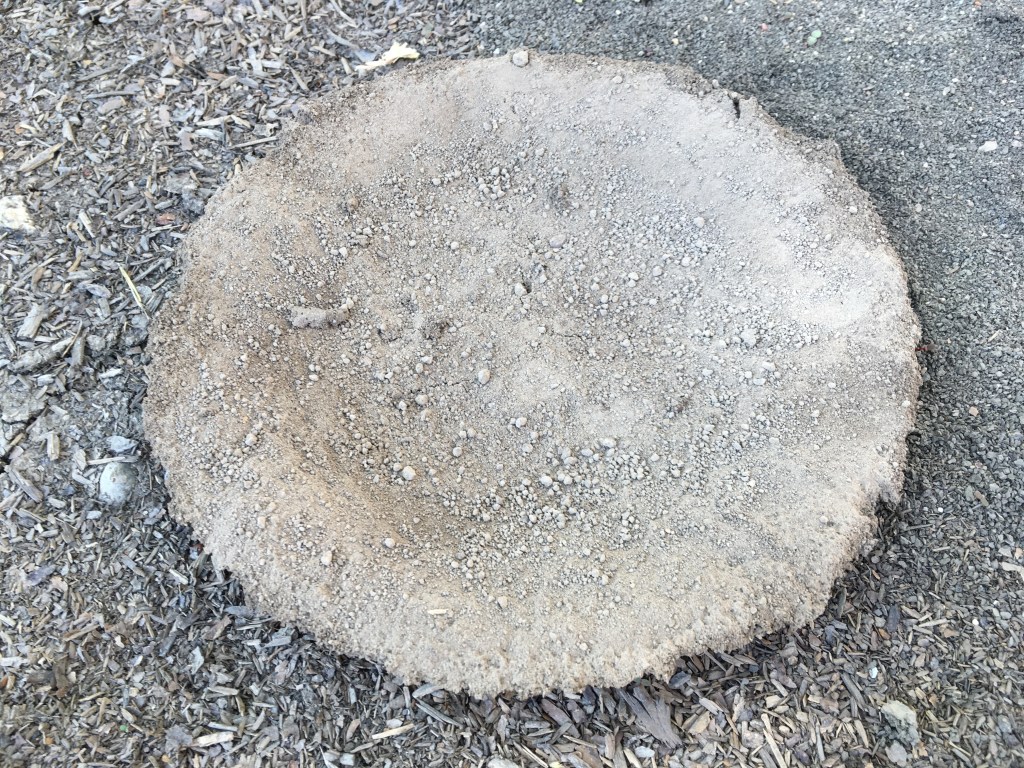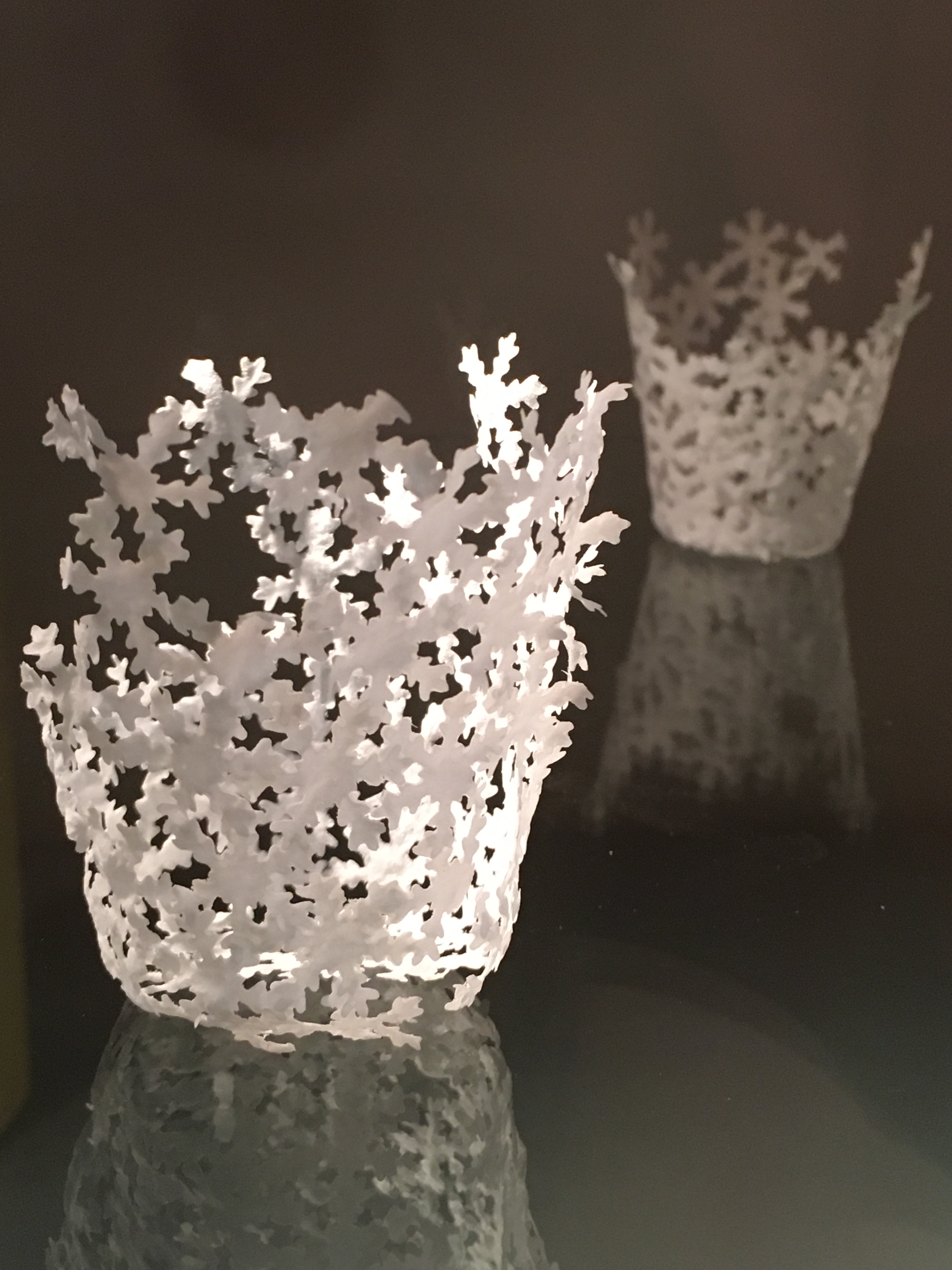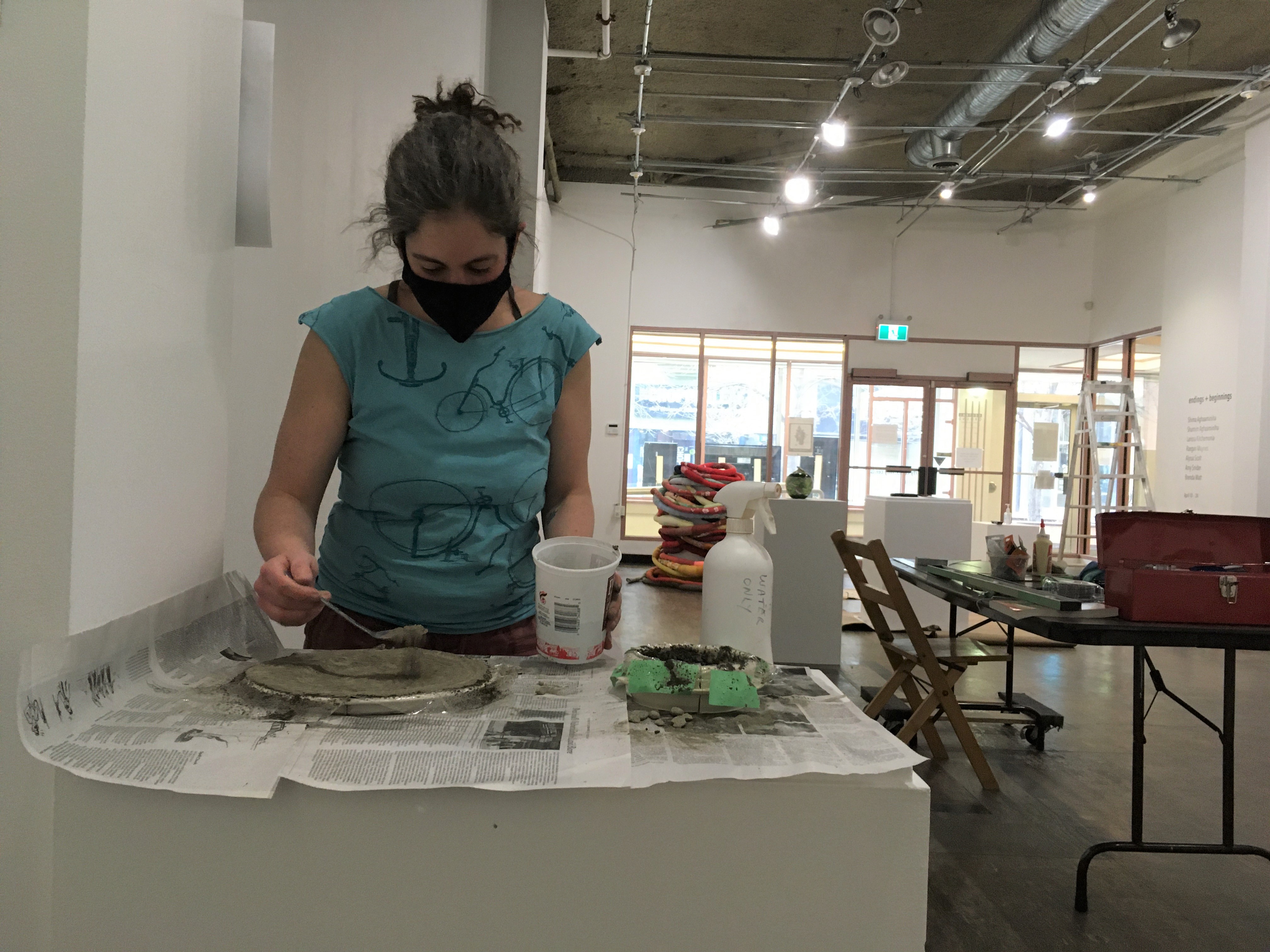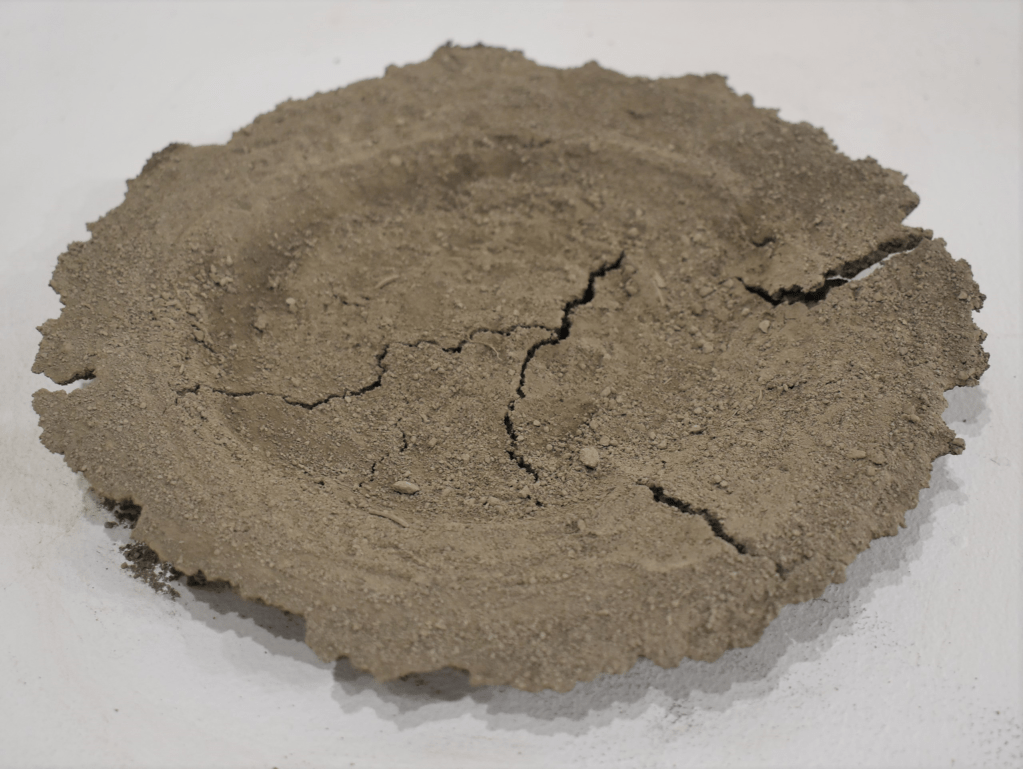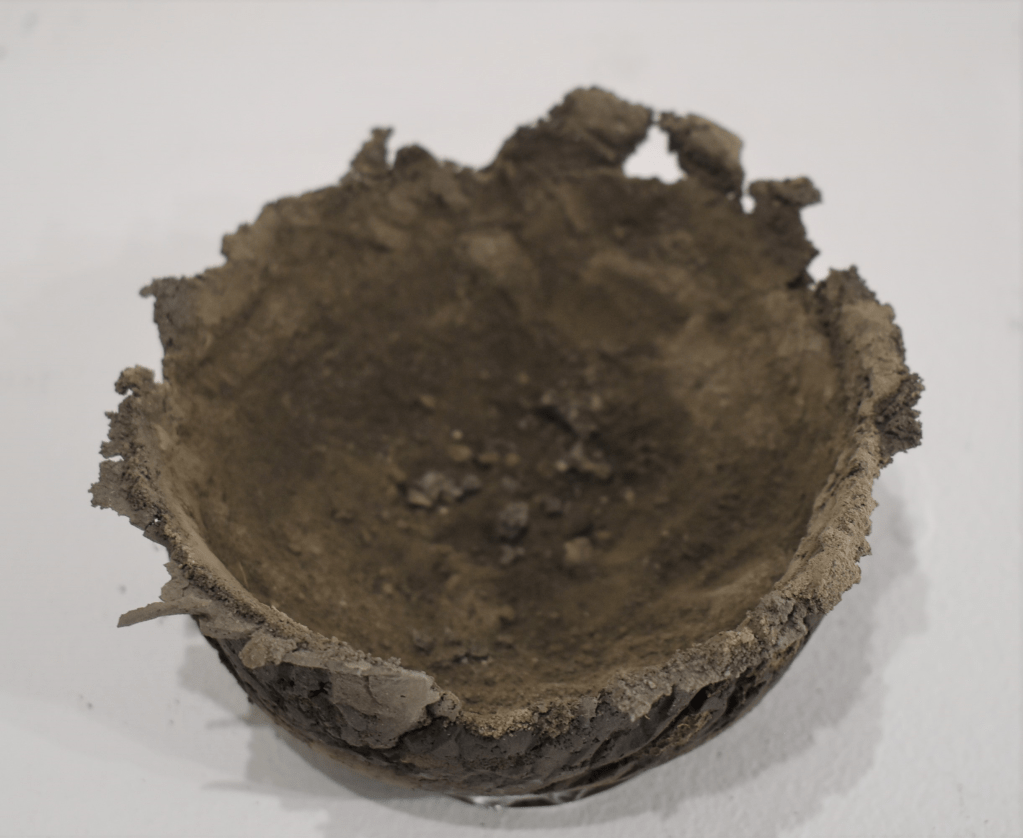
Reflections on my MFA exhibition, Crushed

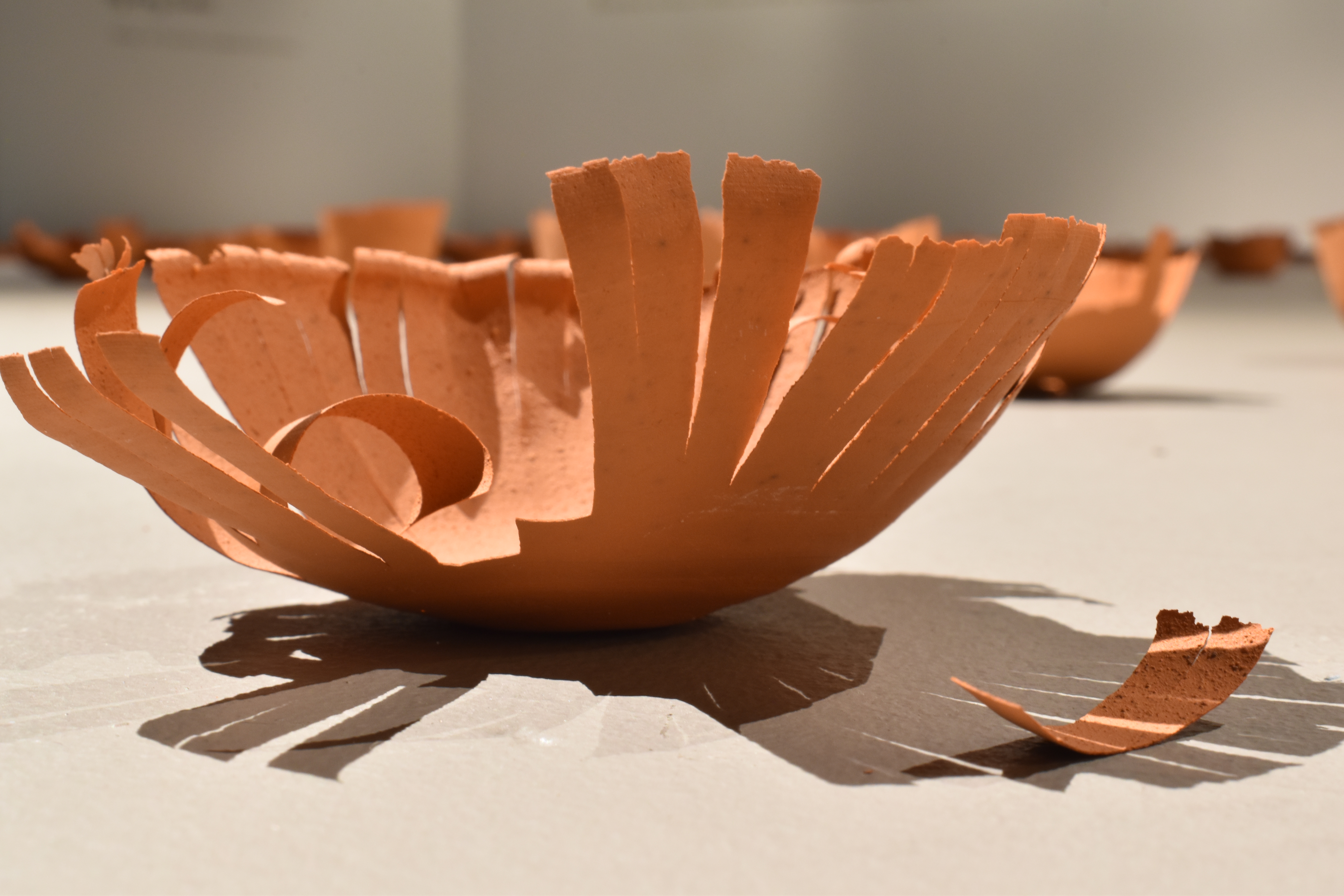
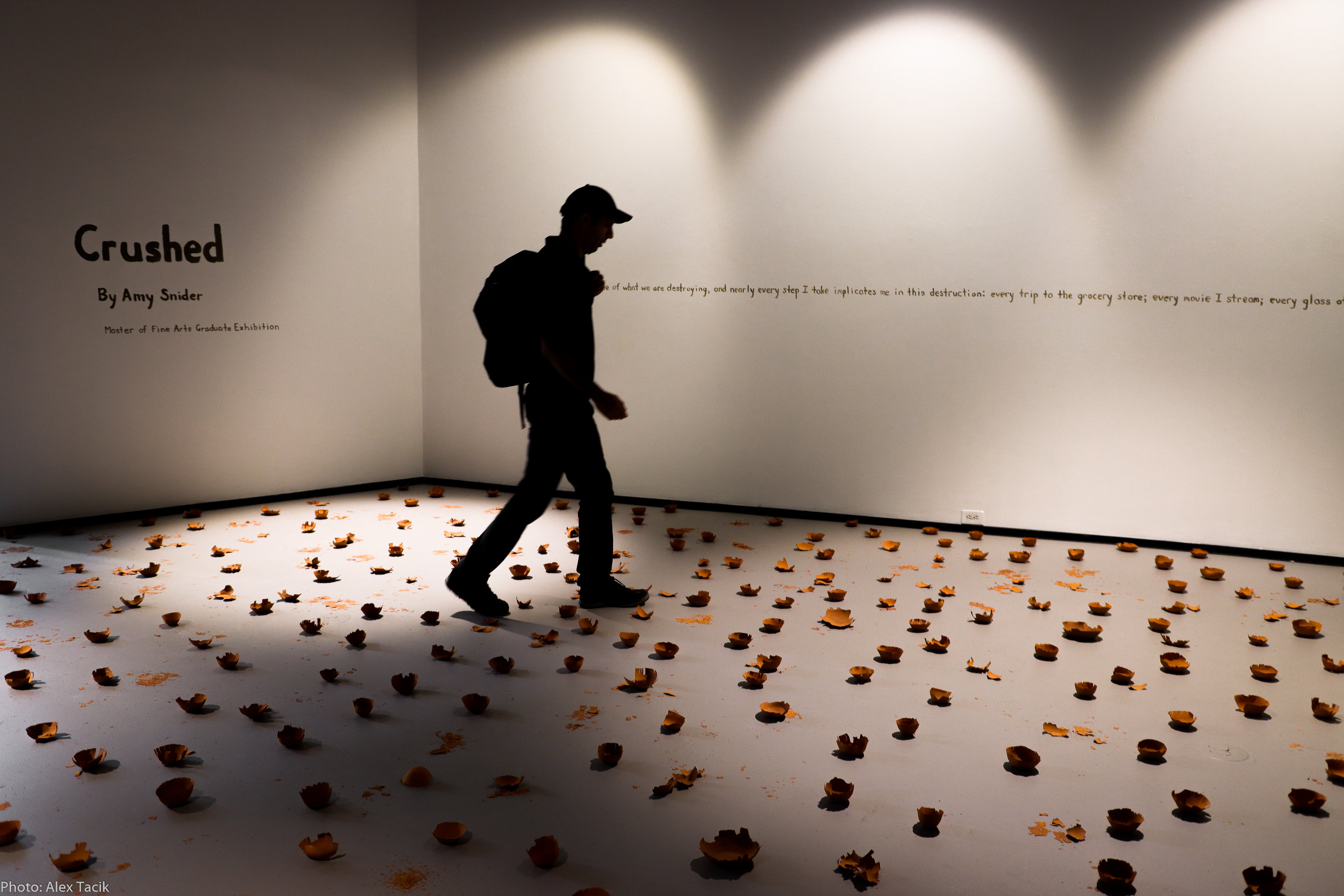
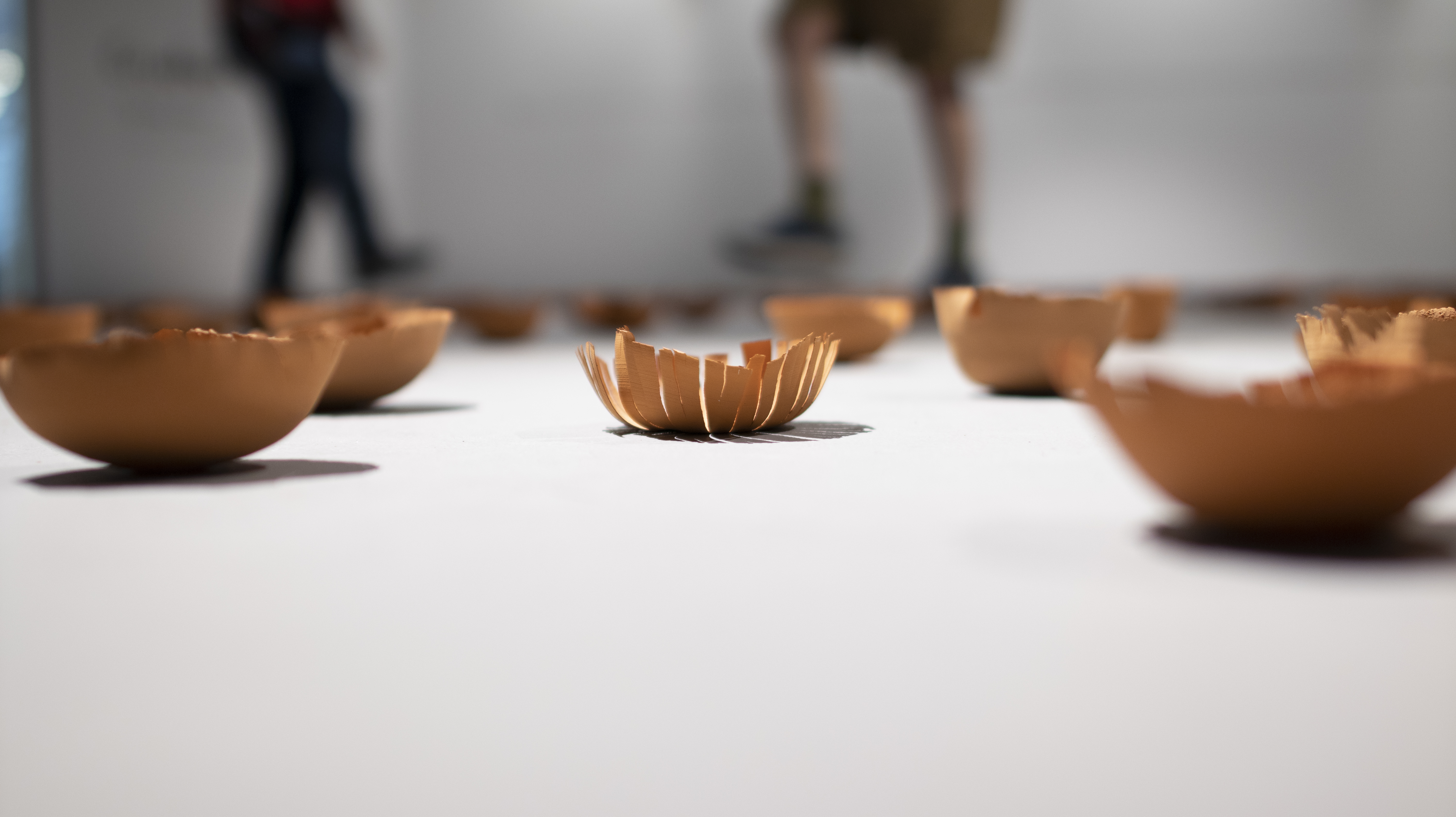
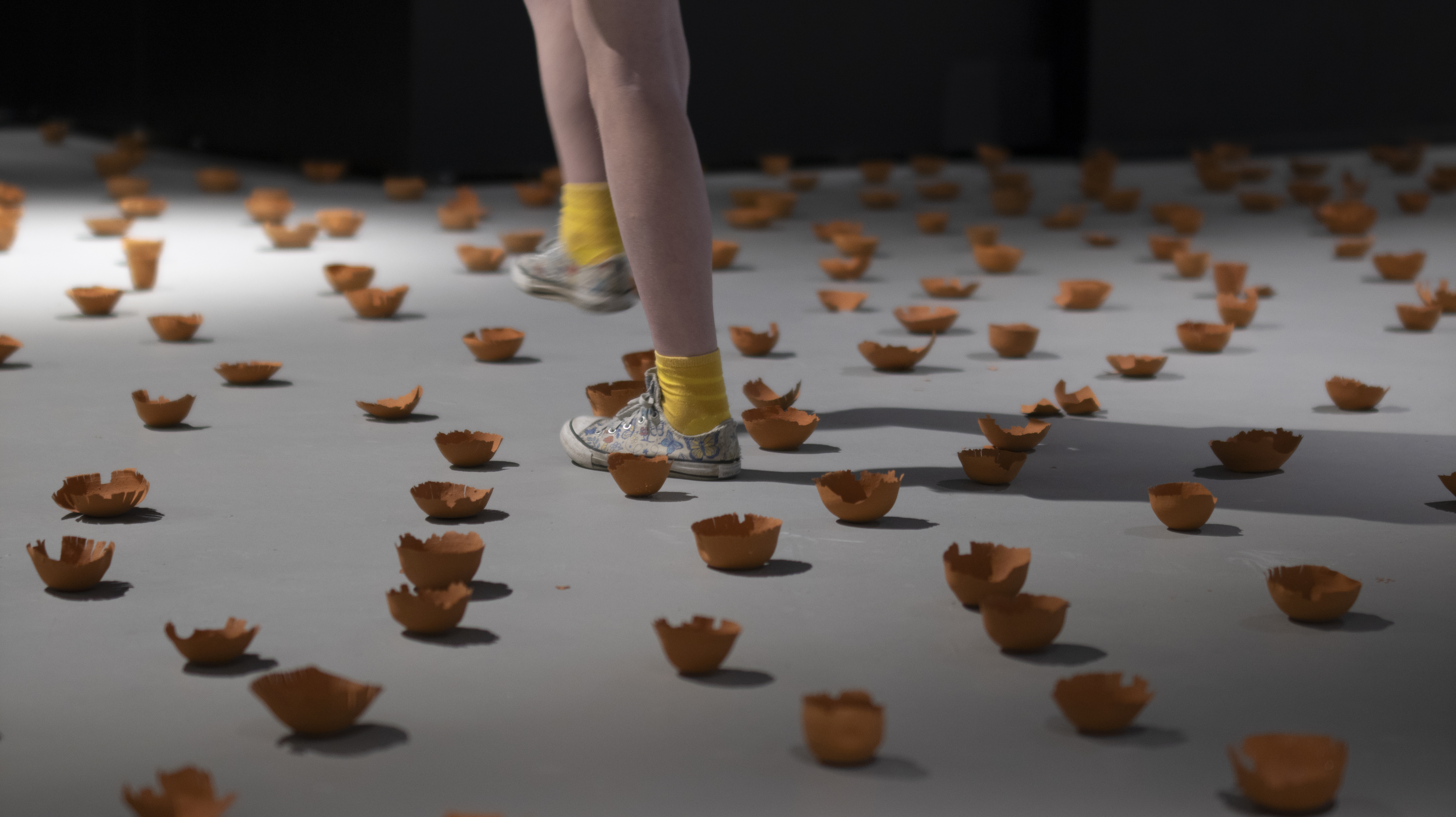
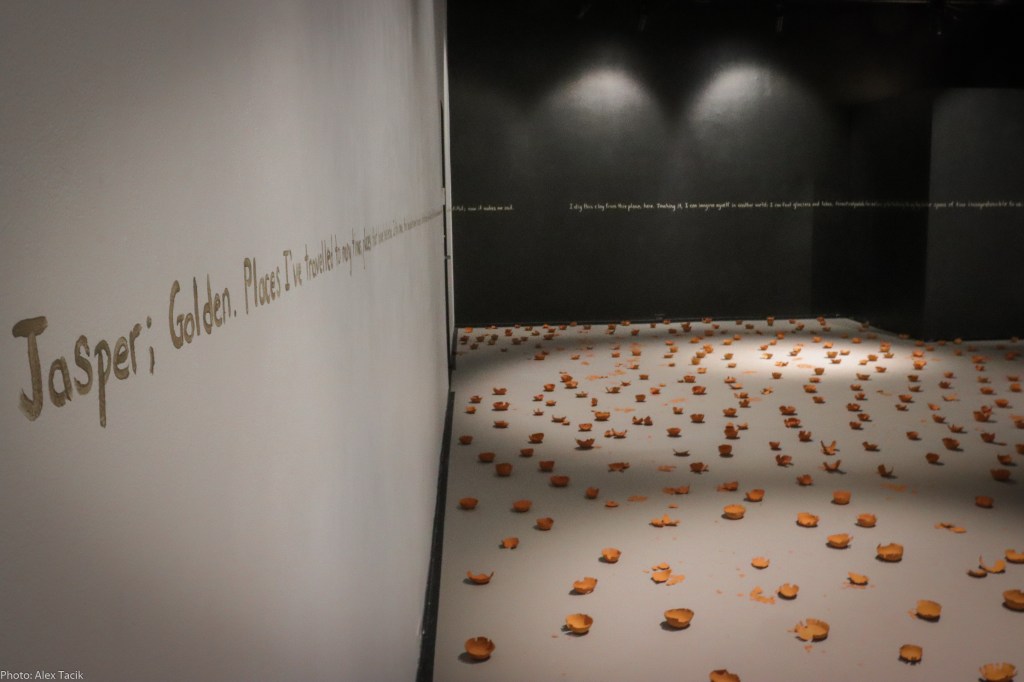
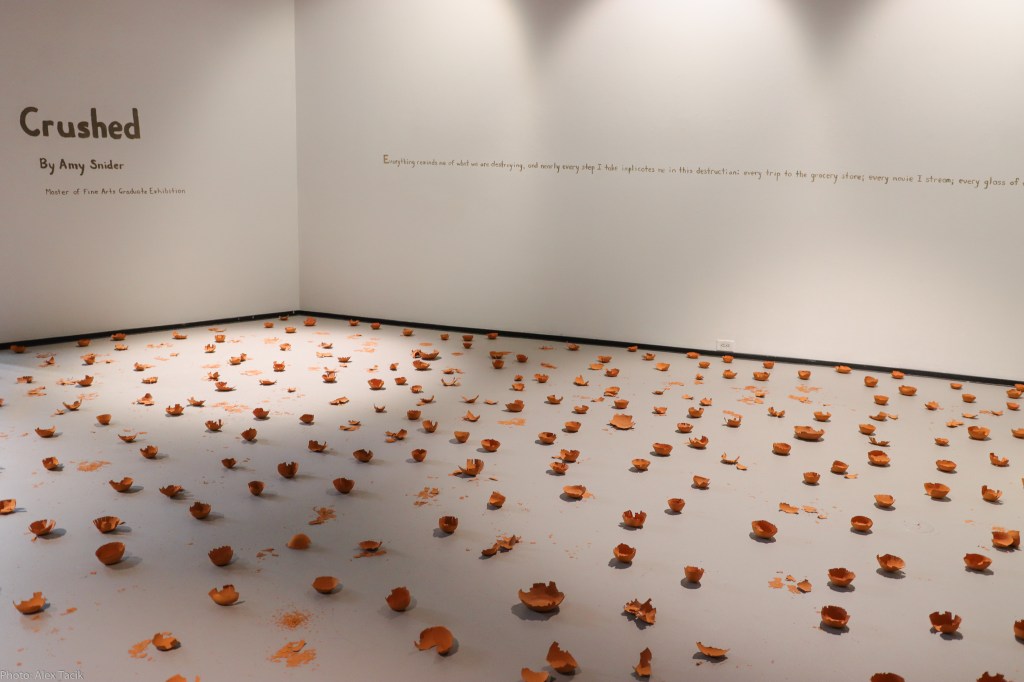
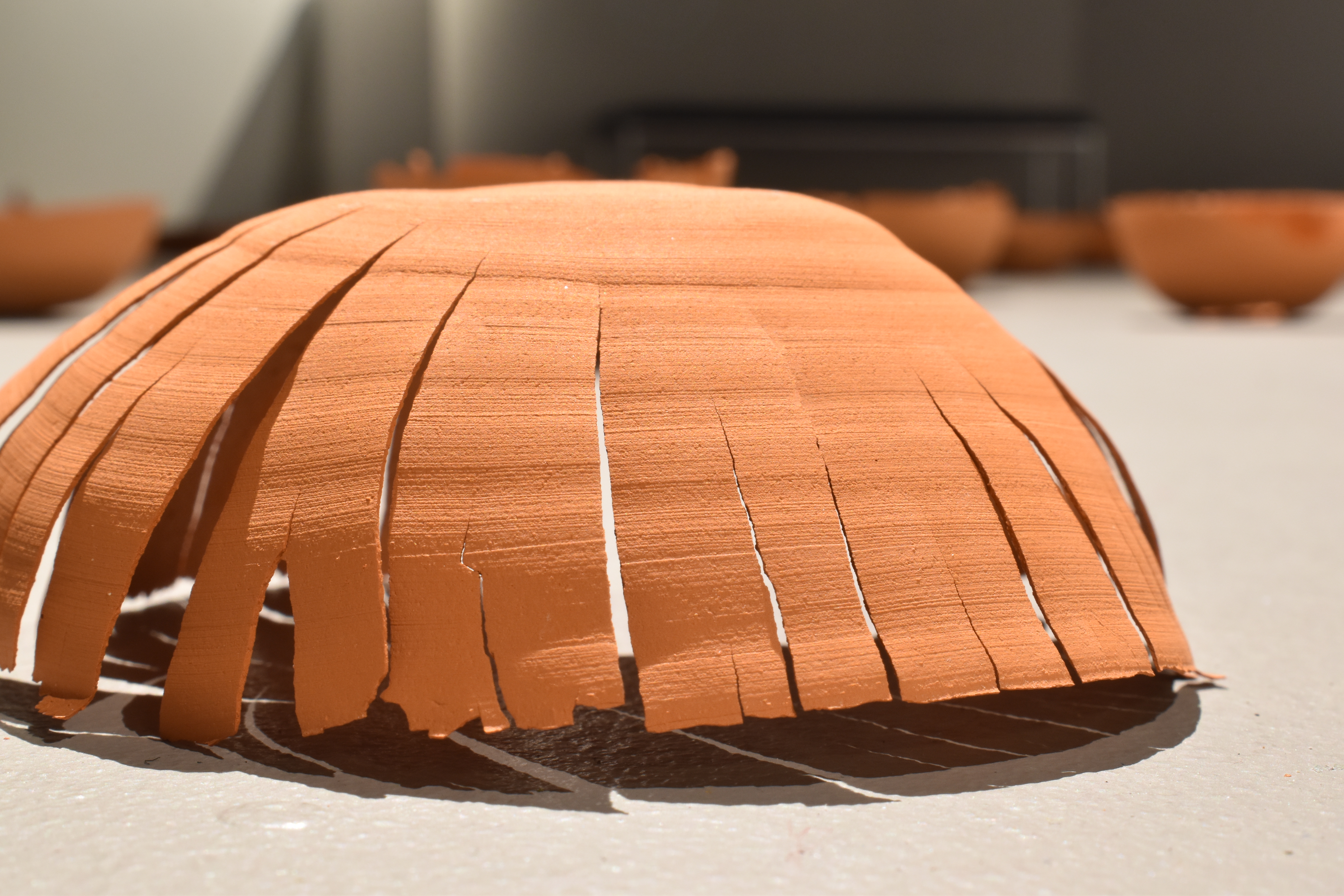
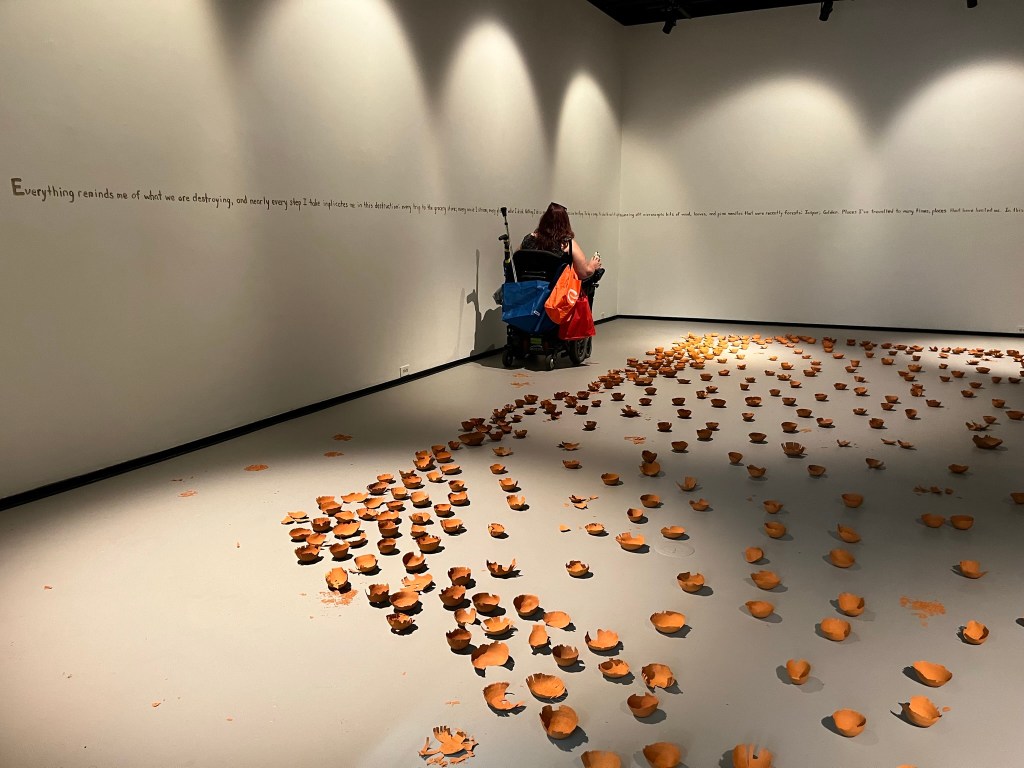
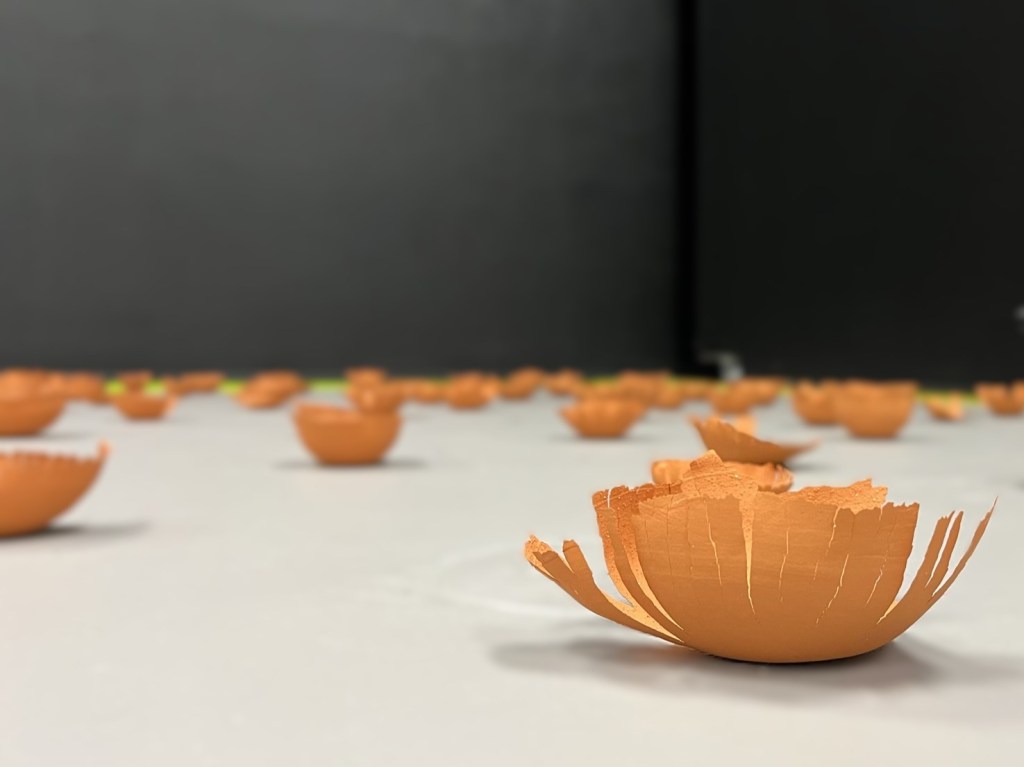
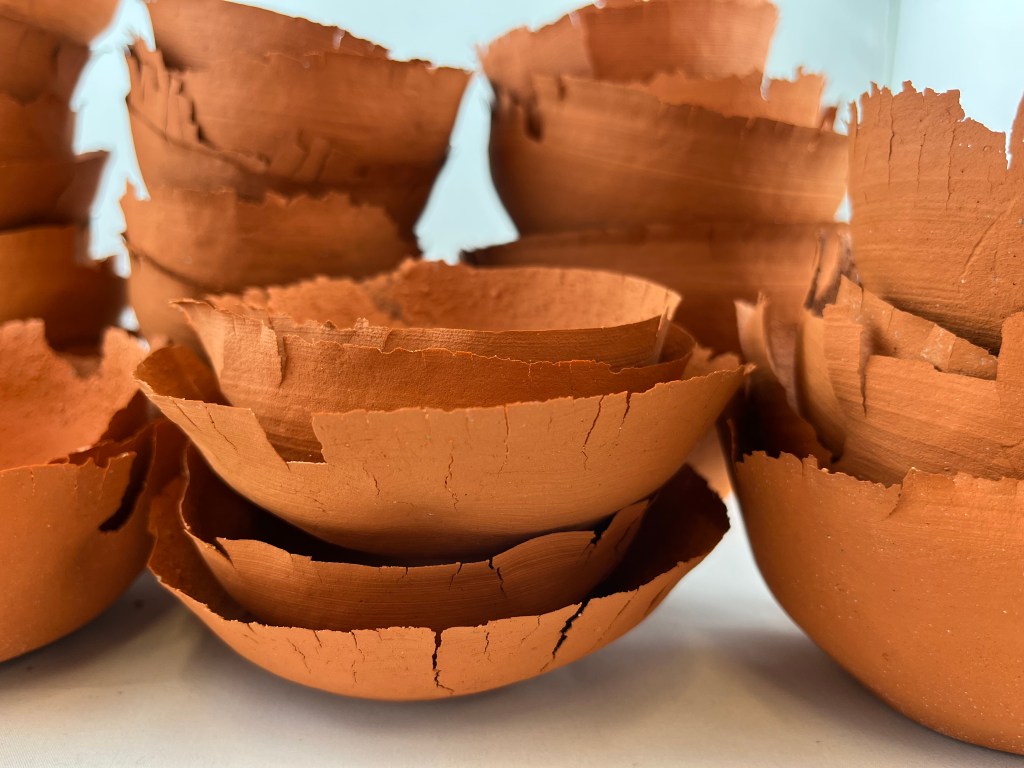
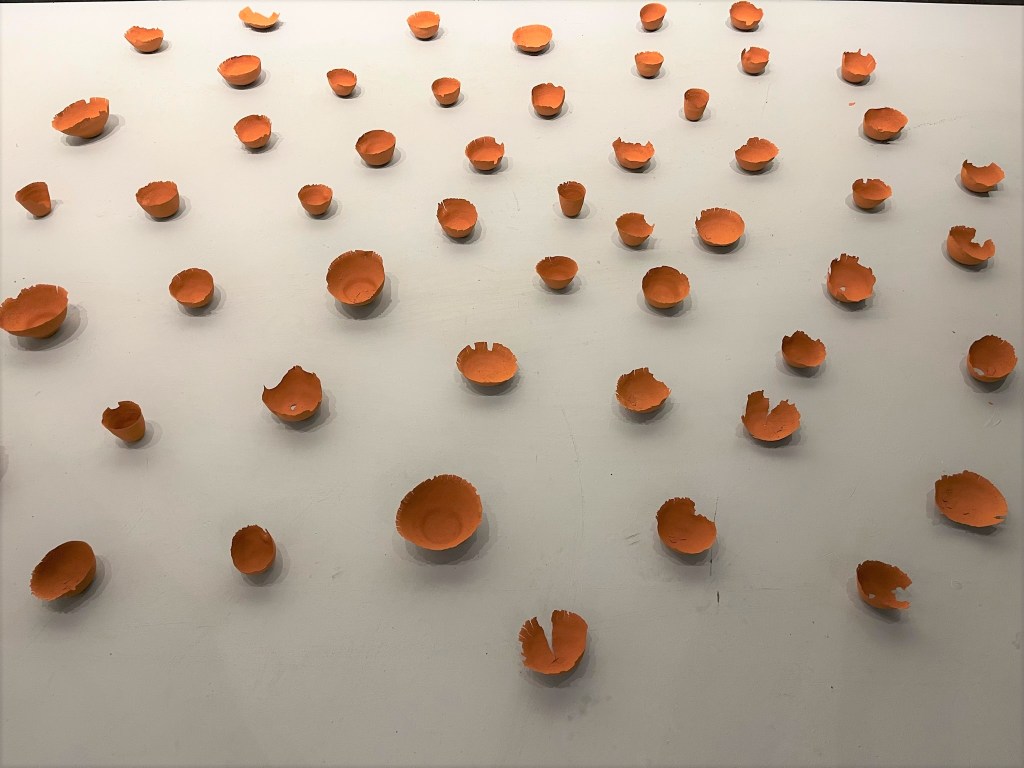
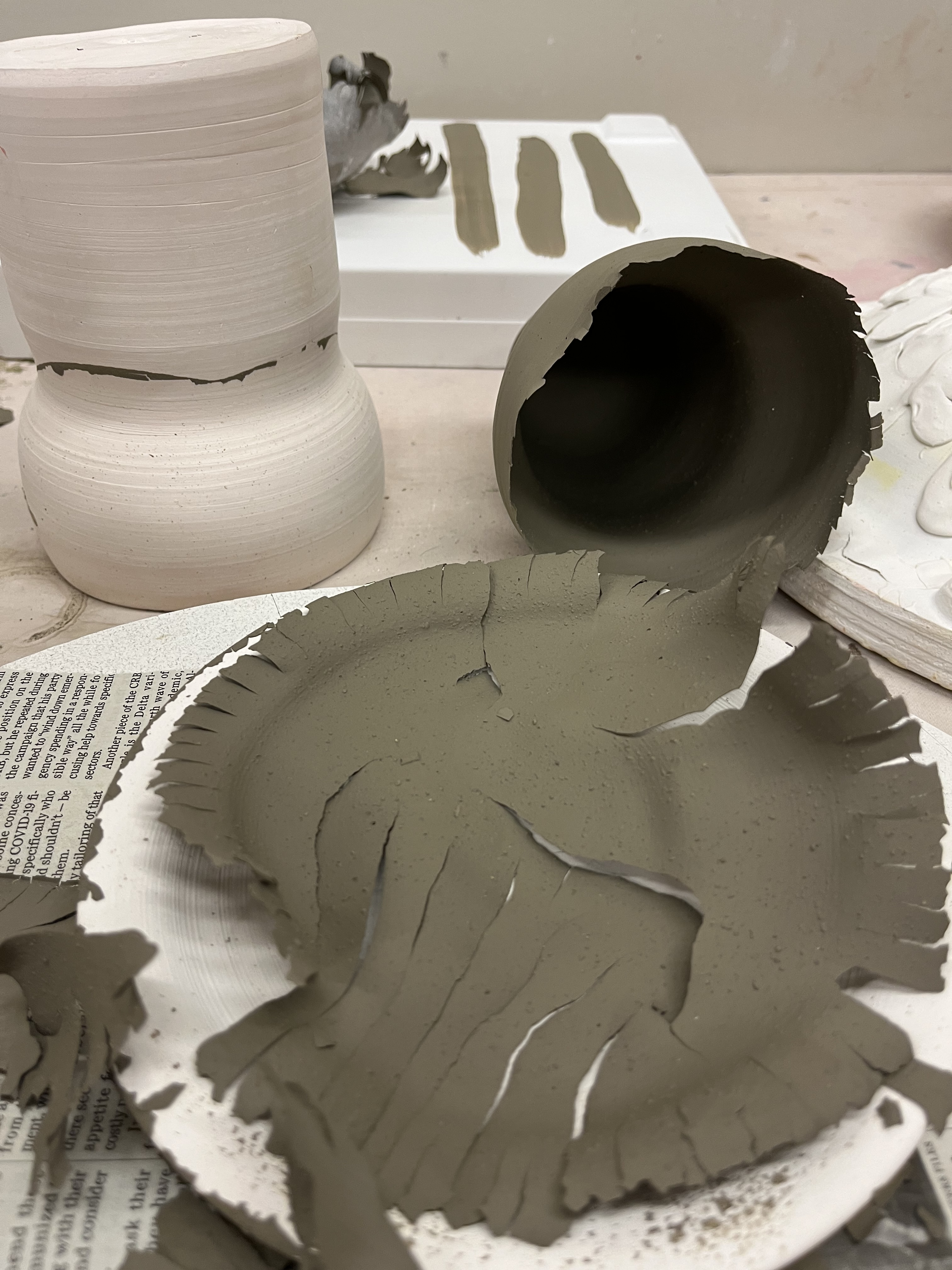
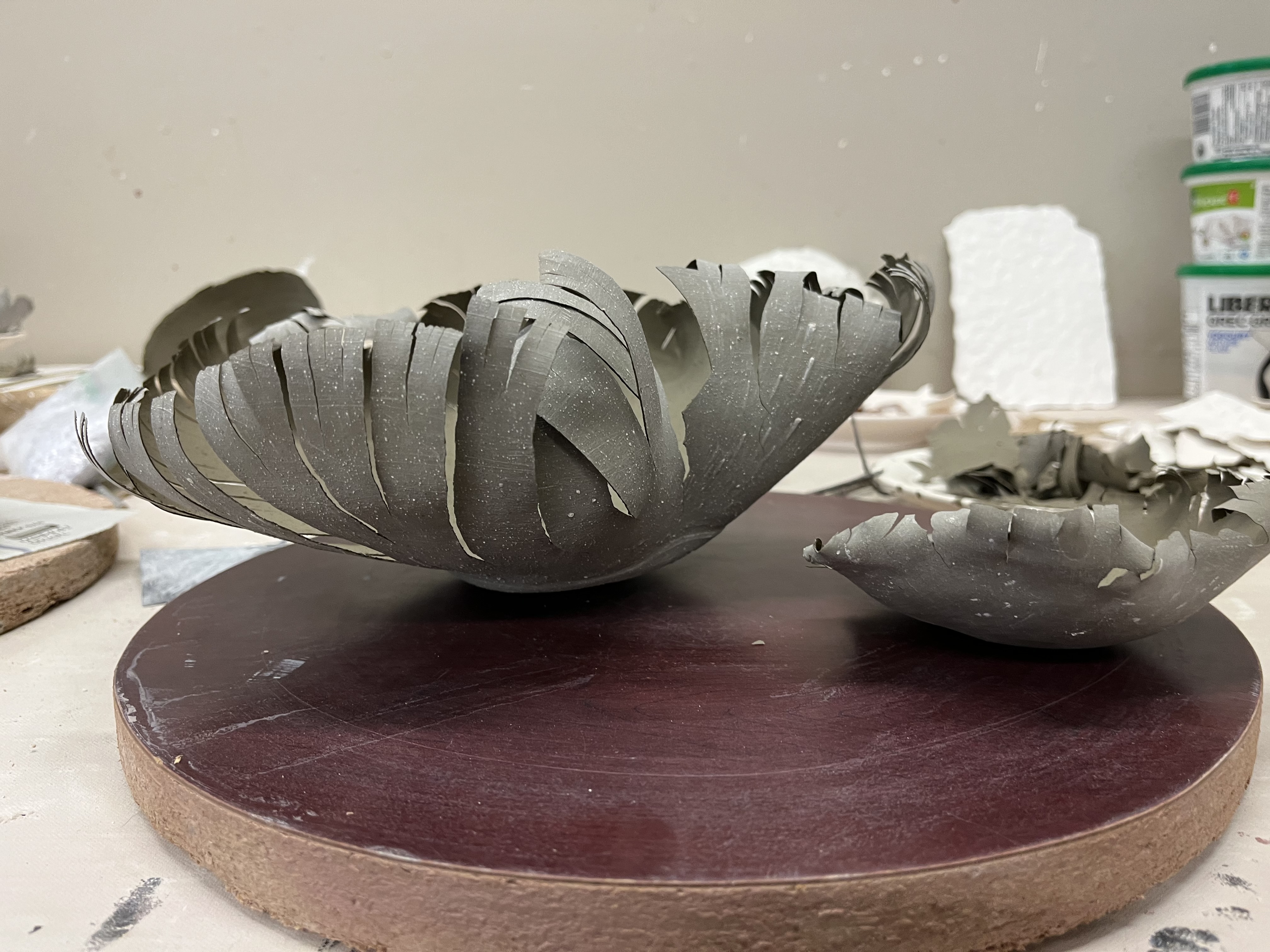
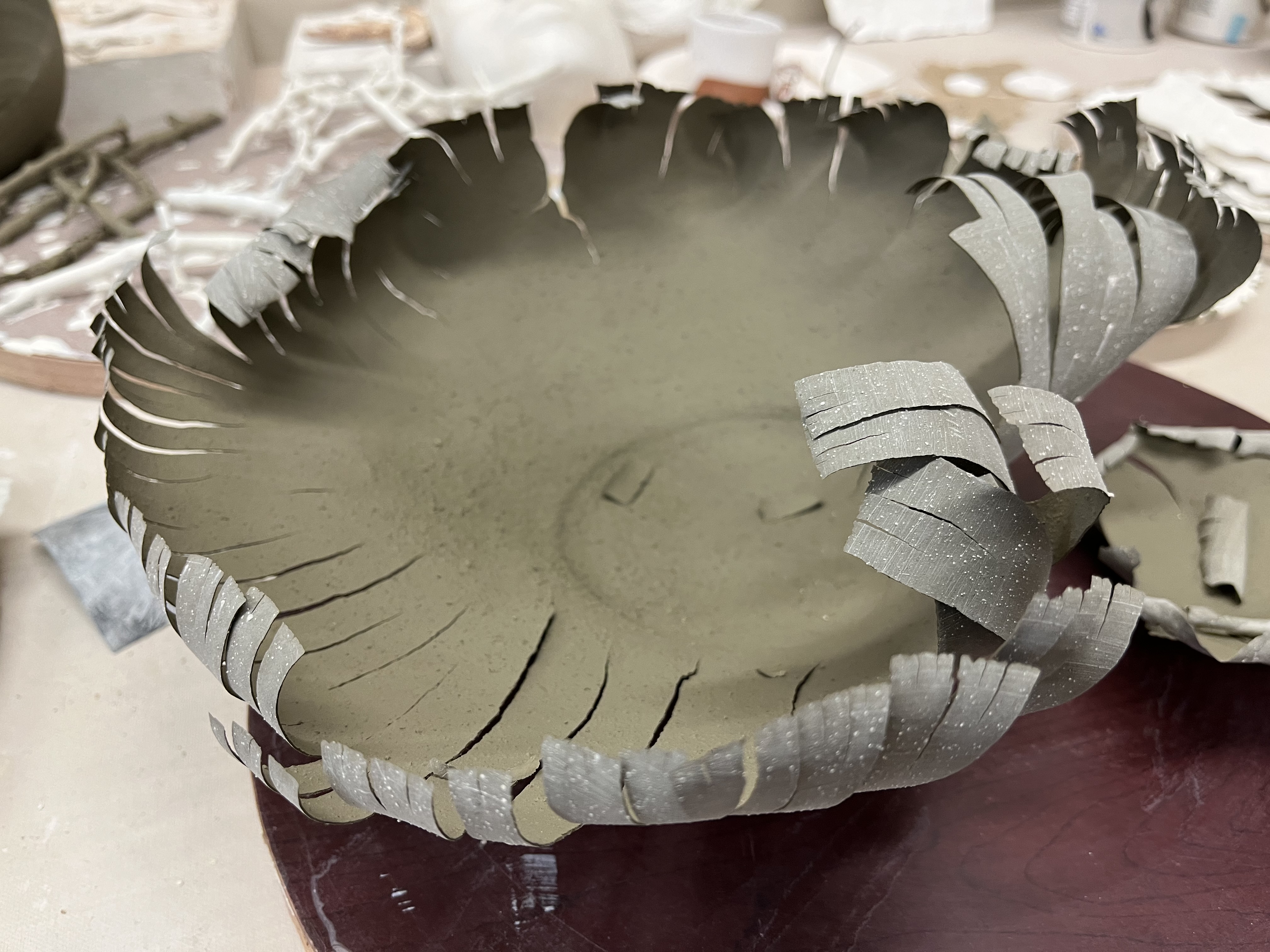
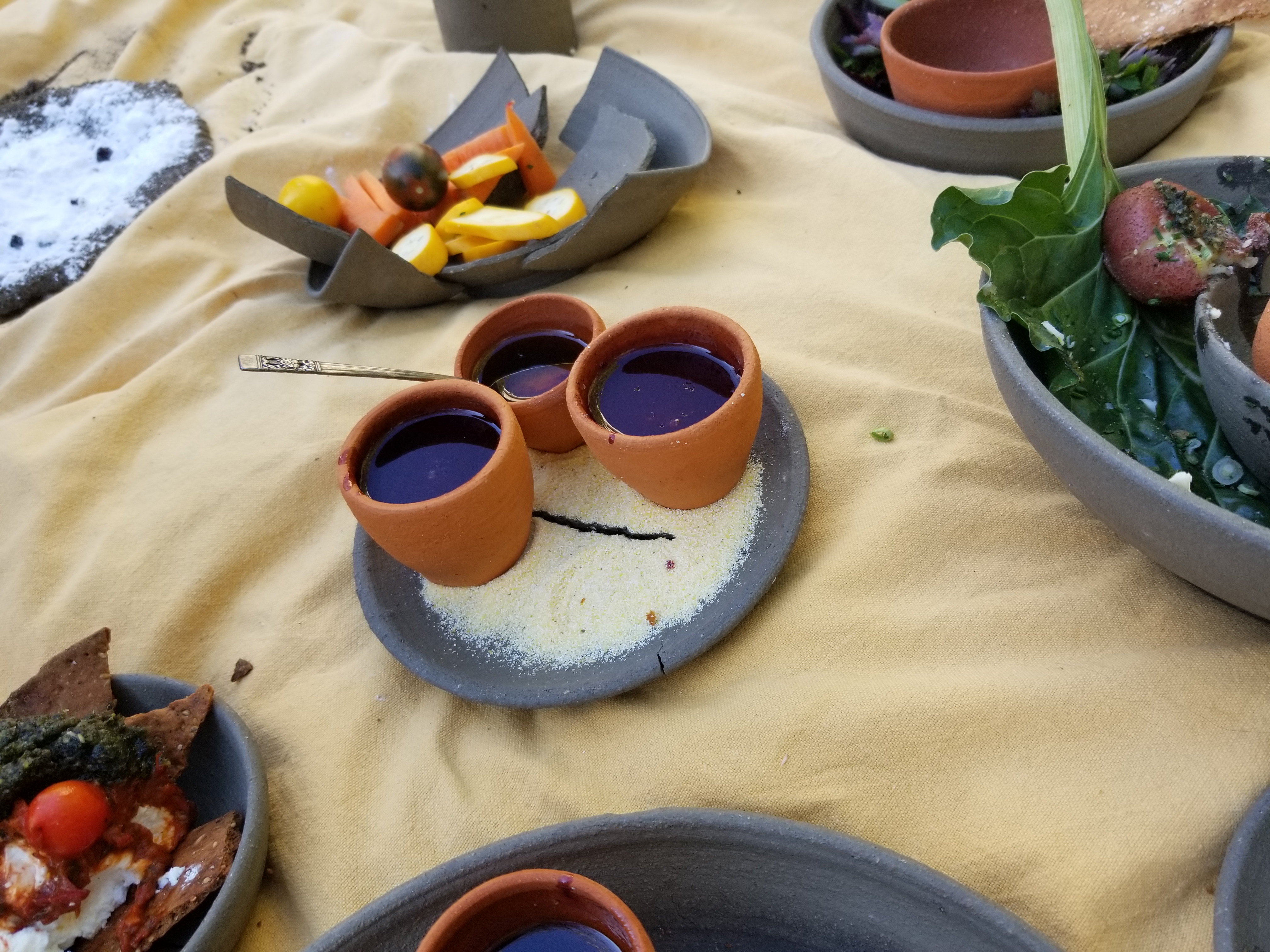
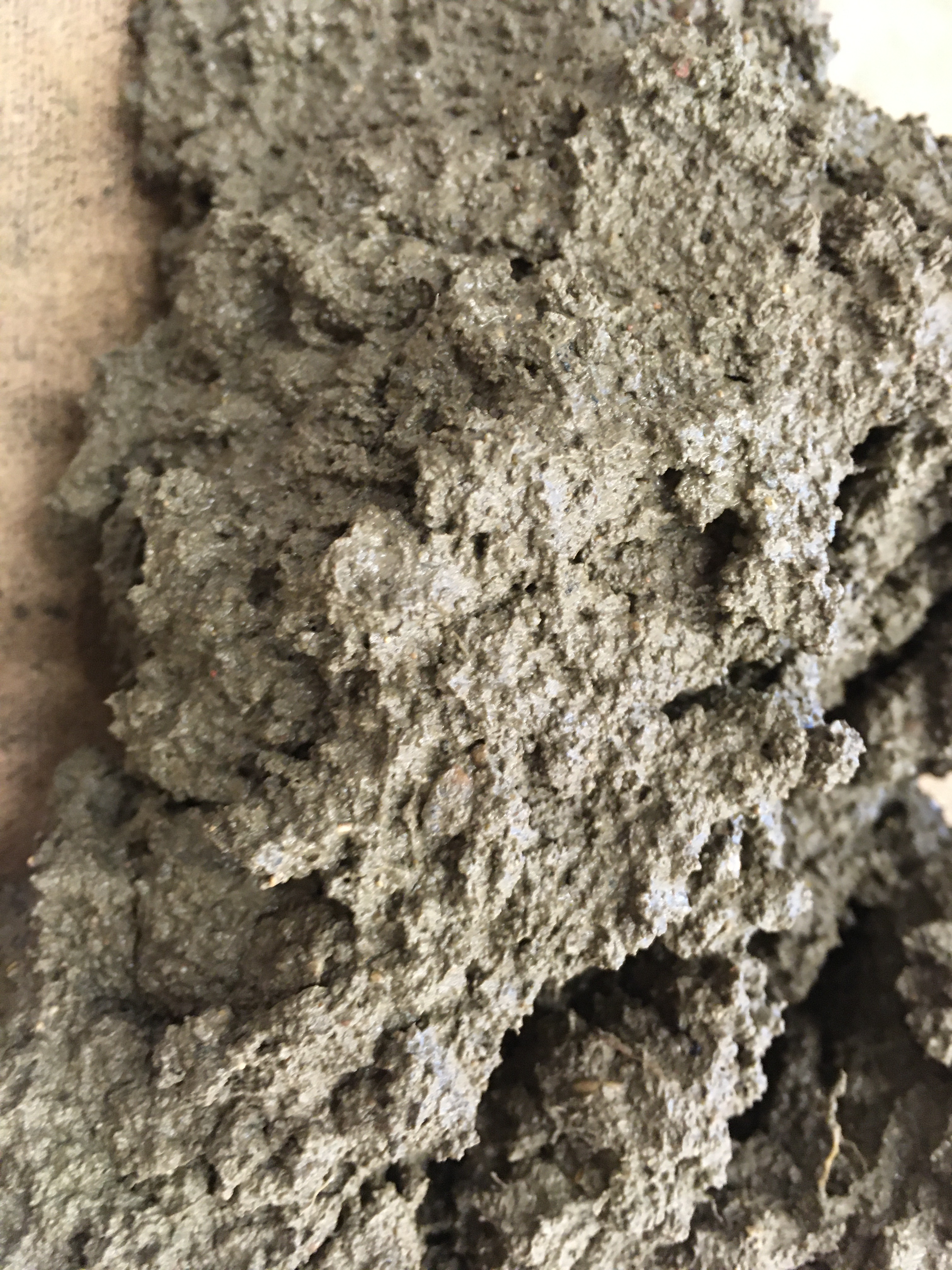
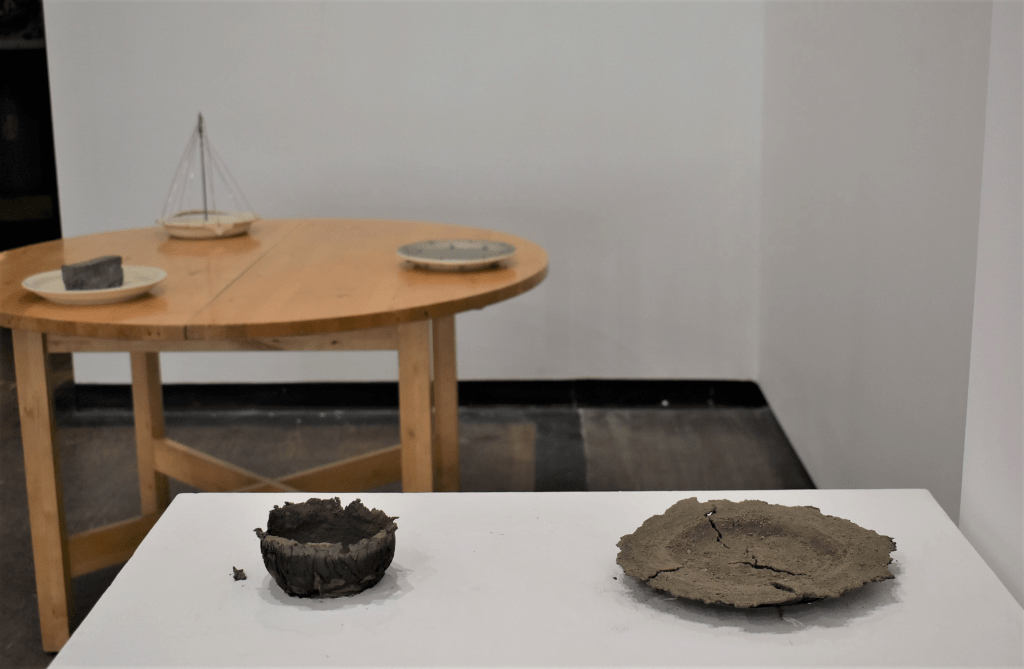
My MFA thesis exhibition, Crushed (August 2024), was a conceptual installation about climate change anxiety. The gallery floor was covered with over 2,000 eggshell thin ceramic bowls made from clay I dug up in Regina. To read a text painted onto the gallery walls with this clay, you needed to become a participant: would you step carefully between the bowls, perhaps tiptoeing or raising your pant cuffs? Or would you stomp ahead, satisfied by the sound of shattering ceramic beneath your feet? What would you leave behind for others?

The wall text circling the gallery read:

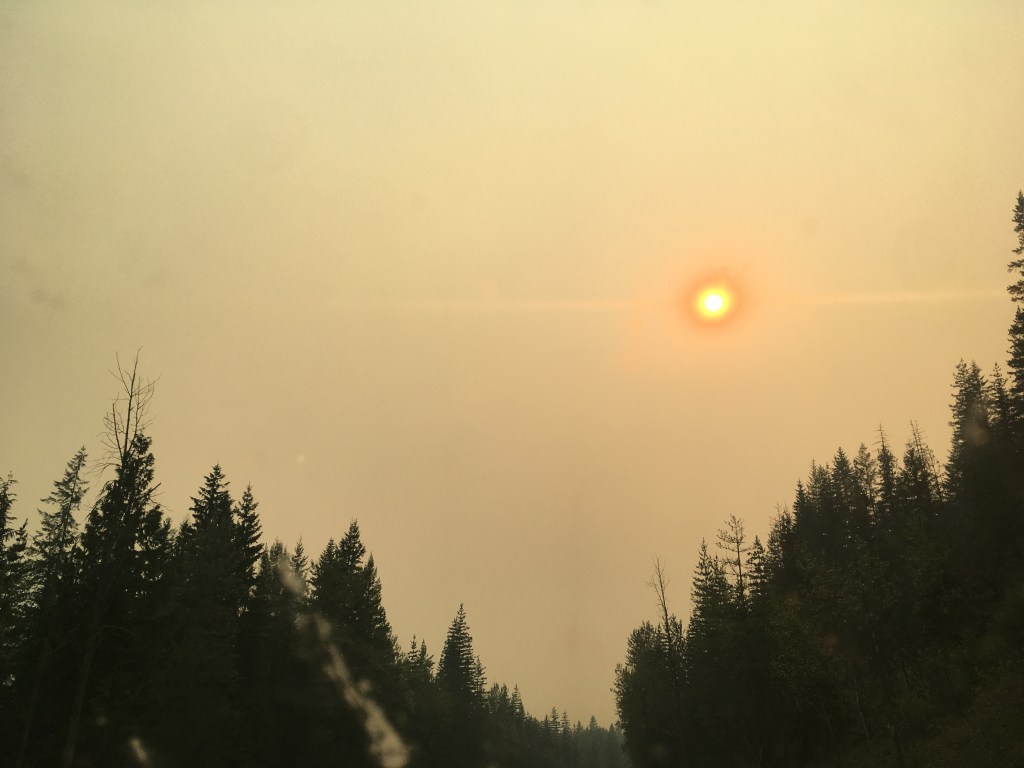
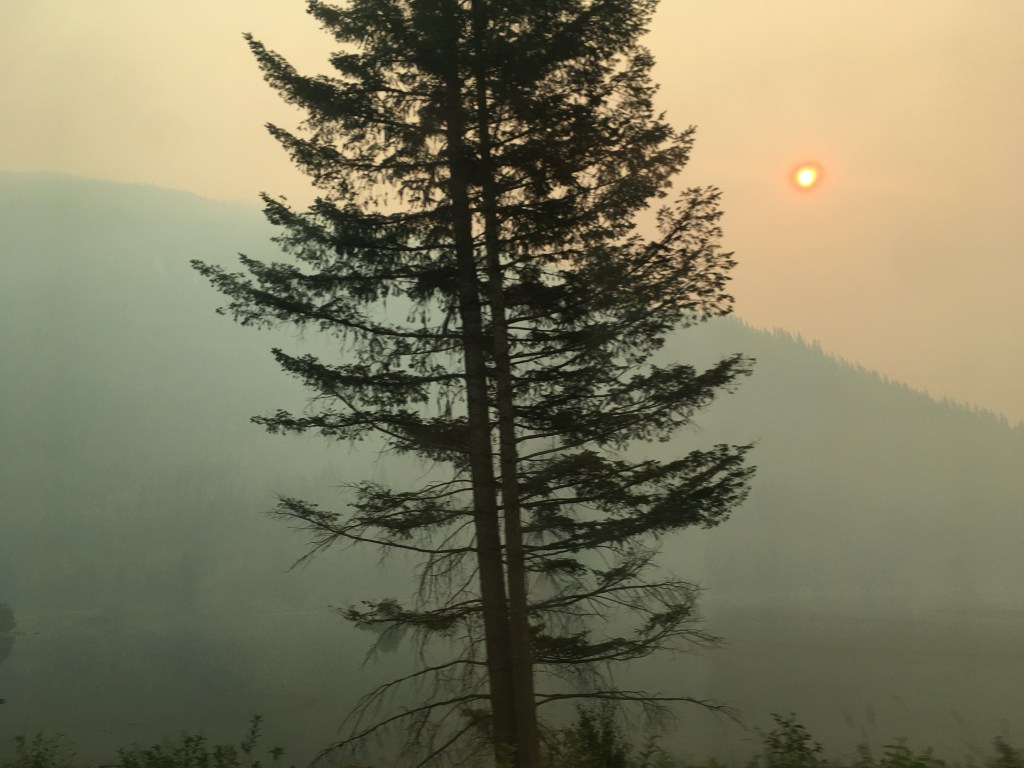
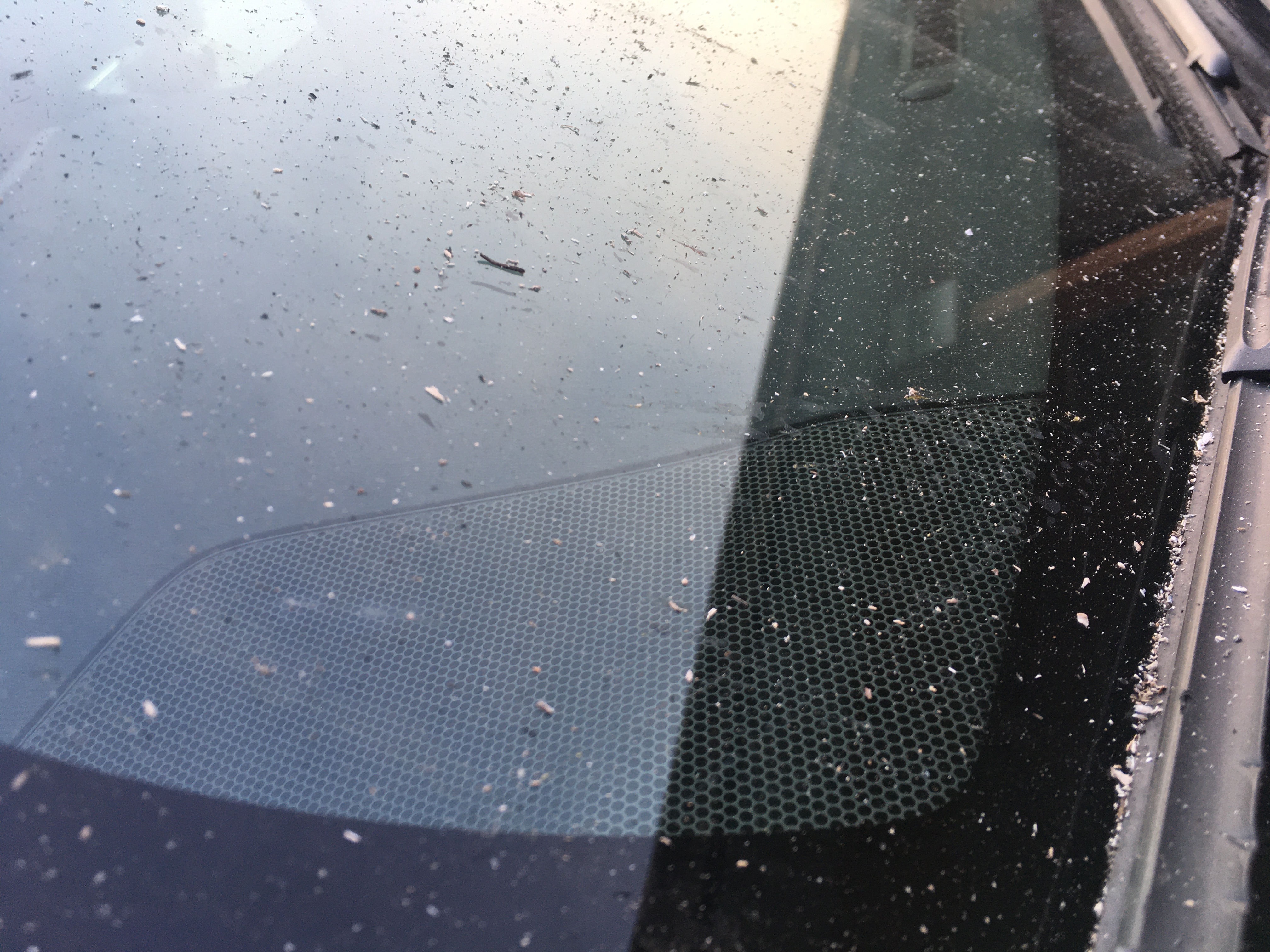
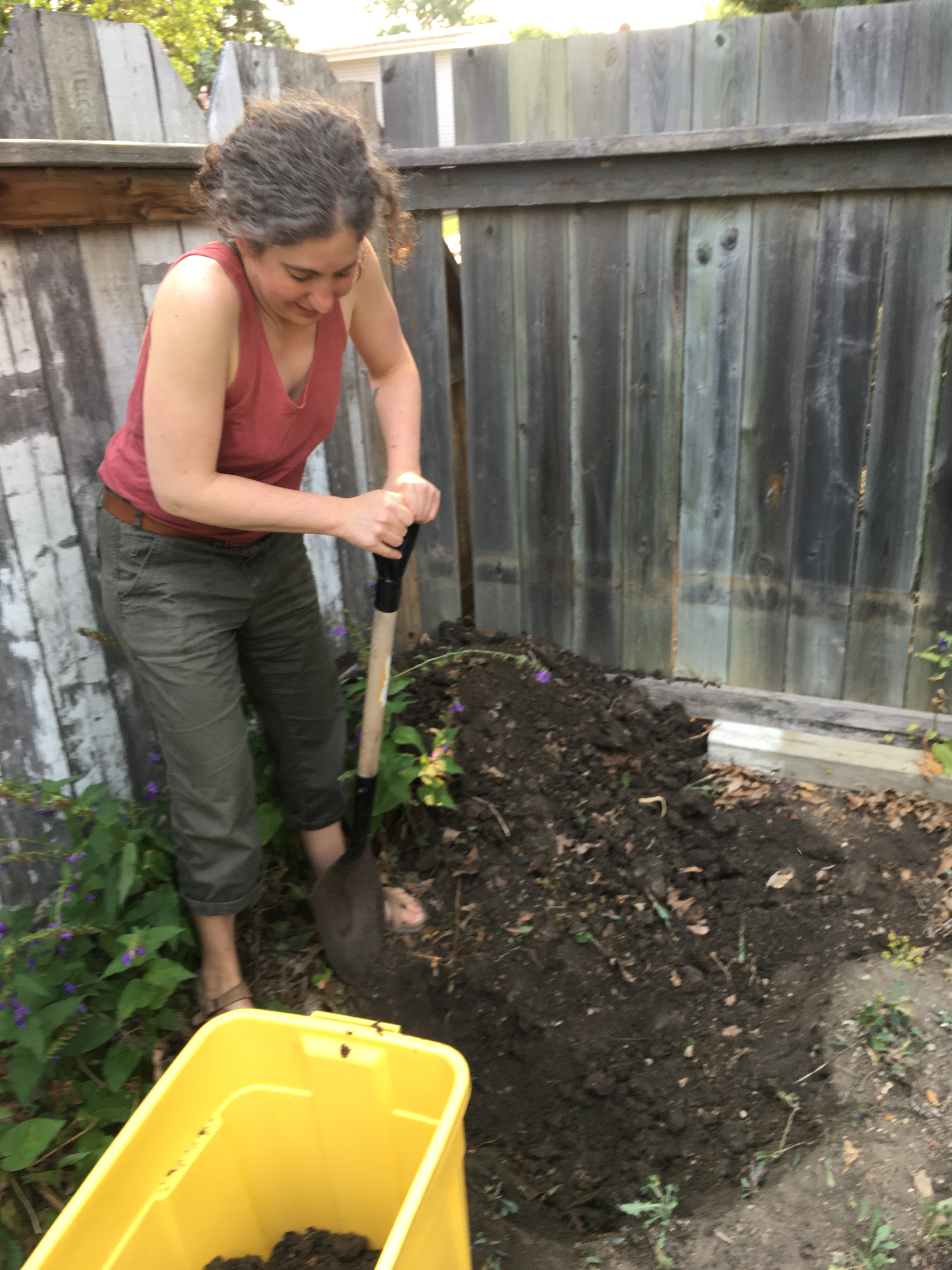
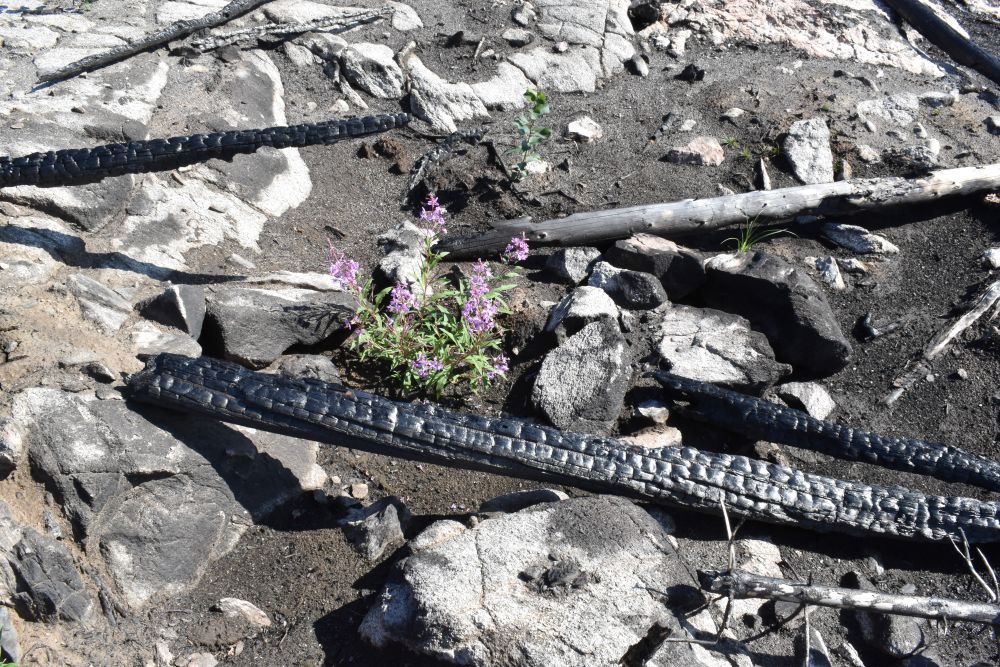
Everything reminds me of what we are destroying, and nearly every step I take implicates me in this destruction: every trip to the grocery store; every movie I stream; every glass of water I drink. Nothing I do is innocent, and the consequences are terrifying. The sky is orange, its colour the result of light bouncing off microscopic bits of wood, leaves, and pine needles that were recently forests: Jasper; Golden. Places I’ve travelled to many times, places that have healed me. In this smoke, their molecules travel to me here. Is that burnt warbler I smell? Was it scared? Did it hurt? I’m grateful to have a home to protect me from this toxic air, but what of the birds in my backyard? Birdsong used to be beautiful; now it makes me sad. I dig clay from this place, here. Touching it, I can imagine myself in another world; I can feel glaciers and lakes, forests and grasslands, flora and fauna, systems functioning the way they had for spans of time incomprehensible to us. What should I make from this clay, today, from within these broken systems? Nothing that will last. Everything reminds me of what we are destroying, and everything I create is a part of this destruction. Nevertheless, I am driven to create.

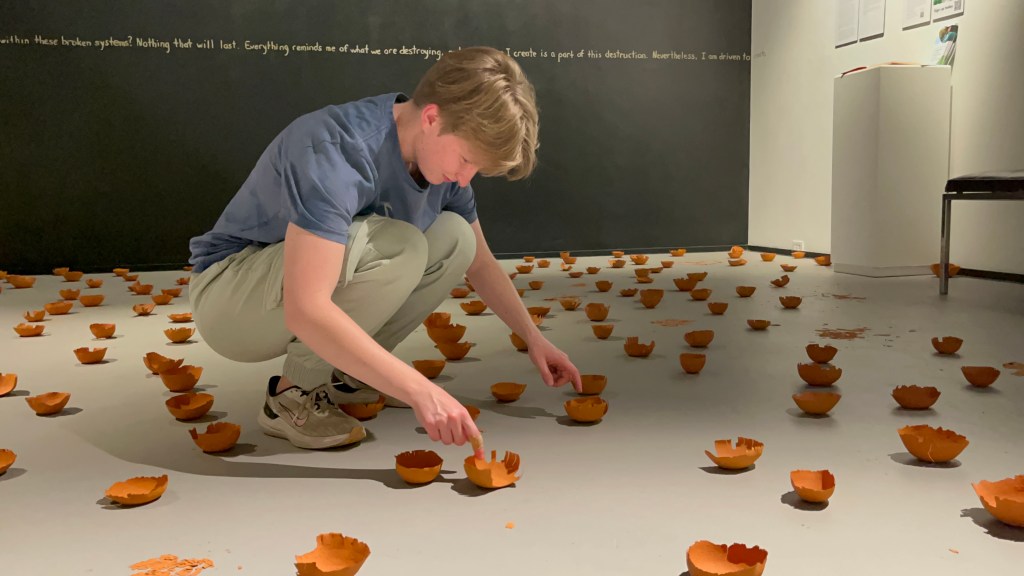
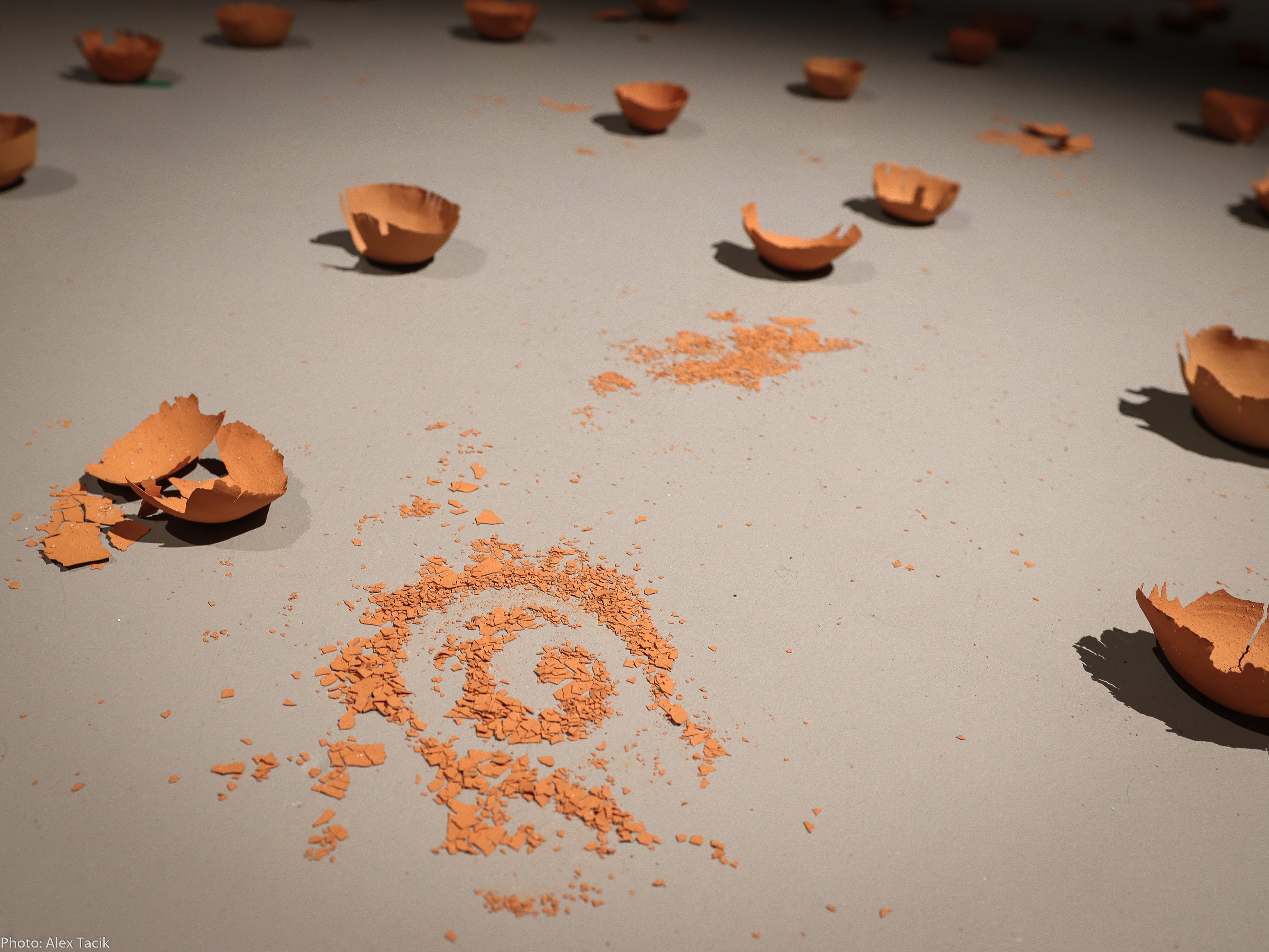
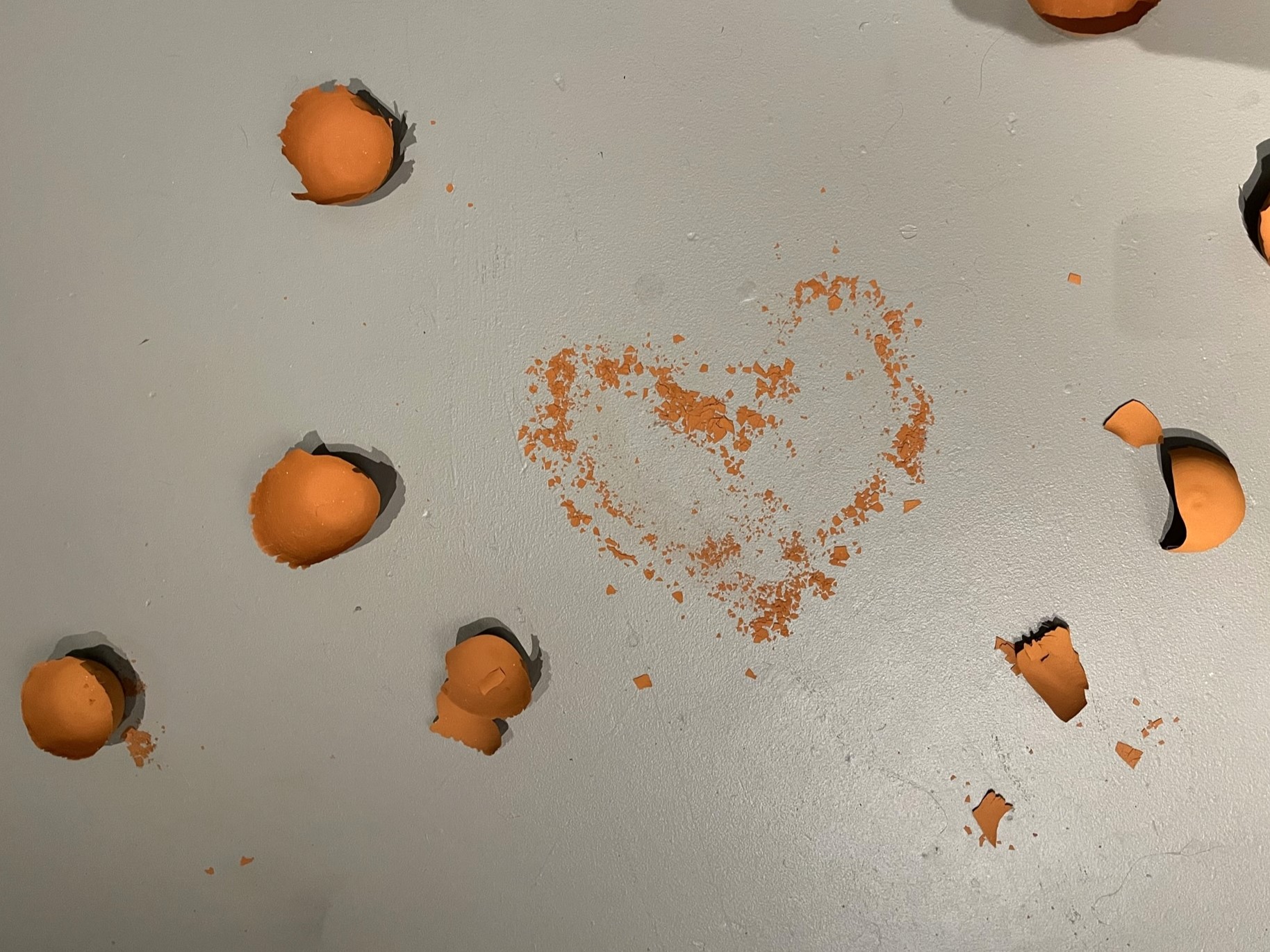
It was incredible to see how people participated with the work. During the months of preparation, I’d wondered if anyone would start off by stepping on bowls but then stop after reading the first sentence of the wall text. It was my hope that this would happen at least once. It happened several times. A few other predictions I’d made played out. Then there were the many other unanticipated interactions with the work. One young person balanced bowls across their arms and head; another squatted and spun the bowls around, making music with their unique, tinny sounds. Someone created a heart shape with the pieces of a shattered bowl. Others copied or created their own designs. A boy went racing across the floor, skipping over bowls while increasing his confidence and speed until his parents told him to stop.

I saw a few people very carefully make their way around the entire gallery without breaking a single bowl. Then, just before exiting, they purposefully held a foot over one and did it — crunch. I guess the curiosity was just too much.

Drawing people towards the gallery was a recording of birdsong that I’d made in the same garden from where I’d dug the clay. Often, people peeked in from the doorway with curiosity: what was this birdsong, and what are those objects on the floor? They hesitated, not sure if they were allowed to enter. If I caught this, I beckoned to them, telling them they were welcome. Several asked if they were supposed to break the bowls. I told them that I wasn’t there to direct them in any way—that they should interact with the work however they chose. If they asked what the show was about, I told them they could come to their own conclusions by reading the text on the walls.

Many people’s experiences of the installation were intense. From the day the show opened, I realized that I needed to be in the space whenever the doors were open. I’d try to hang out in the back office, not wanting to intrude on people as they experienced the show, but there was a steady stream of participants who would come up to me after they finished reading the text; they wanted to share how they felt in that moment. A few were crying. They each wanted to tell me about their experiences of eco-anxiety or solastalgia. I heard about childhood homelands in Mexico, Iran, and Bangladesh that are no longer the places of natural beauty they once were. Parking lots now, as the song goes.

On the second day of the exhibition, I spoke with an amazing 11-year-old who started a climate club in their school. They shared that climate change keeps them up at night. We talked for about an hour. Before they left, they told me the show helped them feel less alone and encouraged them to take more action. With that one conversation, I felt I’d accomplished more in a Masters degree than I’d ever fathomed I would. We are still in touch; I’ve become a bit of a climate-action mentor to them, and they inspire hope in me. I understood from day two of Crushed that my being present for these conversations was a part of the show itself.

Leading up to opening day, people asked me what I’d do if someone came in and crushed everything all at once. I was prepared for that possibility; I would have left all the shards in place. I was glad that this didn’t happen, but it didn’t bother me at all when I heard the occasional crunch. This was, after all, part of the experience I’d created. By the end of the week-long installation, I’d say about half of the 2,000 bowls were destroyed. I left each of them as they were, not sweeping them up nor replacing them, though I did replace the bows that I let people take with them as a souvenir. 

Crushed on the final day it was open.

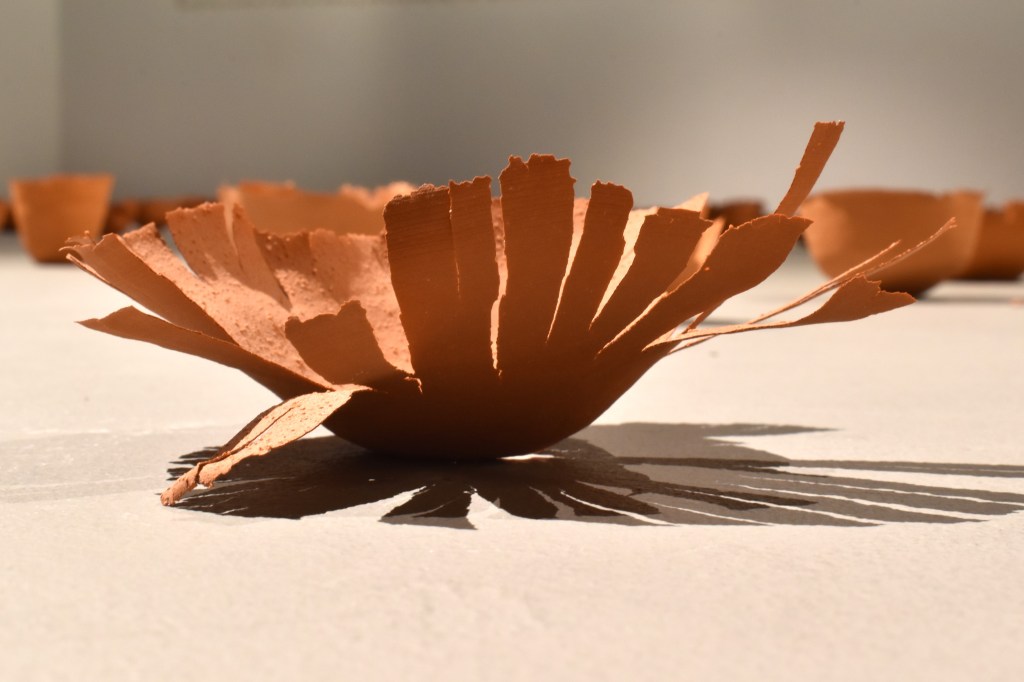
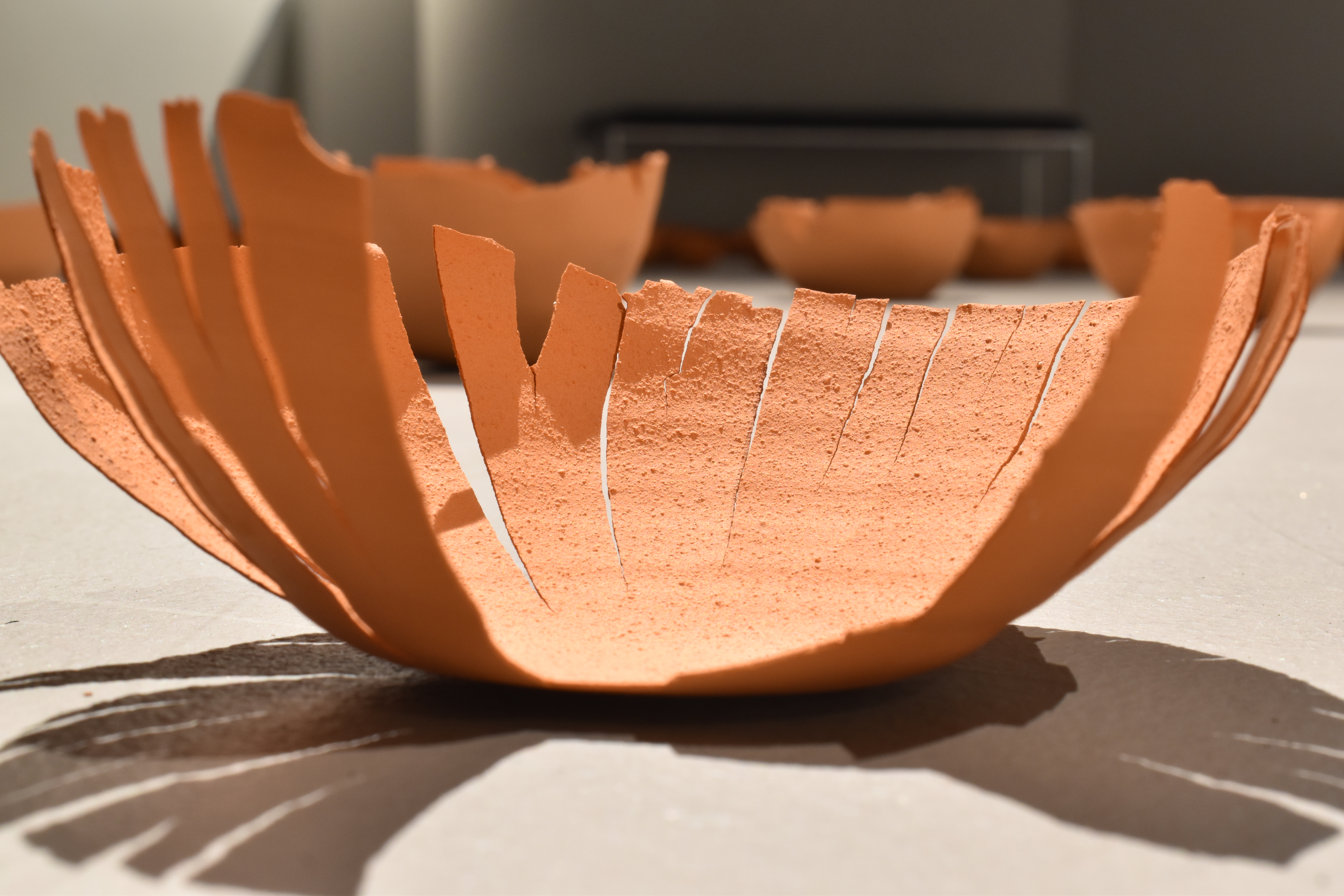
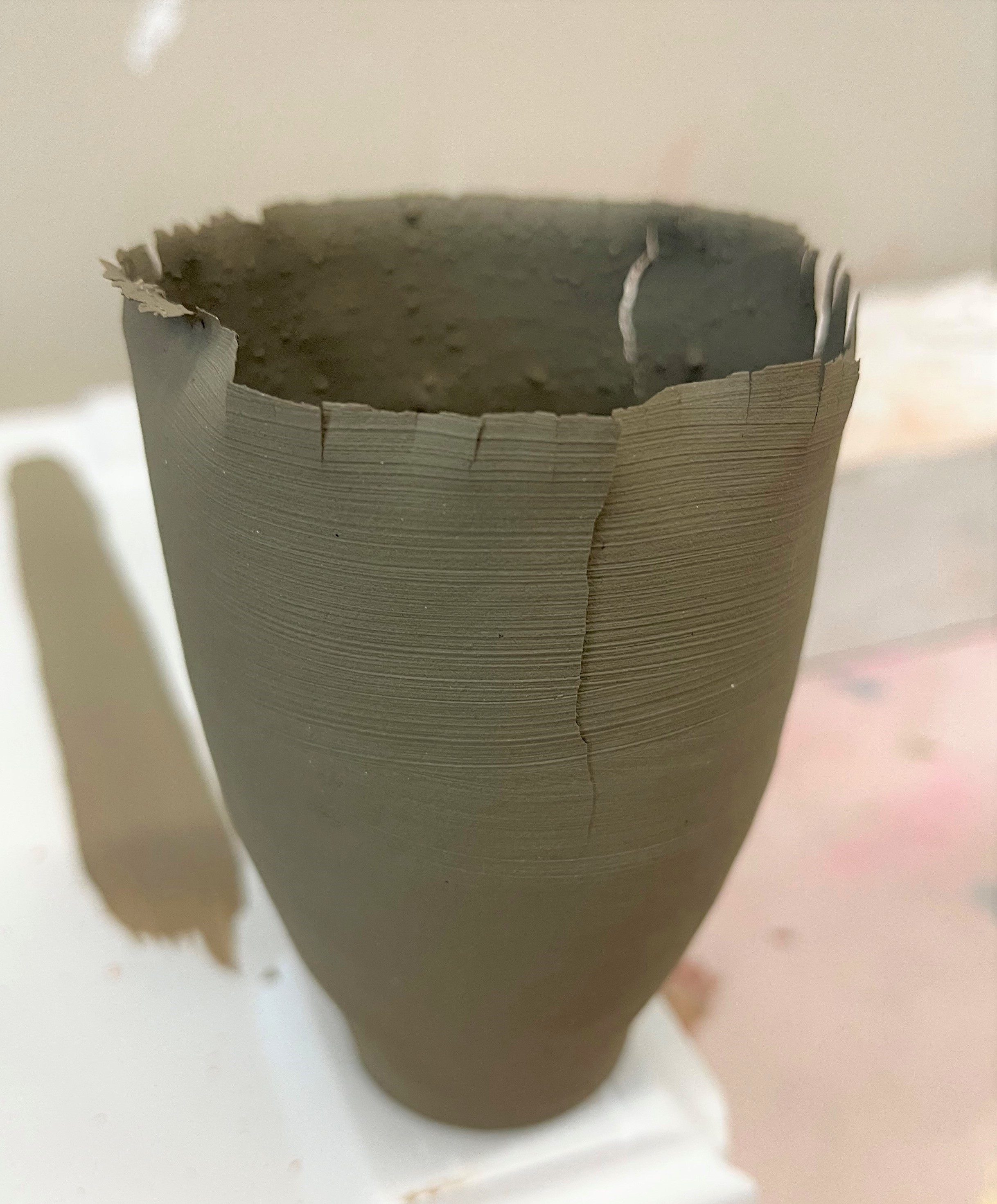
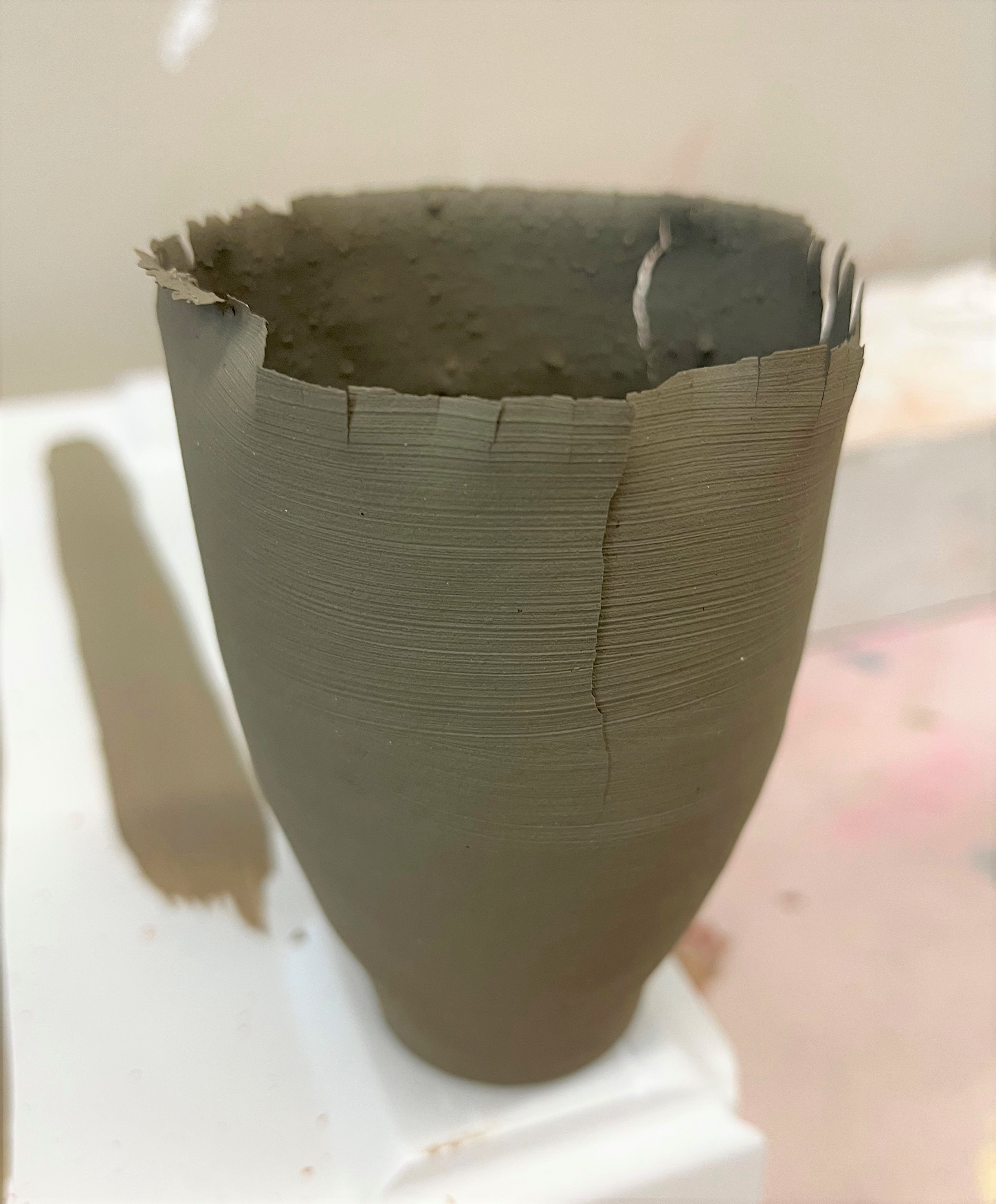
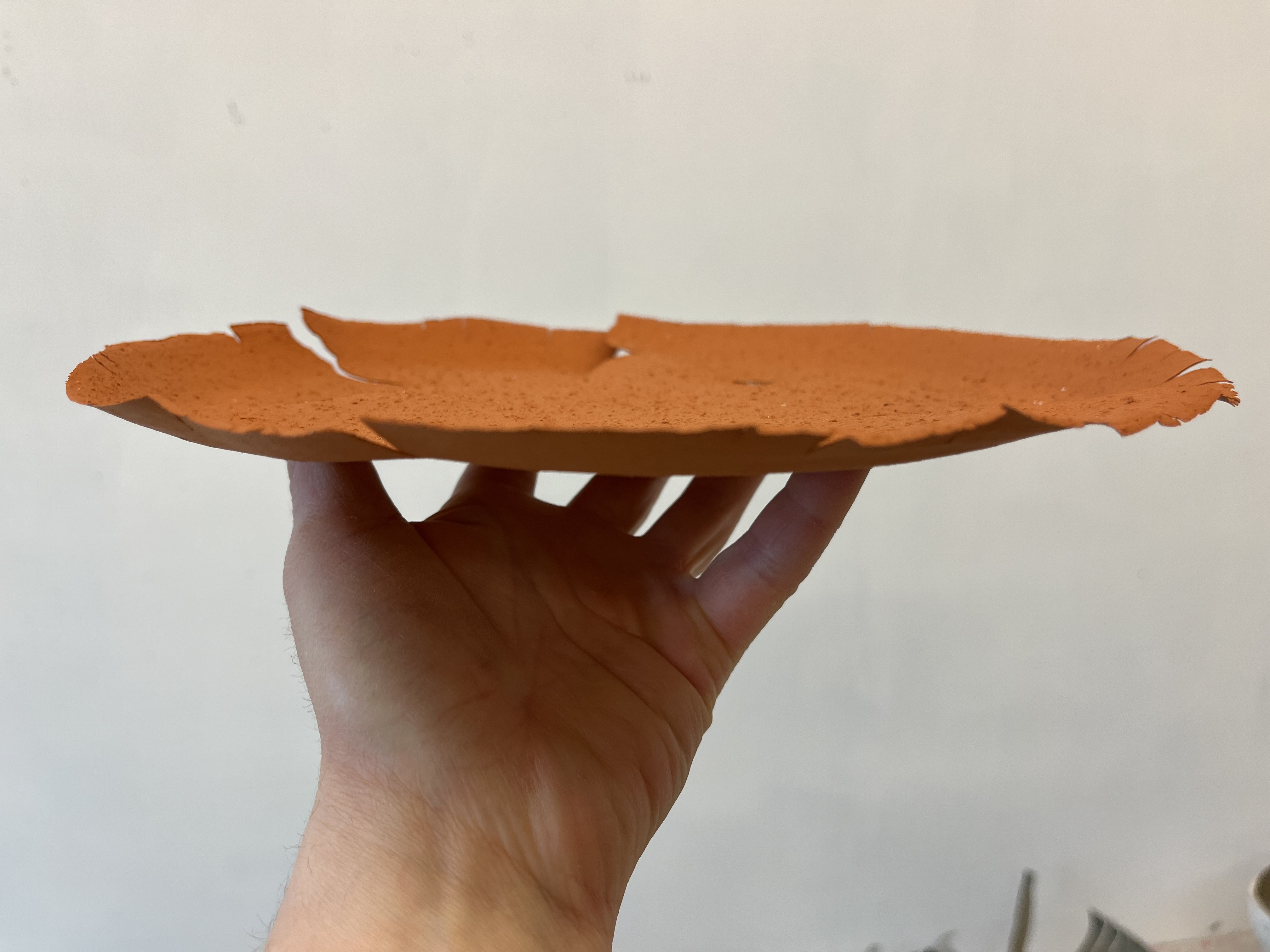
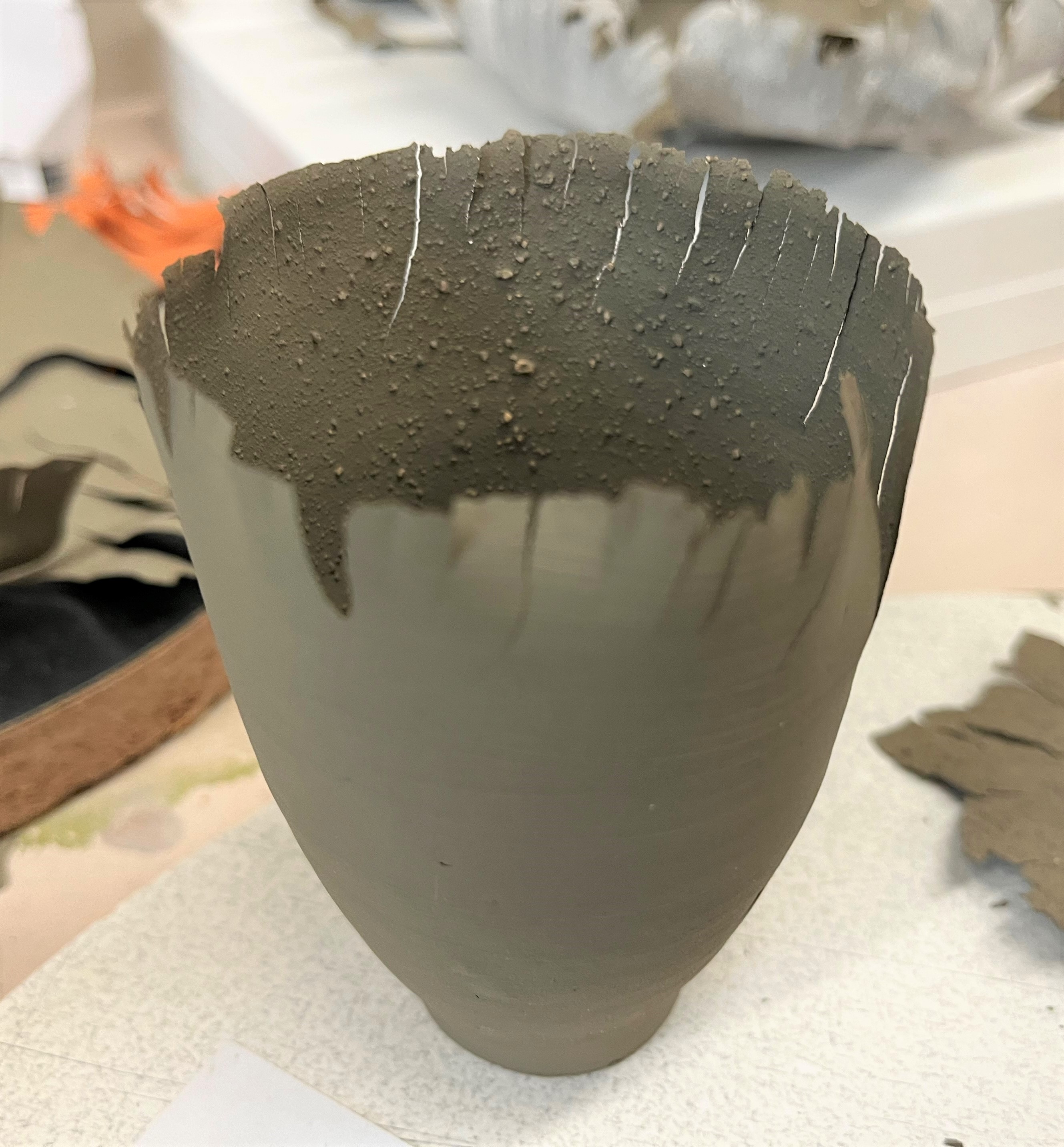
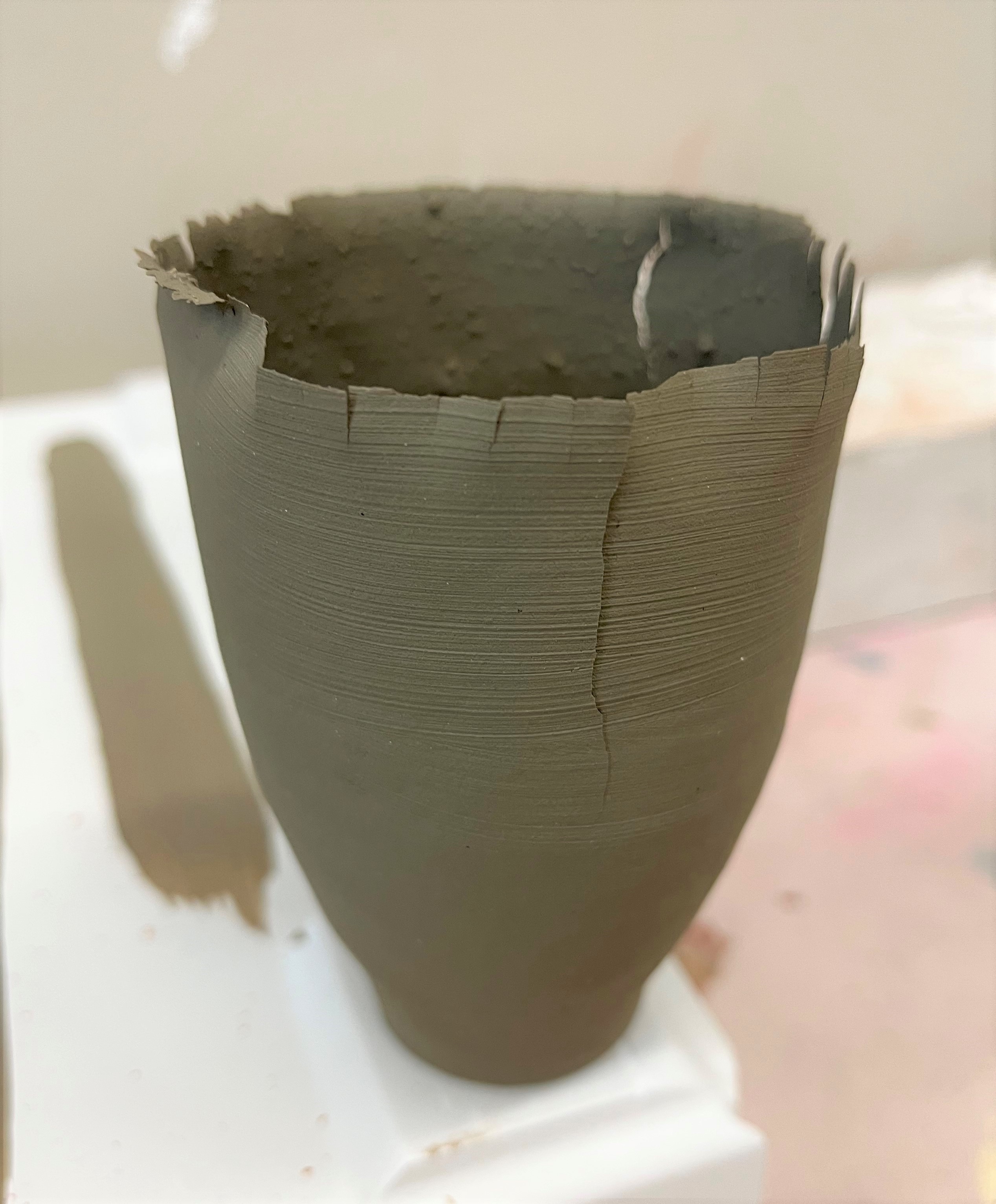
Each bowl started off already broken in its own way, many frayed and splayed into hardly-bowls-at-all. Vestiges. Unlike the pottery of long ago which we uncover today and use to learn about our past, these pots will not last. Fragile, like ourselves at this time of precarity for nearly all life on Earth, they mimic our position as a species at large, and for some, they mimic our own vulnerability. That they will not last is both their form and their content.

Through installation and hours spent sitting with the show. I got to spend time with each bowl. Without the busyness of production (plus life) that had been the previous two years, I now had time before and after the gallery’s open hours to look at each one carefully, seeing their own uniqueness up close. They became individuals again, not only elements of a whole.

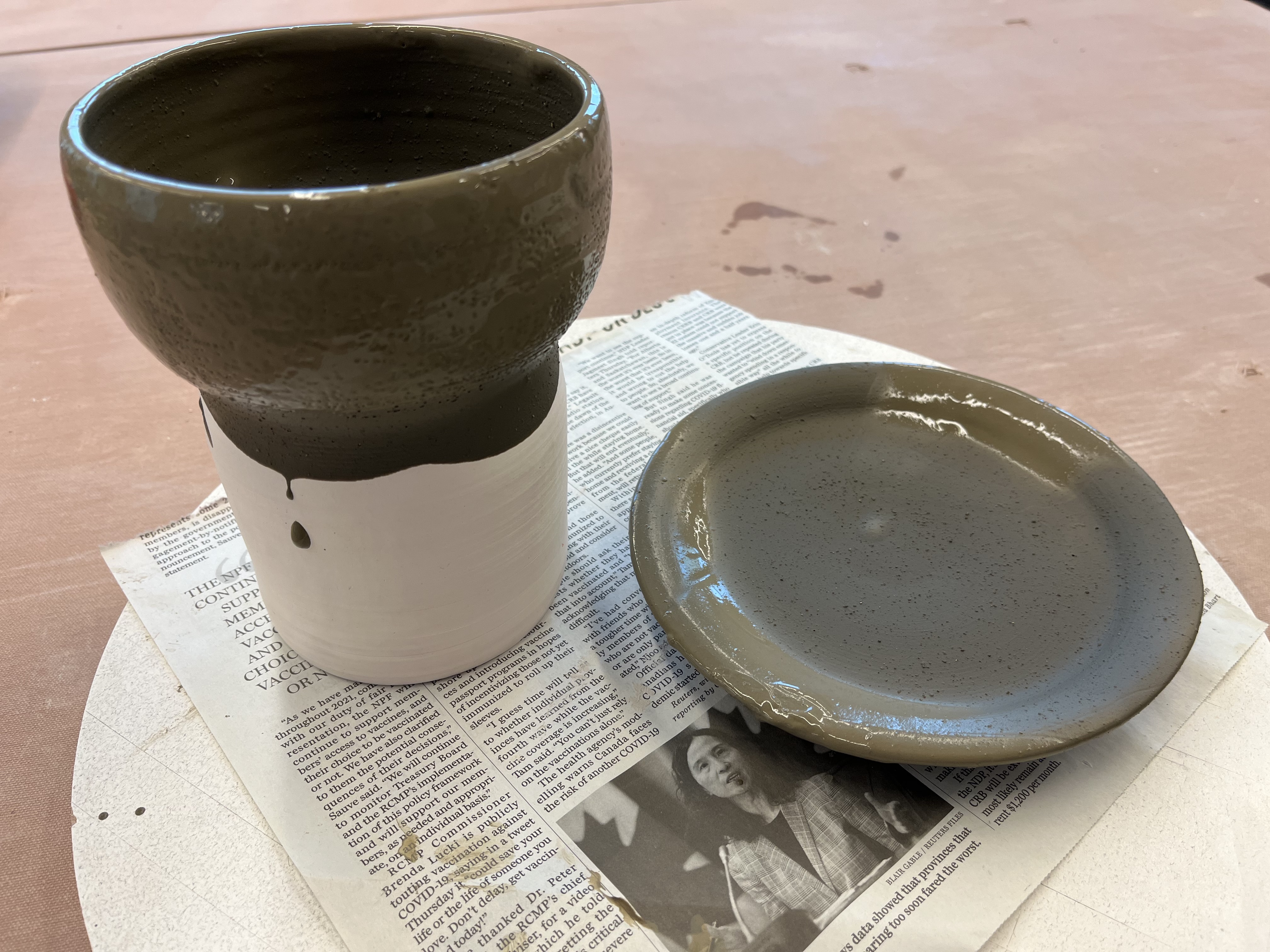
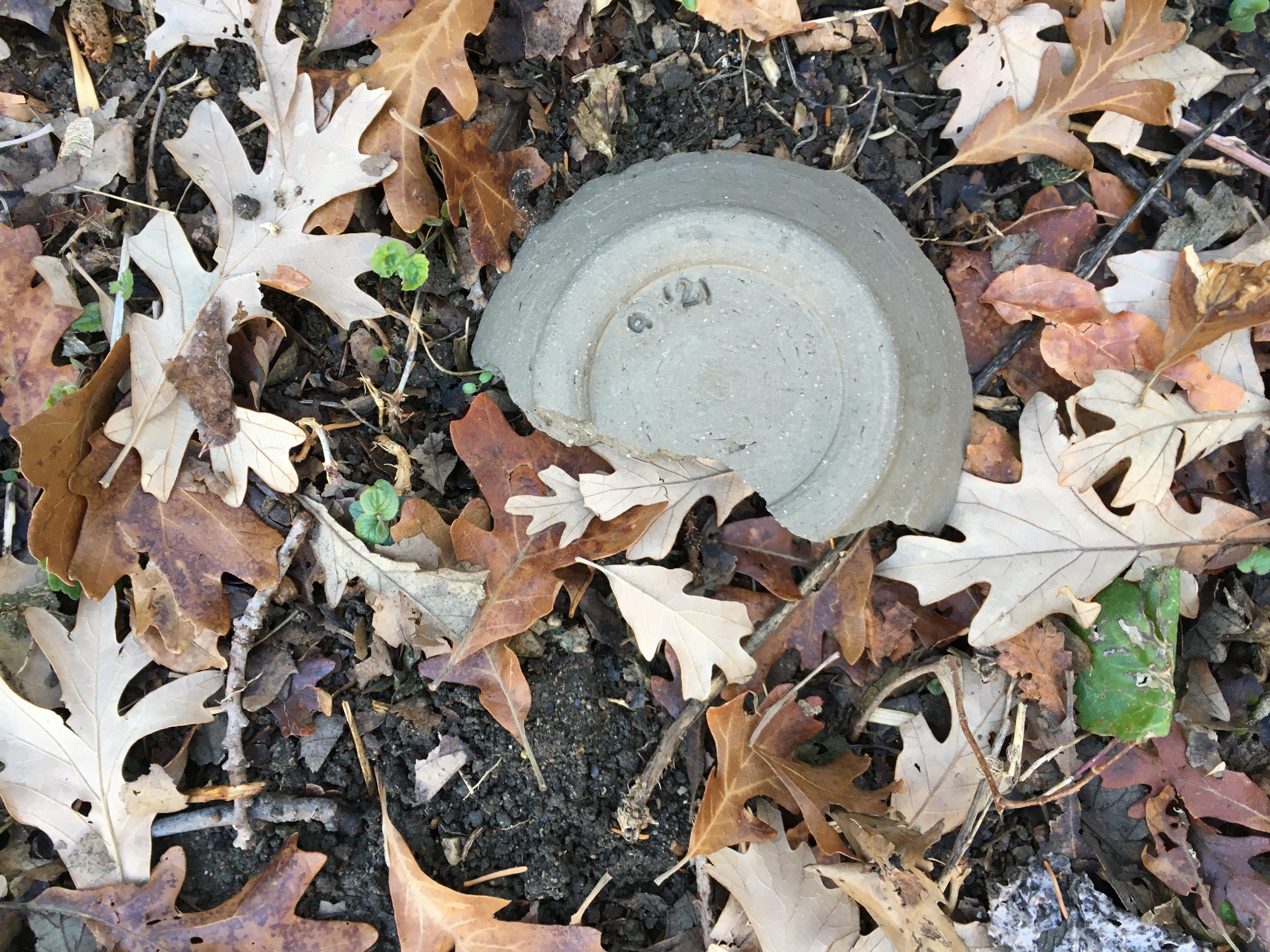
I played with them, too, turning them over and noticing their different textures inside and out: the grittiness of the raw local clay captured on the inside while the outside reveals the rings my fingers left behind when I’d pulled up the walls of the bowls I’d thrown on the wheel and used as molds.

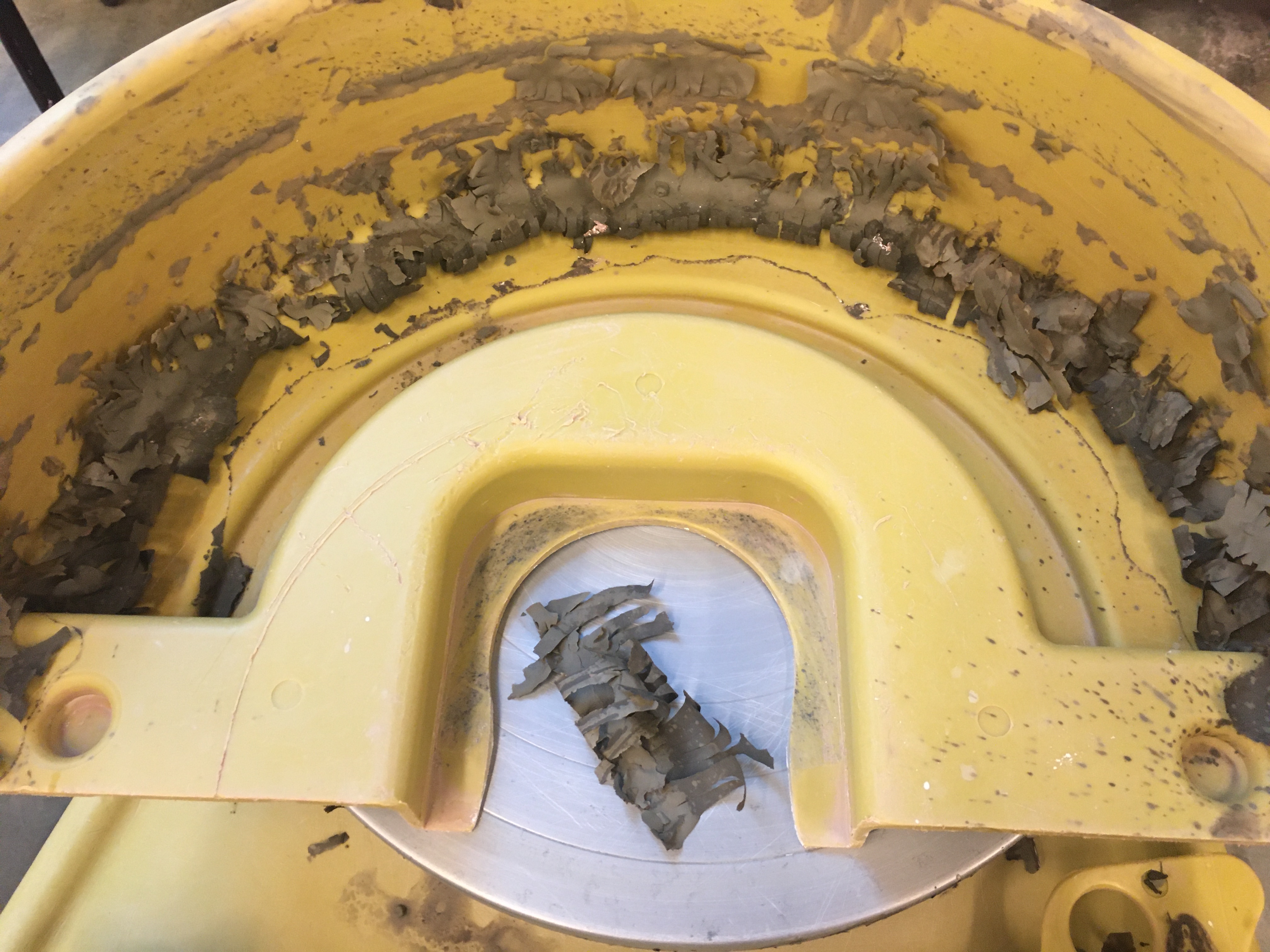
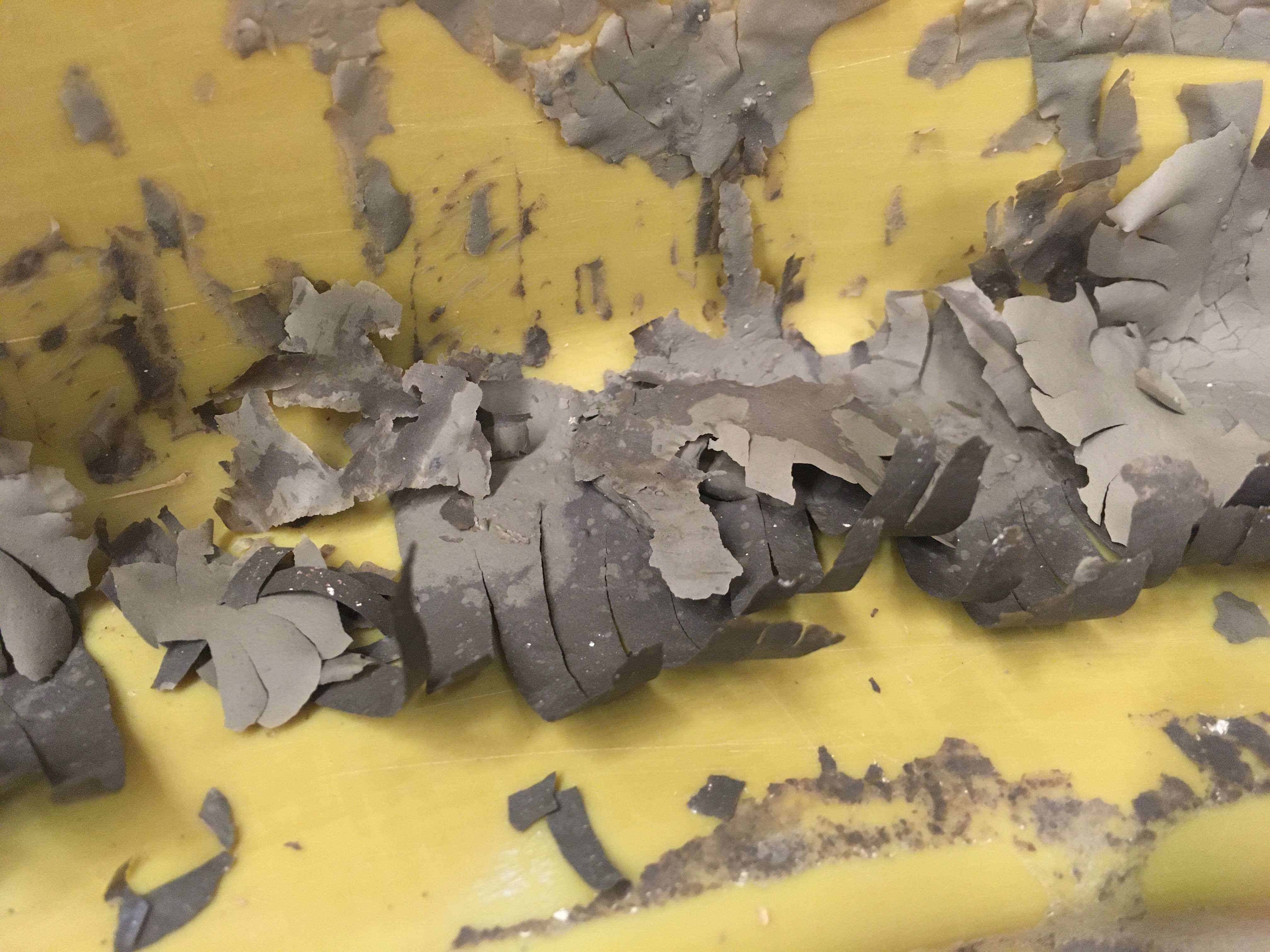
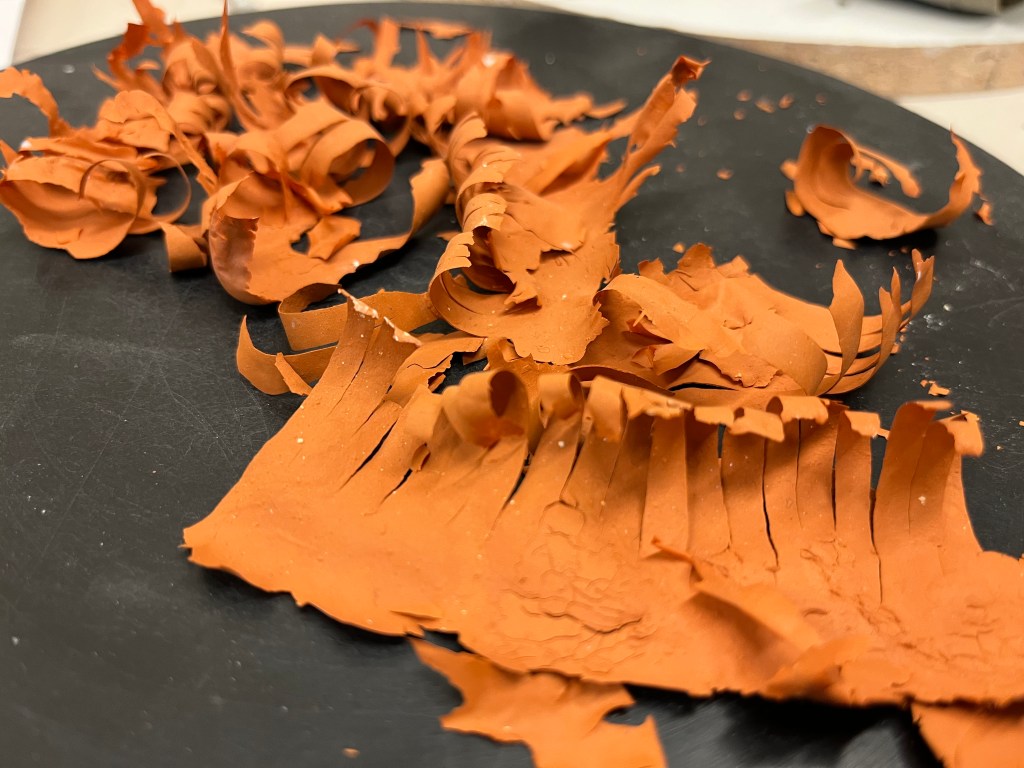
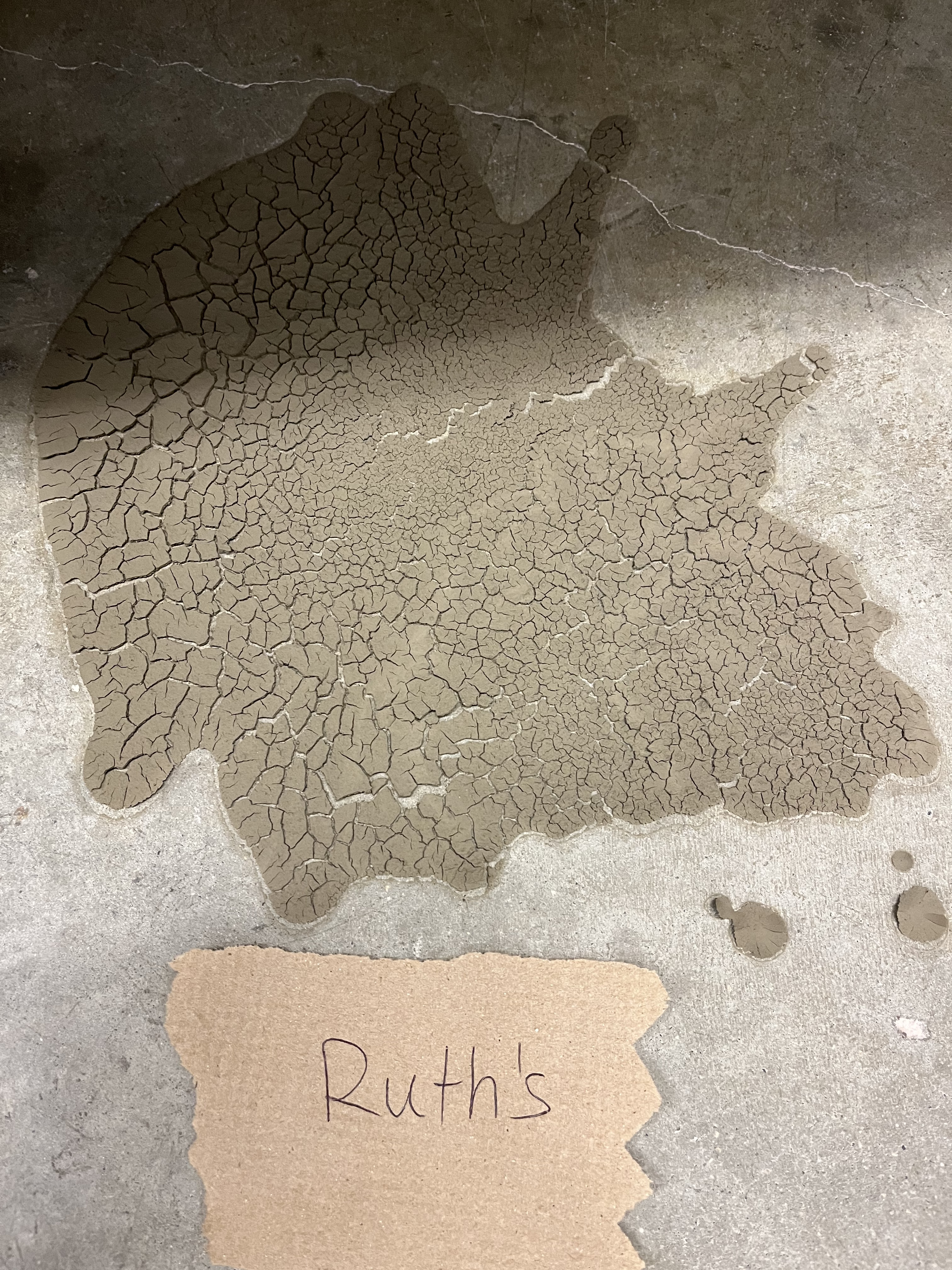
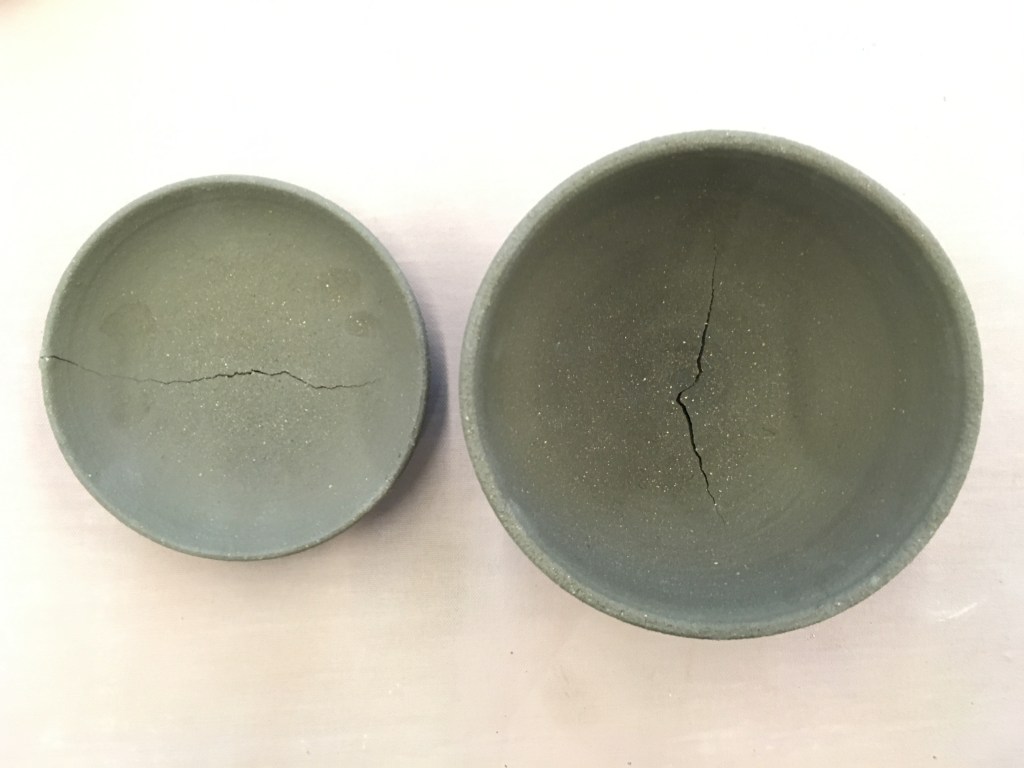
This clay remains a mystery. The way it peels and releases from just about any smooth surface is unlike all other clays I’ve encountered. I call it a magic act. At one point, I tried to break its secrets, but I soon decided to quit.

One question I’d had in the lead-up was how this installation could accommodate people with mobility issues. I realized it was a very ableist show in that the experience I’d intended was only possible for people who could walk on two feet. The whole idea was that people had to choose how they’d interact with the work on the floor. A person in a wheelchair would not have that choice. What I ended up doing when the first person in a wheelchair approached was to ask her how she wanted to engage with the installation. I offered to clear a path for her wheelchair, and she accepted. On two other occasions, I cleared this path for people to participate in the installation this way. I had an eye-opening conversation with a person in a wheelchair about the lines she drew between the lack of sufficient care in our healthcare system and our lack of care for the environment.

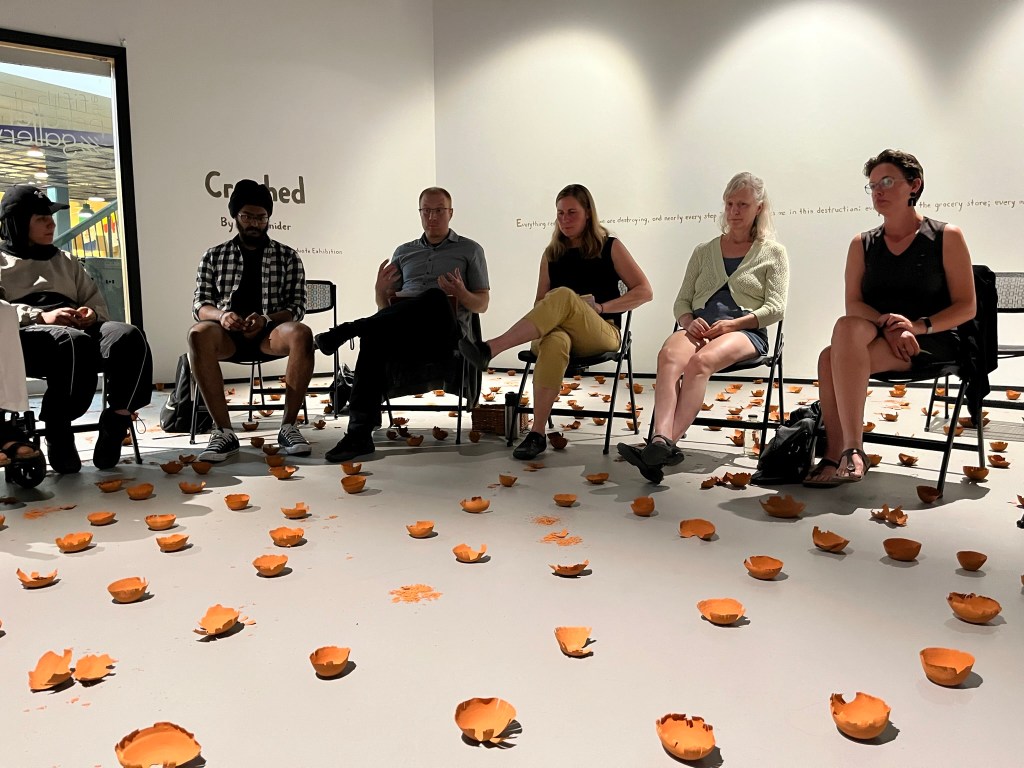
My ambition with Crushed was to create an environment that would bring participants’ own climate fears to the surface, show them that such feelings are justified and shared, and offer them resources and support. So often we are encouraged to be hopeful and focus on the positives. In fact, this is entirely built into the neoliberal society which is leading us towards disaster: never-mind worrying about the future, just keep calm and progress, progress, profit. We don’t often give ourselves and each other the opportunity to confront our difficult emotions about what the future may bring, emotions that are entirely reasonable given the unequivocally terrible state our natural world is in. I believe that it is important to learn how to face those feelings before they become overwhelming, as they have for me. Finding community is key to doing this. That is why at the end of the wall text was information about a non-profit support group I co-founded, EcoStress Sask, and a free discussion circle led by a psychologist and a counsellor that took place in the gallery at the end of the show.

Counsellor Russel Charlton (third from left) and psychologist Amber Klatt (third from right) led a discussion circle on the topic of eco-anxiety on the last day of the show’s opening.

It’s been seven months since I had the magical experience of installing and defending this work at the Fifth Parallel Gallery, University of Regina, August 20th to 27th, 2024. I would have written about it sooner, but sadly I’ve been occupied with a serious illness in my family which is actually in some ways connected to the theme of this show.

I want to thank my supervisor, David Garneau, for his dedication to my project, generosity with his time, and the knowledge and wisdom that enabled me to carry out a successful show and defense. I miss our conversations. Many thanks to my other committee members, Ruth Chambers and Holly Fay, my external examiner, Linda Swanson, and the Chair of my defense, Mel Hart. It was an honour to have the attention of these artists and scholars. A big thanks as well to the friends who helped with the installation and strike: Mona, Sana, Ashkan, and Sara. Thank you Fifth Parallel Gallery director Bree Tabin. Finally, I thank my husband, Michael Trussler, and our son, Jakob. I wouldn’t be here if it weren’t for you two.

 Photo credits: Alex Tacik, Mona Navai, and myself.

Crushed, August 20-27th 2024, Fifth Parallel Gallery, University of Regina

Hours: Tues/Thurs/Sat/Mon 2-6; Wed 5-9

Reception: 5:00-6:30 August 27th

Free Event: Climate Anxiety Conversation and Support, 7:00-8:30, August 27th. Psychologist Amber Klatt and certified counsellor Russell Charlton will co-facilitate a conversation on distress caused by climate change and other environmental crises. They will also teach coping strategies and talk about opportunities for support and community. Registration requested by Aug 26th; contact ecostresssask@gmail.com or visit EcoStress Sask.

Please join me for my Masters of Fine Arts Graduating Exhibition, opening August 20th-27th.

Crushed is an art installation about climate change anxiety. The gallery floor will be covered with over 1,500 eggshell thin ceramic bowls made from clay I dug up in Regina. On the wall, there will be a text about my experience of climate anxiety and grief. To read the text, you need to become a participant: will you step carefully between the bowls, perhaps tiptoeing or raising your pant cuffs, or will you stomp ahead, satisfied by the sound of shattering ceramic beneath your feet? What will you leave behind for others?

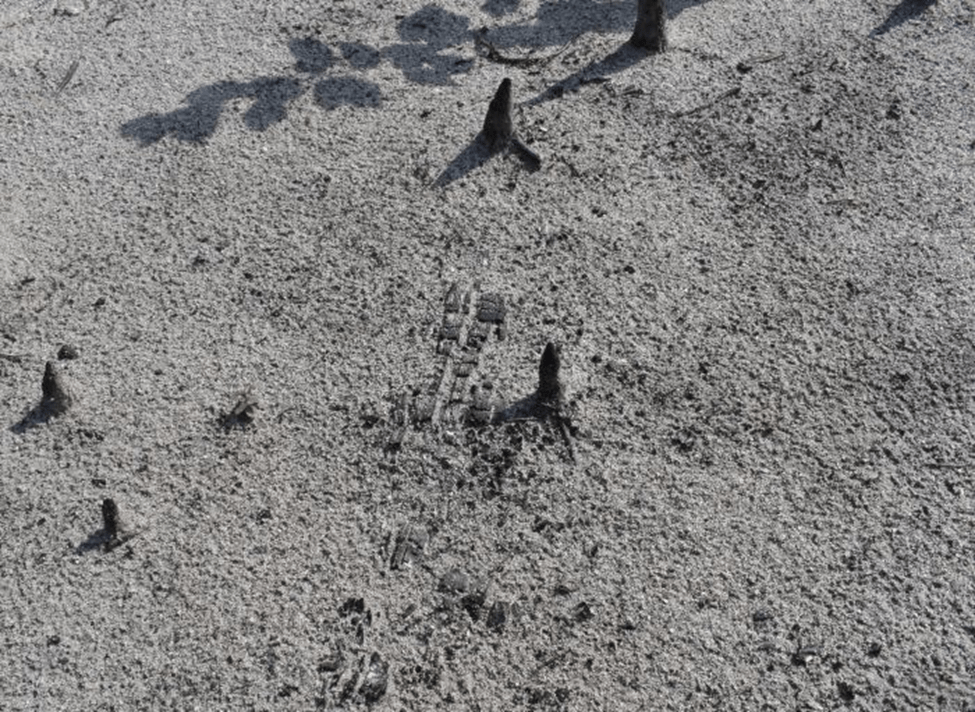
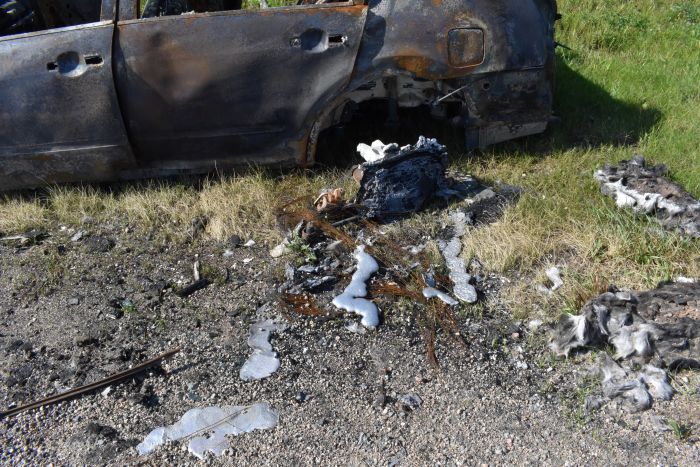
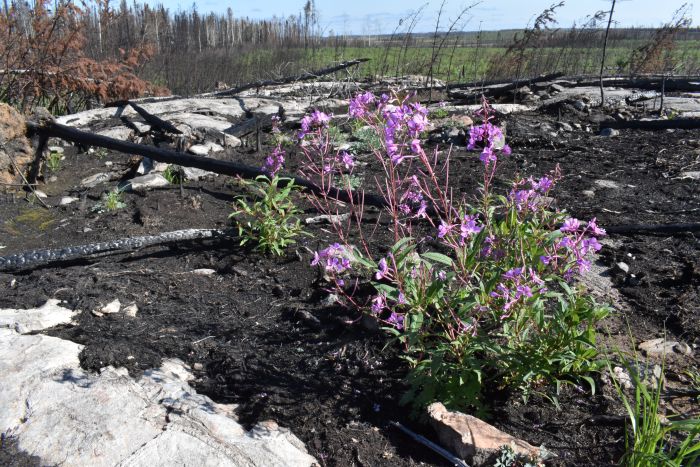
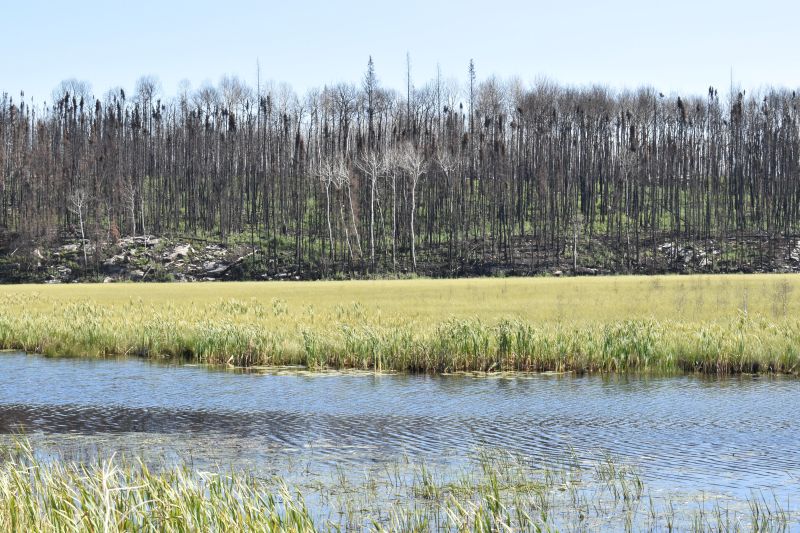
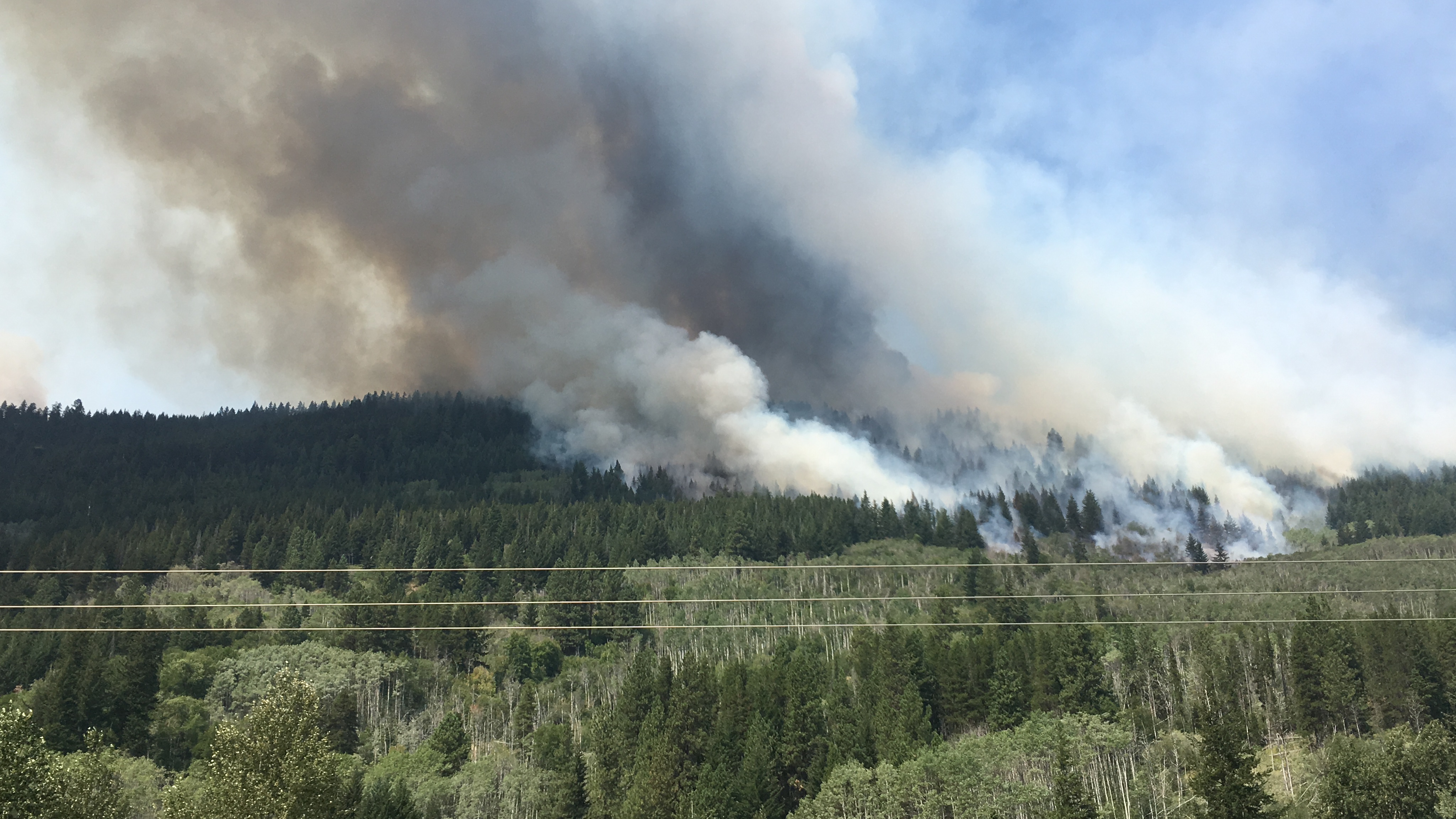
Days ago, Jasper, BC, was evacuated and largely destroyed by forest fires. The whole area is burning. Smoke from those fires made it to my home in southern Saskatchewan. Last year it reached New York. Warnings tell me that it’s toxic.

My family has been to the Jasper area several times. We visited there a year ago. Now, microscopic particles of its trees and animals drift into my house through cracks in my windows. The unnerving red light of Rayleigh scattering screams that the world is upside-down. The forests should not be visiting me.

I grieve the losses that our species is causing, and I worry about the future.

Crushed is a manifestation of my own climate anxiety and grief. Through this work, I show others that such feelings are shared. We must de-stigmatize this topic; we need everyone who cares to be able to say so. Conversations are key to climate action. Connecting with others and doing something positive together is also a much better feeling than paralyzing despair, as I’ve learned myself.

Extreme heat is a global killer — and worse for our health than previously thought, new research shows.” CBC. June 22, 2024.

Sunday was world’s hottest ever recorded day, data suggestsThe Guardian. July 23, 2024.

Show Update / Three Minute Thesis

Crushed (2023-ongoing)

Everything I see reminds me of what we are destroying, and nearly every step I take implicates me in this destruction: every trip to the grocery store; every movie I stream; every glass of water I drink. Nothing I do is innocent, and the consequences are terrifying.  

This is the start of a paragraph that will circle the gallery walls in a single line during my upcoming Master’s of Fine Arts thesis exhibition, Crushed.* Crushed is a ceramics art show about climate change anxiety. The gallery floor will be covered with over 2,000 eggshell thin ceramic bowls made from clay I dig up in Regina. To read the text, you need to become a participant: will you step carefully between the bowls, perhaps tiptoeing or raising your pant cuffs? Or will you stomp ahead, satisfied by the sound of shattering ceramic beneath your feet? What will you leave behind for others?

Climate change is destroying the places I love, from the melting Rocky Mountain glaciers I hike to with my family, to the dried out wetlands where we used to bird watch. This affects me deeply, not only because it robs me of my enjoyment of these places, but also for the fear I have about the unprecedented planetary changes we are causing. Where are the birds who built their nests in these wetlands for generations? What will happen to our water supply when the South Saskatchewan River runs dry? What will the world be like when my son reaches my age? Questions like these are always on my mind.

My research aims to evoke such questions and feelings in others though ceramic art. My thesis exhibition, Crushed, uses the bowl, an common household object, to convey my climate anxiety and offer support to those who share it.

With a floor scattered with super fragile bowls and a text about my fears on the wall, Crushed creates an environment that will bring participants’ own climate fears to the surface, show them that such feelings are justified and shared, and offer them resources and support. At the end of the wall text will be information about a support group I founded and a discussion circle led by a psychologist that will take place in the gallery at the end of the show.

Climate anxiety is on the rise. This is not good. If anything hopeful is possible, we need people who care to demand action. Caring can be painful. I know. My Master’s of Fine Art thesis exhibition Crushed offers people a space of solace and support.

*Crushed will take place between August 20-27, 2024, at Fifth Parallel Gallery, University of Regina, Saskatchewan, Canada.

Class post 6: How was your day today?

For this week’s class, I needed to read “To Say or Not to Say” from Ken Lum’s Everything is Relevant: Writings on Art and Life and answer the question, what does it mean to be self-reflective?

Talking to my Mom about my emerging art practice and is one of the measures I have for determining if my work is real — if it’s a straightforward conversation and I can speak with confidence about what I’m doing, I feel good about things. With her history of severe mental illness and its consequences, including brain lesions from years of being on toxically high doses of antidepressants, she can’t sustain focus for any overly complicated sentences. I need to speak clearly and succinctly; I need to tell her only what is necessary. What is necessary about my current project? Spelling it out for her, I can hear myself as she hears me, and I catch myself asking how real my work is — how meaningful is it to a person who isn’t immersed in art-academia, and how meaningful is it to me? What is the real point of what I’m doing? Is there a point to it, besides (I hope) securing a degree?

Lum talks about how art is losing the battle to remain real in a capitalist (or neoliberal) world that is increasingly cliché. Society, Lum writes (quoting Deleuze), is so saturated with clichés that authentic individualization barely exists. Within this world, he writes, “a paradox is that as art increasingly follows the logic of capital, it becomes deterritorialized to itself” (190). The meaning of art is watered down by its insistence, or requirement, to feed into larger societal systems. One way for art to remain authentic, according to Lum, is for it to acknowledge atrocities of the past. The art world needs to recognize its place in the capitalist, colonialist system that continues to oppress and repress.

Lum starts the piece by talking about an epiphany he had at the Pompideu in 1981, and I believe he ends it with another — an experience he had when he grandmother unexpectedly appeared at an opening to one of his solo exhibitions:

Halfway through the gallery opening, I suddenly heard my grandmother’s voice over the din of chatter. She was loudly calling out my Cantonese name. I remember thinking: Is that my grandmother’s voice? Is she here? Moments later I saw her emerge from the crowd dressed in poor Cantonese attire. […] At first I was completely stunned, even mortified, for I felt completely exposed. My family. My class. My race. My private self as opposed to my public self. My non-artist self as opposed to my artist self. They had been made painfully visible to me and for all to see. (191)

This was an experience of colliding paradigms for Lum, and he writes about it being a moment of realization for him into the “deep disjuncture between art and the real” (194). His grandmother had suffered a harsh life of poverty and persecution; how would she, could she even, read the artworks in her grandson’s show? What meaning would they have to her, or would they be meaningless, created for only a sliver of the general population, that specialized group which comprises the art world?

Being self-reflective, I believe Lum is saying, means asking difficult questions of oneself, such as, for whom am I making this work? Does it communicate something I’d be willing to share about myself with my closest friends and family? Is it really what I need them to know about me and my view on topic x? These questions offer a way to keep the work real, rather than cliché.

Lum’s text itself offers this strategy of keeping the work authentic. By bringing in his personal epiphany and his grandmother alongside theoretical citation, he’s employed the mode of autotheory. In Autotheory as Feminist Practice in Art, Writing, and Criticism, Lauren Fourner describes auototheory as

a term that describes a self-conscious way of engaging with theory–as discourse, frame, or mode of thinking and practice–alongside lived experience and subjective embodiment (7)

and

autotheory points to modes of working that integrate the personal and the conceptual, the theoretical and the autobiographical, the creative and the critical, in ways attuned to interdisciplinary, feminist histories. (7)

Autotheory, I believe Lum would say, is a means of writing and creating that has the potential to remain authentic in the way he’s speaking about in “To Say or Not to Say.” Even the title of this text alludes to the dilemma of how much of the personal one should share in their work. It’s risky to bring the personal into the public sphere for all kinds or reasons. However, I’m guessing Lum would say that “everything is relevant,” and to not take a self-reflexive approach in one’s work is to feed into the capitalist systems that are separating art and what’s real altogether.

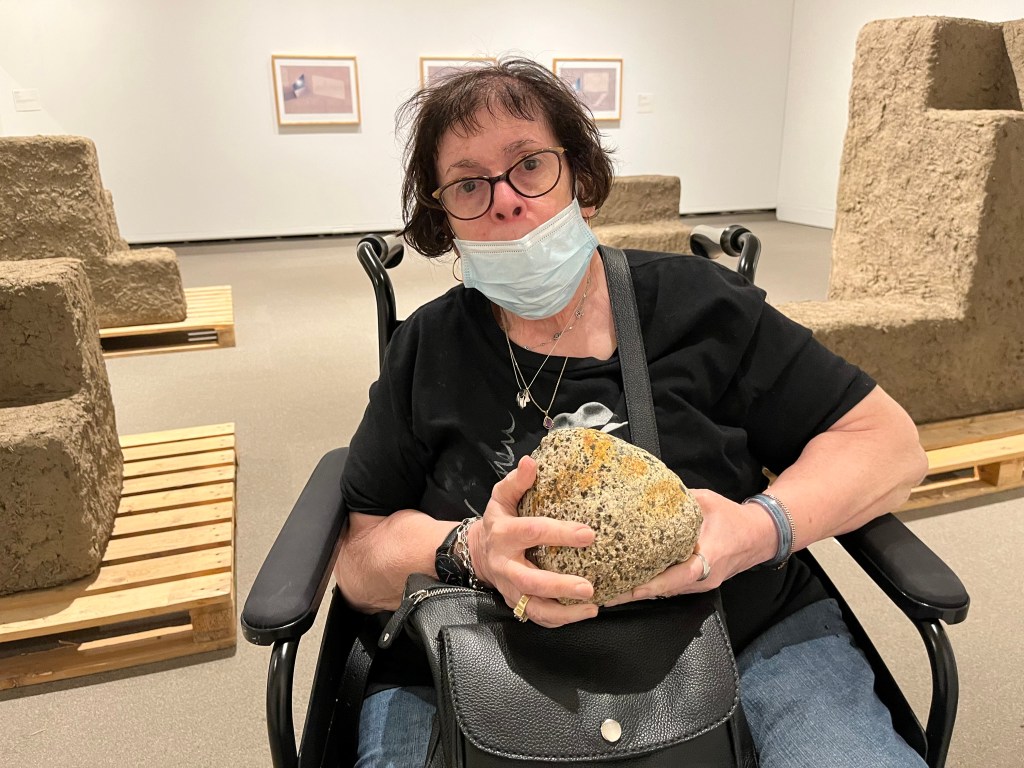
My Mom at the MacKenzie Art Gallery, June 2022, wondering about this rock

What it means to me to be self-reflexive is to constantly be analyzing the motivations behind my work. I keep this blog as a way of practicing the autotheoretical mode of thinking and writing, and I find it immensely helpful. For example, this past summer I posted a “psychoanalysis of a climate change melancholic,” where I attempted to dig deep into my motivation for making work about climate change. Writing this way helps me ensure I am doing work I can believe in, work that seems as authentic as it can be. In other words, thinking and writing this way helps me out when my Mom asks me what I did today. I can answer her in a way that makes sense to us both.

Fournier, Lauren. Autotheory as Feminist Practice in Art, Writing, and Criticism. MIT Press, 2021

Lum, Ken. “To Say or Not to Say.” Everything is Relevant: Writings on Art and Life, ed Ken Lum and Kitty Scott. Montreal: Concordia University Press, 2020, pp 189-195.

Class post 5: I am an artist termite

This week’s assignment is to “do some independent research on the concept of ‘community’ and answer the question, ‘what does community mean to you (as an artist and MFA candidate)?'”

My understanding of the role of community in our lives has really only started developing in the last few years. Being from somewhere else (Richmond, BC), I’ve struggled to find community here without even realizing it. What I always felt was just a core of loneliness which was just natural to me. Living alone with my intensely ill mother as a child, and having few friends, I suffered terribly from loneliness. I remember walking across the street to the Safeway late at night (they were open until midnight) to wander the aisles, starting at rows of deodorant, baby products, or whatever, just to be around people. If I was lucky, I’d see someone I’d seen there before. I didn’t even realize how lonely I was, or what exactly I was missing. I know now that I was craving community.

I teach this term to my ESL students, and it’s one they often find hard to fully get. Perhaps it’s through that teaching effort that I really understood what community means to me as well. When I explain that community is a feeling of belonging with others, I realize that I’ve never had that myself. Now, twenty years into my stay in Regina, I’m aware of the communities I’ve formed here. I know the checkout staff at the local Safeway, but while that brings some minor comfort, it’s other communities that mean more to me. The one that means the most, and I’m not saying this just to suck up to my prof, is the Visual Arts department at the University of Regina.

I’ve learned in recent years that real community is not just recognizing others (say, at the grocery store), it’s also about recognizing yourself.

Alongside being lonely my whole early life, I’ve also never really lived for myself. Growing up, I had to take care of others (largely my Mom), and I didn’t have the mental framework to seriously consider what I wanted to do with my life. I knew I enjoyed making art, but when my Dad told me I’d never get a job basket weaving, (literally what he said), I too easily dropped that thought and made my major English with the idea it would lead me to teaching. It did, but I don’t get much sense of community from my workplace. I’ve been teaching ESL here for nearly two decades, yet very sadly, I don’t feel I belong in that program.

On the other hand, when I enter the Visual Arts area now and see the familiar faces of fellow students, techs, custodians, and profs, I feel like I’m at home. I can be myself here, the “myself” I was meant to be. In other words, I recognize myself when I’m in this space among these people. This shows me that if I can form community among artists, maybe, just maybe, I can be one myself.

Now, a school (or university) is a bit of an imposed community; we are all here for some other purpose (study; work). When my times comes to graduate, presumably I’m going to have to leave this space. The thought saddens me; however, I know that I’ll be able to stay in touch with people I’ve met via events such as Art for Lunch and openings, and if I’m very lucky, perhaps I’ll get to do some teaching here too.

According to Evolve Artist and other hits when you search “value of community to artists,” artist communities offer motivation, inspiration, connections, accountability, and feedback. That all makes perfect sense. To me, however, an artistic community means even more that those practicalities. It’s a feeling of connection and belonging that is core to my identity. Internalizing this sense of artistic community is what has shown me that I am an artist… words that I still struggle to fully believe, but I’m slowly making progress with the help of others.

Christina Battle, who will generously be doing studio visits with a few of us MFA’s in a couple of weeks, has the following in her “about” page where she describes her research into disaster studies:

Relating to the overall complexity that disaster studies engages with, ecology is thus defined: “The English word ecology is taken from the Greek oikos, meaning ‘house,’ our immediate environment. In 1870 the German zoologist Ernts Haekel gave the word a broader meaning: the study of the natural environment and of the relations of organisms to one another and to their surroundings. Thus, ecology is the science by which we study how organisms (animals, plants, and microbes) interact in and with the natural world.”

She goes on to say about her own work that

I look specifically to ecological relationships among plants—especially how plants evade, respond to and prepare for disaster—as a way to find strategies for our own communities. It is important to note that my working definition of community is one that also draws from ecology: “many populations of different kinds living in the same place constitute a community,” and necessarily includes both human and non-human entities.

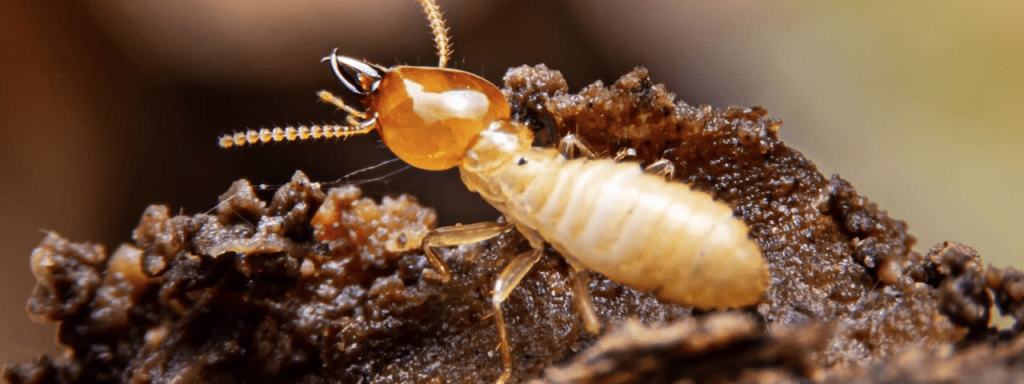
I enjoy this definition of community as tied to ecology. I see that I’ve come a long way from falling asleep listening to “I Am a Rock” as a child to being recognized by others and recognizing myself in the visual arts community at the University of Regina. Now I know that I am not in fact a rock. Now, I am a termite (thanks to Bruno Latour), living and interacting with others in the critical zone of planet Earth, taking care of it and each other. It is from here that I’ll make art.

image source

Class Post 4: the precarious study of precarity

This week for class, I needed to watch Irit Rogoff’s lecture, “Becoming Research,” and answer the question, “What is research for *You*?” As optional other reading, Risa gave us Marquard Smith’s “Why ‘What is Research in the Visual Arts?: Obsessions, Archive, Encounter?'” and Christopher Frayling’s “Research in Art and Design.”

Rogoff’s talk is dense with valuable insight. Among the many points she makes, I am very interested by what she says about our times being of precarity, and how

spatially, technologically, atmosphereically and in terms of social conditions we are in states of extreme instability. […] So, given that these are our conditions, the modes by which we study, we excavate, we investigate, we try and ask questions about, themselves cannot be stable.

14:32

As she puts it elsewhere, “we need a complete reconfiguration of how to know” (13:23 emphasis mine). What is, she asks, “the precarious study of precarity?” (16:25). I would love to have a clear answer to this question as it applies directly to my own research.

I’m fascinated by this notion of there being a necessity for a completely new epistemology for the times we’re in. My current project, my MFA graduating show, is an installation dealing precisely with precarity, instability, and ephemerality. My inquiry is into how others will respond when confronted with the danger and violence of impending environmental collapse at our hands. How will they feel? Will they understand the term solastalgia for the first time, or will they refuse to enter into that understanding, walking away from my show rather than implicating themselves in it by stepping on any of the thousands of super-fragile pieces that will be lining the gallery floor? This is the research I’m interested in doing, and in a sense it’ll be a “new way of knowing” in that this exact show has never before taken place, and it is not based on existing knowledge. It is about the condition of uncertainty and anxiety that I experience and whether others experience it too. It could include a follow-up questionnaire, interview, or survey, but it won’t. I’ll allow it to remain a more private study for each visitor-participant, one about entering into this condition experientially, being in it as I have been in the recent past, say when camping under a blanket of forest fire smoke that made the sky an unmistakeable shade of warning-orange.

In this way, this research stems from my “daily life,” my own “emotional sea changes” and my “crises of identity and security”:

Research is not some elevated activity requiring a great deal of prior knowledge, nor is it simply the urge to find things out. It is in many ways the stuff of daily life. Every form of hardship encountered, whether one is an immigrant or living out catastrophic conditions, affected by emotional sea changes or crises of identity or of security, generates research, and everyone researches. (18:00)

Stuff of daily life should, in my view, include the acknowledgement of the disasters we are creating for ourselves and future generations, though for understandable reasons (psychological survival), it makes sense that we wear significant blinders. Research for me involves allowing in fragments of knowledge and fragments of thought amid general delusion and pleasure, the way I’ll glance at the headlines in the news and then immediately bike to my studio to throw some pots on the wheel, or how I’ll drive past the remains of recent forests fires on my way to soak in some visceral enjoyment of water at Lac La Ronge Provincial Park, later turning into practice (my show) the awareness that my every move is contributing to the problem while I must somehow still enjoy pottery and lakes nevertheless. This is my research, and it’s ongoing throughout every moment of my life until, as happened recently, the precarity of my situation lays its hand down on me in just such a way that I’m broken, unable to say or make anything, and must somehow find a way to come out of that brokenness with more in me to create. This is my precarious study of precarity, and this is what research means to me.

Photo credit: Michael Trussler

initial thoughts on my MFA graduating show

It’s time for me to dig deep into understanding what it is I want to say with my graduating exhibit. I have a vision of what I’d like it to be, as I summarized in my previous post which I’ll paste this paragraph here for quick reference:

I am considering my final exhibition, and the vision I have involves covering the entire gallery floor in super-fragile cups and bowls of bright orange ceramic made from local clay. Viewers will need to enter into the space, crushing these forms as they go, to read my statement and (possibly) see videos that are projected onto the walls. Ideally, I’d also have very large rocks for people to sit on and contemplate the installation (though this may prove financially impossible). I’m curious to see who will decide to enter the show and who will turn away. I’m considering videoing the exhibit, informing people that by entering the space they are agreeing to being videoed. Were I to do this, it would be suggesting accountability: that we are being seen as we destroy the planet for future generations; that there will be a record. On the other hand, I don’t know if I want to bring that thread into the discussion. The main point is to provoke a private contemplation of the situation we’re in (with climate change) and of how it impacts us emotionally. I’d like the installation to be an acknowledgement of eco-anxiety/solastalgia. This is core. This can’t happen while we’re knowingly being surveilled. So, this videoing aspect is one of many decisions I have to make very carefully. Whatever I choose will change the conversation that this show sparks, the dialogue between between me and the viewer, and between my work and others’.

For someone as indecisive as I’ve been lately, how have I settled on this project for my final show? What am I trying to convey? I’ll need to spend a lot of time figuring this out, as for now all I have are many unanswered questions, such as:

  • What do I want people to experience when they see my show?
  • What is the narrative of this show?
  • Why have I chosen to create an installation? Why should the pieces I make cover the entire gallery floor?
  • Why would I use ceramic tableware (cups, bowls, plates)?
  • What is the purpose of having people step of these objects and break them?
  • Why would I use fired objects? Why not raw?
  • Should I include anything else besides covering the floor? (At what point would this be a show and not an installation?)
  • What would video bring to the installation? Which video(s) would I show?
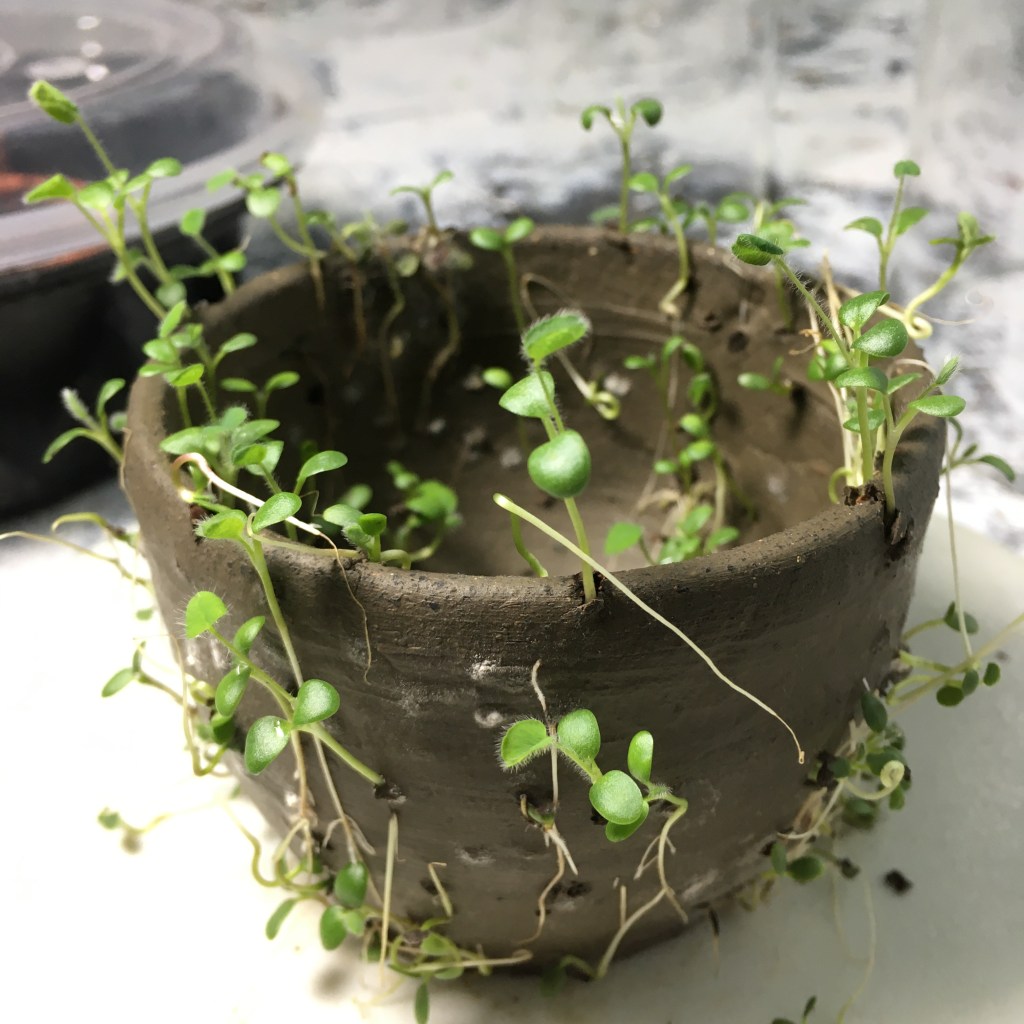
  • Should I include my “life pots,” the cups and bowls that have plants growing out of them?
  • Should I include “Solastones”?
  • What would be the purpose of the rocks? If rocks are impractical, what could be a good substitute? What would be lost?
  • Should I video the entire duration of the show? What would this do to it in terms of how being surveilled may effect their experience?

I’ll take a stab at answering one of these, the first and most important of all — what do I want people to experience when they see my show?

I have to smile because David asked me this question back last winter when I was so thickly depressed that I was incapable of imagining having a show, never mind imagining what it would comprise or how I’d want my viewer to feel upon seeing it. All I could respond with was, “I don’t know.” Seven months later, as I’m out of the worst of it, I’m just so grateful to be here, to have an idea. Now, it’s a matter of articulating what this idea means, or at least what I want it to mean. I think this is an example of what it’s like to be an artist: knowing what you need to do before you necessarily understand why you need to do it.

I want my show to have people consider the psychological weight of the moment we’re in. Catastrophic climate change, the insect apocalypse, and the sixth mass extinction event, all caused by us, are on people’s minds, as can be seen by the increasing numbers of people suffering from eco-anxiety and grief. As we go about our busy days, we may not often stop to think about how uncertain our future is, with extreme weather events, drought, rising sea levels, food and water shortages, and mass migrations to name just a few of the issues we face. Yet we are aware of the situation, and many feel consciously anxious or hopeless, or both, about it. Even for those who aren’t consciously concerned about environmental crises, the knowledge is pretty much inescapable, and I suspect that everyone has some amount of tension in their lives as they witness the current catastrophic weather event and wait for the next. Who will it hit?

My show is meant to bring this tension to the fore. Cups and bowls are normally harmless objects we store in our cupboards. We take them, like so much, for granted. Here, they become embedded in violence. Walking into the show means destroying them, yet that’s what’s expected of viewers to do. Within the paradigm of the gallery system, we are invited to enter this space. In this case, to read about the show (via my statement on the wall), people would need to get to it, leaving a path of destruction in their wake. Or will they tentatively step only where others have stepped, attempting to do as little damage as possible? What does that imply? Is it okay to benefit from the damage done by others before us? When people get to the wall with my statement and read what I say, will they regret walking in? Will they experience momentary solastalgia? Will they feel guilty, or will they feel my show is full of shit, that they are so not implicated in the catastrophes I’ll describe on the wall? I think this show will open up various questions such as these. It’s not that I want people to walk away feeling culpable, but that I want them to feel the personal as well as collective consequences of our actions on the planet, and to recognize that having anxiety and despair about the state of the environment makes complete sense.
Class Post 3: dialogue and dialectics

This week, my assignment is to watch Hito Steyerl’s How Not to be Seen: A Fucking Didactic Educational .MOV File, 2013 and answer the question, “What constitutes dialogue (as it pertains to an art practice; to your art practice)?”

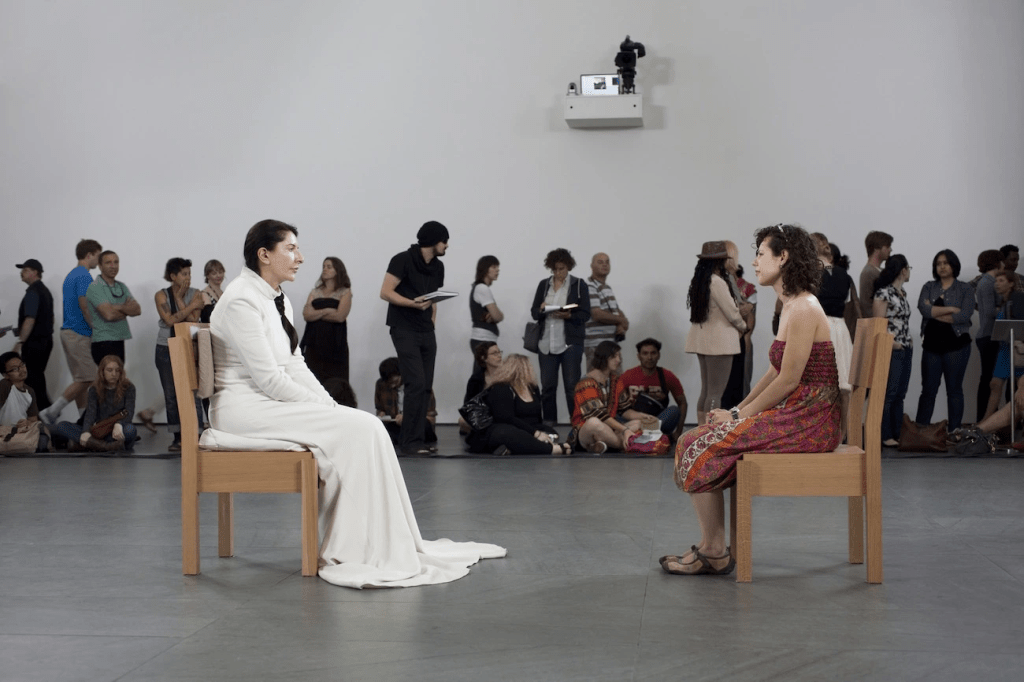
When I consider what this video piece is doing, pointing at the fact of our constant surveillance and the panopticon of ubiquitous images, I think that it is entering into dialogue with so many other works, among them Marina Abramović’s “The Artist Is Present” (2010).

That Abramović chose to “merely” sit and look at people defies the trend in society to “disappear” people, to make them invisible, as the Steyerl satirically demonstrates. What she did by staring at 1,000 people over three months was to tell them each that they are seen. Many were brought to tears through this experience of simply (though so uncommonly) being observed.

image source

This is in contrast to the world which Steyerl captures in this video, where, as Michel Foucault puts it in Discipline and Punish: The Birth of the Prison, with panopticism, each person

is seen, but he does not see; he is an object of information, never a subject in communication.

(Foucault 200)

This means that Steyerl entered into dialogue with Abramović by creating this work three years later. They are coming at the issue of what it means to be seen from two different angles. It’s as though Steyerl could have seen the Abramović and been inspired to respond by saying “right: this never happens; instead, images of us are everywhere and make us disappear.”

Dialogue is conversation. Works of art talk to one another each time we view them. They may talk even without us. Visual art is storytelling (usually) without words.

I am considering my final exhibition, and the vision I have involves covering the entire gallery floor in super-fragile cups and bowls of bright orange ceramic made from local clay. Viewers will need to enter into the space, crushing these forms as they go, to read my statement and (possibly) see videos that are projected onto the walls. Ideally, I’d also have very large rocks for people to sit on and contemplate the installation (though this may prove financially impossible). I’m curious to see who will decide to enter the show and who will turn away. I’m considering videoing the exhibit, informing people that by entering the space they are agreeing to being videoed. Were I to do this, it would be suggesting accountability: that we are being seen as we destroy the planet for future generations; that there will be a record. On the other hand, I don’t know if I want to bring that thread into the discussion. The main point is to provoke a private contemplation of the situation we’re in (with climate change) and of how it impacts us emotionally. I’d like the installation to be an acknowledgement of eco-anxiety/solastalgia. This is core. This can’t happen while we’re knowingly being surveilled. So, this videoing aspect is one of many decisions I have to make very carefully. Whatever I choose will change the conversation that this show sparks, the dialogue between between me and the viewer, and between my work and others’.

This work would also enter into a dialogue with other art dealing with climate change as well as pieces about contemporaneity. This is the moment we are in: the climate crisis is on people’s minds. As the news tells us, “Climate anxiety and PTSD are on the rise.” Art is a response to life; we will be seeing more work that addresses this anxiety that at least half of us (in North America) are experiencing.

“A 2020 poll from the APA found that more than half of respondents were somewhat or extremely anxious about the effects of climate change on their own mental health.” source

While entering into these dialogues (with people; with other works), I hope my show will also engage in dialectics. If cups and bowls are functional items of our daily lives, why are the ones I create purposefully unusable? What is a cup if it cannot hold water? What do these cups say about their very long history of holding water? Our connection to that water? What do they say about what we take for granted in our daily lives? What we are on the cusp of losing? The ease with which they break; the jarring sound of their collapse: when did cups become so dangerous? Can we use form to talk about the destruction of form? I’d like to provoke these questions. In other words, I’d also like to enter into the dialectics of the contemporary moment itself.

According to John Molyneux in The Dialectics of Art,

Art matters because of its ability to articulate in visual imagery the social consciousness of an age, in a way that aids the development of the human personality, and our collective awareness of our natural and social environment.

This broader dialogue, these arguments about the establishment of meaning in our times, is what I strive to join with my own emerging practice.

Foucault, Michel. Discipline and Punish : The Birth of the Prison. Second Vintage Books ed. New York: Vintage Books, 1995.

Class Post 2: a non-studio studio practice

For this week’s readings, we needed to look at Daniel Buren’s “The Function of the Studio” and a couple of YouTube videos on him. We also needed to read Jerry Saltz’s “How to Be an Artist” and then respond to the question, “What is a studio practice?”

According to Buren’s essay, a studio is a place where work is most authentic; it is like there is a private agreement between the artist and the physical space that whatever takes place there only needs to exist for and be understood by artist, no one else. Once work leaves the studio for the gallery, in a way it fails to exist as it was created (it enters the “cemetery” (54) of a museum, for instance). It’s now in the public sphere, subject to anyone’s guess as to its meaning or purpose. There is a paradox here, in that artists most likely wants the work to leave its private existence in the studio, and so in effect it is created for its own “extinction” (58).

Before watching the interview with Buren that Risa also suggested, I may have misunderstood his real purpose in writing this essay. I got that he a cynic of the studio-gallery system; however, I didn’t realize that his own practice offers an alternative, that his work has been key in defining the term in-situ for art. This was great for me to learn as I’ve created in-situ art and wish to make more of it in the future. I want my practice to reach an audience that may not ever step inside a gallery. As Keith Haring is quoted as saying in “Keith Haring on How to Be an Artist,” “The public needs art, and it is the responsibility of a ‘self-proclaimed artist’ to realize [what] the public needs are, and not to make bourgeois art for the few and ignore the masses.”

I’d been thinking while reading the Buren of a text I came across in Sherry Farrell Racette‘s Indigenous Land Art course I took in the spring of 2021. Tanya Willard wrote a BUSH manifesto — a statement of purpose of the BUSH gallery — for a special issue of C Magazine. What is BUSH gallery, you may ask?

BUSH gallery is alive and breathing.

BUSH gallery is eating whipped berries under the stars, punctuating conversations and visits about art.

BUSH gallery is an autonomous space… for birds.

BUSH gallery can disappear.

BUSH gallery fits into our pockets.

Willard, pages 8-9

BUSH gallery is an example of artists taking their work outside the white cube entirely and questioning what art looks like when existing outside of that system. This is especially important from the Indigenous perspective (and therefore to all of us), one which is underrepresented in galleries and artist-run centres (“There are no contemporary art galleries or artist-run centers on First Nation reserves/reservations because people have been too busy surviving” (Willard 10)).

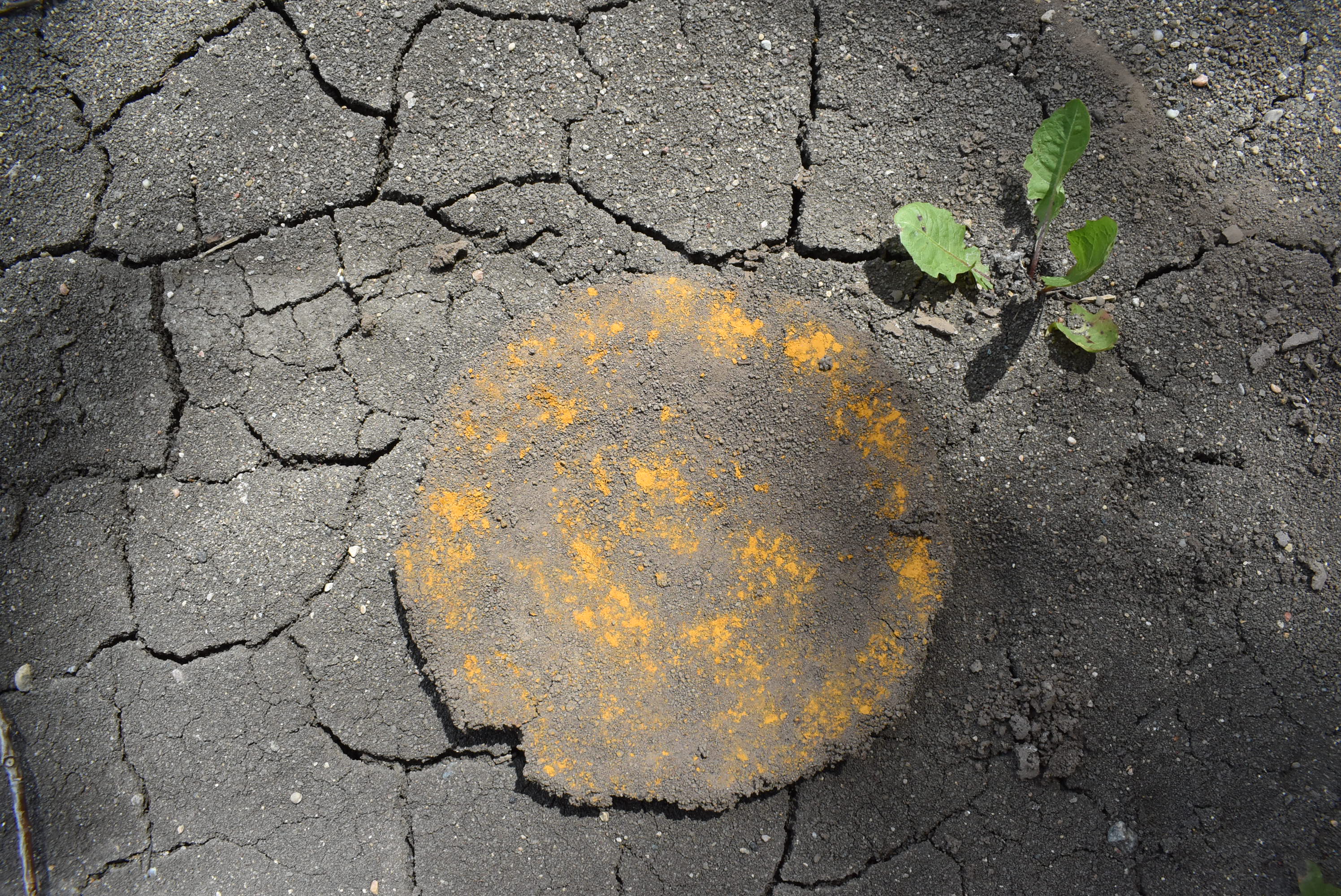
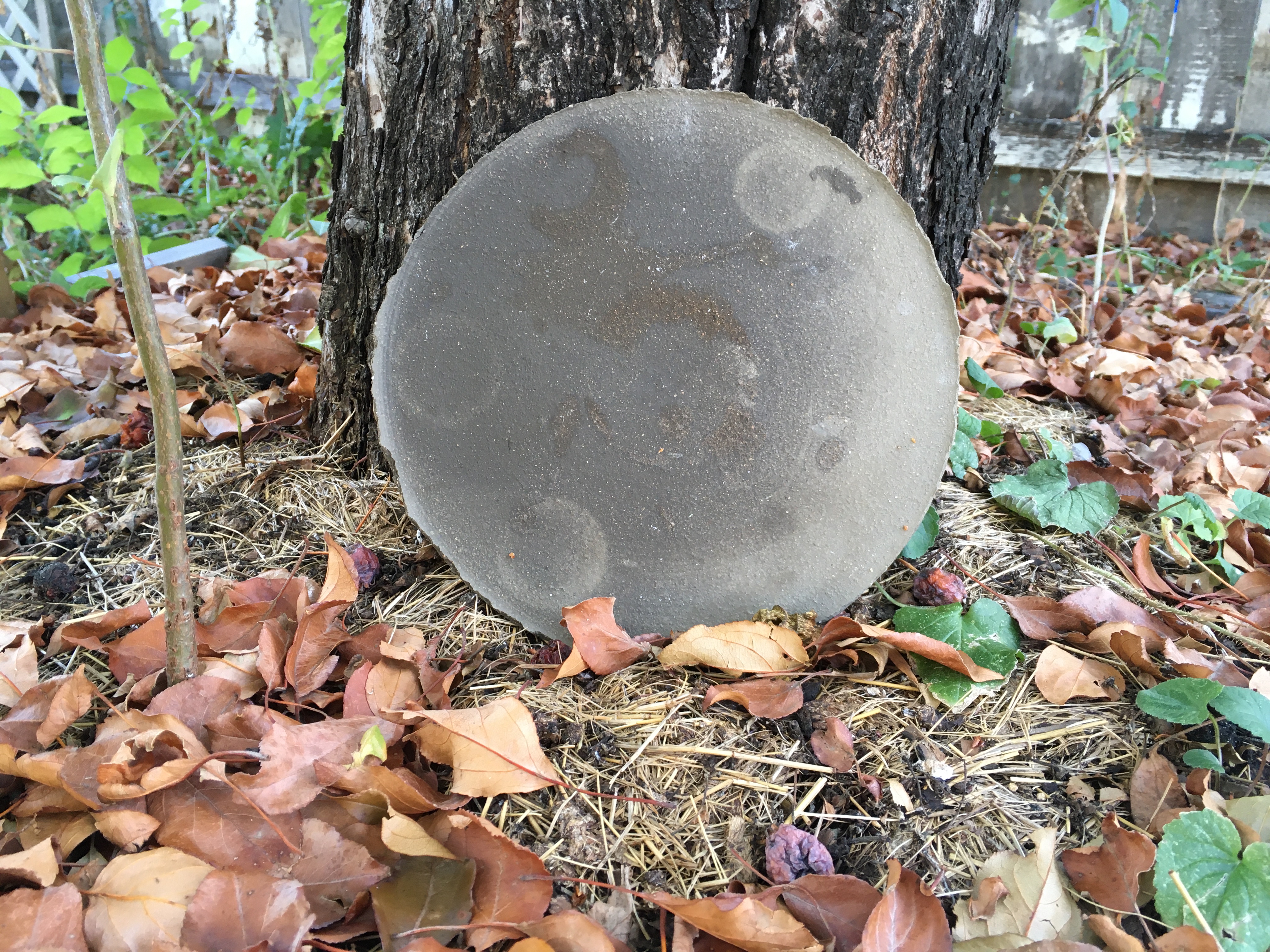
Sherry had us foraging for natural art materials from within the city due to Covid-forced restrictions on the field trips she’d dreamed of taking us on. We found plants, pigments, and clays with which we made work. We created and installed pieces outdoors, and this is how I came to watch and document many Dust plates erode back into the soil from where I’d dug their clay.

Plate made by Sherry Farrell Racette, installed at the U of R, June 2021.

What was the studio to us in that class? It was the city, mostly, and in fact it was also the places where we travelled: several of us took our own side trips looking for materials and inspiration. I spent a few days at Duck Mountain Provincial Park, digging clay and just being inspired. My studio practice includes crucial moments that take place while going for hikes and swims, I learned in that class. I don’t think Buren would disagree at all, in fact, I learned in the YouTube interview that he first came across his famous stripes wandering a marketplace in Paris.

I was pleased that while Buren’s article is dated in a few ways, he does write about the gallery as conforming to and therefore contributing to larger social systems: “By producing for a stereotype, one ends up of course fabricating a stereotype” (55).

If being an artist is, in part, breaking down the systems and stereotypes around us, I think it’s very important that we consider our studios in a new way from how they’ve traditionally been envisioned. A studio practice should take place least at times beyond walls and high ceilings, past the electric lights, or at least bring in as many people as possible to share the work that is the artist’s communication to the world in its most authentic state. This doesn’t mean that we can’t or shouldn’t incorporate galleries in our practices, but that we should be aware at least of what their frames may do to our work. In short, Buren’s essay, though nearly as old as I am (and I’m middle-aged), is still a valuable read.

Buren, Daniel, and Thomas Repensek. “The Function of the Studio.” October 10 (1979): 51-58.

Cain, Abigail. “Keith Haring on How to Be an Artist.” Artsy. https://www.artsy.net/article/artsy-editorial-keith-haring-artist. Accessed 14 September 2022.

“Conversations; Artists’ Influences.” Art Basel. YouTube. https://www.youtube.com/watch?v=S1ejR3ZQVd0. Accessed 14 September 2022.

Saltz, Jerry. “How to be an Artist” Vulture, November 27, 2018. https://www.vulture.com/2018/11/jerry-saltz-how-to-be-an-artist.html. Accessed 13 September 2022.

Site/ation. Special issue C Magazine 136. Tania Willard, Peter Morin, eds. https://cmagazine.com/issues/136/pdf. Accessed 14 September 2022.

Group Studio (Fall 2022) Class Post 1: my vision forward

It’s the start of another school year, and my third in the MFA program at the University of Regina. I’m entering my year of prep for my graduating exhibition and defense, and I’m excited to see what sorts of new challenges I’ll need to overcome and what they’ll teach me.

I’m taking the last of the four Group Studio courses that this program requires. In these classes, students focus on developing their non-studio skills as an artist, primarily practicing how to speak and write about their work in the art world and beyond. As my prof for this semester’s course, Risa Horowitz, put it in the syllabus, “the MFA Group Studio is more about being an artist, than doing the art.” It’s a brilliant addition to the MFA program, and each prof I’ve taken it with has brought a different approach and usefulness to the course.

One of our assignments for the semester is to keep a blog on the weekly readings and viewings we have to complete. This week, we were each given different sections from Living and Sustaining a Creative Life: Essays by 40 Working Artists, edited by Sharon Louden, and asked to write a “vision forward” answering the following questions:

What do you see and wish for yourself as an artist in the next year, 5 years, 15 years, and beyond? What do you envision your day-to-day and your big picture will look like? What sort of life-of-an-artist do you want for yourself? What kind of career do you want? What compromises and risks do you think you will need to make to accomplish that life? How will you cope with failures, and manage successes?

I’m grateful to be shown this book right now, as these are pressing questions for me as I come close to completing my MFA. First of all, I’m just starting to be able to envision myself as an artist, though I’m not quite there. This means that picturing my future practice seems very much like dreaming. What do I wish for “myself as an artist”? Well, just to be one, one day. I wonder if I’ll ever overcome that one. On top of that, I’m hyper-aware of the difficult practical reality of trying to make it as an artist. In the last year or so, as I’ve started allowing myself to even think about this dream, I’ve still been certain of its impossibility. This is where this book’s so helpful. From the three sections I’ve read, I’ve learned about four artists who are sustaining themselves through their creative practices. They write in a very frank and straightforward way, and it almost makes it seems as though it’s actually possible to make a career out of art-making. If so many (40 in this book alone) can do it, well, maybe I can too.

Maggie Michael and Dan Steinhilber are partners who are both artists. They each write about the way they make it work, juggling various roles including parenting. I can associate with them quite a bit, as Mike is an artist (creative writer) who is also a prof, and we share parenting duties too. Maggie mentions that “[a]rtists often partner with someone who has a reliable career and income” (120), though she herself has no regrets. In my case, I have a certain amount of pressure and need to contribute financially to our household, but at the same time, I know that Mike will do anything he needs to in order to support my growth as an artist, and this is something for which I’m grateful.

I found a lot I could associate with in Justin Quinn‘s account. While he talks about having a dream vision of being an all-star, his actual sustenance sounds dreamy enough to me. Commuting “by foot or canoe” (98) to his full-time university teaching job, having a studio on campus and one at home, and having art production that is “steady” (99) sounds like a highly successful juggle to me. What I took away from Justin’s segment the most is how for him, “[e]ach component [of life] — family, teaching and creating — works to keep the other parts going” (99) and that “sustaining a creative life means that life has to be nourished first. Creativity follows sustenance” (100). I understand the importance of striving to find this balance and nourishment, and it’s good to know that it can actually happen for some.

I put more asterisks and underlining in the Jenny Marketou photocopied section of this book than the other two I was given. Jenny has a very clear sense of what she wants from her life, and I can associate with a few of her goals. She realized early on that she needed to pursue “professional art”; she says, “I enjoyed theoretical debates, and practicing art was a way to stay grounded, and at the same time free and use my mind” (80). I think I too need to have some theoretical debate in my life, and that’s likely what led me to take this MFA. At the same time, Jenny decided that she would not tolerate the exploitation of being an adjunct professor, and so she left to pursue her own “creative ambitions as a self-employed artist” (81). I have a huge admiration for anyone brave enough to do this. Jenny admits that “[m]aking money seems to elude [her]” (81), and yet she’s willing to take the risks involved and work extremely hard at sustaining this life. She also knows that she’d rather find her work on the periphery of the art-world-system, so she makes use of “the museum gallery, the public squares, subway platforms, streets and protests as site[s] of production, where the work is produced and supported by commissions, artists’ fees, grants or in-kind sponsorship from education departments” (81). In this sense, she sees herself as a “knowledge entrepreneur — a free agent” (82), and I love the way that sounds.

As I prepare to finish this MFA program, it’s time I need to consider what my next steps will be. As I’ve said above, I haven’t given a lot of thought to creating a life as an artist because I haven’t seen myself as living that life. It’s still a dream, but even that is a life-shifting change for me; until very recently, as in within these last few months, I never even had that dream. I started taking art classes seven years ago just to put something I enjoy into my life. It never crossed my mind that I’d be able to do this — what I enjoy — as a living. However, as I adjust to the idea that I may just have an MFA in a year or so, the possibility of continuing to make art (as I can’t stop now) AND even leaving my current career as an ESL teacher, a job which I now know contributes severely to my mental health issues, well… maybe it’s time to allow myself some dreaming and see where this can actually take me.

If I were going to entirely blue-sky my future vision for five years from now, it would go something like this. I’d work half time (tenured) for a university in a small to medium-sized city that has a reputable visual arts program and top notch studios and facilities. This city would be a place that encourages the arts, and of course environmental sustainability. It would also be somewhere next to intense natural beauty, likely either right in the mountains (i.e. Rocky; coastal) or on an island (i.e. Vancouver; Salt Spring). I’d live just outside of town with a large enough plot of land to garden and keep chickens, and possibly a pet pig … and there’d be a lake or ocean swimming hole for necessary water access. There would be trees immediately on my property, but not so many in the surrounding area; forest fire would not be a worry. On days when I have time not to drive, I’d be able to make the longish bike-ride into town to work and spend time in my studio (though I’d have one at home as well). I’d gain a sense of daily structure, community, and purpose from my work responsibilities and relationships with colleagues and students, yet being half-time, I’d also have sufficient time to work on my own projects. I’d have shows, installations, and performances globally, often outside the typical gallery-setting, and I’d occasionally be asked to give talks and workshops and collaborate with my peers. I’d have time to putz around in the garden, swim, kayak, and cook, hike and bird-watch with my husband, but fitting all of this in would keep me very busy. Weekends and vacations would be something to look forward to. Ha!

I know that the above is just a fantasy. But what can it teach me about how to plan my next steps post-MFA? What parts of the above dream-life should I actually strive to reach? Is the decision to teach half-time a cop-out — a means of avoiding making a decision (to teach or not to teach) or a sign of cowardice (as impossible as it may be to get a tenured position, the thought of “making it” as an artist seems even more unachievable to me). These are questions I have to continue to work hard to answer in the coming year. If I’d like to attempt to get a tenured teaching position, I’ll have to start doing the work that that entails now; looking into programs across the country, seeing who has been recently hired and their credentials, and making sure I build a CV that will be looked at favourably… giving lectures, having shows, etc. I’m already doing a bit of this, but I’d have to amp it up.

What would it mean to abandon the idea of teaching entirely and focus that energy on establishing myself as something of a “knowledge entrepreneur — a free agent”? One challenge would be psychological, as I’ve already made clear. Another challenge, of course, would be financial. Mike is about to retire in three or four years. Where could he and I live that would afford us a decent quality of life on mostly just his pension and whatever dribs and drabs I could bring in? What sacrifices would we need to make to live that way? Location, lack of travel, less organic produce? While we’re responsible, we’re not good at budgeting. This decision is a joint one, and it’s huge.

I think this at least partially answers Risa’s question of “[w]hat compromises and risks do you think you will need to make to accomplish that life?” At least, this is the best I can answer it right now, given how entirely vague and fantastical my plans are. In terms of her final question, “[h]ow will you cope with failures, and manage successes?” I have even less of a clue. All I can say is that failure, or rather not even attempting this life in the first place, has been my go-to from the get-go. I think I’ll be over-the-mood thrilled and recognize my luck and privilege should I be able to make art my life at all, one way or another.

recent tests and questions

It’s the end of this spring course I’ve been taking with Lindsey French, and she’s asked me to reflect on my practice—where I want to take my work in the fall when I’ll need to begin preparing for my MFA graduating exhibit. What do I want to show people? She also asked me to consider how this show could support my practice rather than seeing it as only an end in itself (the end of my degree).

This is a challenge. First of all, I’m still hugely indecisive about just about everything in my day-to-day, and certainly about what I’d like this show to be. The impetus keeps shifting. This is a problem for someone approaching the equivalent of thesis-writing time. Secondly, it seems impossible to imagine myself having an art practice, so I can’t say how I’d like to see this degree support it. Still, I’ll try my best here.

First premise—I’d to give viewers of my show the experience of entering a space that is different from the ones they normally inhabit. I’ve been considering ways to do this by employing largely this local clay I’ve been digging up from Madeleine Greenway’s garden. If I use a traditional (indoor) gallery setting, I can imagine covering its floor with a liquid slip of this clay, meaning that viewers would need to leave footprints wherever they walked in the gallery to look at other pieces or video I’d include. Maddie’s clay does crazy things when it dries on certain types of flooring.

My issue here is that this may not convey what I’d like this show to convey. It’s true I once tried to get clay to crack in ways that would mimic drought-parched land, as I wrote about over a year ago. I failed at getting processed clay (terracotta) to crack in a way that satisfied me, and now, with this local clay, I may be able to. That makes some sense.

However, this work took place was when I was representing the physical effects of climate change in my pieces (melting glaciers, drought, species loss, etc). More recently, my work has been focused on the effects of climate change on me and my family, personally. The issue here is that this effect is a moving target moving between complete despair and some kind of acceptance (never hope), yet I need to know what to focus my work on for the next year… now.

There something about the frailty of the forms that this clay allows me to create which I’m drawn to, something about our own frailty as a species and/or the frailty of Earth’s ecosystems as a result of what we’re doing to them. As Lindsey said during our chat last week, the cups and bowls, as opposed to the splotches of liquid clay drying on the floor, are very human, and this appeals to me.

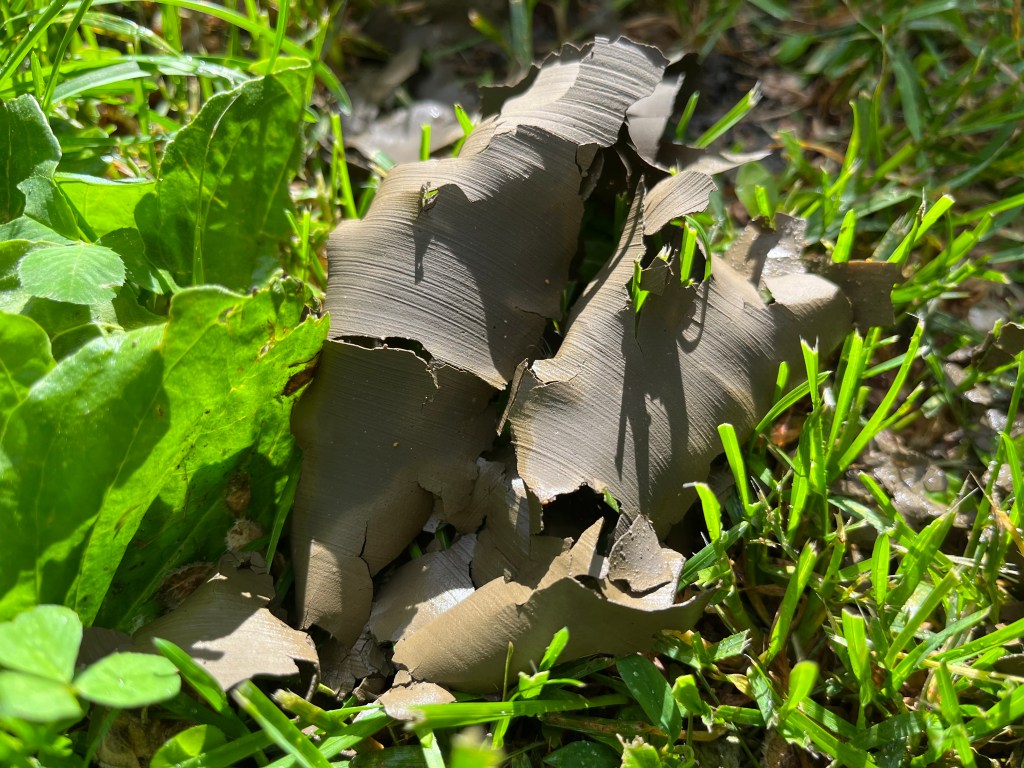
So, another option is to cover the entire floor of a gallery with thin unfired bowls. I’ve tested out what this could look like on a smaller scale, and outdoors.

I did a couple other tests with these thin forms in the last week.

We had one more good rain, so I was able to get a second take at this test, too.

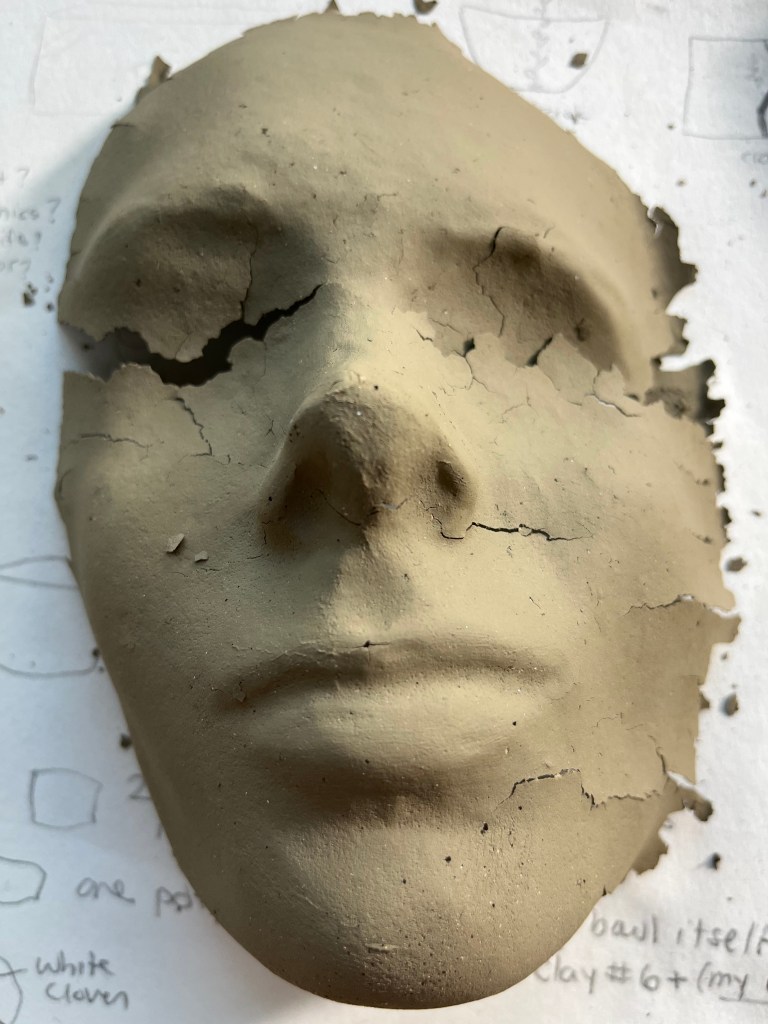
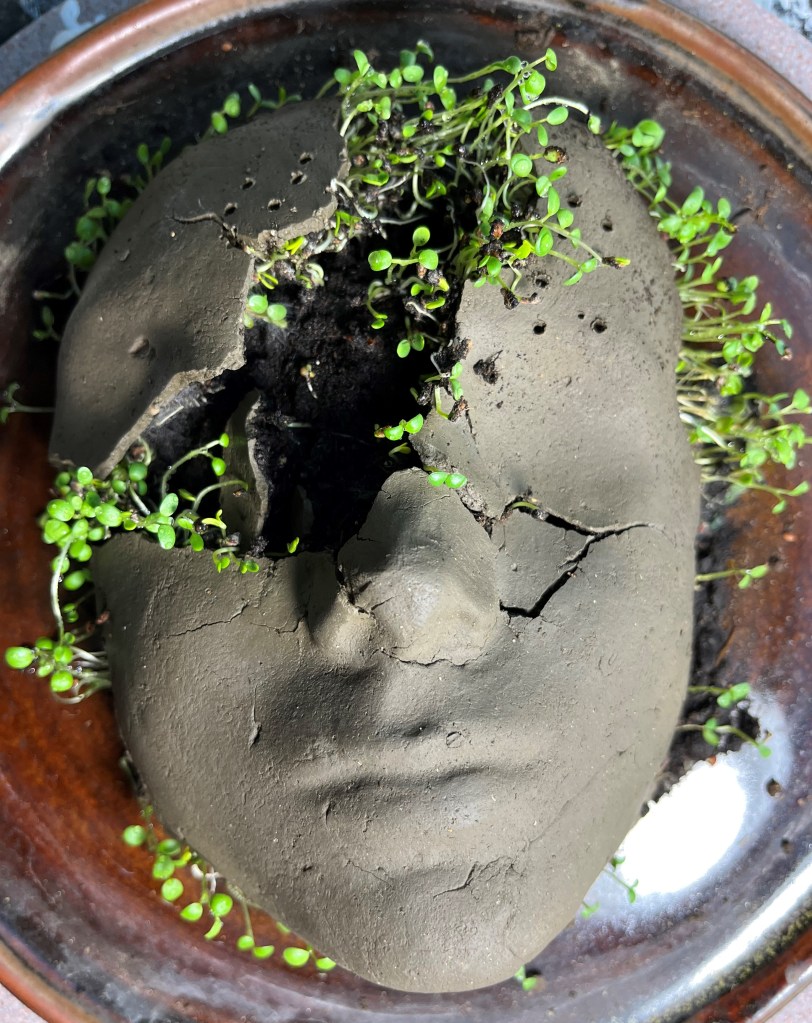
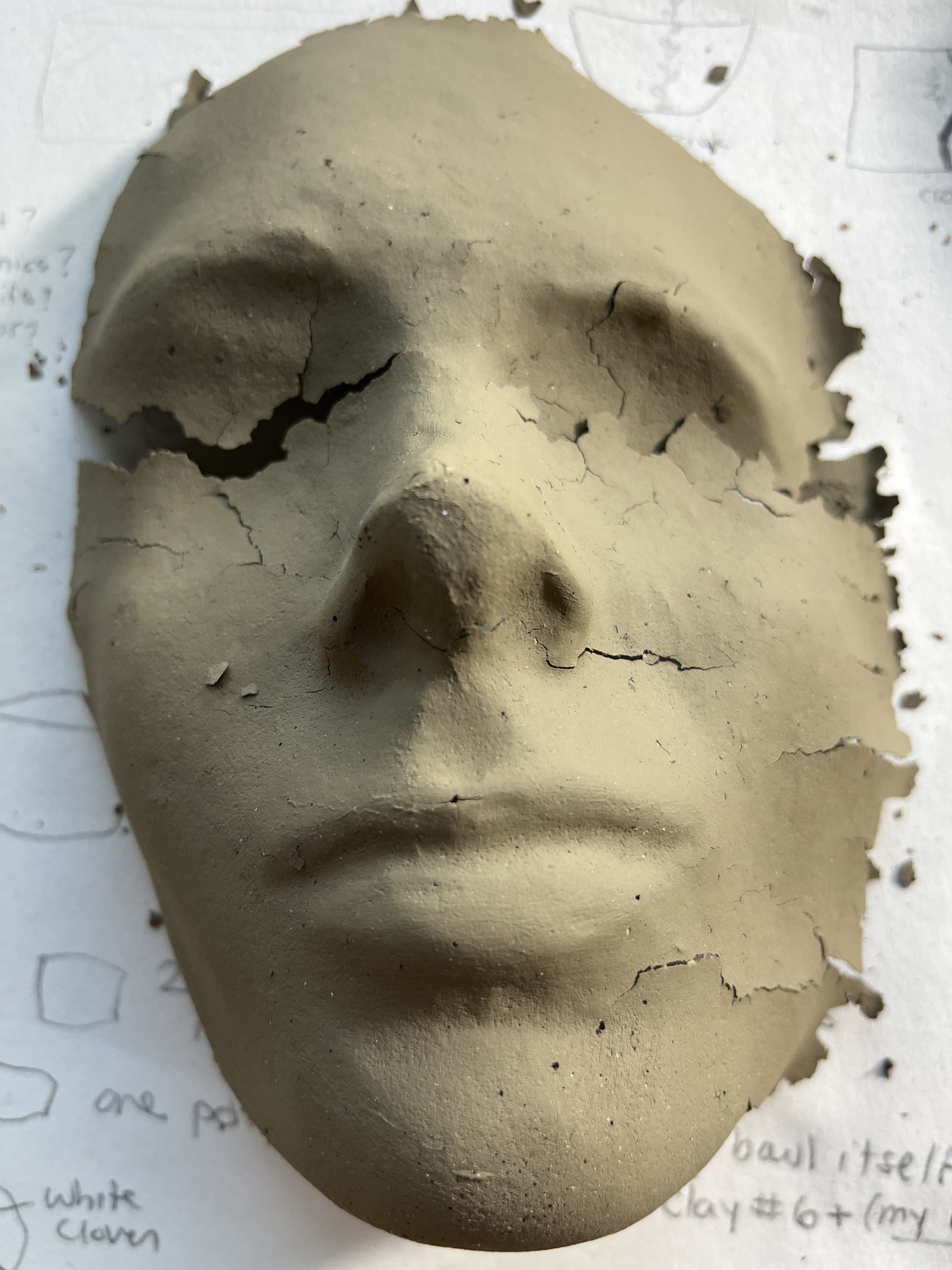
I also experimented with putting the clay cast of Jakob’s face outside in my garden to let it grow, though I’ll need to repeat this test with a new “face” using a few things I learned from this time through.

Another decision I’m still not able to make is whether to have this show indoors or not. I’ll need to spend the next while thinking about how site is important to my work, and also how I’d bring viewers into an experience that may be physically remote (distant) and weather-dependent. Will the show itself be an event, a performance of ephemerality, or will I rely on documentation of an outdoor ephemeral piece to reach a wider audience?

Also, if I see this show as first and foremost important to myself, as opposed to for my profs, I’ll likely have a different set of outcomes and a different way of measuring success. These are each points I need to spend more time considering.

Just as importantly, if I wish to proceed with clay as my primary medium, and Maddie’s garden’s clay in particular, I’ll need to resolve what it is I want to say with this material, and before I get there, what it is about this material that speaks to me. A few of the tests above that speak of violence, destruction, and loss. Then, there are a couple that have a less brutal, more naturally cyclical element to them—somehow they are more accepting, or peaceful (if not hopeful).

I hope to be in a better place after this summer and to know with confidence where I want my focus to be in my practice, at least for this one show. To be honest though, I’m worried about how this year’s fire season will effect me. In the last little while, the weather’s been helping in my recovery from solastalgia, locally at least (and I’m trying to pay less attention to the news). Here in Regina, we’ve had a few good rain showers, and while the trees are still exhibiting signs of extreme distress, such as by dropping record numbers of seeds—a tree’s dying wish—in this present moment things are good and green. Right now, in the middle of this sixth mass extinction the world’s seen, there are so many birds singing in my backyard, and bees are constantly visiting my pollinator garden. This doesn’t mean I believe the problem is any less serious, it just means I’m privileged enough to live in this tiny oasis. Still, for my own well-being, this spring hasn’t been emotionally crippling as last year’s heat domes and forest fire smoke. (I just got gifted a pair of socks that announce to the world that I’m “a delicate fucking flower”). Others in the eco-stress support group I started feel similarly. Now, the task for us environmental-sensitives is to build up some resilience for the times when it doesn’t rain or it rains too much. Perhaps my show should be about that, an acknowledgement of our situation and a learning to live with it. I think that’s a task that many people are facing, and that many more will face in the coming years. I can see having a practice based on it.

breakthroughs

I’ve had a wild day for someone who’s been home sick with a cold.

The cold hit me a yesterday, which makes a lot of sense. Yesterday marked a week since my Mom’s week-long visit came to an end, and I think I finally let my guard down. In this week since she left, I’ve been pretty useless. Apart from spending time beautifying my garden, I’ve done nothing productive. I now think this time wasn’t a waste.

First, a bit about my Mom.

It was very hard to get her here to Regina from Vancouver. She required a team to prepare her both practically and psychologically. I knew this challenge was taking place, but I assumed it was for the reason that I’ve known all my life — that my Mom is the laziest person I’ll ever know, that she’s allowed herself to become completely institutionalized, dependent on her care home staff to take care of many things for her that she’s been physically capable of doing herself. Until the last time I saw her, she was actually able to take care of her daily needs, but feigned incapacity because having someone else do these things was easier.

On this visit, however, I realized that she’s now reached the point of actually incapacity. Covid isolation in her small care-home room has done her in. She hasn’t returned to eating in the dining room or going to play bingo and such in the activity hall. She never leaves her room. She’s become both obese and weak. So, now she actually needs help doing everything, and this came as a shock to me. I had no idea she’d let herself slide this much. This meant that her visit took a greater toll on my than I’d expected, both physically and emotionally.

My Mom’s life is a train-wreck. OCD runs in her family. At six she would worry whenever she heard an ambulance that they were coming to take her away. On top of the illness, her first husband offed himself during a weekend leave from a mental institution when my sister was two years old, my Dad was/is a schmuck who left her when I was seven to save himself (“Amy, if I stayed, it would kill me”), and then her boyfriend died suddenly of a bad cold (combined with diabetes) when I was 13. Because of her OCD, she’s never been able to work or participate in society in any enjoyable way at all. My point is, I feel so incredibly sad for her, especially when I see her taking such intense joy from things like listening to the birds in my backyard or going out for an ice cream, and at the same time, I’m furious with her for her absolute weakness and lack of dignity and drive. Of course, this stirs up feelings I had as a child living alone with her in a slummy apartment, caring really badly for the two of us. I’ll never have an answer to questions about both my parents. For my Mom, it’s this: did she have had any control over her life at all, or is my anger at her unfair?

So, I guess it makes sense that I needed some down time after she left. Everything I’ve been doing to recover some sense of equilibrium in my life was just gone.

I was lying in bed this morning, trying really hard to sleep or at least relax. I was hyper-aware of the many small things I needed to get done, but too sick to get out of bed and do any of them.

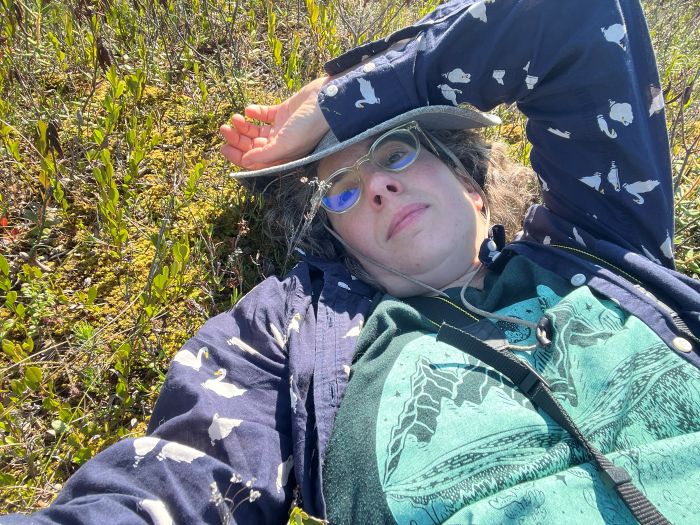
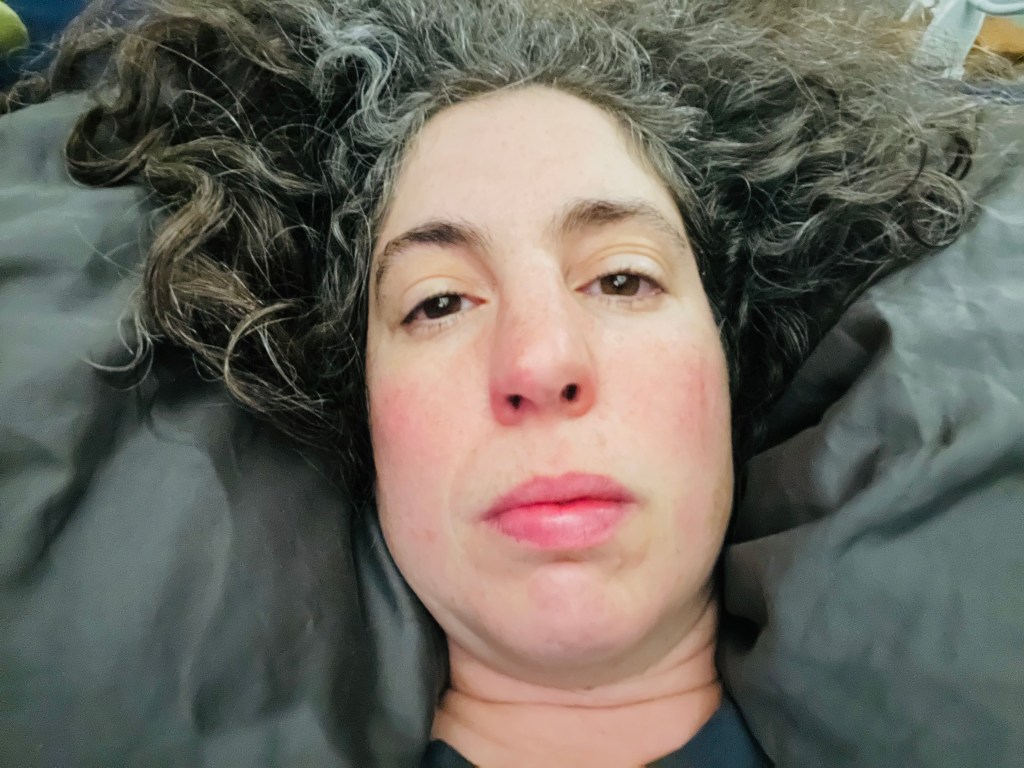
this is the first time I’ve ever shared a selfie

I shamefully started scrolling Facebook on my phone, where I encountered a post by Jeannie Mah that changed everything. It was a section of pasted text from another Facebook post by Velones In Action introducing the artist Jannick Deslauriers.” According to this post, Deslauriers describes her work as:

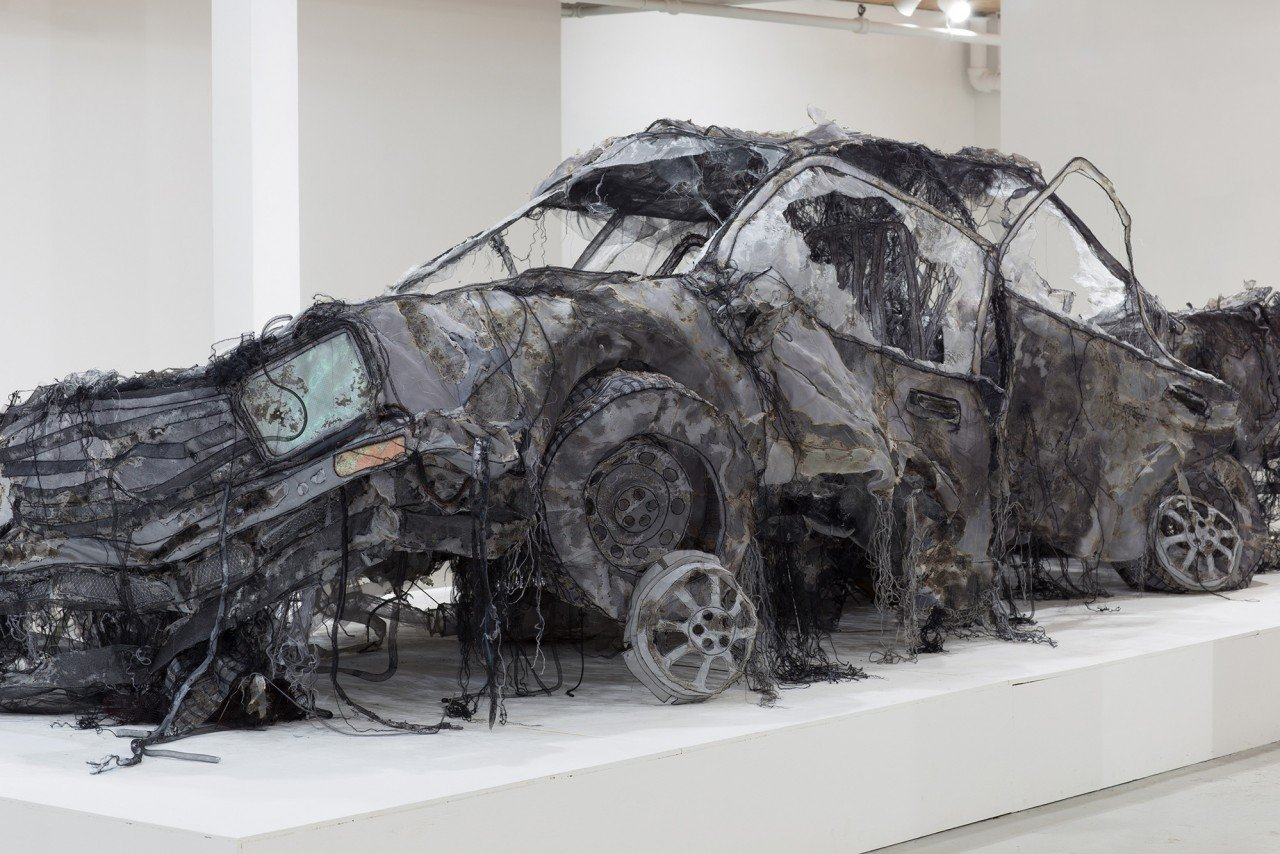
Made of translucent fabrics and threads, my sculptures are intentionally left unfinished and sometimes even visibly damaged, torn or frayed, as if the object has frozen in a moment of destruction. The transparent textile materials and the partial obliteration of my pieces give them a ghostly character that suggests a certain humanity. Like ghosts that have come to haunt us, the objects I make wander and are abandoned. Although light and elegant, their disturbing presence implies something tragic.

This is totally up my alley, and the images of her pieces really spoke to me. (Images are from Velones In Action’s Facebook Post. Here’s info on what Velones In Action is about).

I wish I could see Deslaurier’s work in person and then take her out for lunch.

What’s really neat is that just before giving up on verticality and going to bed, I’d tried sitting and reading a book I’d slid off my shelf when I was feeling shitty yesterday. What’s Next? Eco Materialism and Contemporary introduced me to New Materialism, which is a field of inquiry I believe Deslauriers’ work responds to, and I would love to chat with her about, hence the lunch invite.

This is yet another book I owe thanks to my husband, Michael Trussler, for bringing into our home (this one as a gift to me a few years ago, one I flipped through at the time and then shelved — I wasn’t ready for it).

New Materialists, in a nutshell, are interested in the world’s materiality and see value and wonder in every object that exists. According to Linda Weintraub’s description of it,

New Materialists construct conscious relationships with all forms of matter, including such common objects as paperclips, coffee mugs, pennies, zippers, napkins, shampoo containers, paper cups, birthday candles, junk mail, pencils and plastic spoons. […] These every day, manufactured objects acquire the capacity to enthrall when attention is paid to the elaborate network of professionals whose skills were invested in their production. […] New Materialists are equally inclined to revel in acorns, moss, nail clippings, banana peels, apple cores, chicken bones, peanuts, and egg shells, because each of these items encapsulates ongoing evolutionary struggles and genetic experimentations that originated in primeval times. (5)

Eco Materialists use this attention to every material and sense of wonder at the world to remind us of our own integral connection to Earth, one which industrialization/colonialism has caused many of us to forget. Weintraub invites readers to consider this connection, sharing that we are each in fact physically comprised of so much more than the human, as

approximately one hundred million non-human cells occupy the human body. This is ten times greater than the cells that share the person’s DNA. Human existence, therefore, is not independent and self-determined; it is an ongoing, multispecies drama in which opportunity and emergency are continually being negotiated with myriad microscopic entities. (13)

Wait a second. I’m terrible at math, but does this mean that only one tenth of my body is genetically “me”?

@!#&%

Back to being in bed now, I was lying there looking at Jeannie’s post of Jannick Deslauriers, thinking about material, shifting perceptions of commonplace objects, and the multitudinous lifeforms in my body. Unable to sleep.

I decided there was no point, so I got up and made a quick trip to my studio to pick up a few of my super-fragile unfired local-clay cups and see what I could do with them via documentation. (I threw on some hand sanitizer and an N95 to protect others).

I got home just in time, though I knew not for what. Upon getting in the door, the sky went from Saskatchewan-sunny to overcast in a way that spelled rain. I threw on my rain jacket, grabbed my phone and an umbrella, and took these cups to my backyard to capture them dissolving in the rain, which I knew would happen just from my knowledge of this clay.

I was curled up under said umbrella, my back-end and feet getting wet, while this took place in front of me:

The sky cleared in minutes, before I was ready! There were other cups to try, other angles! Rain is a fickle collaborator. Though, the sun is nice, too.

I then realized I was chilled. My nose dripped onto the grass. Sniffling and sneezing, I wondered about what I was expelling—what inorganic materials and what microscopic animals were leaving me for good? How much of my own preciously limited DNA was in that mix? Where would those atoms end up in the future? They wouldn’t just disappear. What may they become? Would a few of them enter into this backyard’s clay?

Maybe the virus taking over my sinuses made me do it, I don’t know, but I decided to see if I could blow apart a cup by sneezing on it, on video. It turns out that it’s very hard to will yourself to sneeze. I took off my long-sleeved shirt and stood there waiting. I went in and out of the house, hoping for a big chill down my spine, but nothing worked until I stuck a large blade of grass up my left nostril. Three violent expulsions then occurred. And what does the force of the CO2 and these materials traveling at 100mph and hitting a super-thin clay cup look like? The result was anticlimactic.

At the same time as all this was going on, I had a song stuck in my head thanks to a conversation I’d had the day after my Mom left last week. I had the pleasure of meeting Robert Shay, a Kentucky artist who’s visiting Regina to spend time wood-firing with Martin Tagseth. One of the first things Bob said to me, randomly, was, “you must love Leonard Cohen.” I said something like, “yeah, I do?” to which he replied that I must listen to a cover of his songs by some artists I hadn’t heard of. I reciprocated by asking if he knew of Antony’s cover of “If It Be Your Will.” He didn’t. So, among other things I did today while not sleeping as I should have been, I emailed Bob as I’d told him I would to share a link to this song. Hence, I’ve had it in my head all day.

And today, while watching the video I sent to Bob in this email, one I’ve seen many times, I heard Cohen come in (the video cuts to an interview clip) and say something at minutes 1:36 that I’d never really paid enough attention to in the past, as if again, it was waiting for me to find today (which I don’t believe):

A lot of those songs are just the response to what struck me as beauty whatever that curious emanation from a being or an object or a situation or a landscape, you know. That had a very powerful effect on me as it does on everyone, and I prayed to have some response to the things that are so clearly beautiful to me and they are alive.

Leonard Cohen, “Antony singing If It Be Your Will

I’ve appreciated this synchronicity today. It was a gift from the gods I don’t believe in. Or a sign of everything’s interconnectedness? No, I believe these seeming-coincidences are all in our head. Still, I think I’m now ready to move on from mother-visit exhaustion and the creative block I’ve had recently and get back to the self-care I’ve been focused on lately as part of my recovery. But still, I find it meaningful that this cold I have a result of being worn down from her visit played a part in how all of this happened today, from being forced to slow down, to considering my biofluid discharges as an artistic medium. Thanks, Mom.

What’s in a face?

This past winter, as I was exploring the unique properties of Madeleine Greenway’s garden’s clay, my supervisor, David Garneau, asked me if I could think of a vessel that is more personally significant to me than a cup. After taking a moment for this to sink in (doesn’t everyone have a personal relationship with cups?), I thought of my son as that most significant vessel to me. Maybe this idea of the body as a vessel came extra quickly to me because of my training as a potter. We see vessels. As Paul Mathieu put it,

at the conceptual level, all objects are CONTAINERS. They are articulated around the transition between exterior and interior. Containment has to do with the relationship between the object and its environment. Containment bridges an object with its environment. Objects are about difference as continuity, not difference as rupture.

Mathieu 270-1

This way of seeing the world of objects is particularly clear to ceramicists, as “ceramics is the most intimate informed by this theoretical and conceptual framework, in its conflation of a volumetric form with a distinct surface” (271). I understand this notion of seeing any object, a body even, as a volumetric form. I think that my body has an understanding of forms that perhaps those who haven’t spent years handling clay, forming it, may not have. And really, what are we but lumps of clay?

I think I also jumped to my son’s body as I see him, sadly, as having some qualities in common with the cups I’ve been making lately.

Jakob is an incredibly intelligent and sensitive person who knows too much and is constantly seeking to learn more. Whereas his obsessions used to lie within the natural realm, sponging up as much as possible about dinosaurs, sharks, snakes and the like, his interest now lies in the human animal: politics. We need need watch him or he’ll sneak onto to computer to read The Guardian. A compromise is that we let him browse CBC online, but even they, in their pathetic excuse of climate crisis coverage, have headlines that spell doom and gloom, such as this one from last week, “Scientists warn future temperatures will test humans’ ability to survive.”

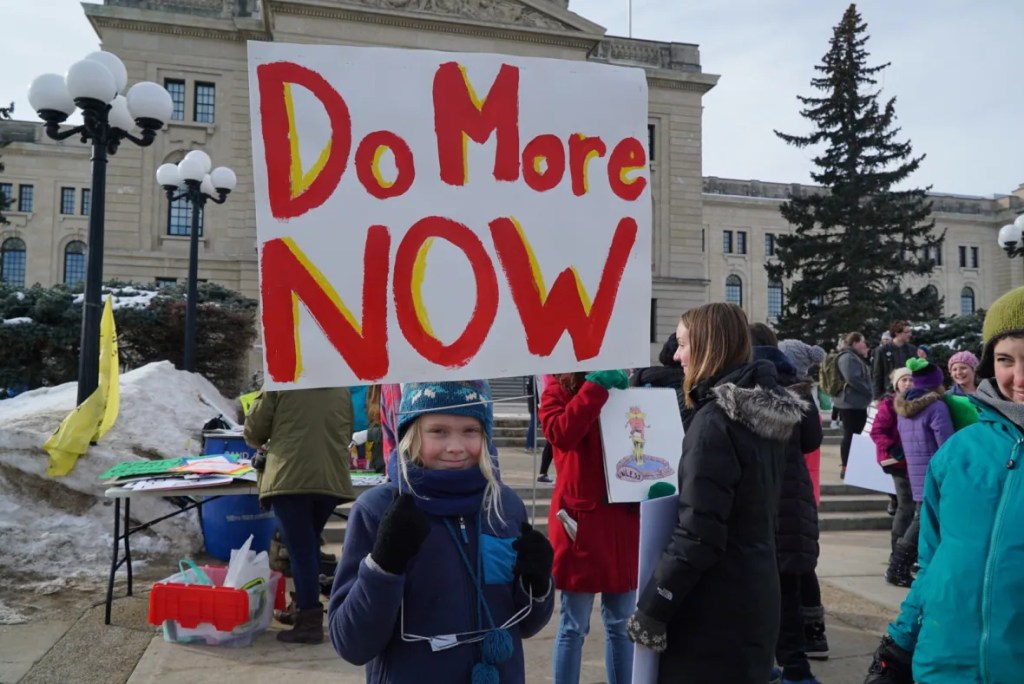
Knowledge about this crisis is hard to avoid in this household I guess. We make some decisions based on their climate footprint, and so of course he knows why we drive a hybrid and never use the clothes dryer. We’ve also attended climate protests together since he was just little, and I could see as he aged that he paid more attention to the placards folks were carrying, many with messages about needing to save the planet, some spelling out the situation in even more frightening terms. Sign that read “There’s no Planet B” or “How can we work when the earth is burning?” are pretty clear for anyone who stops to think about them. Not to mention the “die-in” we all once staged.

CBC reported on one protest here in Regina back in March of 2019 in the article “I’m not old enough to vote, but I’m marching against climate change.” There was a particularly good turnout in front of the legislative building for this “day of global action,” and as you can see from the photo of us in this article, I was proud to be a part of it, proud my son was a part of it.

Yes, I was proud of my son for holding up this placard. His dad and I raised him with the idea that he should be involved in this unfair fight, if not because it would get us anywhere than at least so he’d know he know to stand up and fight, and that ultimately, he did what he could for his age. I was pleased too for times when I’d get this issue in the news, thinking he’d know without a doubt that I didn’t just stand by idly while the house was on fire.

Still, I’ve realized that this awareness and participation can come at a cost for some kids, and this is increasingly on my mind these days. Jakob’s always been matter-of-fact about the reality that our species is causing problems; in fact, when he was five years old, he told me with a straight face that humans have evolved to create the next mass extinction as these things just have to happen every few million years. Lately, however, I can sense this scientific approach to the situation diminishing, or perhaps at least living alongside another perspective, one that involves worry, anger, shame, and fear.

For one thing, he’s started saying “I’m sorry” for no apparent reason up to hundreds of times a day. He’ll say it when you walk past him on the couch. He’ll say it at the breakfast table. He’ll say it when he’s brushing his teeth. When asked what he’s sorry about, he says “I don’t know, I just feel I should be sorry.” It’s a compulsion, and while we (including doctors) don’t know the cause, I have my own theory: he’s sorry for being alive.

It breaks my heart each time he utters these words.

So, this is why I’ve started hiding certain things I do from him. For instance, I did not want him to know that at the start of my MFA, when I was experimenting with performance work, I read aloud Roy Scranton’s chapter of his book We’re Doomed; Now What?, “Raising a Daughter in a Doomed World” across from the provincial legislature on the election day. I try to hide books with titles like this one from his view.

When he’s around, I also try not to talk much about my dust plates, which embody drought and as David says, a sort of “end of ceramics” tied to the end of humanity as we know it. Likewise, he was not invited to the picnic I had with Madeleine, at which we celebrated the abundance of life her garden creates while also grieving its imagined future loss.

I think that if Jakob weren’t the sort he is, clearly anxious and disturbed by what’s wrong with this world, I’d be more relaxed about it too. I’d feel less worry and guilt, at least. At the same time, I’m perfectly aware that the flip-side is also true: if I were more relaxed about all that’s wrong with this world, our son would very likely be more relaxed about it too. So really, we’re stuck being us, feeding off each others’ neuroses. Even our poor cat Toby is medicated, but still pees in our shoes over any slight shift in his daily routine. As Philip Larkin puts it so well,

They fuck you up, your mum and dad.

They may not mean to, but they do.

They fill you with the faults they had

And add some extra, just for you.

lines 1-4

I don’t want this to be true, just as I don’t want the world to be fucked up for my child. Who does? But — here’s my question — how do you raise a child in this world who knows what’s going on and can choose to participate in it, yet who isn’t entirely fucked up by it at the same time?

Karla McManus has generously been sharing some of her time and books with me lately, and just recently sent me this poem after a conversation we had in my studio:

I’m always trying to make this place beautiful for Jakob. It’s what every parent does. It’s what most of us try to do for ourselves as well, it’s just that some are better at it than others.

I’m realizing these days that Jakob’s place in this world is a key component of my art practice. While climate change is perhaps at the surface of my work, it’s also about larger core issues like my own anxiety and grief about the situation, which includes my anxiety and grief over my son’s anxiety and grief.

So, this must be why I immediately thought of Jakob when David asked me to consider other, more meaningful, vessels, and why this ultra thin and fragile version of his face makes complete sense to me.

The frailty of this piece aligns with the frailty I worry he has and will continue to have as climate change increasingly impinges on our lives. At the same time, I’m aware that this piece also speaks about the naturalness of this frailty. This material, this ancient clay, outlives us, and really, it is us. As I’ve written about before, the elements that comprise our bodies all come out of the ground, and back to the ground they’ll return.

I’ve explored this line of thinking by returning to an idea I had last fall while I was really, really struggling to make anything at all, and forcing myself to experiment with bringing *life* into my work with the hopes it would help shift the needle a tad from grief to hope. This idea involves planting seeds directly in the clay body and watching them germinate and grow. At the time, it worked! At least momentarily, the tiny seedlings coming from these cup forms gave me a jolt of joy, an experience of what Deborah Bird Rose refers to as “shimmer.” As I wrote in an end of semester summation that term,

Deborah Bird Rose uses the Australian Aboriginal aesthetic term bir’yuni to describe the brilliance of life as well as art: “the shimmer of life’s pulses and the great patterns within which the power of life expresses itself” (G61). She talks about how after drought, “the rains start to bring forth shiny green shoots. […] Shimmer comes with the new growth, the everything-coming-new process of shininess and health, and the new generation.”

(my post from November 2021)

Developing this more, I’ve added soil in the hollow of Jakob’s face to help the plants live longer.

I see this piece taking a turn towards other themes or ideas, ones about our connection to the land and the its cycles that I mentioned above. Paired with their uber-fragile compoent, I could frame these works as being about our struggle with oscillating on the grief—–hope spectrum, one I know many deal with from meetings of the EcoStress support group I recently created. Do I want to see my son’s face about to disintegrate into life-less clay dust, perhaps focusing on his anguish, fragility, and hopelessness, or do I wish to focus on its potential to sprout new growth from its process of decay, and what would that mean?

I feel that there’s potential here to explore one or both of these versions of Jakob’s face, but at the same time I’ve been asked by several people why I’ve chosen Jakob’s face. This is something I’ve been trying to work out.

To help me think about what faces mean, I first turned to the philosopher who’s written most on it, Emmanuel Levinas. (I owe a lot to having a husband with an enormous library). Levinas sees the face as the pinnacle expression of the Other, or what he calls Autrui. The face is the way we know someone.

In the concreteness of the world a face is abstract or naked. It is denuded of its own image. Through the nudity of face nudity in itself is first possible in the world. The nudity of a face is a bareness without any cultural ornamentation, an absolution, a detachment from its form in the midst of the production of its form.

Levinas 53

The face is the portal into our understanding of the Other. It is unique in this ability; unlike everything else, “the epiphany of the face is alive” (53). I think I was drawn to use the face because it is my entrance-way into my son’s being.

I’ve also bumped into the face in other reading I’ve done. In “On Transience,” it was serendipitous to me that Freud writes, “[t]he beauty of the human form and face vanish for ever in the course of our own lives, but their evanescence only lends them a fresh charm” (305-6). This idea of the face as something that vanishes is another possibility for what I’m on about with my paper-thin mask of Jakob; maybe my work is about our own ephemerality, regardless of climate change and eco-anxiety, just the fact that we all, including my son, are here for such a very short time.

Then, while experimenting with planting seeds in Jakob’s face, I was likewise pleasantly surprised to come across a chapter in a book Karla lent me in which Sabine Lenore Müller discusses “Environmental Modernism: Ecocentric Conceptions of the Self and the Emotions in the Works of R. M. Rilke and W. B. Yeats.” In this chapter, Müller analyzes Rilke’s poem Der Tod des Dichters, “Death of the Poet.” Here are a few of its lines:

Those who saw him alive knew not

How much he was at one with all this.

Because this: these depths, these

meadows

And these waters were his face.

Oh, his face was all this vast expanse

wanting even now still to be near him,

wooing;

And his mask, which now perishes, un-

certain, is tender, open as the inside

of a fruit, decaying in the air.

Rilke qtd in Müller 53

Wow, thank you Rilke, and thank you Müller for showing me this. The face, as an embodiment of our entire being, is really the landscape, nature itself. This is divergent from Paul Mathieu’s notion of the object. While for him, objects bridge the exterior and the interior, for Rilke, we are both of those spaces; we are everything.

As Müller points out, for Rilke,

“the face is described as a vast expanse, the environment itself, meadows and woods, to which the body, which used the human body as a mask for self-expression, yet, was obscured beneath it. In death the mask is wasting away, and the face is finally revealed — the poet’s face was the expanse of the natural world.

Müller 54

In other words, the poet in Rilke’s poem is an example of Heidegger’s Being, connected to everything else in existence. If I place this concept next to my mask of Jakob’s face, I see that through this work I am connecting Jakob to the world. Jakob becomes like Rilke’s poet he writes about, “tender, open as the inside / of a fruit, decaying in the air” (lines 16-17). Vulnerable, yet immortal. Dying, and yet alive.

I have to leave off for now. It’s been good to get all of this into writing, yet I feel like it’s still just a start. I’m not yet decided on if or how I’ll use these pieces, these faces of my son, or if I’ll find something less representational to embody him and what he/we are experiencing. It may be that I abandon the face entirely, but that it will still have informed my work, somehow.


Works Cited

Bird Rose, Deborah. 2017. “Shimmer When All You Love Is Being Trashed.” Arts of Living on a Damaged Planet, edited by Anna Tsing et al, 51-63. Minneapolis: University of Minnesota Press.

Larkin, Philip. “Your Parents.” High Windows. Faber and Faber, 1974.

Levinas, Emmanuel. Basic Philosophical Writings, edited by Adriaan T. Peperzak, Simon Critchley, and Robert Bernasconi, Indiana UP, 1996.

Matthieu, Paul. “Object Theory.” The Ceramics Reader, edited by Andrew Livingstone and Kevin Petrie, Bloomsbury, 2017.

Müller, Sabine Lenore, “Environmental Modernism: Ecocentric Conceptions of the Self and the Emotions in the Works of R.M. Rilke and W.B. Yeats.” From Ego to Eco: Mapping Shifts from Anthropocentrism to Ecocentrism. Edited by Sabine Lenore Muller and Tina-Karen Pusse. Brill, 2018.

Smith, Maggie. “Good Bones.” Good Bones. Tupelo Press, 2017.

(Mostly) At Great Blue Heron

My family just made a camping trip to Great Blue Heron Provincial Park, located 45 minutes north of Prince Albert, Saskatchewan. It was a treat to leave the city for a while and reconnect with the outdoors.

We spent much of our time hiking, which in retrospect was too much activity — we each wished we had another day there to spend doing nothing. It was our first time up there, and there was so much to explore that it was hard to stay still. We’ve learned for next time.

While Saskatchewan still doesn’t give me a feeling of home despite having lived here for half my life now, I thoroughly appreciate it. Up here in the almost-north, the lakes and trees do give me much. Maybe home for me isn’t necessarily British Columbia as much as it is water.

I also thought about how irrelevant provincial borders are when considering the larger systems this land is a part of. For instance, at the trailhead of a hike in Prince Albert National Park, just next to Great Blue Heron, I was reminded of the ice age that shaped this landscape. A temperature shift of five degrees Celsius covered all of Canada in thousands of feet of snow.

I paused to consider the current climactic changes we’re causing and those projected for the relatively near future—some predictions of five or even eight-degree heating. On top of that, Canada’s temperatures are rising at twice the speed of global averages. While I’ve recently felt somewhat more hopeful when Regina, my own small city (pop 229K), approved their fairly ambitious Energy and Sustainability Framework, aiming to keep us in line with the Paris Agreement, I still recognize that the world is past the eleventh hour, and temperature shifts such as the one that caused the last ice age are most likely already inevitable. My non-stop daily dilemmas about how to reduce my footprint are laughable.

Still, we’re here and now, and despite reminders of this crisis all around, I tried really hard on this trip to find calm in seeing the life and death that was all around. We saw 41 bird species, white-tailed and mule deer, a fox, a young moose, and uncountable other wonders on the forest floor.

I also saw my son, Jakob, relaxed. This was a treat, as his own burgeoning anxieties about our current and future world normally weigh him down.

Even here, away from world news (which was particularly awful this past weekend, I learned upon my return), our anxieties were still in the background. I couldn’t shake the tension that I experience physically in my neck, back, and (oddly?), forearms. I tried taking deep breaths and lowering my shoulders, but it didn’t work. My mind wouldn’t stop. I was there but not there.

Jakob too was obviously still processing some heavy stuff. The epic story he told me as we walked several hours each day involved a gentlemanly protagonist, Toby (our cat), dealing with a barbarian invasion amid a plague called kittypox. Just before leaving, we’d seen the news of monkeypox, clearly on Jakob’s mind. It’s strange to be out on a beautiful hike, marveling at your your child’s creativity and skill at storytelling (he’s a budding writer, taking after his dad), also aware that planted in his narrative are fears of disease and social collapse.

Back at home while we were away, I had a fellow MFA student, Sabine Wecker, water a test piece I got started before leaving.

This is an alternate version of a cast I made of Jakob’s face with an extremely thin clay slip. It’s the same local clay body, just presented differently.

I’m still having difficulty understanding what I’m trying to get at with this work, and I’m still not sure it’s the direction I should be taking. I didn’t have the time alone I’d hoped for on this trip to think more about this either, so I’ll have to leave off once again with a promise to myself to figure something out by next week.

Psychoanalysis of a climate change melancholic

I wrote last week about the connection between ephemeral art and mourning, reflecting on Mary O’Neill’s “Ephemeral Art: Mourning and Loss.” One of O’Neill’s citations that I found most helpful came from Freud’s essay “On Transience.” I figure that if I’m now going to cite Freud, I should do so from his original writing, so I went and picked up volume 14 of The Standard Edition of the Complete Psychological Works of Sigmund Freud. Thank god for libraries. After gobbling up “On Transience” (it’s only three pages), I moved onto Mourning and Melancholia. From it, I learned that according to Sigmund, surprise surprise, my melancholia (aka clinical depression) is indeed connected to narcissism, regression, an oral cannibalistic phase of libidinal development, mania, hysteria, sadism, and yes, anal erotism. I feel a whole lot better now, knowing this.

While I stand with many in not agreeing with everything Freud has to say, I have respect his intelligence and much of his understanding of the human condition. A few of his beliefs on melancholia are precise from my experience.

I’ve been concerned that this reading may be a sidetrack from my project for this term, but I’m pretty sure it make sense to spend time here. O’Neill (and many others) write that ephemeral art-making (often) stems from experiences of mourning. So, I’m confident in my reason for making ephemeral work, as I certainly believe I’ve been in a state of mourning over the loss of natural places I love since my trip to BC last summer. Why, though, am I experiencing this? I’m often asked why climate change affects me so strongly, and I don’t have any good, quick answers. People often tell me that this effect climate change has on me has more to do with my own weakness or illness—it’s some kind of psychosis—as to them it’s unnatural and unhealthy to care as much as I do about the situation (as if this existential threat should not be terrifying and tragic). How should I respond to them? More importantly, I need to sort this out for myself. So, it’s time to try a bit of psychoanalysis, as much as one can perform it on oneself, which may be not at all, to see if it will give me insight into my work.

My son and I about to go for a swim on Gabriola Island (2015) (photo credit Michael Trussler); fire burning by a highway in BC (2021)

My first question is, why am I such a nature lover? In “On Transience,” Freud writes,

“We possess, as it seems, a certain amount of capacity for love—what we call libido—which in the earliest stages of development is directed towards our own ego. Later, though still at a very early time, this libido is diverted from the ego on to objects, which are thus in a sense taken into our ego. If the objects are destroyed or if they are lost to us, our capacity for love (our libido) is once more liberated; and it can then either take other objects instead or can temporarily return to the ego.
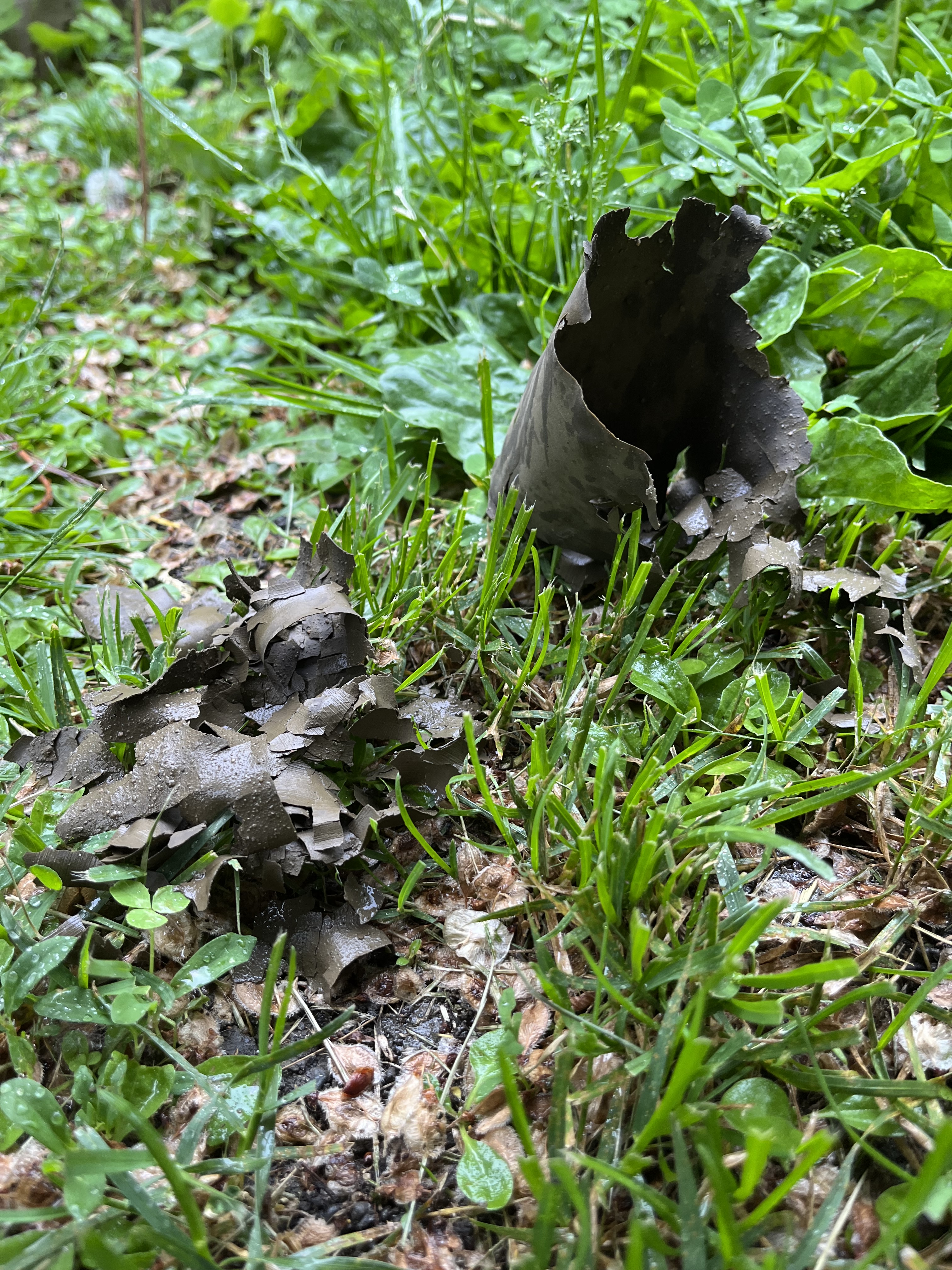
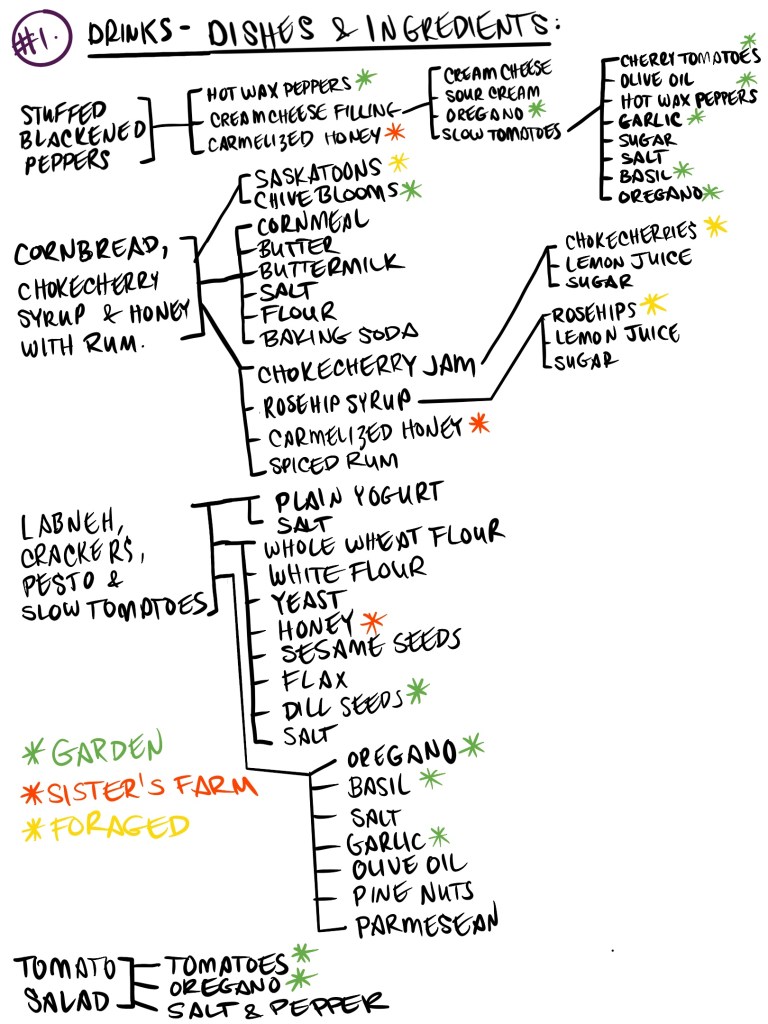
On Transience,” 306

I’m not sure how convinced I am of this limit to one’s capacity for love, but relating the above to my own history is interesting. I grew up alone with my severely mentally ill mother. She couldn’t take care of either of us, and so I had to take care of us both. She had (and still has), among other things, extreme OCD. Hers manifested itself mostly in the form of rituals surrounding every minutia of daily living. Each task (dressing, closing a bottle lid, taking medications) had its own set ritual, always involving a vocalization of information (a visual description of each pill before swallowing it, for example) that would spill out of her in a kind of song she’d repeat in sets of four. Needless to say, it was a huge effort for her to leave the house (and she could never, ever, get anywhere remotely on time). She never held a job, and it’s only because of her parents generosity that she didn’t end up on the street. Our apartment was packed full with mail that would be too time consuming and stressful for her to open, and other clutter and filth too—laundry, bags of used Depends, breakfast dishes going moldy in the sink. We couldn’t cook because every surface of the kitchen was covered in stuff, so I grew up largely on McDonald’s and family restaurants open late. I gradually stopped going to school. The principal sent letters home, but my Mom rarely opened them. If she did and tried to tell me to go to school (or to do anything), I’d tell her to fuck off. She’d sometimes tell me she’d kill herself if I went out with my friends, and I’d still leave. (I always came home though, and always put my Mom to bed.) I said and did many awful things to her over the years that I regret, but I understand this period of my life now in a way I didn’t then, and I don’t blame myself. I was filled with rage and loneliness. I believe the rest of my family knew enough to at least have asked the right questions, but they never did. No one came to my rescue. I didn’t graduate with my class, and it’s really only because of my drive to travel that I got myself together enough to return to school and move out of that situation. It was one in which no child should be placed. I’ve been diagnosed with PTSD as a result of living in a state of trauma throughout my developmental years. I’m certain this trauma physically affected my brain’s development, and that my severe struggles with forming long-term memories is one result.

I could write more, but the point I’m getting at is this: for three weeks each summer between the ages of 10 to 15, I got to escape from all of the above and spend time at a hippy-loving summer camp on the gloriously beautiful Gabriola Island off the gulf of British Columbia; I believe I directed my libido (my love) to this place and all the world’s natural beauty that it showed me. Now, as I see this “object” being destroyed, I suppose that libido should be “liberated” and that I should, according to Freud, direct it towards something else. More on how that’s going, later.

Jelly fish at Galiano Island (2015); water put out along a BC highway due to encroaching forest fires (2021)

One more part of “On Transience” that interested me was Freud’s mention of the war, and how

It destroyed not only the beauty of the countrysides through which it passed and the works of art which it met with on its path but it also shattered our pride in the achievements of our civilization […]. [It] let loose the evil spirits within us which we thought had been tamed for ever by centuries of continuous education by the noblest minds. […] It robbed us of very much that we had loved, and showed us how ephemeral were many things that we had regarded as changeless.

On Transience,” 307

Some of what Freud’s saying here can also apply to anthropogenic climate change today. Climate change is, after all, an example of what Rob Nixon refers to as slow violence, “a violence that occurs gradually and out of sight, a violence of delayed destruction that is dispersed across time and space, an attritional violence that is typically not viewed as violence at all” (2). Thinking of this violence, this unseen and slow-moving war, I too feel let down by my species, and most especially (because not everyone is to blame), I feel let down by those in positions of authority. My pride in the “achievements of our civilization” was long ago shattered by my awareness of the disgusting history that led us here. To me, this is another instance of neglect and abandonment. Why aren’t our governments coming to the rescue? In this case, they (we) have abandoned ethics; they (we) have abandoned the right to life and freedom of others, and they (we) have abandoned the planet. The “strong moral compass” I’ve been told I have may stem from an intolerance I have of this behaviour. Why can’t we all just care?

A final point I’ll mention about my response to “On Transience” is less for the sake of a personal analysis and more to voice a point of disagreement I have with this text that I’d like to park here for future thought. Freud writes about the illogical assumption (of his poet friend who couldn’t enjoy their walk because of the knowledge that everything beautiful around them was going to die) that transience does not diminish beauty, in fact:

A flower that blossoms only for a single night does not seem to us on that account less lovely. Nor can I understand any better why the beauty and perfection of a work of art or of an intellectual achievement should lose its worth because of its temporal limitations. A time may indeed come when the pictures and statues which we admire to-day will crumble to dust, or a race of men may follow us who no longer understand the works of our poets and thinkers, or a geological epoch may even arrive when all animate life upon the earth ceases; but since the value of all this beauty and perfection is determined only by its significance for our own emotional lives, it has no need to survive us and is therefore independent of absolute duration.

“On Transience,” 306 (emphasis mine)

I balk at this idea that the “value of all beauty and perfection” exists only in “our own emotional lives,” and so do many others. Recent reading I’ve done challenges it, as many consider non-humans capable of autonomous value and consciousness. For instance, in “Environmental Modernism: Ecocentric Conceptions of the Self and the Emotions in the Works of R.M. Rilke and W.B. Yeats,” Sabine Lenore Müller focuses on “the conception of an environmental, communal self, and the understanding of emotions as centred within ecosystems rather than within the human self” (40) and “the relinquishment of the privilege of considering the human body as the prime seat of emotions, thought and memory” (44). Müller notes that “the re-conception of emotions as shared environmental phenomena, is central to Rilkes [sic] entire oeuvre” (49). For instance, she brings in Rilke’s poem, “Der Tod des Dichters” (Death of the poet), in which the face of the poet “is described as a vast expanse, the environment itself, meadows and woods” (53-54). (I keep saying this, but I do need to write more about faces and my reason for bringing my son’s into my recent work. Maybe in my next post.) Anyways, what I’m suggesting in response to this passage from Freud is that the transience of natural beauty may mean something to more than just the human, and certainly when I consider this extinction event we’re causing, I mourn not only for what this loss means to my species. Also, again, I see a difference between the death of a single flower, which is an integral a part of life’s beautiful cycle, and the human-caused obliteration of species and ecosystems.

Dead tree sprouting new growth, Gabriola Island, 2015.

There is yet another way of conceiving of emotions that I’m considering these days. Glenn Albrecht, the Australian philosopher who coined the term solastalgia, introduces his book, Earth Emotions: New Words for a New World by saying,

Emotions are defined as “that which moves us” or affects us. Our universe is shaped by, and shapes with, powerful forces, and is the prime mover in both creating and destroying the conditions for life. In the most real sense, the universe is the source of all emotional force.

Earth Emotions, 1

He goes on to describe the key emotional forces that exist in the universe, namely terraphthora (Earth destoyer) and terranascia (Earth creator). These destructive and creative energies that exist in the universe are the same energies that exist in ourselves, leading to the range of feelings and behaviours from violence to love (2-3). As he puts it, seeing human life as an extension of the universe, we are “products of a larger system” and only “a tiny speck of life fighting against the entropic forces of destruction and decay” (3). There’s much here to think about, but what I’ll note for now is that these other writers (and I’ve named only two of so many) present arguments that at least appear to me to present challenges to Freud’s idea that “the value of all this beauty and perfection is determined only by its significance for our own emotional lives.”

Like I said, I don’t agree with everything Freud had to say, but at the same time there is much in his work that I believe is accurate, and I can certainly place myself into much of what I’ve just read. Take for example his description of the melancholic, next to which I wrote in the marginalia of my photocopy of “Mourning and Melancholia,: “Me!”:

The melancholic displays something else besides which is lacking in mourning—an extraordinary diminution of his self-regard, an impoverishment of his ego on a grand scale. In mourning it is the world which has become poor and empty; in melancholia it is the ego itself. The patient represents his ego to us as worthless, in capable of any achievement and morally despicable; he reproaches himself, vilifies himself and expects to be cast out and punished. He abases himself before everyone and commiserates with his own relatives for being connected with anyone so unworthy. He is not of the opinion that a change has taken place in him, but extends his self-criticism back over the past; he declares that he was never any better.

“Mourning and Melancholia,” 246.

In the fall, I fell into a state of severe depression that I’m still struggling to overcome. The above passage precisely articulates some of what I’ve been experiencing. I recall my supervisor, David Garneau, telling me that my belief that I’ve fooled my profs into giving me good grades in the past, and that I’ll never create anything again, was simply “a medical issue.” Fair enough (though I still believe some of what I believed then).

My next question is, why does the loss of beautiful places (and the broader issue of the climate emergency) affect me so much that it contributes to my experience of “a medical issue”? In other words, what is the cause of melancholia, according to Freud, and how is it distinct from mourning? To Freud, mourning is the absolutely clear and necessary process of redirecting one’s libido (love) from the lost person or object. This process takes time, but it always comes to an end. Where it becomes pathological is when this process does not end, and where it exhibits a few key differences from mourning, such as he describes in the following:

In one set of cases it is evident that melancholia too [as well as mourning] may be the reaction to the loss of a loved object. Where the exciting causes are different one can recognize that there is a loss of a more ideal kind. The object has not perhaps actually died, but has been lost as an object of love […]. In yet other cases, one feels justified in maintaining the belief that a loss of this kind has occurred, but one cannot see clearly what it is that has been lost, and it is all the more reasonable to suppose that the patient cannot consciously perceive what he has lost either. This, indeed, might be so even if the patient is aware of the loss which has given rise to his melancholia, but only in the sense that he knows whom he has lost but not what he has lost in him. This would suggest that melancholia is in some way related to an object-loss which is withdrawn from consciousness, in contradistinction to mourning, in which there is nothing about the loss that is unconscious.

“Mourning and Melancholia,” 245

This ambivalence of the loss, as he describes it later, is likely a key component of what I and others experiencing solastalgia are facing. It is perhaps partially connected to what Mary O’Neill refers to as “ambiguous loss” (iii), one for which society does not have social recognition, or what botanist Phyllis Windle describes in “The Ecology of Grief.” As I wrote in an earlier post, Windle “explains that one reason it’s difficult to rid oneself of the distress caused by environmental degradation is that this very type of loss, unlike the loss of a loved one, is ambiguous: ‘Environmental losses are intermittent, chronic, cumulative, and without obvious beginnings and endings’ (365). I understand her point that it feels impossible to move forward from this place of grief when the situation is still unfolding, and in fact worsening.” There is no clear beginning and certainly no foreseeable end to the climate catastrophe. This ambiguity can be a part of the experience of ambivalence regarding environmental loss. Is there still room for hope? Is the future going to be as bleak as scientists continually claim? Other causes for ambivalence may also exist, of course. As Freud puts it, I know whom I’m losing (nature), but perhaps not what I am losing in him (why this loss is so relevant to me). My loss is possibly “withdrawn from consciousness,” and thus inaccessible to me through my own psychoanalysis.

I wrote above that as I see my “love object” being destroyed, a healthy response would be to liberate my libido and then direct it towards something else. This would be mourning. Melancholia, on the other hand, involves a process wherein “countless separate struggles are carried on over the object, in which hate and love contend with each other; the one seeks to detach the libido from the object, the other to maintain this position of the libido against the assault” (256).  

I’m aware that for me, love is complicated matter (I’m sure it is for most). Could it be that there’s something in me that needs my love-object to be destroyed, perhaps for fear of more abandonment, or perhaps out of anger? If so, am I actually, unconsciously of course, seeking to devote my libido to a doomed object? If so, why, and how does one fix that?

According to Freud, it’s likely a result of my trauma that I’m doing this to myself. It all comes back to the mother, of course:

traumatic experiences in connection with the object may have activated other repressed material [blocking mourning]. Thus everything to do with these struggles due to ambivalence remains withdrawn from consciousness, until the outcome characteristic of melancholia has set in. This, as we know, consists in the threatened libidinal cathexis [my placement of energy on objects other than myself] at length abandoning the object, only, however, to draw back to the place in the ego from which it had proceeded. So by taking flight into the ego love escapes extinction.

“Mourning and Melancholia,” 257

I like this phrase, that “love escapes extinction.” Maybe I cannot stand to lose that which I love (nature), so I’m harming myself instead to deny myself the proper acceptance of and mourning for that which I’m losing.

There are far too many possible reasons why I’m experiencing what Freud would call a pathological response to climate change to ponder here, but these have been a few I’ve found useful to put into words; importantly, to me, is also to think outside of this (in many ways outdated) viewpoint altogether and accept that a pathology may just be an appropriate response to the situation. Actually, to be fair to him, Freud asks in this essay, “why a man has to be ill to before he can be accessible to a truth of this kind” (246). If there is anything good that has come out of my illness, it’s greater awareness of a few “truths,” and I’m sure this will help me out eventually.

Myself at the Blaeberry River, near Golden BC, 2021. Photo credit Michael Trussler.

Works Cited:

Albrecht, Glenn. Earth Emotions: New Words for a New World. Cornell UP, 2019.

Freud, Sigmund. “On Transience,” The Standard Edition of the Complete Psychological Works of Sigmund Freud, Vol. 14. London, 1957, pp. 305-307

Freud, Sigmund. “Mourning and Melancholia,” The Standard Edition of the Complete Psychological Works of Sigmund Freud, Vol. 14. London, 1957, pp. 243-258.

Müller, Sabine Lenore, “Environmental Modernism: Ecocentric Conceptions of the Self and the Emotions in the Works of R.M. Rilke and W.B. Yeats.” From Ego to Eco: Mapping Shifts from Anthropocentrism to Ecocentrism. Edited by Sabine Lenore Muller and Tina-Karen Pusse. Brill, 2018.

Nixon, Rob. Slow Violence and the Environmentalism of the Poor. Harvard UP, 2013.

O’Neill, Mary. “Ephemeral Art: Mourning and Loss.” Doctoral Thesis, Loughborough University, June 2007.

Windle, Phyllis. “The Ecology of Grief.” BioScience, vol. 15, no. 5, 1992, pp. 363-366.

On reading “Ephemeral Art: Mourning and Loss”

In my previous post, I told the story of the work I’ve been doing lately and mentioned that I had more to say about the clay slip mold of my son’s face and what it conveys.

Really, I have a lot of thinking to do about the direction my work is going and my use of this material to create ephemeral forms in general. This semester, I’m taking a directed reading course with Lindsey French, so this is the perfect opportunity for me to try to understand what my work means to me and what I wish to say with it. This is critically important as I approach the time in my MFA program for developing my graduating exhibition, the equivalent of a thesis.

Browsing the aisles of the Archer library recently, I lucked out by pulling from the shelf (Im)permanence: Cultures in/out of Time. This is a book covering the proceedings of a conference of this title that took place to mark the one hundredth anniversary of Albert Einstein’s publication of his article on relativity. The conference, and this book, “examine the state of time as represented in the arts and in culture at the beginning of a new century” (5). In its intro, the editors state that,

[t]he late twentieth century has been called an era of ephemerality. One hundred years after Einstein, time became a fungible commodity, a matter of interpretation rather than of measurement. Artists all over the world seized on the idea of the impermanent, building transience into the form and content of their art. (6)

The chapter of this book that most interests me (and more than anything I’ve read in a long time), is Mary O’Neill’s “Ephemeral Art: Mourning and Loss.” As a way of getting started with this term’s reading and thinking, I’m going to connect several ideas from this chapter to my own thought and work processes.

O’Neill starts with a definition of ephemeral art as not simply temporary works, but “works in which the decay or disappearance of the work over the course of time is an intrinsic element of the piece. In these cases the decay and/or disappearance is intentional and is an essential aspect of what the work communicates” (88).

This connection O’Neill makes between ephemerality and mourning in this chapter is precisely how I’ve been thinking about my practice—the ephemeral nature of all of my works has been purposeful, melding content and form.

I was thrilled to see someone connect this type of work with the grieving process in the way O’Neill has done: “[E]phemerality is a means of communicating mourning and of bearing witness to the obsessive remembering associated with what Freud calls ‘grief work'” (88). For me, my work is about loss. It makes sense that on top of this work’s contextual layer of which I am consciously aware are other connections between this work and my grief. I hadn’t considered, for instance, that using this local material, even studying it closely, is likely an act of “obsessive remembering.” O’Neill later elaborates on the process of mourning:

“Mourning is the reaction to the loss of a loved one or an ideal, a belief, for example in truth or the immortality of one’s home or country. It refers to the painful process of relinquishing emotional ties to the lost person or object through a process of reality testing. This process involves periods of obsessive remembering, as the mourner seeks to conjure up the lost person and to replace him or her with an imaginary presence. This magical resurrection allows the mourner to prolong the existence of the lost person, which is the main object of Trauerarbeit (grief work). This is a very difficult and painful process made even more difficult by the fact that when we mourn the loss of another we are also mourning the loss of part of the self.” (92)

I appreciate that O’Neill recognizes that one can mourn an ideal or a belief, such as a belief in the immortality of one’s home. However, nowhere else in this chapter does O’Neill really stray into the area of environmental loss. Her focus throughout is on the loss of people or objects. In my practice, I’d like to expand on her work with this topic to consider the mourning needed as a result of environmental destruction. What, I wonder, does she have to say today about climate change and the in-our-face impermanence of everything alive right now (perhaps excluding fungi and waterbears)? I’d like to know what she and Glenn Albrecht, the Australian philosopher who coined the term solastalgia, would chat about.

My jaw dropped when I read of Freud’s poet friend in this chapter:

“In his 1915 essay On Transience Freud describes a conversation he had with a poet friend while out walking. The young poet was unable to enjoy the beauty of the scene surrounding him because of his awareness of the inevitable decay of all natural splendor, in fact the transience of everything, both natural and human creations. Freud states that this despondency is one of two possible reactions to the knowledge of the inevitability of death and decay, the other being a rebellion against the facts—an assertion of, or a demand for, immortality” (90).

I definitely suffer from the former response to my “knowledge of the inevitability of death and decay;” that is, my experience over the past year, since our summer of near-constant smoke and heat domes, mirrors that of Freud’s friend. A major setback in my recovery has been that nature, normally that great balm for emotional distress, is the very source of my grief, so spending time in it only triggers more pain. However, I’m not sure where my despondency really stems from exactly. Unlike for Freud’s friend, I don’t think that its cause is my own mortality, and neither am I bothered by the death of any particular individual tree or bird that I see. I fully recognize the necessity for death in nature, which includes my own. What saddens me is the loss we are seeing during this sixth mass-extinction event which we have caused. It’s the injustice and the huge loss, larger and faster than previous extinctions, that stops me in my tracks.

I’m not sure, in other words, where the usefulness of Freud ends in this conversation, as the world is now in an entirely different situation from the one in which he lived. O’Neill writes that “Freud’s description of the ‘old myth of redemption’ is particularly significant for our understanding of the need for permanence in relation to artworks. The myth of the immortality of art represents a victory of humankind over nature” (91). Okay, but what if one is quite certain that humankind, as a result of destroying nature, is in fact destroying itself? This notion of the “immortality of art” can’t apply in a world where there are no people left to view it. Or can it?

O’Neill writes that permanence is a requirement of the art world for both the institutions (adding to and preserving their collections) and to the art-makers (establishing themselves and ensuing their perpetual existence); however, “underlying this is a greater emotional need for our cultural objects to survive intact—we need to know that some things will always be safe, will always be ‘sacred,’ and that through them some part of ourselves will survive” (89). I’d say that we now know that nothing will be sacred or safe as the future is unsafe, and here is where ephemeral work makes sense for me. It’s not so much that “ephemeral art engages with our fear of mortality both in ourselves and in others” (89), but more that it embodies our fear of global catastrophe at an apocalyptic scale, or, if it’s not about fear for others, it is at least an acknowledgement of our collective precarity and transience.

O’Neill does speak about mourning in situations of “disenfranchised or ambiguous grief” (95). Taking from Kathleen Gilbert, she shares that there are “deaths that society does not prepare us for or provide guidelines for the appropriate mourning behavior” (95), and that:

“This lack of social recognition can increase the sense of loss, and according to Gilbert, ‘expresses itself in a variety of physical, psychological, or behavioral manifestations.’ One of these behavioral manifestations for artists who have experienced loss, especially disenfranchised loss, is an engagement with transience. At a time when the only constant in their life is transience, they seek meaning not by trying to create something permanent, but by embracing the transient and embodying it in their work.” (95-6)

Yes. This makes a lot of sense. I’m going to delve further into this topic (ephemeral art as a response to loss) in coming weeks, also looking at the value of art in general, historically and in the present. I hope that this research will give me a sense of where to take my work from here.

O’Neill, Mary. “Ephemeral Art: Mourning and Loss.” (Im)Permanence: Cultures In/Out of Time. Penn State UP, 2008.

O’Neill subsequently published her doctoral thesis on this topic.

at the limits of a vessel

While working with the clay I dug from Madeleine Greenway’s garden last summer, I noticed it has a peculiar quality. Liquid clay that would hit the splash pan on the pottery wheel would peel off as it dried, unlike any other clay I’d ever thrown with before. I carefully collected and fired a few of these pieces, finding them intriguing and thinking that perhaps I’d find a way to work with them one day.

This clay body goes bright orange when fired:

This semester, while lost and looking around for an idea, I decided to explore this clay some more. I wondered, what does this material want to do, and what potential could it have? This is what I’ve discovered.

When poured onto a bisqued ceramic pot, rather than remain stuck to the surface as other slips do, behaving as a glaze, it dries and peels off.

When poured into a plaster mould, which absorbs moisture more quickly than bisqued ceramic, this effect is magnified:

It even does this when poured on the floor. Very unusual! Other local clay dries out in a more predicable way (see Ruth’s).

To determine what properties cause this difference in how the two backyard Regina clays act, I had them analyzed by the Department of Chemistry. Fortunately, the Department will, for a fee, run analyses for the public on their Rigaku X-Ray Diffractometer. This is a machine that can determine a substance’s composition of elements heavier than sodium. Rebecca Jamieson, the Department’s technician, enthusiastically ran these tests for me.

Rebecca Jamieson, Department of Chemistry Technician, with their Rigaku.

I have yet to meet with Rebecca to glean from her what these results can tell us, and the secrets of these clays are not apparent to me upon examination of the test results. Both clays have almost identical chemical makeup (I also tested silt from Blaeberry River as I’m interested in working with it as well, and I included terracotta as the test’s standard).

 Maddie’s ClayRuth’s ClayTerracottaBlaeberry Silt
Remaining5053.252.4 55.2
Silicone (Si)26.726.228.322.1
Alumina (Al)87.6811.210.7
Calcium (Ca)2.932.810.2497.76
Iron (Fe)4.163.943.273.99
Potassium (K)2.051.982.692.89
Magnesium (Mg)1.431.360.6161.51
Titanium (Ti)0.4460.4140.7320.525
Sulfur (S)0.08920.09170.06380.13
Manganese (Mn)0.07110.0680.02970.0716
Strontium (Sr)0.01580.01550.01130.0376
Vanadium (V)0.04110.04030.06020.0354
Barium (Ba)0.0580.05790.1840.0332
Chromium (Cr)0.02820.03080.02330.0302
Nickel (Ni)0.02290.02260.02240.0229
Chlorine (Cl)0.01830.01820.0140.018
Zirconium (Zr)0.01480.01390.02520.0141
Zinc (Zn)0.0240.02380.01270.0138
Rubidium (Rb)0.01090.01010.01170.0134
Copper (Cu)0.01530.01480.01270.0134
Gallium (Ga)0.00340.00310.00390.0035
Lead (Pb)0.00880.00930.00340.0029
Yttrium (Y)0.00270.00220.00320.0025
Niobium (Nb)0.0010.0005*0.00190.0018
Arsenic (As)0.00180.00150.00110.0006
Silver (Ag)0.0007*0.0006*0.00090.0004
Phosphorus (P)  0.0627 
Cadmium (Cd)0.00210.00190.0018 
Tin (Sn)0.0020   

As an aside, I’d always thought that raw local clay was pretty innocuous stuff, and it is, but I wasn’t expecting to find trace amounts of arsenic, cadmium, and barium (among other highly toxic elements). Goes to show that not everything natural is good for you. I suppose one shouldn’t eat too much dirt.

I’ve continued playing around with the clay from Madeleine’s garden, seeing what we could come up with together.

I tested it out in a pre-made plaster mould I found lying around:

This could take me somewhere, but I’m not yet sure where.

I then returned to my project of using cups, bowls, and plates to speak about climate change and created another super fragile cup:

David suggested I think about a vessel that is more significant to me than the cup, and for some reason I immediately thought of my son. I decided to cast his face and turn it into a mould:

And with this mould I can create super fragile copies of my son’s face:

I have some more thoughts to share on why I think I jumped to my son’s face, and what I believe this above object conveys, but I’ll save those for another post.

I feel there’s something I can work with here, with this clay in general, and something I’d like to carry forward with while planning my MFA graduating exhibition. I imagine creating an installation that would include the audience in some way. I also know now that my work has crossed over from being about the effects of climate change on the world to the effects of climate change on me. I think David must have been right when he joked once that all student work ends up being about the student. Guilty as charged.

recent reading, thinking, and making

In “The Ecology of Grief,” botanist Phyllis Windle writes about the need for society to respond emotionally to nature, and the difficulties of dealing with the grief that can come from doing so after one becomes aware of the state it’s in. While the article is slightly dated (1992), there are observations in it that are very relevant in today’s world. For instance, Windle includes Bill McKibben’s response to environmental degradation that I can associate with as we move into winter and have a break from the forest fires and heat waves:

The end of nature probably also makes us reluctant to attach ourselves to its remnants, for the same reason that we usually don’t choose friends from among the terminally ill. I love the mountain outside my back door….But I know that some part of me resists getting to know it better – for fear, weak-kneed as it sounds, of getting hurt. […] I find now that I like the woods best in winter, when it is harder to tell what might be dying. The winter woods might be perfectly healthy come spring, just as the sick friend, when she’s sleeping peacefully, might wake up without the wheeze in her lungs.

(McKibben qtd. in Windle 364)

McKibben’s words resonate with me. I find myself reluctant to attach myself to natural places, afraid of getting hurt. Even more difficult to deal with, I hurt whenever I’m in natural places that I’m already attached to, as though I’m experiencing tomorrow’s loss today. Friends have suggested to me that going for walks in nature may help me out of this serious slump I’m in. “Listen to the birds,” my swim coach told me just this morning as we were walking to the parking lot post-swim. The problem, I told him, is that these days birdsong only reminds me that birds are quickly going extinct. I feel sorry for every creature I see. I know what Windle means when she writes about the winter – less life around me means fewer reminders of what we’re about to lose. This admittedly unhealthy perception of reality, nearly an obsession, started early this summer, with the heatwaves and forest fires that took place. As I described in my first post from this semester, my trip to British Columbia this summer had the opposite effect of previous years: rather than give me comfort or solace for other stresses in my life, the natural beauty around me “only made me feel worse: all of this beauty around me is about to disappear.”

I now think that witnessing the forest fires up close on our way west was an actual experience of trauma for me. This may sound hyperbolic to some people, and some friends, only trying to help, basically tell me to get over it and enjoy what we still have. I myself have mixed feelings about my emotional response to climate change and its ensuing crises. On the one hand, I ask myself how this problem, so huge, doesn’t affect more people more seriously. How is it that we’re going on with business as usual? On the other hand, I can see how my reaction may be hard for some to understand—after all, my life is pretty good. I’m certainly experiencing nothing close to the real hardship that those least responsible for and most affected by this catastrophe are experiencing. I should appreciate my privilege, the privilege which has in fact given me the time to become aware of how bad the situation is and the time to dwell on it. I get that. People also sometimes remind me that this problem is out of my control. I know it’s good advice to accept the things I cannot change, etc., but something is making it impossible for me to heed that advice.

I suspect that much like Glenn Albrecht, the person who coined the term solastalgia, my life history at least partially explains why is that I experience “the emotional richness of contact with nature,” and therefore also “the opposite possibility, in the form of severe distress at sickness and death in nature” (24). Like others he writes about in his book, Earth Emotions: New Words for a New World,nature provided something for me during my childhood that my family did not. In short, it was always good, even when everything else around me was bad.

Albrecht defines solastalgia as

the pain or distress caused by the ongoing loss of solace and the sense of desolation connected to the present state of one’s home and territory. It is the existential and lived experience of negative environmental change, manifest as an attack on one’s sense of place. It is characteristically a chronic condition, tied to the gradual erosion of identity created by the sense of belonging to a particular loved place and a feeling of distress, or psychological desolation, about its unwanted transformation.

(38-39)

I’m concerned by his use of the word chronic and that that he isn’t the only person using it in this context. Windle also describes the risk of losing oneself to environmental grief. She explains that one reason it’s difficult to rid oneself of the distress caused by environmental degradation is that this very type of loss, unlike the loss of a loved one, is ambiguous: “Environmental losses are intermittent, chronic, cumulative, and without obvious beginnings and endings” (365). I understand her point that it feels impossible to move forward from this place of grief when the situation is still unfolding, and in fact worsening.

Another element that makes environmental grief difficult to overcome is that society doesn’t provide opportunities for it to take its normal course. Windle compares the grief that botanists like herself experience to that experienced when a loved one is dying. She talks of how “honest conversations about grief that come quite naturally at a bedside are far more difficult at a lab bench or conference table” (365). I too feel there aren’t many opportunities to speak openly about how we feel regarding the environment. Even with those in the local activist community, I haven’t had much response when I’ve mentioned what I’m experiencing. Perhaps we are all too busy fitting any activism into our already busy lives to have time for the “grief work” that Windle says is so important that we do (365). We certainly lack the mourning customs that help people recover from loss. I’ve noticed only one instance of this taking place: in a few places around the world, people have organized funerals for glaciers. In “How to Mourn a Glacier,” Lacy M. Johnson writes about her experience at the funeral for the Okjökull glacier in Iceland, an event that included installing a plaque noting its death: “It is unusual for a glaciologist to fill out a death certificate, but something concrete, like a piece of paper or a plaque, helps to make clear that the loss is irreversible” (Johnson). This ceremony allowed people the chance to concretize their loss in a way that involves ritual and community – likely two essential elements for the recovery from grief.

I’ve been experimenting with two ways to work through my grief in my art practice that may (I’m not sure) be incommensurate. First of all, I recently discovered that I am able to experience a small jolt of something like hope when I see life growing from my pieces made out of locally dug clay. For a few weeks I’ve been testing what happens when I add different seeds to different combinations of clay and compost, hoping to see life. It recently happened: I entered my studio to find germination taking place from a bowl I’d thrown on the wheel, and to me, it was the most beautiful thing I’d seen in a long time. I’ve repeated the steps, and the results are the same. In only one day, tiny green roots come bursting through the walls of a bowl to search for light and nourishment. I enclose these pieces under a bell jar, so they remain humid in their own small protective environments. It’s a simple act of plant reproduction, and yet it somehow feels magical to me. With a bit of water, these bowls literally come to life, and contrary to my “snowflake cups” and “dust plates,” life is what these pieces are about. However low I’m feeling, entering my studio and seeing these pieces somehow lifts my mood.

Unfortunately, the feeling subsides, and I have other periods of the day where I feel physically sick with depression and anxiety. I can’t do anything. I can hardly speak. I don’t eat. It takes all my strength to appear somewhat normal in front of my son, but I know he knows something is very wrong. I wonder, often, what I need to do to get out of this terrible place. It’s not entirely caused by solostalgia, but that is a major contributor. I think about Windle’s writing on “the benefits of grieving well” (365). She tells us, “experts urge us to grieve not only for its benefits but also because failure to grieve can have such far-reaching consequences” (365). Most crucial for me to understand is what’s in Colin Murray Parkes’ elaboration of work by Charles Darwin:

Willingness to look at the problems of grief and grieving instead of turning away from them is the key to successful grief work in the sufferer, the helper, the planner, and the research worker….We may choose to deal with our fear by turning away from its source….But each time we do this we only add to the fear, perpetuate the problems, and miss an opportunity to prepare ourselves for the changes that are inevitable in a changing world.

(Parkes qtd. in Windle 366)

I’ve been asking myself if my plant-growing bowls are a way I am turning away from the source of my grief, and if this is premature. Do I too easily allow myself to be lured in by those spindly green root tendrils? After all, these are little red clover plants that will not even be able to live out their full life cycle: they will not feel the real sun (they’re under a grow lamp); they will not reach their full size; they will not help pollinators do their work. They are entirely separated from real nature, and they will die soon. The hope they give me is entirely false. Perhaps I need to stop forcing this hope to happen and allow myself to really go through the process of grieving.

The second project I’ve just started working on is a series of small objects that would work as worry stones—ceramic pieces smaller than the palm of your hand with a smooth glossy glaze and an indentation over which it feels soothing to rub your thumb. Worry stones have a long history that I’m starting to explore. I can imagine making several of these to give away to fellow environmental activists and concerned friends. The intention would be that they’d be a sign of solidarity, an acknowledgement that we are feeling grief together. Maybe this gesture would help spark conversations and strengthen our community. Perhaps this could help us even just slightly with our “grief work.”

I’ll need to think carefully about which of these projects, or neither or both, I’ll continue with from here, assuming I’ll be able to continue making at all. I hope I will.

Works Cited

Albrecht, Glenn. Earth Emotions: New Words for a New World. Cornell UP, 2019.

Windle, Phyllis. “The Ecology of Grief.” BioScience, vol. 15, no. 5, 1992, pp. 363-366.  

Picnicing with Madeleine and solastalgia

Madeleine and I carried out our picnic this past Saturday, October 15th. After much processing and producing with clay and food over the last several weeks, it was wonderful to see our efforts materialize for this event. We lucked out weather-wise, with sunny skies and a high of around 17. Two days earlier, it had snowed.

Madeleine prepared a feast for us full of incredibly rich colours, textures and tastes. Each dish was composed at least in part of food from her garden, her sister’s farm, or items foraged.

The warm oranges, reds, and purples complemented the cool dark olive colour of the unfired clay beautifully. The bulk of the plates we used were unfired, and most had cracks. The cracks turned out to be entirely suitable though. The decadence of the dishes Madeleine served contrasted them very well, embodying the fact that we are feasting while fully aware that everything around us is falling apart. Can we still enjoy this meal while experiencing the deep grief and anxiety we have for the fact that feasts like this one may soon be impossible? Madeline shared that she sometimes wonders what food she’ll miss the most in the future. I’ve wondered the same thing.

I think that many of us are trying to figure out how to carry on enjoying our lives while aware of what we’re losing. My 11 year-old son is even facing this struggle. One evening last week, I asked him if he wanted to redecorate his room. He’s had a dozen or so posters from the World Wildlife Fund up on his walls for the last several years. We received them from the WWF as a thank you for donations we’d made to symbolically adopt an animal. Wildlife featured heavily in his earlier years as he’d spent endless time watching BBC’s Planet Earth, Blue Planet, and other nature documentaries as a toddler and young child. When he was five, in response to my question about how he could recognize an opossum from a photo of one in his animal encyclopedia, he said “because of the opposable thumbs and the prehensile tail, of course!” In response to my question about redecorating his room and removing these posters, he said that no, he wanted to keep the animals up on the walls as a reminder of what we’re losing. “The tiger,” he said sadly looking around at the posters. “Oh, the arctic hair!” This is literally what he said, and it felt like a punch to my gut. On top of my own sense of loss, I’m sad for my son’s.

This extreme sense of grief has really had a hold over me over the last few months. It’s critical that I find a way to be able to once again take pleasure in what I’m so fortunate to have in my life. I need to do this for myself, but I also need to model this attitude for my son.

The picnic was a clear manifestation of this situation and what I need to do: I need to shift focus from my cracked plates to the delicacies that were placed on them, or better yet, I need to recognize that the food was in fact even more beautiful because of how it was offset by the cracked plates. Furthermore, on top of the absolute beauty of the picnic items, there is the care and sense of community that Madeleine has offered me by serving me this food. During the picnic, I asked her a question that is often on my mind: is collective loss any greater than loss at the individual level? Her answer was that she’s found that on the contrary, being able to share an experience of loss with others is helpful.

So many are sharing the experience of environmental grief that there is a relatively new word coined to describe it: solastalgia. Glenn Albrecht formed this portmanteau of the words solace and nostalgia to describe “a form of homesickness one experiences when one is still at home” (“Solastalgia” 35). Unlike eco-anxiety, which is anxiety about what the future will look like as a result of environmental crisis, solastalgia is the feeling of depression caused by current and predicted environmental loss. While nostalgia is the experience of longing for a home that is far away, solastalgia is the longing for a home one can never return to because environmental change has destroyed it. The destruction of one’s home (which could be an local environment or the planet at large) involves a sense of powerlessness and hopelessness. It’s not good. Albrecht offers two suggestions to help those experiencing solastalgia. First, he says, “clear acknowledgement of that which needs to be confronted can be an empowering experience” (36). Secondly, “a commitment to engage in action to support distressed people and heal distressed environments is itself a profoundly healing” (36). Madeleine and I are both confronting that which we need to confront, and through our own contributions to this picnic, we have offered each other support.

Now that we’ve had our picnic, we are both processing what it really meant to each of us, and what we can take away from it. The documentation of this event will help me wrap my head around it. I’m looking forward to seeing the photographs and videos that Alex Tacik took for us. We’re grateful to him for his collaboration on this project, as the documentation will play such an important part, being the only lasting evidence of this event.

The only photos I have are ones I took after the feast, and even these communicate a lot to me.

Albrecht, Glenn. “Solastalgia.” Alternatives Journal, vol. 36 (4/5), 2006, pp. 34-36.

the perfect failure?

Throwing with local clay is an exercise in failure. Unlike commercially made clays, this material I dig up from Madeleine’s garden creates all sorts of issues for the potter. Perhaps to the benefit of the plants that grow from this clay-soil we have here, this clay does not give up its moisture easily. It takes a very long time to dry pieces thrown with it, and in that process, they warp and crack excessively.

Of the several bowls, plates, and platters I’ve thrown over the last ten days, over half have cracked. There must be something in this clay’s chemical composition to blame for this.

Thinking about its composition leads me to thinking about its history. From where have its compounds originated, and how did they get here? Here I run up against my mind’s limitations of understanding the spans of time that created this land and landscape. I know from James Chappell’s The Potter’s Complete Book of Clay and Glazes that native earthenware clays like this one are what’s called “secondary clays,” meaning their materials “have been removed from the site of the parent rock by the forces of water, wind, or glacial action” (19). I love rocks, and have several pet ones. Holding them, they are entirely solid — rock-hard. I can’t fathom the process of erosion that leads such material to the fine particles of clay I also love to handle. I wonder what life on the planet will look like by the time our current mountains turn to clay. What life was here when this clay was solid rock? Clay reminds me that the world has not always been as human-centric as it is now. In other words, clay helps me understand that while human exceptionalism has led to the sixth mass extinction, it still exists as a blip in the scales of deep time.

Meanwhile, I’m here to make something, and I’m getting nowhere quick with Madeleine’s garden’s clay. Of course I realize that I’m the one causing these problems I’m having with it. I’m the one trying to control this substance, expecting it to behave as I want.

Here’s another example of how my plans for this clay are failing. This earthenware will not hold water. It’s not in its nature to do so. I’ve tested firing to different temperatures to see if I can get its pores to seal so it’ll be watertight, but it just doesn’t work. These cups and bowls continue to leak. My idea of leaving these pieces behind after the picnic to serve as bee homes and bird and bee baths is not going to come to fruition unless I alter this material somehow.

So, I’m faced with a decision about my work for this project. Should I embrace cracked and leaking bowls and plates because they say something about what I’m working through at the moment? After all, if these pieces are part of my response to environmental crisis, shouldn’t they be “broken”? Madeleine and I would need to drink our soup real fast before it disappears through the crack in its bowl.

Or, should I manipulate this material by adding other ingredients to it (such as frit to form a glaze). Doing so would then remove the element of using the land, pure, that I harvest from Madeleine’s garden, with all the meaning that has for us, but it would allow me to create pieces that could serve a purpose.

In other words, am I interested in creating work that is only really symbolic (“Amy Snider makes cracked bowls because, she says, the planet is cracked”), or do I want to make work that can be of some use, however small, to Madeleine’s garden? Am I willing to incorporate processed materials, with their own environmental footprints, to achieve the latter? (And really, isn’t it just a fool’s game to think we can help birds and bees at this stage?). Do I need to embrace the fact that there are no perfect solutions to the environmental problems we’ve created? I think, for example, of the problems with sourcing the materials needed for the batteries of electric vehicles that are supposed to be better for the planet. It often seems that our solutions cause further problems.

As my prof, Holly, has suggested that my primary focus for this semester should be to simply explore–try new thing, research, play with materials–I think it’s best if I not focus too much on having answers for all the questions above and just see what happens in the next two weeks before this picnic takes place (now set for October 15th). I’ll create a variety of pieces, some which will hold food better than others, and then consider how I feel about them after the event takes place.

One final question to myself for this post — can I actually convince myself that there is any way out of failure right now? Maybe failure is the invisible ingredient of this whole endeavor. Maybe I won’t feel right about anything I create these days, just because it doesn’t feel right to feel right right now… if that makes any sense at all. But here I may be walking into a paradox: if this work is about failure (ecosystem failure; failure of people to improve how we treat the planet; my own feeling of failure at coping with the situation; my failure at producing functional pieces out of only Madeleine’s garden clay), am I nonetheless trying to to perfect this failure somehow? What would good work about failure look like?

My brain hurts. I must be overthinking this. I’m not sure where to go from here.

Chappell, James. The Potter’s Complete Book of Clay and Glazes: A Comprehensive Guide to Formulating, Mixing, Applying, and Firing Clay Bodies and Glazes, 2nd ed., New York: Watson-Guptill Publications, 1991.

Preparing for a feast

I love to throw on the potter’s wheel. It’s been a long time since my work involved much throwing, and I’ve missed it. For the picnic project with Madeleine, I’ve decided I’ll throw a few pieces in addition to creating a few “dust” plates and bowls. Plates and bowls made out of unfired clay dust will obviously not hold any water, and Madeleine’s list of dishes she plans to serve at this feast includes rather liquidy delicacies like crabapple rosehip pink lemonade and cream of celery soup.

No, such treats need an impermeable vessel, and that means firing clay.

So, I’ve been preparing clay from Madeleine’s garden that can be thrown on a wheel and fired. It’s a bit of a process to get to this stage, but this week I got to start throwing with it, and it is well worth the work. It feels great on the hands.

Madeleine’s idea of this project being as much about joy as it is about grief is a gift to me. Its allowed me to delight in the act of collecting this clay and working with it to create these pieces. Local clay, sometimes called “native” or even “wild,” gives one a real feeling of connection to this place, this land, this soil, and the forces of nature that allow us to derive life from it. As James Chappell writes in The Potter’s Complete Book of Clay and Glazes, a ceramicist’s bible really, “Hand-dug clay provides an extra thrill to the potter who can take immeasurable pride in experiencing the full challenge of forming a work directly from its natural source” (18).

For a class I took this spring titled Indigenous Land Art, I wrote in a paper about my “dust plates”:

“We are so accustomed to not asking from where the materials that compose the myriad of objects in our lives come. We take it for granted that we can, so long as we have the money, buy whatever we want. Capitalism requires that we not concern ourselves with the origins of everything we use and consume. We are hardly aware that “ultimately all aspects of capitalist society are nature-driven in some way, shape or form: the making, moving, selling, servicing, consuming and disposal of any and all commodities necessarily requires raw materials, energy sources, physical spaces and waste disposal opportunities” (Castree qtd. in Tuck and McKenzie 3). We give little thought to the ethical implications of the electronic devices, the furniture, or the plates that we have in our homes—the thousands of miles their components travelled nor the labour that went into their manufacturing—and even beyond that, the millennia that went into the creation of the raw materials that form them and went into their processing, packaging, and transportation. How often do we stop to recognize the eons involved in the making of our dinner plates? Handling local clay and considering its history has the potential to help us recognize every object we use in our daily lives comes from the finite resources on Earth. In other words, creating these pieces is a gesture of respect for this land, a respect we normally fail to have.”

While all of that is still important to me, what matters to me most now, given how I’ve been feeling lately, is that I’m once again able to feel joy in making. Digging in the dirt with Madeleine’s daughter, physically clawing at it with my hands, dog-digging style, smelling it, feeling it, and being surrounded by the bounty of produce grown from it (and getting to take some home), was all joyful experience.

I’ve still been dealing with one dilemma that has been on my mind for the past few years: what it means to kiln-fire work that is about climate change. I know that we cannot live without creating any greenhouse gas emissions, and that the situation shouldn’t be viewed as all-or-nothing. Yes, I heat my home while being concerned about climate change (and reducing my emission footprint in several ways) — that doesn’t make me a hypocrite. Regardless, I still have major qualms about burning electricity for my climate change-related work. An example of the kind of thinking I have about this problem can be seen in this rough recounting of a conversation I had with Darcy, the U of R’s sculpture and ceramic technician, yesterday:

Amy: Can you remind me how long to keep the test kiln on low when firing? [“bisque firing” is firing to a low temperature, which is, fortunately, all that this clay can take]

Darcy: Overnight.

Amy: Oh. Or else the pieces may crack?

Darcy: Uh-huh.

Amy: Fffffffffff. Well, it’s only 3pm now. There’s no need to turn it on for the night yet, but….

Darcy: But if not you’ll need to drive your car back here later?

Amy: Yep.

Darcy: [scoffs]

(as an aside, I was able to ask a kind fellow ceramic student working late to turn the kiln on for me that night).

After that little conversation, I went to throw a few more pieces on the wheel, cognizant of the electricity I was using of course. Every single thing I do in the studio is somehow bad: the water I’m using to wash my hands, the plastic liquid soap dispenser, the soap in it; the lighting and central ventilation in this room; the rubber tread of the bike tires I partially wore down to ride here on; the clay-ed up clothes I’ll have to wash… It goes on and on. When we consider the footprint of every action we take and every object we use, we understand the scale of the problem we have with trying to get ourselves out of this mess, and this line of thinking just leads to deeper hopelessness.

(This blog is definitely contributing to the problem… the array of materials that went into making this computer, the factories that produced each of its components, the transportation of all of those objects, the coal-burning electrical grid I’m using to power it up, and the storage facilities housing the data that each word I type and each photo I attach requires. The first chapter in Tatiana Schlossberg’s Inconspicuous Consumption: The Environmental Impact You Don’t Know You Have is titled “Technology and the Internet.” She tells us that the Information and Communication Technologies sector globally produces more emissions than air travel, and that it’s expected to increase in size twenty-fold by the year 2030 (10). Still, she says, we have to get out of thinking that the consumer bears the responsibility: “the size of the problem and the narrative of personal responsibility is destructive! It makes us feel guilty about everything we do” (6).)

I understand this. Still, I see a problem with creating emissions specifically for the purpose of making art that speaks to the problems arising from burning emissions. Doesn’t that sound hypocritical? If not to you, certainly some will say so, and I need to have full confidence that it isn’t so I’m prepared to reply. I’m not there yet. This is a topic I need to delve into, and I may talk about it for my part in a panel presentation at National Council on Education for the Ceramic Arts (NCECA) in California next March (will I fly there???) titled “Environmental Engagement: Clay + Solistagia.”

One thing that has helped me with thinking about firing pieces for this project is what my directed studio course instructor, Holly, said to me in one of our weekly meetings — that perhaps the pieces I fire can remain in the garden and serve it somehow. Perhaps this work can contribute to nourishing the garden somehow, she said. This got me thinking about bowls becoming bee baths and cups turning into bee homes.

Future solitary bee homes.

This is where I’m at for the moment — any fired objects needed for watery foods will serve some other garden purpose post-picnic. Solid foods will be served on “dust” plates made out of a mixture of unfired clay and compost that will erode and feed the garden.

Unfortunately, I haven’t yet figured out the temperature at which this clay becomes “mature,” or watertight. Water seeps through the test pieces I fired (yes, on low overnight). I also don’t know why it keeps cracking. These are the practical issues I need to overcome in the next week, otherwise we’ll be losing our soup very quickly … which may not be so bad. We are running out of time after all.

Works Cited:

Chappell, James. The Potter’s Complete Book of Clay and Glazes: A Comprehensive Guide to Formulating, Mixing, Applying, and Firing Clay Bodies and Glazes. New York: Watson-Guptill Publications, 1977.

Schlossberg, Tatiana. Inconspicuous Consumption: The Environmental Impact You Don’t Know You Have. Grand Central Publishing, 2019.

Tuck, Eve, and Marcia McKenzie. Place in Research: Theory, Methodology, and Methods, Routledge, 2015.

From dust to ???

It’s the start of another school year, and time for me to get busy thinking about and making art again as I embark on another semester in my MFA program. This time, I’m taking a directed studio course with Holly Fay. I’m grateful Holly is making time for me this term because her work and mine share a few common themes, as I briefly described in a post I made for her Group Studio class this past winter, and so I’m sure she’ll be able to help me progress with my own developing practice. I’m also taking another Group Studio course, where the prof, Rob Truszkowski has lined up a bunch of fun and thought-provoking assignments that will complement the art-making I’ll be doing for Holly’s class. There’s just one problem – I’ve been spiralling into a depression since early in the summer when heat waves and forest fires made it even harder than usual for me to put environmental catastrophe out of mind, and I’ve reached a point where my protective psychological barriers are failing.

I’m no stranger to depression and anxiety issues, but with a lot of work, they’ve been pretty far in the background of my daily life for the last few years. Now, however, I feel enveloped by them both. It’s a classic case of feeling as though you’re wearing a weighted blanket you can’t shake. Every moment and every action feels off. Whereas I normally take pride in my efficiency at getting things done, I now feel like a complete failure as nothing I do feels like it’s any good. I’m indecisive about every small decision (this piece of writing is coming along very, very slowly), and I feel like I’m constantly fucking up. The depression makes it feel like everything is going wrong; the anxiety makes it feel like everything is about to. Then, when something does mess up, I immediately think, well, why should anything go well? The world is fucked. Every small failure is a reminder of how we’re failing in the bigger picture. Then come the feelings of weakness and guilt. Who am I to complain about this or that minor mishap when towns are burning to the ground and cities are sinking? Catastrophe is striking, and I must appreciate how lucky I am to be here, where I’m still safe and not at the real front-lines of this catastrophe. All I have to deal with is a bit of heat and smoke when I leave my air-conditioned home. My own minor fuck-ups are meaningless, and so is my grief.

The problem is, I can’t rationalize my way out of depression. No amount of awareness of my privilege to be living where I am living, in a place thus far relatively unaffected by climate change, can reduce the despair and anxiety I feel about what’s going on in the world.

This past summer, my family made our usual road trip to British Columbia, where I’m from. As I’ve described in past writing and presentations, this trip fuels me for the remainder of the year in Regina, living through a Saskatchewan winter and having a job that I find unfulfilling. Swimming in glacial lakes and frolicking in the silky silt of their banks has always filled me up, until this year.

This year, being in these beautiful places only made me feel worse: all of this beauty around me is about to disappear. As my partner asked when we reached the summit of The Great Glacier hike, from where the glacier is no longer visible because of how much it’s receded, what will happen to the lush forest we hiked through to get there once the ice has completely disappeared and the waterfalls and streams run dry?

There was a bit of smoke in the sky that day, but we were lucky that it wasn’t too bad. You could just smell it a bit, and the air had a slight haze. This is exactly all that was needed to compound the missing glacier and make us each, even our eleven year-old, unable to enjoy the day as if it were just another mountain hike like the many we’ve done ones in previous years.

On other days of the trip, there was literally ash falling from the sky. Our windshield wipers brushed it away for us. Towns along Highway 1 show signs of preparation. The fact that we were on the road, contributing to emissions, did not escape us.

I now believe that David is right. In the winter, he told me there was hope in my work. I disagreed. He said that “any act of making is a gesture of hope.” I disagreed. I told him that “dust” was only about grief and loss. He said it still showed hope. I told him I’d have to think about it. We left it at that. Something has shifted. Whereas before it was an intellectual/scientific belief that we are screwed, I now feel hopeless. And from this place, I have no interest in making. Where do I go now? What comes after dust?

This is supposed to be a post about my objectives for my directed studio course with Holly this semester, but I guess I needed to get all of the above off my chest, and it also informs what I’ll be doing this term.

There is one project I’m grateful to already have on the go because it’s a set goal that I can work towards accomplishing. A recently graduated MFA student, Madeleine Greenway, told me in the winter term that she’d like to serve food from her garden (a central component of her art practice, as I described in a previous post) on plates I make from her garden’s clay.

We met to discuss this idea in August, and have decided to put on a picnic as a performance of our feelings about the climate crisis. Back in August, I dug up some clay from her garden, and I’m now processing and testing it.

This performance would be an event for only the two of us where we sit with, literally, our feelings about the climate crisis. One of us suggested it would be a type of “last supper.” We both agreed we would not invite our kids because it’s just too dark.

That said, Madeleine has a different understanding of this piece. She and I chatted about the project this weekend. I told her about my recent depression, and how part of it at least is connected to climate change. I shared that I didn’t know how wise it was for me to pursue this performance with her as I was afraid that it would just add to my feelings of grief. Madeleine had some extremely valuable insights to share with me. For one thing, sees this project a bit differently from me – for her it isn’t only about the “doom” of the situation (and she says we’re both suffering the same injury), but it’s also a celebration of the joy of being in the garden, and the joy that comes from producing from it. While dark, our picnic would still be a sensual and joyful act for her, and she chooses to immerse herself in that part of it.

When she explained this, I considered the fact that I too may still be able take joy from working with clay (it may be close to the only thing I could take joy from at this moment), despite the fact that the pieces I’ll be creating from it are dealing with the very issue that is causing me the most pain. At least, I want to still be able to take joy from clay.

Maddie also told me that she keeps bumping into this idea (on social media and such) that being involved in activism requires some level of positive thinking, energy, and community-building, and that we need to work to foster those things. When she proposed this idea, she also imagined it as a form of care — she recognizes my own struggle, and she sees this picnic as a way for her to “serve” me, literally, with her food, but also at a deeper level, as a friend and supporter. This was huge for me to hear. I told her I can’t express what her care means to me (at least not without breaking down into tears).

Perhaps working on this project with Madeleine will give me the opportunity I need to turn things around. Perhaps the combination of her beautiful garden, her beautiful offer to show me care, and her belief that we still have cause to celebrate is the best thing that I could ask for as I try to move on from “dust” and the hopelessness I’m experiencing right now.

Getting to the purpose of this post, finally, my objective in my course with Holly is to explore ideas and materials and see where they take me. Madeleine and I have tentatively set September 30th for our picnic date, so by that time I’ll need to have figured out how to finish and fire plates and bowls with the clay from her garden. That will take me significant time. I’m also mulling over ways to continue work with “dust,” namely, ways to document it so I can share it with more people without placing the actual pieces in a gallery (where they do not belong). I’d like to also consider how to use some charcoal I took off of a burnt tree in British Columbia.

Mostly, through this exploration, I need to understand how to place myself in my work: how does where I am on the grief-hope scale affect what I produce; how does what I produce affect where I am on the grief-hope scale? Who am I making art for? What do I want it to do for me?

I hope that through this semester of exploring materials and methods (including the return to performance via the picnic) I’ll regain the energy and hope required to make anything. That’s my number one objective right now.

Group Studio Arts and Culture Journal, entry 8: Nic Wilson

Way back on February 5th (feels like eons ago), I attended Nic Wilson‘s Art for Lunch . I was so enthralled by what he shared that I got in touch with him to chat some more. We met (via Zoom) to talk about art, being an MFA student, and writing. He also gave me a copy of the talk he’d written for this Art for Lunch, admitting that he’s the type to do that—to carefully write out a talk in advance. I asked him for this text because I wanted to look at what he’d shared again, and also because there were names they mentioned that I wanted to look up.

It’s taken me until now, April 11th, to finish writing up this response to Nic’s talk. Partially, I just got lost in other work in the meantime, but mostly it’s because I’ve wanted to process what he said and write a proper response. It’s now near the end of the semester, and deadlines are looming. I don’t feel I’ve had the time or mental space this term to do the processing I wanted to do, and nor have I had time to look up any of the writers Nic mentioned… though of course that opportunity doesn’t end with this semester’s classes. I look forward to July, when my teaching duties will be on pause and I’ll be less busy. For this assignment, I’ll post a bit of my response to Nic’s talk, as it stands right now, and mostly as documentation to jog my own memory down the road. Quotations are given in red (from the text Nic sent me).

This is Nic’s bio: “Nic Wilson (he/they) is an artist and writer who was born in the Wolastoqiyik territory now known as Fredericton, NB in 1988. He graduated with a BFA from Mount Allison University, Mi’kmaq territory, in 2012, and an MFA from the University of Regina, Treaty Four Territory, in 2019 where he was a SSHRC graduate fellow. He has shown work across Canada and internationally at Third Space Gallery, Art Mûr, the Remai Modern, Modern Fuel, and at Venice International Performance Art Week. Their work often engages time, queer lineage, and the distance between art practice and literature. Their writing has appeared in publications such as BlackFlash Magazine, Headlights Anthology, and Public.”

Near the start of their talk, Nic said the following:

There is a kind of hiccup when I try to talk about the fact that most of my activity as an artist is spent putting pen to paper to form words rather than images. I don’t often dwell on it because I know so many other people engaged in the same activities that I don’t feel I need to explain myself that often, but it is a bit of a pickle. How do I define myself as an artist? Why is it that I feel a pang of anxiety about placing my work in relation to ‘Literature’? Is it because hundreds of years ago some monks used to do the letter and others did the pictures? Is it because some dudes made the splatter paintings and other dudes wrote about them? If the one dude who makes the paintings is also writing about them, what does the one activity owe to the other? Which action begins and which follows. Can you make a painting about an essay? Can you make a sculpture or series of sculptures that functions as an essay? Thankfully, there remain many areas of ambiguity between the visual arts and literary practice.

I found Nic’s statements and questions particularly insightful because I have a background in English literature (a BA and an MA in it) and have dabbled in creative writing in the past. In fact, until 2015, I figured that if I were going to carve out some time for creativity, it would be writing, not visual art, that I’d give that time to. When I returned to ceramics later that year, I didn’t anticipate that clay—or visual art in general—would come to have such a large role in both my day-to-day life and my identity. Nic’s talk also interested me because I’ve noticed how I’m still hanging on to writing much more than I need to while taking this MFA. It’s as though the writing is a part of my art-making (which Nic would clearly understand). Keeping up this blog, for instance, is my own choice; no one told me to start blogging, and apart from these “Arts and Culture Journal” entries for one class, nothing else I write here is for a grade, yet I keep spending a lot of time on these blog posts despite being stupidly busy with other work and responsibilities. (WordPress recently informed me that I’d published my 50th post). At first, this was a good way to keep track of my readings (thank you, Risa Horowitz), but I soon realized that I also enjoy writing about what I’m doing for my course projects, and at times I feel nearly as good after writing one of these posts as I do after resolving an issue with a sculpture. This is my second semester as an MFA student, and I think that “growing” into/with this blog has a lot to do with the fact that I’m growing to accept myself as an emerging artist.

To record a bit more about Nic: Nic shared a work from his installation Pavilion of Shadows in which he was exploring the formal/aesthetic connections between his mother’s eyes and his eyes. He made this piece after his mother was diagnosed with glaucoma. In it, he shows an image of an eye with glaucoma next to an image taken from the Hubble space telescope when it briefly had a flaw that blurred its images. I’m interested in these types of connections between patterns as well. This piece reminded me of Holly’s work, especially in Floating Series, where she reflects on how “patterns of structure that are self similar can be observed over a wide range of scales.”

From Pavilion of Shadows, Art Gallery of Regina, November 13, 2020 – January 28, 2021 catalogue.

The piece also includes writing that he presented as computer print-outs pinned to a board:

From Nic’s website: “Pavilion of Shadows is an ever-expanding database of mourning and decay. Marble, ashes, celebrity death merchandise, and photographs of distant galaxies create analogies, both personal and public, to the finite nature of bodies. Though many of the histories, anecdotes, and objects that make up this database are drawn from communal experiences, this work is seated in a particular body and subject-position. Wilson draws on their own embodied experiences and observations to wade through histories of life, death, and the distance between these two states.”

In this Art for Lunch lecture, Nic talked about including writing in a gallery, and how it is normally perceived as supplementary to the work:

There is undoubtedly a kind of privileged information in this work and in many other artworks. Many institutions use didactic panelling, guided tours, and publications as a way of supplementing work with this type of context. In my work I prefer to do the words part too and bring the ‘supplement’ into the realm of my art practice.

A point Nic made that I found interesting was about an obvious intersection of visual art and text: titles.

I once heard a curator say that if there was any artistic merit to be found in the work of Damien Hirst, it was in the titles of his work which include “Some Comfort Gained from the Acceptance of the Inherent Lies in Everything” and “The Physical Impossibility of Death in the Mind of Someone Living”. In some ways, I agree with this statement. These terse little poems do something for me, the way a great book cover might do something for me. There is a crisp quality to their use of language. When I think about the convention of naming in general, I am tempted to describe an artwork as the ‘main thing’ and the name as a ‘supplementary thing’ ascribing more value or weight to one ‘thing’ over the other but I know this is a loosing game. In my experience, art is always a social thing, a product of the stories we tell about it and what function it holds in a culture. How one refers to a thing, an image, an action, an object, is deeply imbricated with the supposed subject.

overview
“Some Comfort Gained from the Acceptance of the Inherent Lies in Everything,” 1996 Damien Hirst image source

Titles of my work have been very important to me. I’ve often used them to convey the meaning I’m trying to get across. For instance, in “Athabasca Glacier: 2018-2019,” no one would likely know to associate that piece with a melting glacier were it not for the title. Likewise, with “Saskatchewan Glacier,” I suppose, which would just be “pretty snowflake cups” without those two words.

Another point of interest to me from Nic’s talk was the fact that he referred to several writers I know, such as Annie Dillard, Karl Ove Knausgård, Lydia Davis, and Sadie Smith. It was really something to hear someone referring to these people in the context of an artist talk. I came across these people either through my degrees in English or as a reader since completing them. It was/is kind of groundbreaking to think about the connections between literature and visual arts, and how I may be not as far from where I began (in English) by taking this MFA as I’d imagined. Nic asked,

What does it mean for a text to act like art? What is the ethos of art making? How and why do we have spaces that claim merely to comment on this activity, and is it possible for such spaces to remain unfettered by the subject they are purporting to comment on?

I was a bit of a hog in the question period. Maybe not just a bit. I asked Nic about W. G. Sebald (the writer on whom I wrote my MA research paper) and what it means to have art in writing or writing in art. You can tell I’m a keener; hence, I contacted Nic and the two of us chatted via Zoom. I hope to bump into him again; David (my supervisor) has suggested that he and I put on a kind of symposium of writers/artists. I shared the idea with Nic, and he seemed keen. I just don’t know when either of us would be able to find the time to organize such an event. If I could be a full-time MFA student and not also a full-time faculty member at the University (plus Mom, plus activist), I imagine I’d do all kinds of neat art-related things. For now, I’m happy just to be taking these classes and making the most of them that I can.

I was certainly delighted to meet Nic and get to chat with him.

Dust update 5 / endings + beginnings show

As I’ve mentioned in recent posts, I was offered an opportunity in the middle of this semester, late-February, to have my work in a show with six other first- and second-year MFA students.

It was quite a bit of extra stress to get new work ready to show in this short time-frame, but totally worth it, of course. I’m grateful to Amber Phelps Bondaroff for inviting MFA students to show their work.

I suggested the theme of “endings and beginnings” for this show to the others, and everyone agreed, seeing possibilities to fit their work into it. This is the show’s statement I wrote:

endings + beginnings is an exhibition showcasing the works of Shima Aghaaminiha, Shamim Aghaaminiha, Larissa Kitchemonia, Raegan Moynes, Alyssa Scott, Amy Snider and Brenda Watt, a group of emerging artists and artists in the beginning of their careers as candidates in the MFA program at the University of Regina.

Our lives are filled with beginnings and endings that result from changes of all sorts. In our recent time, the Covid19 pandemic has imposed another ending and a beginning on us. Like with all defining events, our lives now have a line drawn through them: pre-Covid/post-Covid. What makes this situation exceptional is that these new definitions apply to every person’s experience. Other global changes, political, technological, and environmental, are also looming or already happening at what feels like a continuously increasing pace. These constant changes to our lives and our understanding of the world lead us to the question of where one contemporary moment ends and another begins. The works in endings + beginnings are each reflections on this question.

I suppose my work fits into this theme’s “endings” component. 😉

I just posted about one of the two projects I installed in the show, a set of three plates title “Keep it Up,” “Hold it Together,” and “Build a Wall.” Here, I’ll summarize the work I installed of my second project I’ve been developing this term, “Dust.”

Arriving at the gallery to install, spatially-challenged husband and broken plate in tow, I got to work creating pieces of the project “Dust” I’ve been experimenting with all semester.

The plinth that I was expecting to use for a “Dust Plate” had been taken by another student (we had to book individual appointments to install due to Covid), so I was left with either one that was quite low to the ground or one that was much larger in width (more rectangular) than I’d expected to have. Fortunately, I’d brought the bowl-mold with me as well as the plate-mold, and I immediately realized that I was being told (by the art gods?) to go for it and create both a plate and a bowl in this gallery space. I took the larger plinth and got to work. This was my first time trying to use this mold in a while; the previous time had been a complete flop.

I got them set up and then left, hoping very much that when I returned the next day, they would hold their form while I slid their molds out from under them.

And did they?

They did!

“Dust Plate”
“Dust Bowl”

It’s kind of funny that “Dust Plate” has cracks in it… given my other project’s beginnings.

As with the other pieces I have in this show, I know I could develop this idea further and improve the end-product, the objects themselves. These aren’t perfect, and they’re far from what I’d originally envisioned: a plate that would look more perfectly plate like until it would blow away (on video), revealing that it was made entirely of dust. As with the other work in this show, though, I’m satisfied enough with the result of “Dust” after three months of experimenting and thinking about it. I’m now curious to see what others will say about it. I’m happy I decided to find and use local, brown-coloured clay, and I’m relieved that I found a technique that allows this clay dust to hold a shape. At least, these two pieces had held up for one day when I last saw them… I’ll return to the gallery when it reopens on Tuesday and see what I find on this plinth.

Now I need to turn my attention to writing up an “End of Semester Review Statement” by Tuesday. How will I summarize all that I’ve learned this semester in just 600 words?

update: cracked / a pound of cure / hold it together

It’s been a long while since I posted about this project (actually, it’s been four weeks, but it feels like four months). In the meantime, it has gone from being titled “Cracked,” to “A Pound of Cure,” to being a set of three pieces, each with their own titles, which I’ll get to shortly.

To re-cap, I’d originally envisioned pieces of cracked earth that are shaped as plates underneath, inspired by formations of dried riverbank mud I came across on the shores of the North Saskatchewan River a few years back. These pieces were meant to convey the drought we’ll face in this part of Canada as a result of climate change.

My attempts at getting clay to crack in a way that mimics the forms caused by drying riverbank earth/clay failed.

I may return to this idea once I can use the natural elements found outdoors. It was -30C when I worked on this project.

So, I came up with a second version of this project: throwing plates on the wheel that have cracks in them. Plates are very difficult to throw, and they are notorious for cracking if any part of the process isn’t done well.

It took me a while, but by doing everything as wrongly as possible, I achieved very cracked plates.

Around this time, I had the great fortune of meeting a fellow Visual Arts student, Maggie Dixon, and receiving a few scraps of metal from her treasure-trove studio. I got to work designing and building “repairs” for these plates. Jesse Goddard, a Visual Arts Technician, let me use the woodshop and helped me build a stand from which to suspend a bottle of white glue.

At this point, my idea with this set of cracked plates, which I’d titled “A Pound of Cure,” was to convey the foolishness of relying on technology alone to save us.

My thinking was (and still in part is) to build these contraptions that are meant as ridiculous attempts at repairing these plates. Rather than improve the skill with which we live (or throw pots), we continue to destroy the planet (throw faulty pots) and hope others will find ways of repairing the damage. I’ve read a bit about proposed technological solutions to climate change. As I posted about recently, Elizabeth Kolbert’s Under a White Sky: The Nature of the Future gives a good overview of the situation we’re dealing with and a glimpse into several extreme technological solutions being developed (and in some cases, employed) around the globe. In her concluding comments, Kolbert writes:

This has been a book about people trying to solve problems created by people trying to solve problems. In the course of reporting it, I spoke to engineers and genetic engineers, biologists and microbiologists, atmospheric scientists and atmospheric entrepreneurs. Without exception, they were enthusiastic about their work. But, as a rule, this enthusiasm was tempered by doubt. The electric fish barriers, the concrete crevasse, the fake cavern, the synthetic clouds—these were presented to me less in a spirit of techno-optimism than what might be called techno-fatalism. They weren’t improvements on the originals; they were the best that anyone could come up with, given the circumstances. (200)

Kolbert, Elizabeth. Under a White Sky: The Nature of the Future. New York: Random House, 2021.

I saw my cracked plates as a response to this situation. Even the experts, sincere in their efforts to find solutions to this crisis, regret that their work is necessary, worry about the consequences of putting it to use, and doubt whether it’ll suffice. At this stage, the statement I’d written to accompany these plates went like this:

In “A Pound of Cure” (2021), I am suggesting the foolishness of relying on technology alone to save us. While some technology can help us reduce the damage we are causing to the planet, these solutions also require us to change much of the way we lead our lives, and we are not changing quickly enough. Other innovations proposed for getting us out of this crisis are too expensive, too slow, and too dangerous.

My supervisor, David, very usefully pointed out all kinds of problems with these pieces, most importantly:

  • What is special enough about these plates to warrant saving them?
  • Why would anyone fire broken plates?
  • White glue??? No one would ever come up with a solution that ridiculous; it’s a strawman argument. Are all technological attempts at solving this problem equally foolish?

By the end of this conversation, I was completely freaking out. Not wanting to pass up an opportunity that had come up suddenly just weeks earlier, I’d agreed to enter work in a show at a local artist-run gallery, Neutral Ground, and was struggling to come up with finished pieces in time for my install date. My other project, “Dust,” was nowhere close to being ready to show, and I started to think I’d have to withdraw from the show.

David gave me a lot to think about. On the one hand, he told me about a couple of artists who only ever put out work that is perfect. On the other hand, there are always spaces out there where people can show work that isn’t perfect… and perhaps doing so could be useful somehow too. It was, or course, my call. I’m deeply indecisive. I hated being in this situation, and even though I understood that this was certainly not a life-or-death decision, the stress of it, on top of work, parenting, MFA classes, and Covid-anxiety, was wearing.

I sat on this decision for a while, then decided to speak with the organizer-curator at Neutral Ground, Amber Phelps Bondaroff to get her input. I explained the situation to her—that I had one project that was conceptually strong (“Dust”) but still in the experimental phase, and another project that could be finished on time but that was much weaker. Amber told me that the gallery is a space for, among other things, artists (especially emerging ones) to take chances. Our chat encouraged me to install “A Pound of Cure” as well as “Dust” and to take any input I got from the experience and put it to use in developing these projects further. Done. I was reassured I’d have something in the show, though I still felt uncomfortable about showing work that I knew was flawed.

Then, on the day of the install, I had an “aha moment.”

These pieces aren’t a criticism of technology, or even a criticism of my species (well, maybe there’s still a bit of that); these pieces are mostly about my own anxiety over the crisis we’re dealing with. While biking to the studio that morning to do the finishing touches on one of these plates, it hit me that they represent how I feel about the idea of “people trying to solve problems created by people trying to solve problems.” I feel utter hopelessness at the prospects of anything working out. At the same time, there’s nothing I can do about the crisis or how I feel. I can’t solve the climate crisis. I can’t help feeling that all of my efforts are futile. I can’t tell my son that things are going to be okay. Likewise, I can’t just quit living. Really, I’m the one who needs repair.

Kolbert writes about an idea to keep the ice from melting:

“it’s been proposed that sea-level rise could be slowed by propping up the Arctic ice shelves or by blocking the mouth of one of Greenland’s largest outlet glaciers, the Jakobshavn ice stream” with a “three-hundred-foot-tall, three-mile-long concrete-topped embankment” (199)

That 300-foot wall? I’ve got my own, equally futile one!

“Build a Wall”

Build a Wall

This plate with the entirely cracked rim being held up by steel and copper rods? What am I holding up? You guessed it. Myself.

“Keep It Up”

Keep It Up

Ultimately, what am trying to do in my day to day life, going about the busyness of working, parenting, studying, making art, and being a climate activist all at the same time, while simultaneously feeling as though we’re all living on a precipice? (Note: it was at this point that I changed the title of this blog/website. I’d been wondering what to call it. Now I know.) Answer:

“Hold It Together”

Hold It Together

So, I installed these pieces (on my kitchen/dining room table) in Neutral Ground two days ago. There were going to be four, but one suffered just a few too many cracks when a gust of wind blew it out of my spatially-challenged husband’s hands and onto the road on the way into the gallery. Coincidentally, it was the one piece I didn’t have a title for yet. Amber told me that she thinks three plates on the table works better than four would have, and that “the wind was my curator.” Too funny!

Keep It Up; Hold It Together; Build a Wall

I still recognize that this isn’t great work, but I feel good enough about it now that I’ve figured out where it comes from in me, and I’m very curious to see what feedback I receive on it. If nothing else, I feel I’ve taken this idea a long way from where I started with it in January. I wonder where, if anywhere, I’ll go with it next.

This is the statement that accompanies these pieces as well as the “Dust” ones at Neutral Ground:

We are facing planetary system failure that will make it difficult for many species, including our own, to survive. As a ceramicist, I express my constant feeling of living on a precipice via a series of preposterous dinner plates. “Keep It Up,” “Hold It Together,” and “Build a Wall” (2021), convey my worry about relying on technology to repair the world. While some technology can help us reduce the damage we are causing to the planet, these solutions also require us to change how we lead our lives, and we are not, as a society, changing quickly enough. Other innovations proposed for getting us out of this crisis are too expensive, too slow, and too dangerous. The situation has me imagining a potter not learning how to make a pot properly (cracks are a potter’s bane), yet hoping to fix the problem after the fact. “Dust Plate” and “Dust Bowl” (2021) are the final pieces of ceramics, made entirely of clay dust. Their own impossibility conveys the situation we are in. Enduring drought, as seen in the Great Depression, is likely to be one of worst consequences of climate change we will face in this part of Canada. These works stem from my personal dilemma: how to face the fact that we are destroying the planet while continuing to live and create nonetheless?

I’ll post an update on “Dust” with photos of it installed in the gallery next.