This week for class, I needed to watch Irit Rogoff’s lecture, “Becoming Research,” and answer the question, “What is research for *You*?” As optional other reading, Risa gave us Marquard Smith’s “Why ‘What is Research in the Visual Arts?: Obsessions, Archive, Encounter?'” and Christopher Frayling’s “Research in Art and Design.”
Rogoff’s talk is dense with valuable insight. Among the many points she makes, I am very interested by what she says about our times being of precarity, and how
spatially, technologically, atmosphereically and in terms of social conditions we are in states of extreme instability. […] So, given that these are our conditions, the modes by which we study, we excavate, we investigate, we try and ask questions about, themselves cannot be stable.
14:32
As she puts it elsewhere, “we need a complete reconfiguration of how to know” (13:23 emphasis mine). What is, she asks, “the precarious study of precarity?” (16:25). I would love to have a clear answer to this question as it applies directly to my own research.
I’m fascinated by this notion of there being a necessity for a completely new epistemology for the times we’re in. My current project, my MFA graduating show, is an installation dealing precisely with precarity, instability, and ephemerality. My inquiry is into how others will respond when confronted with the danger and violence of impending environmental collapse at our hands. How will they feel? Will they understand the term solastalgia for the first time, or will they refuse to enter into that understanding, walking away from my show rather than implicating themselves in it by stepping on any of the thousands of super-fragile pieces that will be lining the gallery floor? This is the research I’m interested in doing, and in a sense it’ll be a “new way of knowing” in that this exact show has never before taken place, and it is not based on existing knowledge. It is about the condition of uncertainty and anxiety that I experience and whether others experience it too. It could include a follow-up questionnaire, interview, or survey, but it won’t. I’ll allow it to remain a more private study for each visitor-participant, one about entering into this condition experientially, being in it as I have been in the recent past, say when camping under a blanket of forest fire smoke that made the sky an unmistakeable shade of warning-orange.
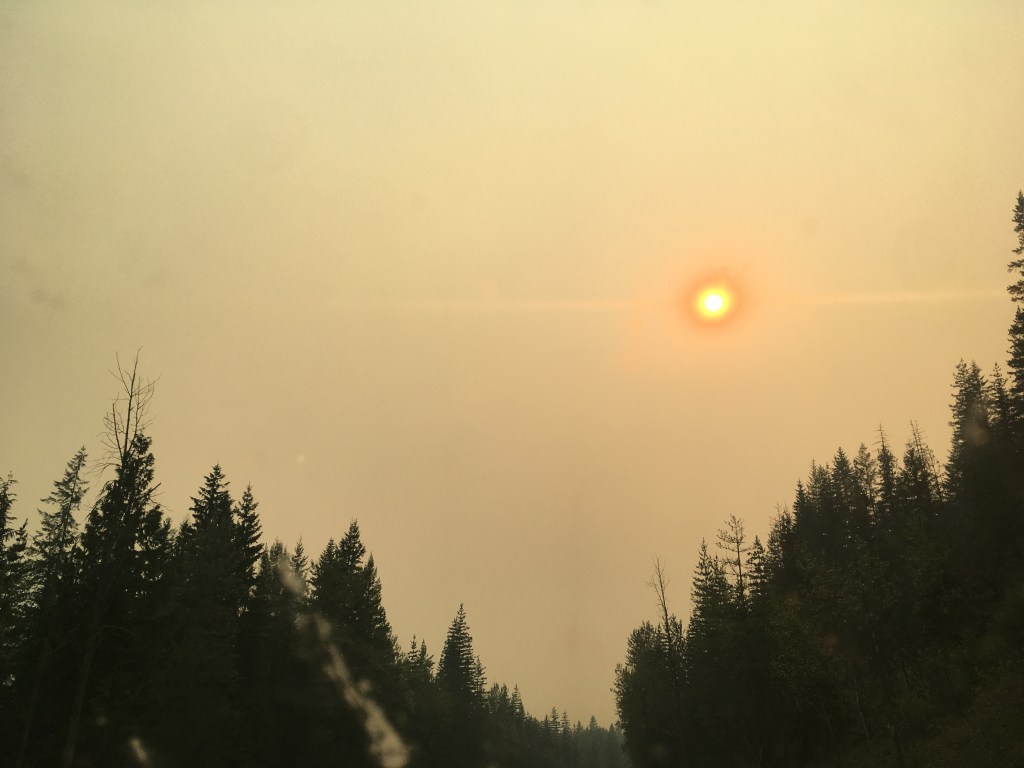
In this way, this research stems from my “daily life,” my own “emotional sea changes” and my “crises of identity and security”:
Research is not some elevated activity requiring a great deal of prior knowledge, nor is it simply the urge to find things out. It is in many ways the stuff of daily life. Every form of hardship encountered, whether one is an immigrant or living out catastrophic conditions, affected by emotional sea changes or crises of identity or of security, generates research, and everyone researches. (18:00)
Stuff of daily life should, in my view, include the acknowledgement of the disasters we are creating for ourselves and future generations, though for understandable reasons (psychological survival), it makes sense that we wear significant blinders. Research for me involves allowing in fragments of knowledge and fragments of thought amid general delusion and pleasure, the way I’ll glance at the headlines in the news and then immediately bike to my studio to throw some pots on the wheel, or how I’ll drive past the remains of recent forests fires on my way to soak in some visceral enjoyment of water at Lac La Ronge Provincial Park, later turning into practice (my show) the awareness that my every move is contributing to the problem while I must somehow still enjoy pottery and lakes nevertheless. This is my research, and it’s ongoing throughout every moment of my life until, as happened recently, the precarity of my situation lays its hand down on me in just such a way that I’m broken, unable to say or make anything, and must somehow find a way to come out of that brokenness with more in me to create. This is my precarious study of precarity, and this is what research means to me.
 Amy Snider