For this week’s readings, we needed to look at Daniel Buren’s “The Function of the Studio” and a couple of YouTube videos on him. We also needed to read Jerry Saltz’s “How to Be an Artist” and then respond to the question, “What is a studio practice?”
According to Buren’s essay, a studio is a place where work is most authentic; it is like there is a private agreement between the artist and the physical space that whatever takes place there only needs to exist for and be understood by artist, no one else. Once work leaves the studio for the gallery, in a way it fails to exist as it was created (it enters the “cemetery” (54) of a museum, for instance). It’s now in the public sphere, subject to anyone’s guess as to its meaning or purpose. There is a paradox here, in that artists most likely wants the work to leave its private existence in the studio, and so in effect it is created for its own “extinction” (58).
Before watching the interview with Buren that Risa also suggested, I may have misunderstood his real purpose in writing this essay. I got that he a cynic of the studio-gallery system; however, I didn’t realize that his own practice offers an alternative, that his work has been key in defining the term in-situ for art. This was great for me to learn as I’ve created in-situ art and wish to make more of it in the future. I want my practice to reach an audience that may not ever step inside a gallery. As Keith Haring is quoted as saying in “Keith Haring on How to Be an Artist,” “The public needs art, and it is the responsibility of a ‘self-proclaimed artist’ to realize [what] the public needs are, and not to make bourgeois art for the few and ignore the masses.”
I’d been thinking while reading the Buren of a text I came across in Sherry Farrell Racette‘s Indigenous Land Art course I took in the spring of 2021. Tanya Willard wrote a BUSH manifesto — a statement of purpose of the BUSH gallery — for a special issue of C Magazine. What is BUSH gallery, you may ask?
BUSH gallery is alive and breathing.
BUSH gallery is eating whipped berries under the stars, punctuating conversations and visits about art.
BUSH gallery is an autonomous space… for birds.
BUSH gallery can disappear.
BUSH gallery fits into our pockets.
Willard, pages 8-9
BUSH gallery is an example of artists taking their work outside the white cube entirely and questioning what art looks like when existing outside of that system. This is especially important from the Indigenous perspective (and therefore to all of us), one which is underrepresented in galleries and artist-run centres (“There are no contemporary art galleries or artist-run centers on First Nation reserves/reservations because people have been too busy surviving” (Willard 10)).
Sherry had us foraging for natural art materials from within the city due to Covid-forced restrictions on the field trips she’d dreamed of taking us on. We found plants, pigments, and clays with which we made work. We created and installed pieces outdoors, and this is how I came to watch and document many Dust plates erode back into the soil from where I’d dug their clay.
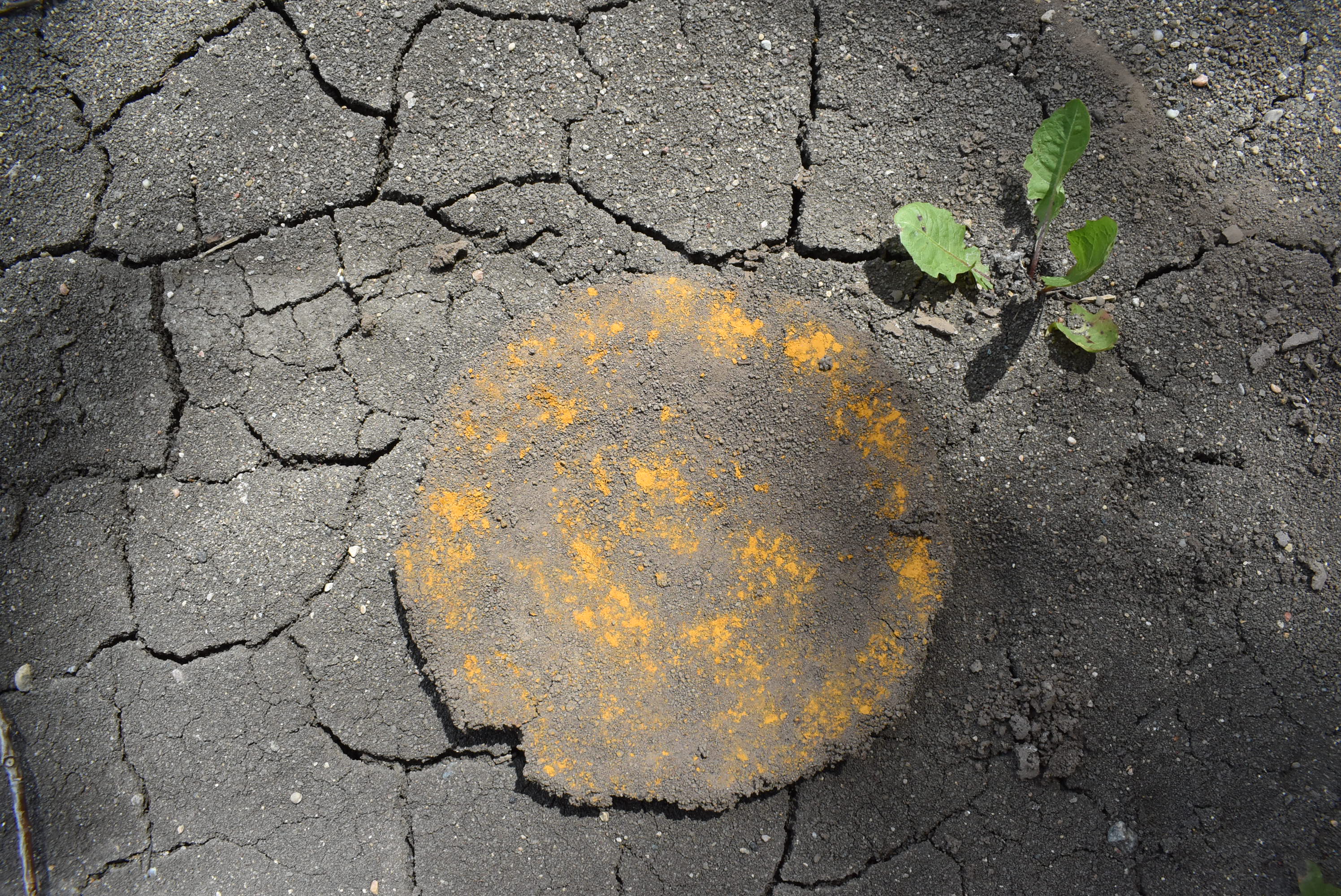
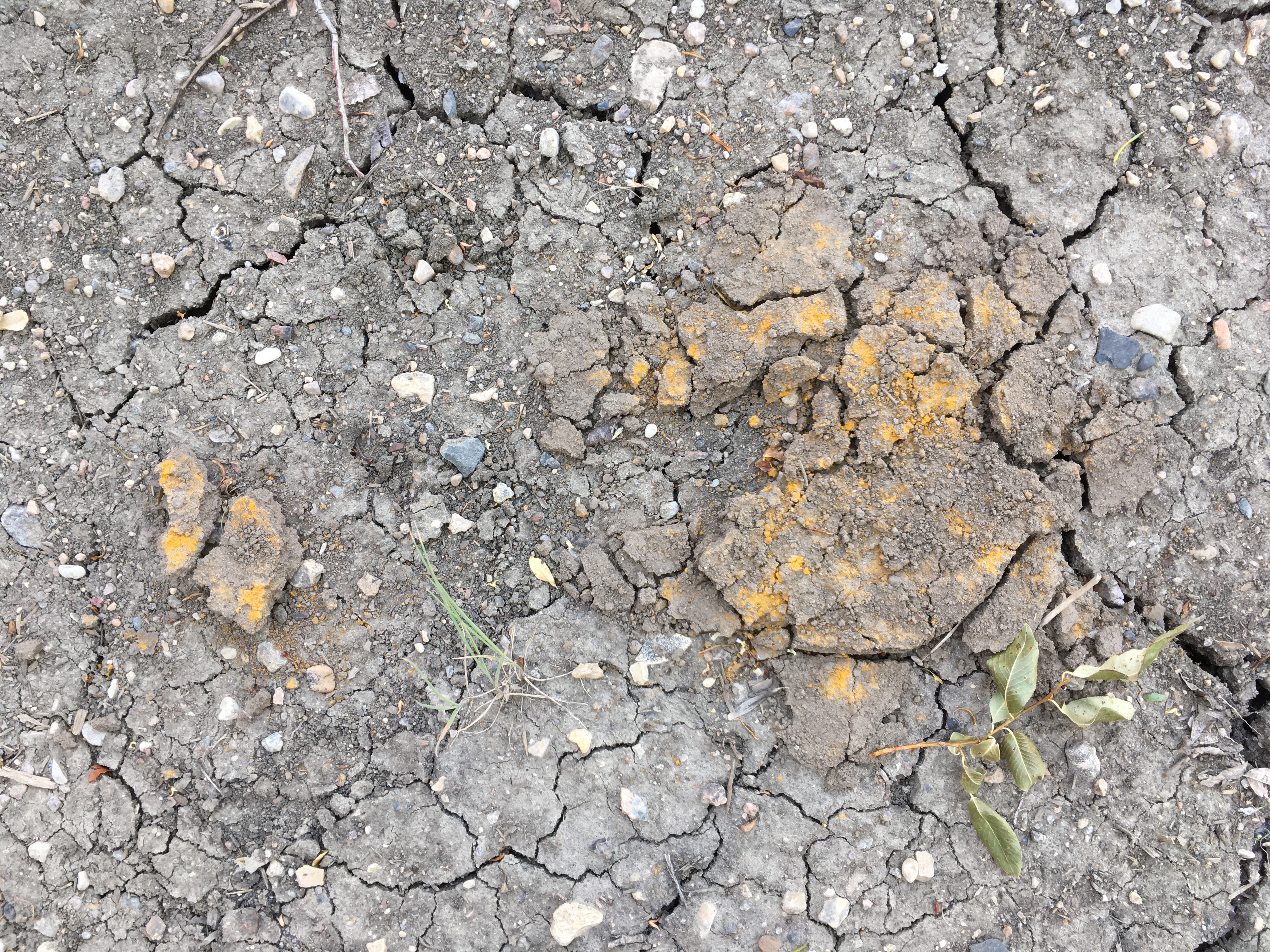
Plate made by Sherry Farrell Racette, installed at the U of R, June 2021.
What was the studio to us in that class? It was the city, mostly, and in fact it was also the places where we travelled: several of us took our own side trips looking for materials and inspiration. I spent a few days at Duck Mountain Provincial Park, digging clay and just being inspired. My studio practice includes crucial moments that take place while going for hikes and swims, I learned in that class. I don’t think Buren would disagree at all, in fact, I learned in the YouTube interview that he first came across his famous stripes wandering a marketplace in Paris.
I was pleased that while Buren’s article is dated in a few ways, he does write about the gallery as conforming to and therefore contributing to larger social systems: “By producing for a stereotype, one ends up of course fabricating a stereotype” (55).
If being an artist is, in part, breaking down the systems and stereotypes around us, I think it’s very important that we consider our studios in a new way from how they’ve traditionally been envisioned. A studio practice should take place least at times beyond walls and high ceilings, past the electric lights, or at least bring in as many people as possible to share the work that is the artist’s communication to the world in its most authentic state. This doesn’t mean that we can’t or shouldn’t incorporate galleries in our practices, but that we should be aware at least of what their frames may do to our work. In short, Buren’s essay, though nearly as old as I am (and I’m middle-aged), is still a valuable read.
Buren, Daniel, and Thomas Repensek. “The Function of the Studio.” October 10 (1979): 51-58.
Cain, Abigail. “Keith Haring on How to Be an Artist.” Artsy. https://www.artsy.net/article/artsy-editorial-keith-haring-artist. Accessed 14 September 2022.
“Conversations; Artists’ Influences.” Art Basel. YouTube. https://www.youtube.com/watch?v=S1ejR3ZQVd0. Accessed 14 September 2022.
Saltz, Jerry. “How to be an Artist” Vulture, November 27, 2018. https://www.vulture.com/2018/11/jerry-saltz-how-to-be-an-artist.html. Accessed 13 September 2022.
Site/ation. Special issue C Magazine 136. Tania Willard, Peter Morin, eds. https://cmagazine.com/issues/136/pdf. Accessed 14 September 2022.
 Amy Snider