initial thoughts on my MFA graduating show

It’s time for me to dig deep into understanding what it is I want to say with my graduating exhibit. I have a vision of what I’d like it to be, as I summarized in my previous post which I’ll paste this paragraph here for quick reference:

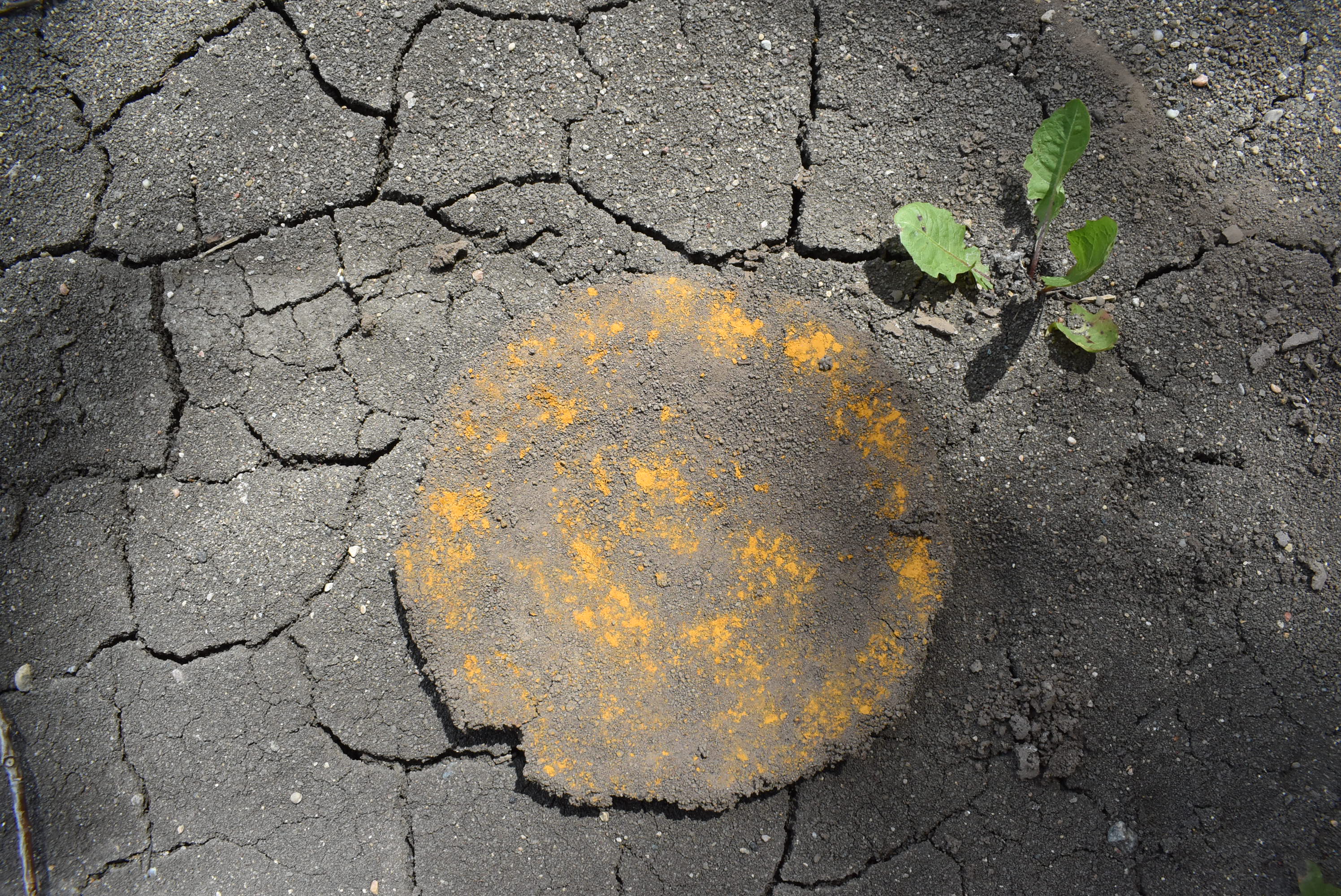
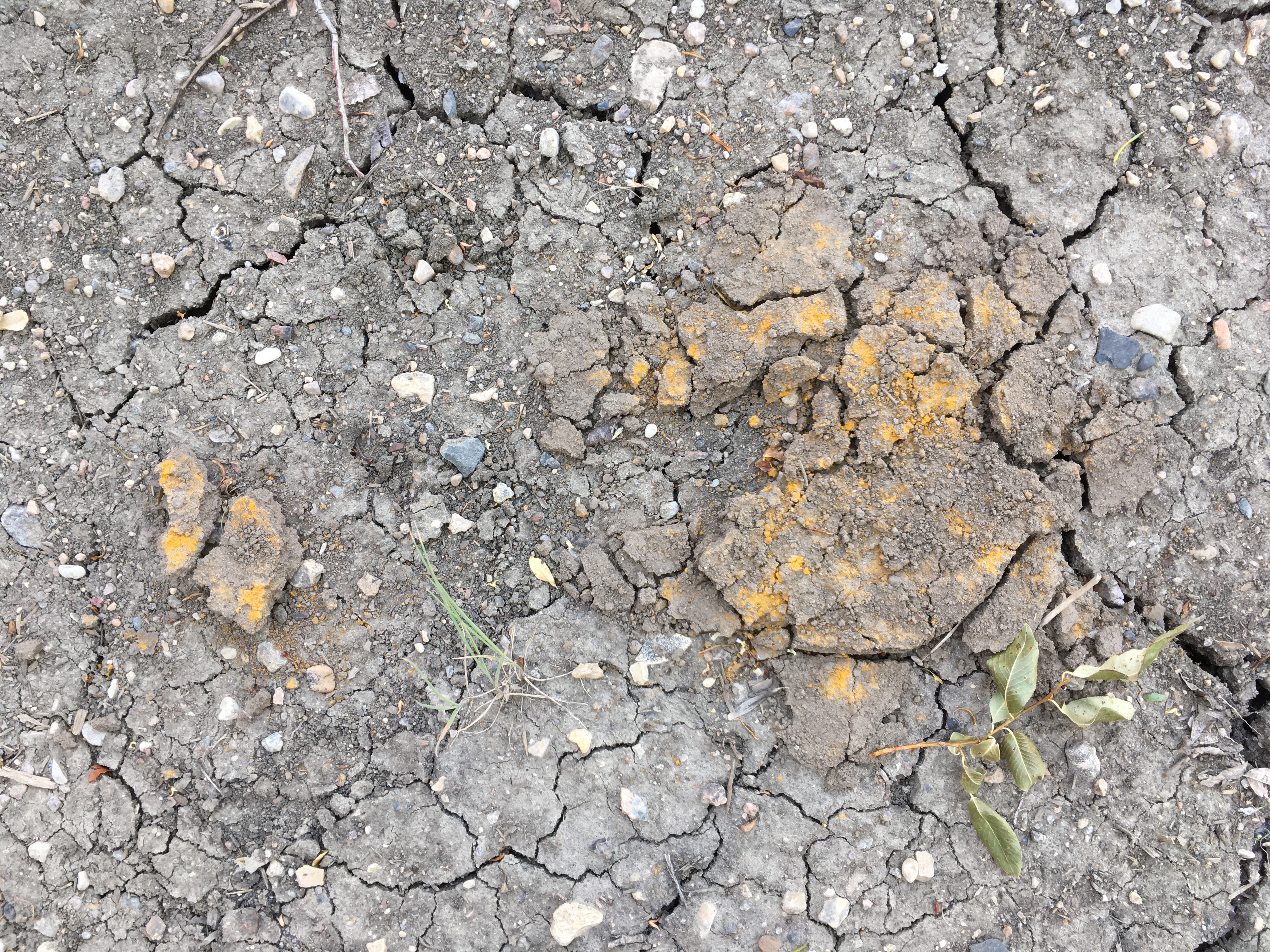
I am considering my final exhibition, and the vision I have involves covering the entire gallery floor in super-fragile cups and bowls of bright orange ceramic made from local clay. Viewers will need to enter into the space, crushing these forms as they go, to read my statement and (possibly) see videos that are projected onto the walls. Ideally, I’d also have very large rocks for people to sit on and contemplate the installation (though this may prove financially impossible). I’m curious to see who will decide to enter the show and who will turn away. I’m considering videoing the exhibit, informing people that by entering the space they are agreeing to being videoed. Were I to do this, it would be suggesting accountability: that we are being seen as we destroy the planet for future generations; that there will be a record. On the other hand, I don’t know if I want to bring that thread into the discussion. The main point is to provoke a private contemplation of the situation we’re in (with climate change) and of how it impacts us emotionally. I’d like the installation to be an acknowledgement of eco-anxiety/solastalgia. This is core. This can’t happen while we’re knowingly being surveilled. So, this videoing aspect is one of many decisions I have to make very carefully. Whatever I choose will change the conversation that this show sparks, the dialogue between between me and the viewer, and between my work and others’.

For someone as indecisive as I’ve been lately, how have I settled on this project for my final show? What am I trying to convey? I’ll need to spend a lot of time figuring this out, as for now all I have are many unanswered questions, such as:

  • What do I want people to experience when they see my show?
  • What is the narrative of this show?
  • Why have I chosen to create an installation? Why should the pieces I make cover the entire gallery floor?
  • Why would I use ceramic tableware (cups, bowls, plates)?
  • What is the purpose of having people step of these objects and break them?
  • Why would I use fired objects? Why not raw?
  • Should I include anything else besides covering the floor? (At what point would this be a show and not an installation?)
  • What would video bring to the installation? Which video(s) would I show?
  • Should I include my “life pots,” the cups and bowls that have plants growing out of them?
  • Should I include “Solastones”?
  • What would be the purpose of the rocks? If rocks are impractical, what could be a good substitute? What would be lost?
  • Should I video the entire duration of the show? What would this do to it in terms of how being surveilled may effect their experience?

I’ll take a stab at answering one of these, the first and most important of all — what do I want people to experience when they see my show?

I have to smile because David asked me this question back last winter when I was so thickly depressed that I was incapable of imagining having a show, never mind imagining what it would comprise or how I’d want my viewer to feel upon seeing it. All I could respond with was, “I don’t know.” Seven months later, as I’m out of the worst of it, I’m just so grateful to be here, to have an idea. Now, it’s a matter of articulating what this idea means, or at least what I want it to mean. I think this is an example of what it’s like to be an artist: knowing what you need to do before you necessarily understand why you need to do it.

I want my show to have people consider the psychological weight of the moment we’re in. Catastrophic climate change, the insect apocalypse, and the sixth mass extinction event, all caused by us, are on people’s minds, as can be seen by the increasing numbers of people suffering from eco-anxiety and grief. As we go about our busy days, we may not often stop to think about how uncertain our future is, with extreme weather events, drought, rising sea levels, food and water shortages, and mass migrations to name just a few of the issues we face. Yet we are aware of the situation, and many feel consciously anxious or hopeless, or both, about it. Even for those who aren’t consciously concerned about environmental crises, the knowledge is pretty much inescapable, and I suspect that everyone has some amount of tension in their lives as they witness the current catastrophic weather event and wait for the next. Who will it hit?

My show is meant to bring this tension to the fore. Cups and bowls are normally harmless objects we store in our cupboards. We take them, like so much, for granted. Here, they become embedded in violence. Walking into the show means destroying them, yet that’s what’s expected of viewers to do. Within the paradigm of the gallery system, we are invited to enter this space. In this case, to read about the show (via my statement on the wall), people would need to get to it, leaving a path of destruction in their wake. Or will they tentatively step only where others have stepped, attempting to do as little damage as possible? What does that imply? Is it okay to benefit from the damage done by others before us? When people get to the wall with my statement and read what I say, will they regret walking in? Will they experience momentary solastalgia? Will they feel guilty, or will they feel my show is full of shit, that they are so not implicated in the catastrophes I’ll describe on the wall? I think this show will open up various questions such as these. It’s not that I want people to walk away feeling culpable, but that I want them to feel the personal as well as collective consequences of our actions on the planet, and to recognize that having anxiety and despair about the state of the environment makes complete sense.
Class Post 3: dialogue and dialectics

This week, my assignment is to watch Hito Steyerl’s How Not to be Seen: A Fucking Didactic Educational .MOV File, 2013 and answer the question, “What constitutes dialogue (as it pertains to an art practice; to your art practice)?”

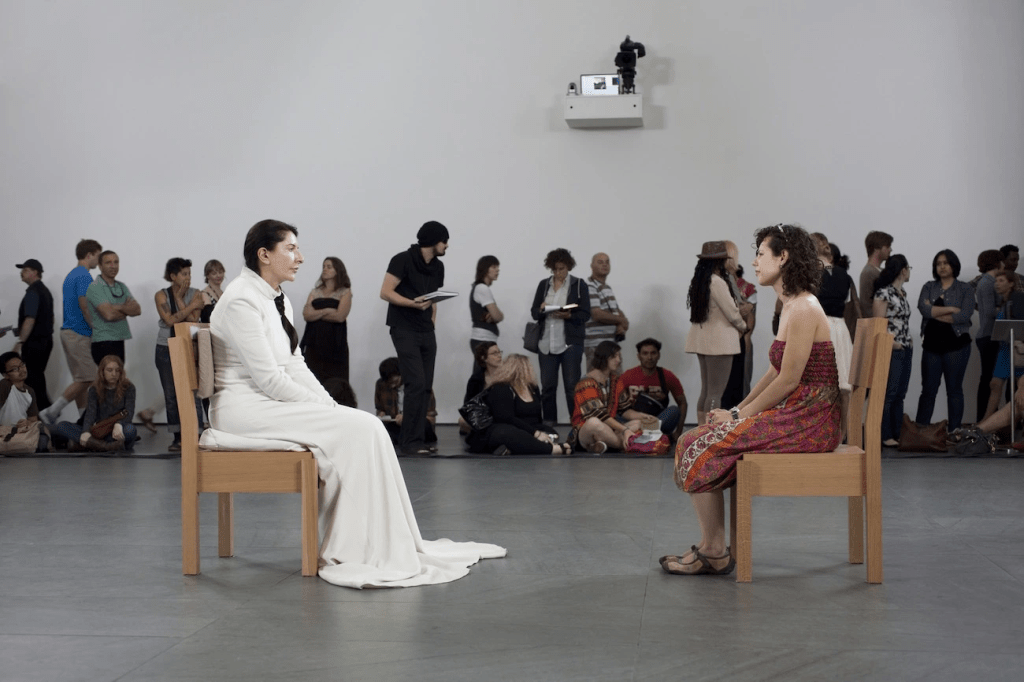
When I consider what this video piece is doing, pointing at the fact of our constant surveillance and the panopticon of ubiquitous images, I think that it is entering into dialogue with so many other works, among them Marina Abramović’s “The Artist Is Present” (2010).

That Abramović chose to “merely” sit and look at people defies the trend in society to “disappear” people, to make them invisible, as the Steyerl satirically demonstrates. What she did by staring at 1,000 people over three months was to tell them each that they are seen. Many were brought to tears through this experience of simply (though so uncommonly) being observed.

image source

This is in contrast to the world which Steyerl captures in this video, where, as Michel Foucault puts it in Discipline and Punish: The Birth of the Prison, with panopticism, each person

is seen, but he does not see; he is an object of information, never a subject in communication.

(Foucault 200)

This means that Steyerl entered into dialogue with Abramović by creating this work three years later. They are coming at the issue of what it means to be seen from two different angles. It’s as though Steyerl could have seen the Abramović and been inspired to respond by saying “right: this never happens; instead, images of us are everywhere and make us disappear.”

Dialogue is conversation. Works of art talk to one another each time we view them. They may talk even without us. Visual art is storytelling (usually) without words.

I am considering my final exhibition, and the vision I have involves covering the entire gallery floor in super-fragile cups and bowls of bright orange ceramic made from local clay. Viewers will need to enter into the space, crushing these forms as they go, to read my statement and (possibly) see videos that are projected onto the walls. Ideally, I’d also have very large rocks for people to sit on and contemplate the installation (though this may prove financially impossible). I’m curious to see who will decide to enter the show and who will turn away. I’m considering videoing the exhibit, informing people that by entering the space they are agreeing to being videoed. Were I to do this, it would be suggesting accountability: that we are being seen as we destroy the planet for future generations; that there will be a record. On the other hand, I don’t know if I want to bring that thread into the discussion. The main point is to provoke a private contemplation of the situation we’re in (with climate change) and of how it impacts us emotionally. I’d like the installation to be an acknowledgement of eco-anxiety/solastalgia. This is core. This can’t happen while we’re knowingly being surveilled. So, this videoing aspect is one of many decisions I have to make very carefully. Whatever I choose will change the conversation that this show sparks, the dialogue between between me and the viewer, and between my work and others’.

This work would also enter into a dialogue with other art dealing with climate change as well as pieces about contemporaneity. This is the moment we are in: the climate crisis is on people’s minds. As the news tells us, “Climate anxiety and PTSD are on the rise.” Art is a response to life; we will be seeing more work that addresses this anxiety that at least half of us (in North America) are experiencing.

“A 2020 poll from the APA found that more than half of respondents were somewhat or extremely anxious about the effects of climate change on their own mental health.” source

While entering into these dialogues (with people; with other works), I hope my show will also engage in dialectics. If cups and bowls are functional items of our daily lives, why are the ones I create purposefully unusable? What is a cup if it cannot hold water? What do these cups say about their very long history of holding water? Our connection to that water? What do they say about what we take for granted in our daily lives? What we are on the cusp of losing? The ease with which they break; the jarring sound of their collapse: when did cups become so dangerous? Can we use form to talk about the destruction of form? I’d like to provoke these questions. In other words, I’d also like to enter into the dialectics of the contemporary moment itself.

According to John Molyneux in The Dialectics of Art,

Art matters because of its ability to articulate in visual imagery the social consciousness of an age, in a way that aids the development of the human personality, and our collective awareness of our natural and social environment.

This broader dialogue, these arguments about the establishment of meaning in our times, is what I strive to join with my own emerging practice.

Foucault, Michel. Discipline and Punish : The Birth of the Prison. Second Vintage Books ed. New York: Vintage Books, 1995.

Class Post 2: a non-studio studio practice

For this week’s readings, we needed to look at Daniel Buren’s “The Function of the Studio” and a couple of YouTube videos on him. We also needed to read Jerry Saltz’s “How to Be an Artist” and then respond to the question, “What is a studio practice?”

According to Buren’s essay, a studio is a place where work is most authentic; it is like there is a private agreement between the artist and the physical space that whatever takes place there only needs to exist for and be understood by artist, no one else. Once work leaves the studio for the gallery, in a way it fails to exist as it was created (it enters the “cemetery” (54) of a museum, for instance). It’s now in the public sphere, subject to anyone’s guess as to its meaning or purpose. There is a paradox here, in that artists most likely wants the work to leave its private existence in the studio, and so in effect it is created for its own “extinction” (58).

Before watching the interview with Buren that Risa also suggested, I may have misunderstood his real purpose in writing this essay. I got that he a cynic of the studio-gallery system; however, I didn’t realize that his own practice offers an alternative, that his work has been key in defining the term in-situ for art. This was great for me to learn as I’ve created in-situ art and wish to make more of it in the future. I want my practice to reach an audience that may not ever step inside a gallery. As Keith Haring is quoted as saying in “Keith Haring on How to Be an Artist,” “The public needs art, and it is the responsibility of a ‘self-proclaimed artist’ to realize [what] the public needs are, and not to make bourgeois art for the few and ignore the masses.”

I’d been thinking while reading the Buren of a text I came across in Sherry Farrell Racette‘s Indigenous Land Art course I took in the spring of 2021. Tanya Willard wrote a BUSH manifesto — a statement of purpose of the BUSH gallery — for a special issue of C Magazine. What is BUSH gallery, you may ask?

BUSH gallery is alive and breathing.

BUSH gallery is eating whipped berries under the stars, punctuating conversations and visits about art.

BUSH gallery is an autonomous space… for birds.

BUSH gallery can disappear.

BUSH gallery fits into our pockets.

Willard, pages 8-9

BUSH gallery is an example of artists taking their work outside the white cube entirely and questioning what art looks like when existing outside of that system. This is especially important from the Indigenous perspective (and therefore to all of us), one which is underrepresented in galleries and artist-run centres (“There are no contemporary art galleries or artist-run centers on First Nation reserves/reservations because people have been too busy surviving” (Willard 10)).

Sherry had us foraging for natural art materials from within the city due to Covid-forced restrictions on the field trips she’d dreamed of taking us on. We found plants, pigments, and clays with which we made work. We created and installed pieces outdoors, and this is how I came to watch and document many Dust plates erode back into the soil from where I’d dug their clay.

Plate made by Sherry Farrell Racette, installed at the U of R, June 2021.

What was the studio to us in that class? It was the city, mostly, and in fact it was also the places where we travelled: several of us took our own side trips looking for materials and inspiration. I spent a few days at Duck Mountain Provincial Park, digging clay and just being inspired. My studio practice includes crucial moments that take place while going for hikes and swims, I learned in that class. I don’t think Buren would disagree at all, in fact, I learned in the YouTube interview that he first came across his famous stripes wandering a marketplace in Paris.

I was pleased that while Buren’s article is dated in a few ways, he does write about the gallery as conforming to and therefore contributing to larger social systems: “By producing for a stereotype, one ends up of course fabricating a stereotype” (55).

If being an artist is, in part, breaking down the systems and stereotypes around us, I think it’s very important that we consider our studios in a new way from how they’ve traditionally been envisioned. A studio practice should take place least at times beyond walls and high ceilings, past the electric lights, or at least bring in as many people as possible to share the work that is the artist’s communication to the world in its most authentic state. This doesn’t mean that we can’t or shouldn’t incorporate galleries in our practices, but that we should be aware at least of what their frames may do to our work. In short, Buren’s essay, though nearly as old as I am (and I’m middle-aged), is still a valuable read.

Buren, Daniel, and Thomas Repensek. “The Function of the Studio.” October 10 (1979): 51-58.

Cain, Abigail. “Keith Haring on How to Be an Artist.” Artsy. https://www.artsy.net/article/artsy-editorial-keith-haring-artist. Accessed 14 September 2022.

“Conversations; Artists’ Influences.” Art Basel. YouTube. https://www.youtube.com/watch?v=S1ejR3ZQVd0. Accessed 14 September 2022.

Saltz, Jerry. “How to be an Artist” Vulture, November 27, 2018. https://www.vulture.com/2018/11/jerry-saltz-how-to-be-an-artist.html. Accessed 13 September 2022.

Site/ation. Special issue C Magazine 136. Tania Willard, Peter Morin, eds. https://cmagazine.com/issues/136/pdf. Accessed 14 September 2022.

Group Studio (Fall 2022) Class Post 1: my vision forward

It’s the start of another school year, and my third in the MFA program at the University of Regina. I’m entering my year of prep for my graduating exhibition and defense, and I’m excited to see what sorts of new challenges I’ll need to overcome and what they’ll teach me.

I’m taking the last of the four Group Studio courses that this program requires. In these classes, students focus on developing their non-studio skills as an artist, primarily practicing how to speak and write about their work in the art world and beyond. As my prof for this semester’s course, Risa Horowitz, put it in the syllabus, “the MFA Group Studio is more about being an artist, than doing the art.” It’s a brilliant addition to the MFA program, and each prof I’ve taken it with has brought a different approach and usefulness to the course.

One of our assignments for the semester is to keep a blog on the weekly readings and viewings we have to complete. This week, we were each given different sections from Living and Sustaining a Creative Life: Essays by 40 Working Artists, edited by Sharon Louden, and asked to write a “vision forward” answering the following questions:

What do you see and wish for yourself as an artist in the next year, 5 years, 15 years, and beyond? What do you envision your day-to-day and your big picture will look like? What sort of life-of-an-artist do you want for yourself? What kind of career do you want? What compromises and risks do you think you will need to make to accomplish that life? How will you cope with failures, and manage successes?

I’m grateful to be shown this book right now, as these are pressing questions for me as I come close to completing my MFA. First of all, I’m just starting to be able to envision myself as an artist, though I’m not quite there. This means that picturing my future practice seems very much like dreaming. What do I wish for “myself as an artist”? Well, just to be one, one day. I wonder if I’ll ever overcome that one. On top of that, I’m hyper-aware of the difficult practical reality of trying to make it as an artist. In the last year or so, as I’ve started allowing myself to even think about this dream, I’ve still been certain of its impossibility. This is where this book’s so helpful. From the three sections I’ve read, I’ve learned about four artists who are sustaining themselves through their creative practices. They write in a very frank and straightforward way, and it almost makes it seems as though it’s actually possible to make a career out of art-making. If so many (40 in this book alone) can do it, well, maybe I can too.

Maggie Michael and Dan Steinhilber are partners who are both artists. They each write about the way they make it work, juggling various roles including parenting. I can associate with them quite a bit, as Mike is an artist (creative writer) who is also a prof, and we share parenting duties too. Maggie mentions that “[a]rtists often partner with someone who has a reliable career and income” (120), though she herself has no regrets. In my case, I have a certain amount of pressure and need to contribute financially to our household, but at the same time, I know that Mike will do anything he needs to in order to support my growth as an artist, and this is something for which I’m grateful.

I found a lot I could associate with in Justin Quinn‘s account. While he talks about having a dream vision of being an all-star, his actual sustenance sounds dreamy enough to me. Commuting “by foot or canoe” (98) to his full-time university teaching job, having a studio on campus and one at home, and having art production that is “steady” (99) sounds like a highly successful juggle to me. What I took away from Justin’s segment the most is how for him, “[e]ach component [of life] — family, teaching and creating — works to keep the other parts going” (99) and that “sustaining a creative life means that life has to be nourished first. Creativity follows sustenance” (100). I understand the importance of striving to find this balance and nourishment, and it’s good to know that it can actually happen for some.

I put more asterisks and underlining in the Jenny Marketou photocopied section of this book than the other two I was given. Jenny has a very clear sense of what she wants from her life, and I can associate with a few of her goals. She realized early on that she needed to pursue “professional art”; she says, “I enjoyed theoretical debates, and practicing art was a way to stay grounded, and at the same time free and use my mind” (80). I think I too need to have some theoretical debate in my life, and that’s likely what led me to take this MFA. At the same time, Jenny decided that she would not tolerate the exploitation of being an adjunct professor, and so she left to pursue her own “creative ambitions as a self-employed artist” (81). I have a huge admiration for anyone brave enough to do this. Jenny admits that “[m]aking money seems to elude [her]” (81), and yet she’s willing to take the risks involved and work extremely hard at sustaining this life. She also knows that she’d rather find her work on the periphery of the art-world-system, so she makes use of “the museum gallery, the public squares, subway platforms, streets and protests as site[s] of production, where the work is produced and supported by commissions, artists’ fees, grants or in-kind sponsorship from education departments” (81). In this sense, she sees herself as a “knowledge entrepreneur — a free agent” (82), and I love the way that sounds.

As I prepare to finish this MFA program, it’s time I need to consider what my next steps will be. As I’ve said above, I haven’t given a lot of thought to creating a life as an artist because I haven’t seen myself as living that life. It’s still a dream, but even that is a life-shifting change for me; until very recently, as in within these last few months, I never even had that dream. I started taking art classes seven years ago just to put something I enjoy into my life. It never crossed my mind that I’d be able to do this — what I enjoy — as a living. However, as I adjust to the idea that I may just have an MFA in a year or so, the possibility of continuing to make art (as I can’t stop now) AND even leaving my current career as an ESL teacher, a job which I now know contributes severely to my mental health issues, well… maybe it’s time to allow myself some dreaming and see where this can actually take me.

If I were going to entirely blue-sky my future vision for five years from now, it would go something like this. I’d work half time (tenured) for a university in a small to medium-sized city that has a reputable visual arts program and top notch studios and facilities. This city would be a place that encourages the arts, and of course environmental sustainability. It would also be somewhere next to intense natural beauty, likely either right in the mountains (i.e. Rocky; coastal) or on an island (i.e. Vancouver; Salt Spring). I’d live just outside of town with a large enough plot of land to garden and keep chickens, and possibly a pet pig … and there’d be a lake or ocean swimming hole for necessary water access. There would be trees immediately on my property, but not so many in the surrounding area; forest fire would not be a worry. On days when I have time not to drive, I’d be able to make the longish bike-ride into town to work and spend time in my studio (though I’d have one at home as well). I’d gain a sense of daily structure, community, and purpose from my work responsibilities and relationships with colleagues and students, yet being half-time, I’d also have sufficient time to work on my own projects. I’d have shows, installations, and performances globally, often outside the typical gallery-setting, and I’d occasionally be asked to give talks and workshops and collaborate with my peers. I’d have time to putz around in the garden, swim, kayak, and cook, hike and bird-watch with my husband, but fitting all of this in would keep me very busy. Weekends and vacations would be something to look forward to. Ha!

I know that the above is just a fantasy. But what can it teach me about how to plan my next steps post-MFA? What parts of the above dream-life should I actually strive to reach? Is the decision to teach half-time a cop-out — a means of avoiding making a decision (to teach or not to teach) or a sign of cowardice (as impossible as it may be to get a tenured position, the thought of “making it” as an artist seems even more unachievable to me). These are questions I have to continue to work hard to answer in the coming year. If I’d like to attempt to get a tenured teaching position, I’ll have to start doing the work that that entails now; looking into programs across the country, seeing who has been recently hired and their credentials, and making sure I build a CV that will be looked at favourably… giving lectures, having shows, etc. I’m already doing a bit of this, but I’d have to amp it up.

What would it mean to abandon the idea of teaching entirely and focus that energy on establishing myself as something of a “knowledge entrepreneur — a free agent”? One challenge would be psychological, as I’ve already made clear. Another challenge, of course, would be financial. Mike is about to retire in three or four years. Where could he and I live that would afford us a decent quality of life on mostly just his pension and whatever dribs and drabs I could bring in? What sacrifices would we need to make to live that way? Location, lack of travel, less organic produce? While we’re responsible, we’re not good at budgeting. This decision is a joint one, and it’s huge.

I think this at least partially answers Risa’s question of “[w]hat compromises and risks do you think you will need to make to accomplish that life?” At least, this is the best I can answer it right now, given how entirely vague and fantastical my plans are. In terms of her final question, “[h]ow will you cope with failures, and manage successes?” I have even less of a clue. All I can say is that failure, or rather not even attempting this life in the first place, has been my go-to from the get-go. I think I’ll be over-the-mood thrilled and recognize my luck and privilege should I be able to make art my life at all, one way or another.