It’s the end of this spring course I’ve been taking with Lindsey French, and she’s asked me to reflect on my practice—where I want to take my work in the fall when I’ll need to begin preparing for my MFA graduating exhibit. What do I want to show people? She also asked me to consider how this show could support my practice rather than seeing it as only an end in itself (the end of my degree).
This is a challenge. First of all, I’m still hugely indecisive about just about everything in my day-to-day, and certainly about what I’d like this show to be. The impetus keeps shifting. This is a problem for someone approaching the equivalent of thesis-writing time. Secondly, it seems impossible to imagine myself having an art practice, so I can’t say how I’d like to see this degree support it. Still, I’ll try my best here.
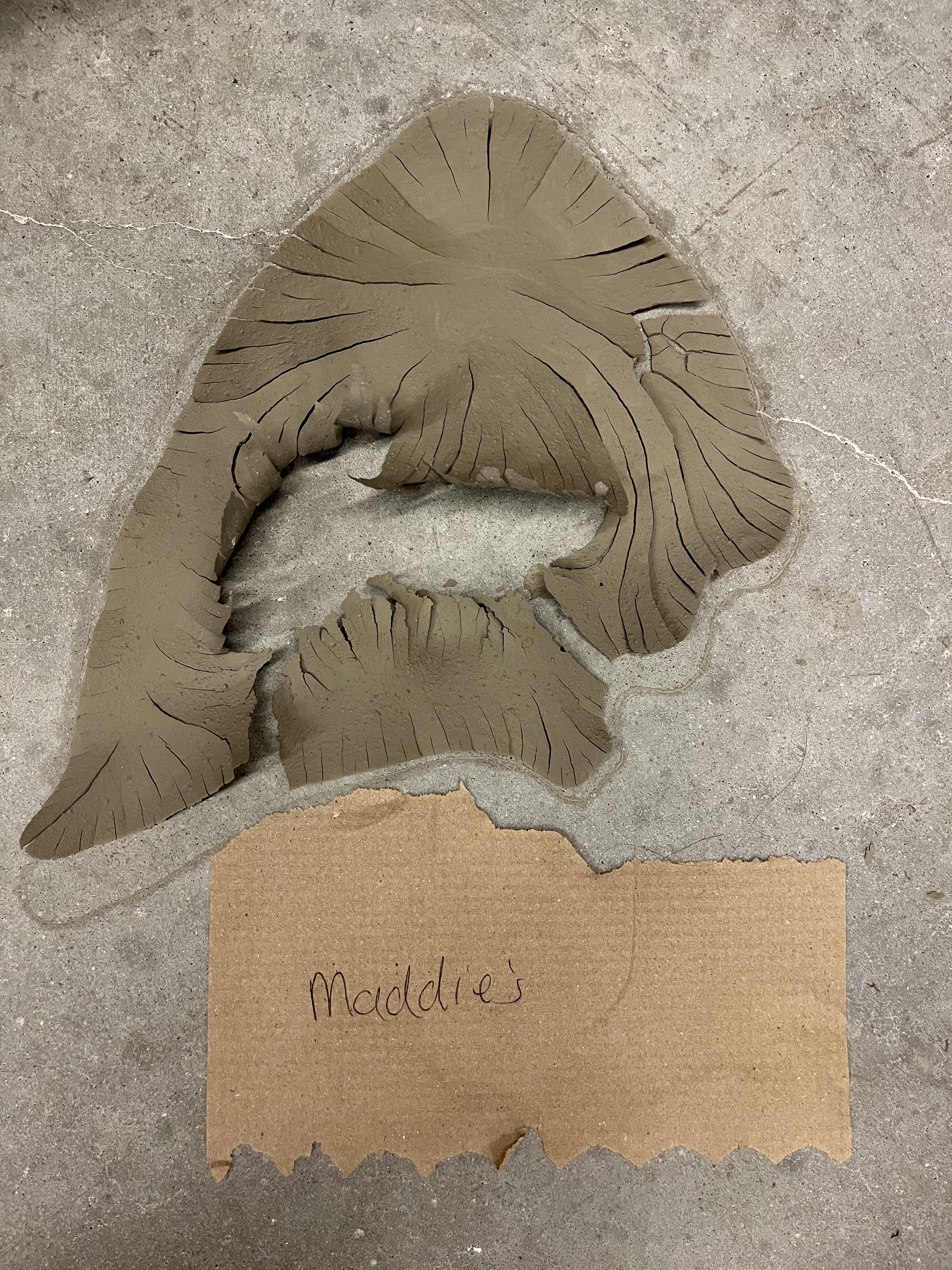
First premise—I’d to give viewers of my show the experience of entering a space that is different from the ones they normally inhabit. I’ve been considering ways to do this by employing largely this local clay I’ve been digging up from Madeleine Greenway’s garden. If I use a traditional (indoor) gallery setting, I can imagine covering its floor with a liquid slip of this clay, meaning that viewers would need to leave footprints wherever they walked in the gallery to look at other pieces or video I’d include. Maddie’s clay does crazy things when it dries on certain types of flooring.
My issue here is that this may not convey what I’d like this show to convey. It’s true I once tried to get clay to crack in ways that would mimic drought-parched land, as I wrote about over a year ago. I failed at getting processed clay (terracotta) to crack in a way that satisfied me, and now, with this local clay, I may be able to. That makes some sense.
However, this work took place was when I was representing the physical effects of climate change in my pieces (melting glaciers, drought, species loss, etc). More recently, my work has been focused on the effects of climate change on me and my family, personally. The issue here is that this effect is a moving target moving between complete despair and some kind of acceptance (never hope), yet I need to know what to focus my work on for the next year… now.
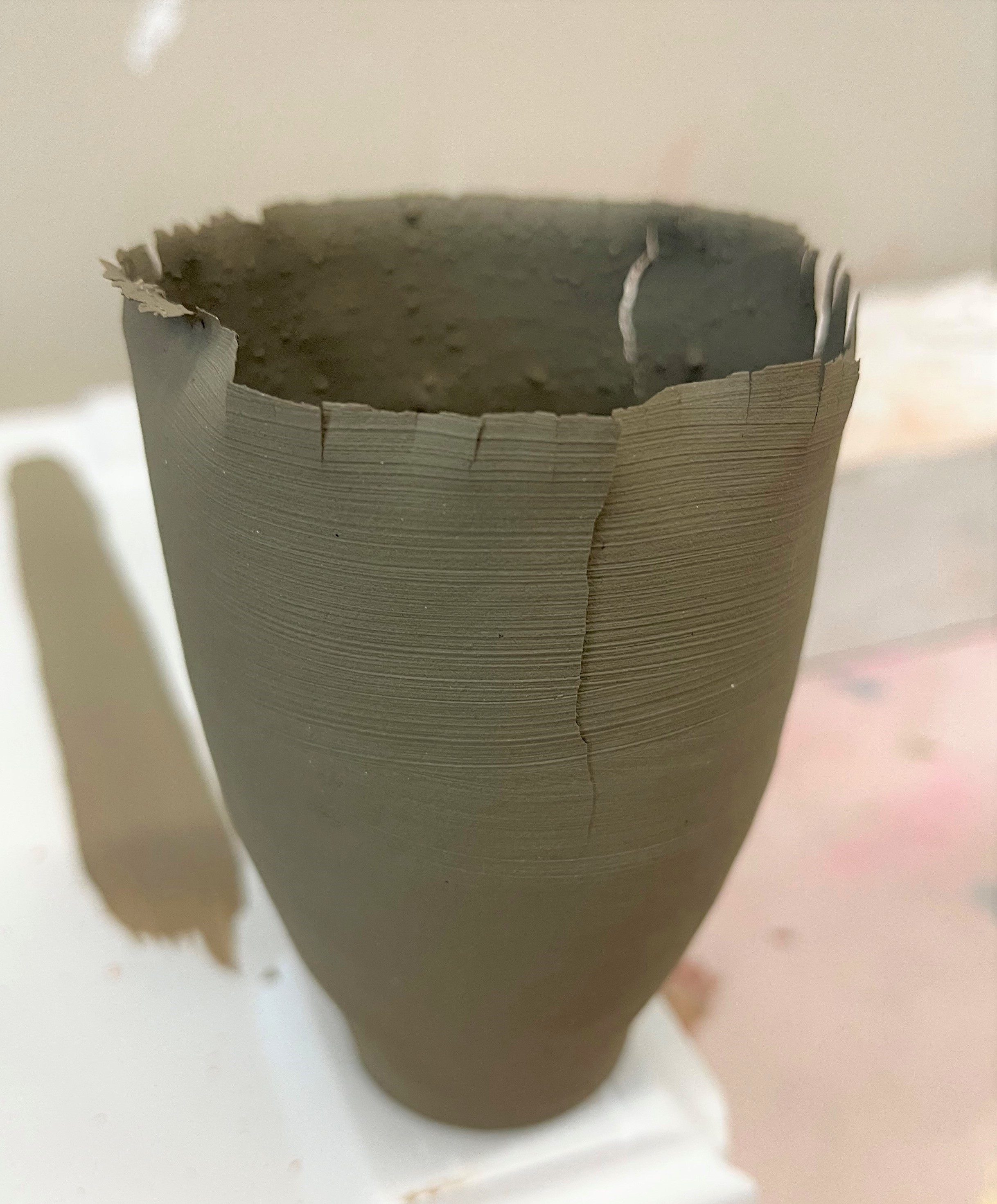
There something about the frailty of the forms that this clay allows me to create which I’m drawn to, something about our own frailty as a species and/or the frailty of Earth’s ecosystems as a result of what we’re doing to them. As Lindsey said during our chat last week, the cups and bowls, as opposed to the splotches of liquid clay drying on the floor, are very human, and this appeals to me.
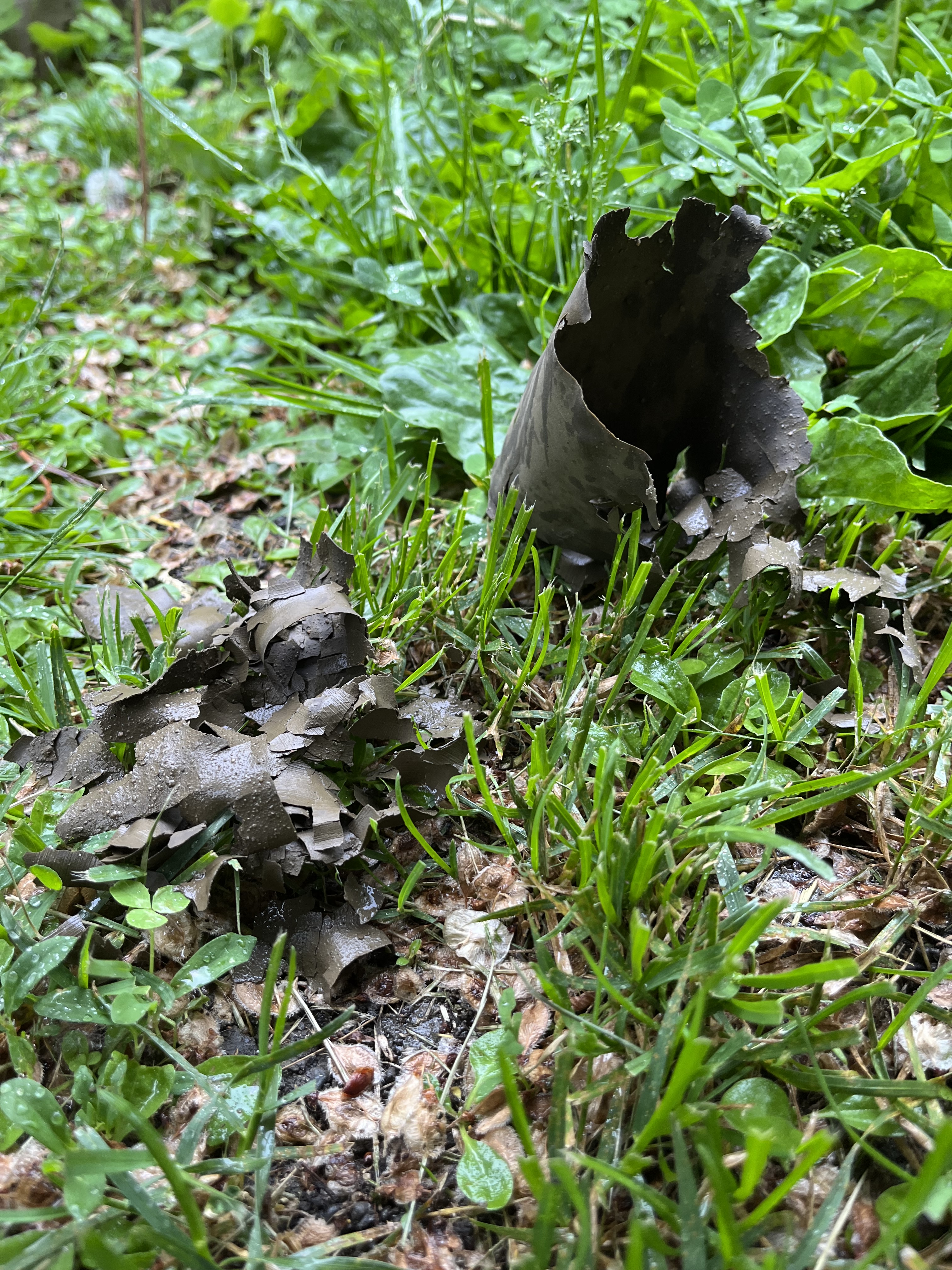
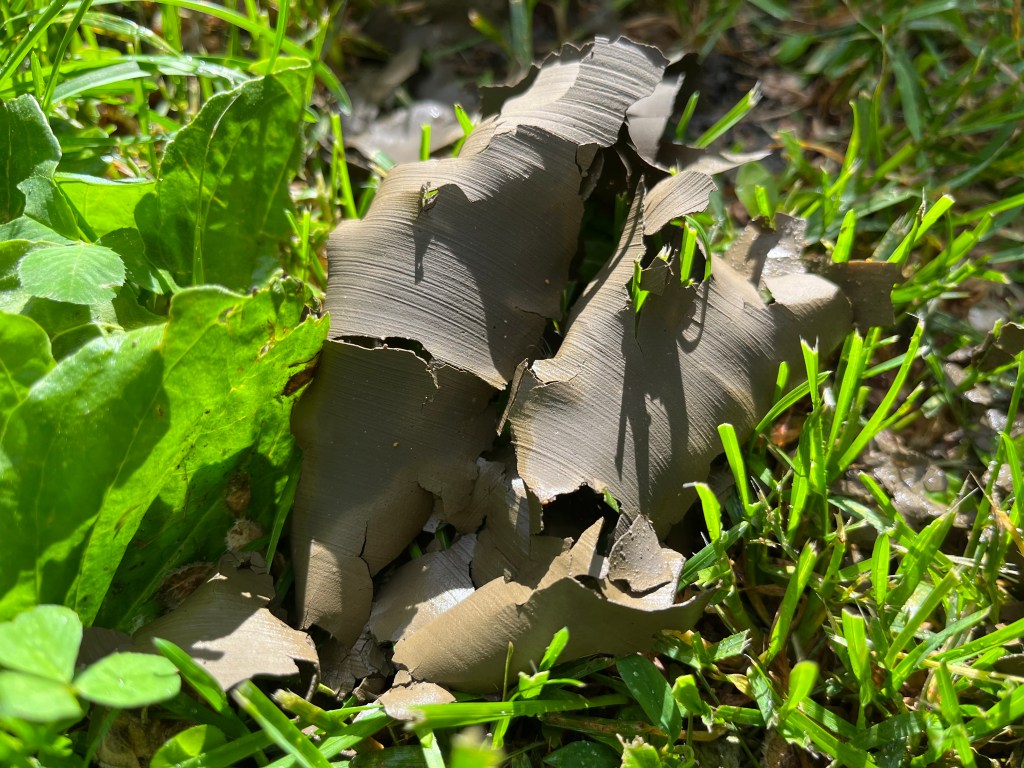
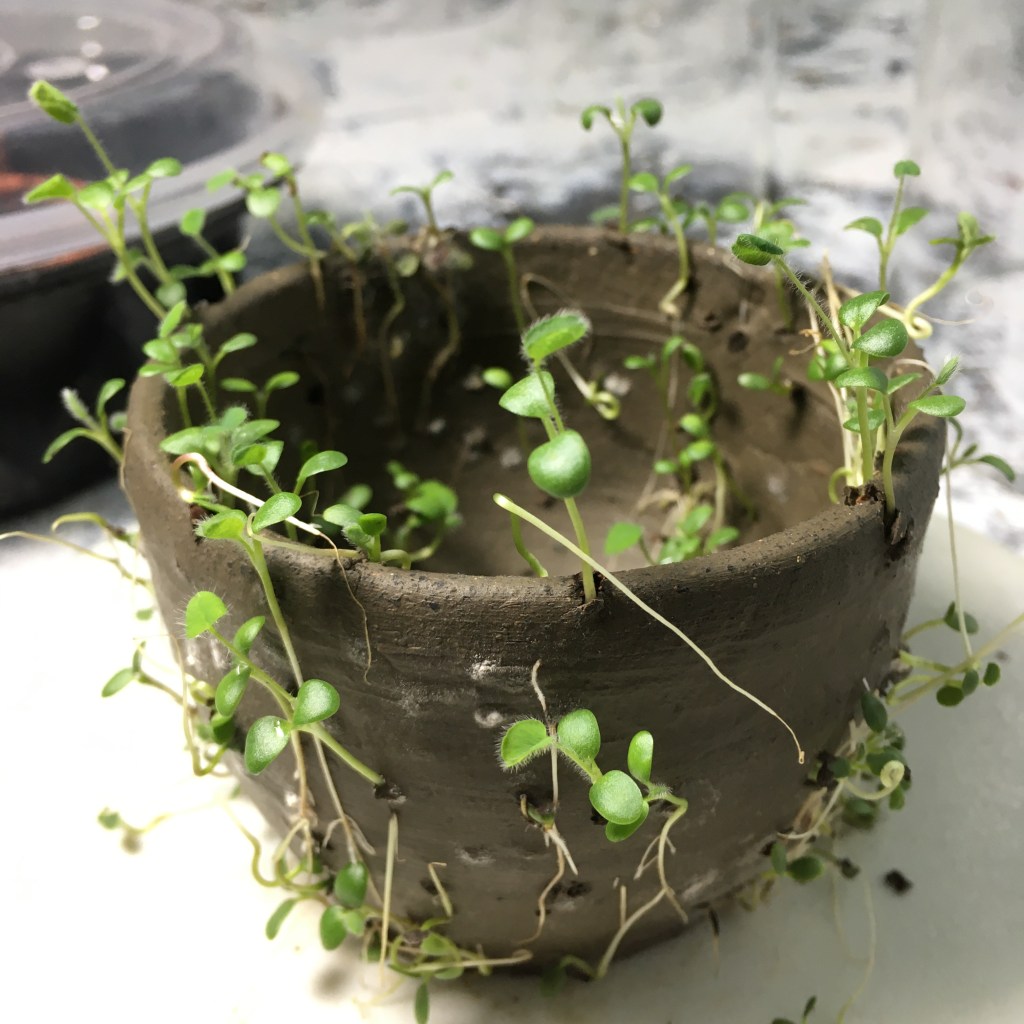
So, another option is to cover the entire floor of a gallery with thin unfired bowls. I’ve tested out what this could look like on a smaller scale, and outdoors.
I did a couple other tests with these thin forms in the last week.
We had one more good rain, so I was able to get a second take at this test, too.
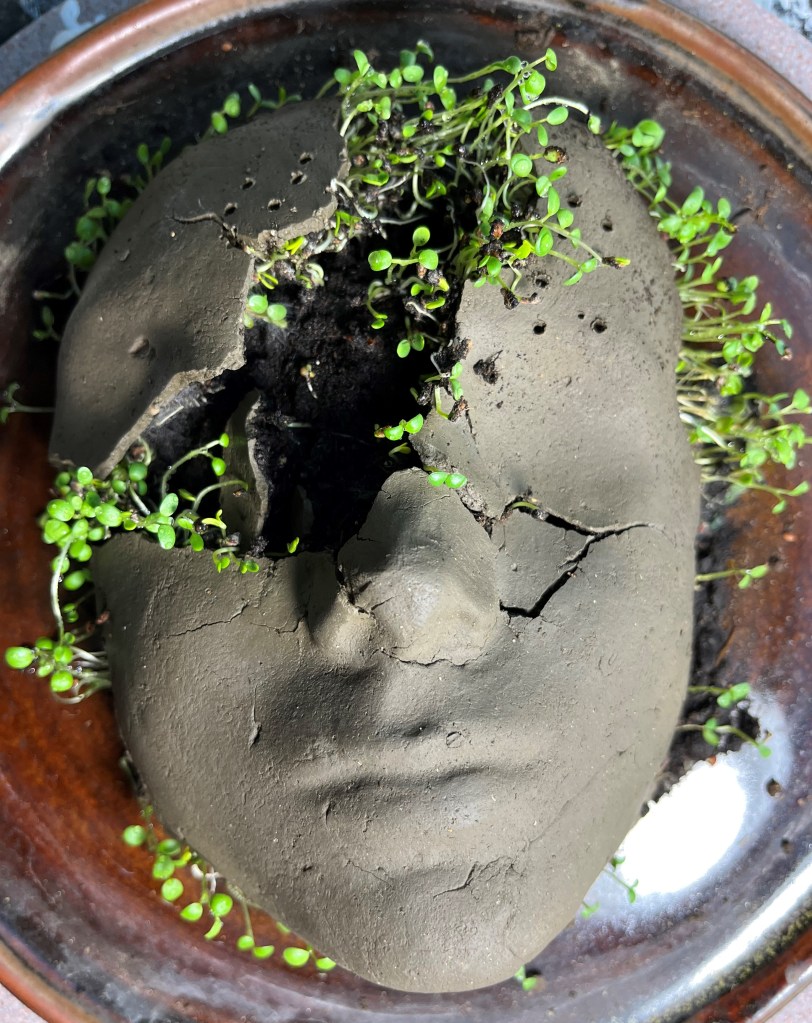
I also experimented with putting the clay cast of Jakob’s face outside in my garden to let it grow, though I’ll need to repeat this test with a new “face” using a few things I learned from this time through.
Another decision I’m still not able to make is whether to have this show indoors or not. I’ll need to spend the next while thinking about how site is important to my work, and also how I’d bring viewers into an experience that may be physically remote (distant) and weather-dependent. Will the show itself be an event, a performance of ephemerality, or will I rely on documentation of an outdoor ephemeral piece to reach a wider audience?
Also, if I see this show as first and foremost important to myself, as opposed to for my profs, I’ll likely have a different set of outcomes and a different way of measuring success. These are each points I need to spend more time considering.
Just as importantly, if I wish to proceed with clay as my primary medium, and Maddie’s garden’s clay in particular, I’ll need to resolve what it is I want to say with this material, and before I get there, what it is about this material that speaks to me. A few of the tests above that speak of violence, destruction, and loss. Then, there are a couple that have a less brutal, more naturally cyclical element to them—somehow they are more accepting, or peaceful (if not hopeful).
I hope to be in a better place after this summer and to know with confidence where I want my focus to be in my practice, at least for this one show. To be honest though, I’m worried about how this year’s fire season will effect me. In the last little while, the weather’s been helping in my recovery from solastalgia, locally at least (and I’m trying to pay less attention to the news). Here in Regina, we’ve had a few good rain showers, and while the trees are still exhibiting signs of extreme distress, such as by dropping record numbers of seeds—a tree’s dying wish—in this present moment things are good and green. Right now, in the middle of this sixth mass extinction the world’s seen, there are so many birds singing in my backyard, and bees are constantly visiting my pollinator garden. This doesn’t mean I believe the problem is any less serious, it just means I’m privileged enough to live in this tiny oasis. Still, for my own well-being, this spring hasn’t been emotionally crippling as last year’s heat domes and forest fire smoke. (I just got gifted a pair of socks that announce to the world that I’m “a delicate fucking flower”). Others in the eco-stress support group I started feel similarly. Now, the task for us environmental-sensitives is to build up some resilience for the times when it doesn’t rain or it rains too much. Perhaps my show should be about that, an acknowledgement of our situation and a learning to live with it. I think that’s a task that many people are facing, and that many more will face in the coming years. I can see having a practice based on it.
I’ve had a wild day for someone who’s been home sick with a cold.
The cold hit me a yesterday, which makes a lot of sense. Yesterday marked a week since my Mom’s week-long visit came to an end, and I think I finally let my guard down. In this week since she left, I’ve been pretty useless. Apart from spending time beautifying my garden, I’ve done nothing productive. I now think this time wasn’t a waste.
First, a bit about my Mom.
It was very hard to get her here to Regina from Vancouver. She required a team to prepare her both practically and psychologically. I knew this challenge was taking place, but I assumed it was for the reason that I’ve known all my life — that my Mom is the laziest person I’ll ever know, that she’s allowed herself to become completely institutionalized, dependent on her care home staff to take care of many things for her that she’s been physically capable of doing herself. Until the last time I saw her, she was actually able to take care of her daily needs, but feigned incapacity because having someone else do these things was easier.
On this visit, however, I realized that she’s now reached the point of actually incapacity. Covid isolation in her small care-home room has done her in. She hasn’t returned to eating in the dining room or going to play bingo and such in the activity hall. She never leaves her room. She’s become both obese and weak. So, now she actually needs help doing everything, and this came as a shock to me. I had no idea she’d let herself slide this much. This meant that her visit took a greater toll on my than I’d expected, both physically and emotionally.
My Mom’s life is a train-wreck. OCD runs in her family. At six she would worry whenever she heard an ambulance that they were coming to take her away. On top of the illness, her first husband offed himself during a weekend leave from a mental institution when my sister was two years old, my Dad was/is a schmuck who left her when I was seven to save himself (“Amy, if I stayed, it would kill me”), and then her boyfriend died suddenly of a bad cold (combined with diabetes) when I was 13. Because of her OCD, she’s never been able to work or participate in society in any enjoyable way at all. My point is, I feel so incredibly sad for her, especially when I see her taking such intense joy from things like listening to the birds in my backyard or going out for an ice cream, and at the same time, I’m furious with her for her absolute weakness and lack of dignity and drive. Of course, this stirs up feelings I had as a child living alone with her in a slummy apartment, caring really badly for the two of us. I’ll never have an answer to questions about both my parents. For my Mom, it’s this: did she have had any control over her life at all, or is my anger at her unfair?
So, I guess it makes sense that I needed some down time after she left. Everything I’ve been doing to recover some sense of equilibrium in my life was just gone.
I was lying in bed this morning, trying really hard to sleep or at least relax. I was hyper-aware of the many small things I needed to get done, but too sick to get out of bed and do any of them.
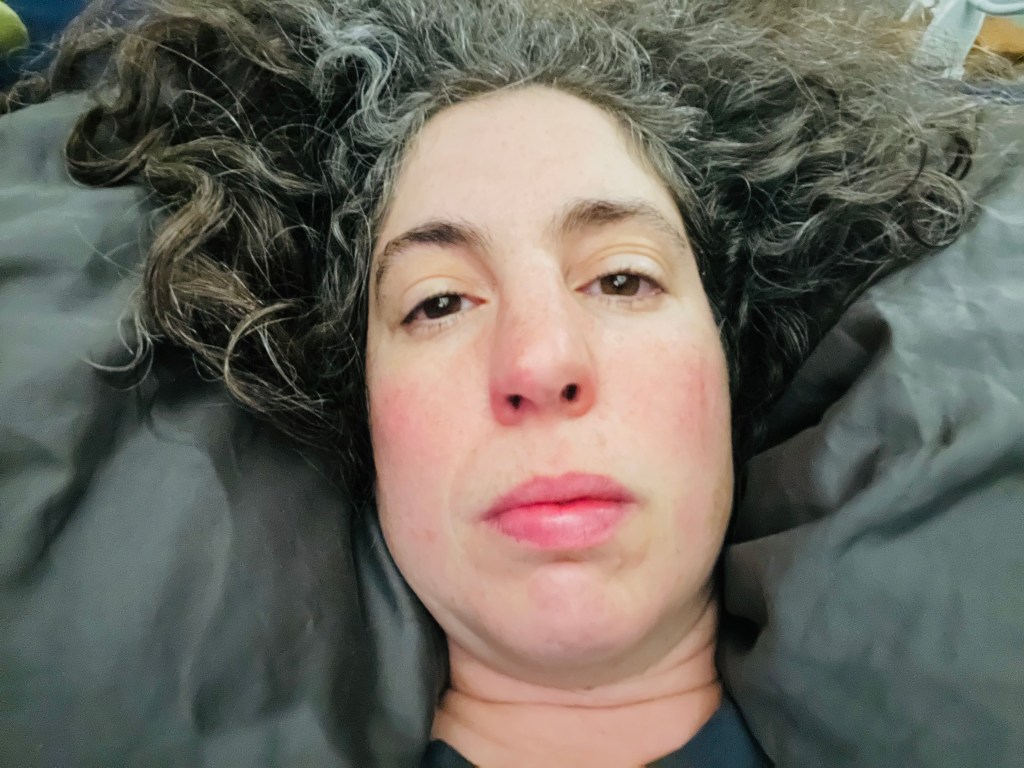
this is the first time I’ve ever shared a selfie
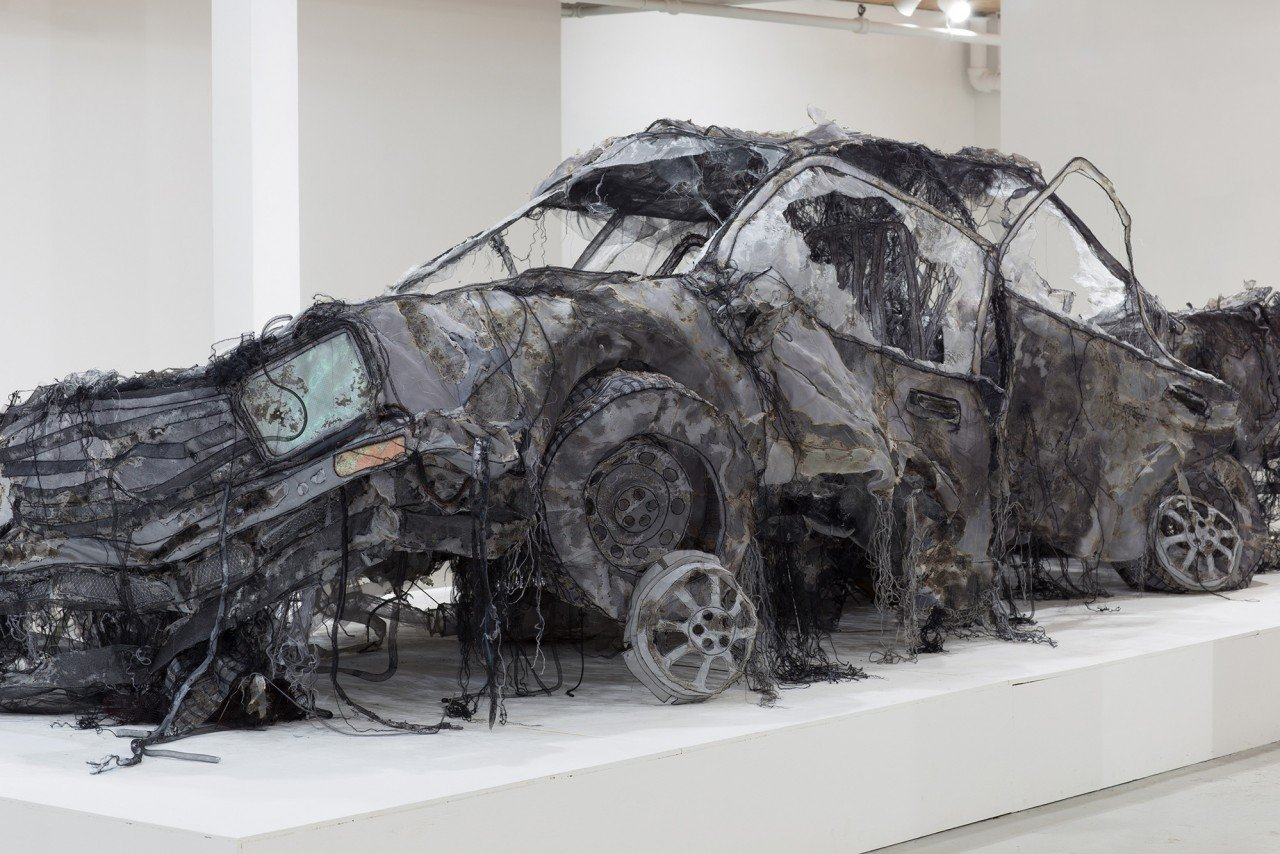
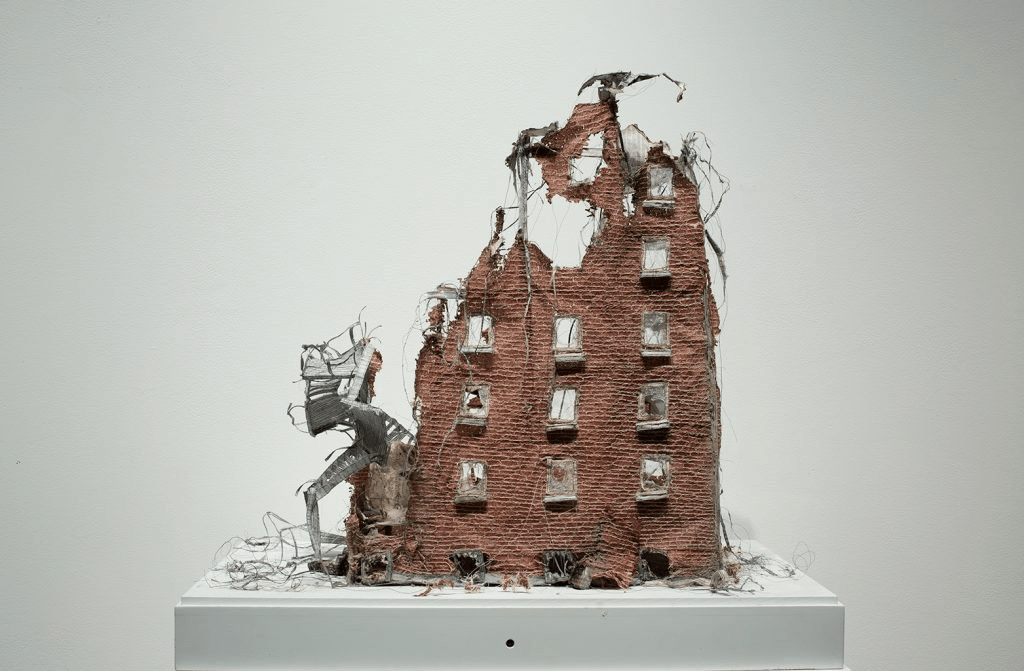
I shamefully started scrolling Facebook on my phone, where I encountered a post by Jeannie Mah that changed everything. It was a section of pasted text from another Facebook post by Velones In Action introducing the artist Jannick Deslauriers.” According to this post, Deslauriers describes her work as:
Made of translucent fabrics and threads, my sculptures are intentionally left unfinished and sometimes even visibly damaged, torn or frayed, as if the object has frozen in a moment of destruction. The transparent textile materials and the partial obliteration of my pieces give them a ghostly character that suggests a certain humanity. Like ghosts that have come to haunt us, the objects I make wander and are abandoned. Although light and elegant, their disturbing presence implies something tragic.
I wish I could see Deslaurier’s work in person and then take her out for lunch.
What’s really neat is that just before giving up on verticality and going to bed, I’d tried sitting and reading a book I’d slid off my shelf when I was feeling shitty yesterday. What’s Next? Eco Materialism and Contemporary introduced me to New Materialism, which is a field of inquiry I believe Deslauriers’ work responds to, and I would love to chat with her about, hence the lunch invite.
This is yet another book I owe thanks to my husband, Michael Trussler, for bringing into our home (this one as a gift to me a few years ago, one I flipped through at the time and then shelved — I wasn’t ready for it).
New Materialists, in a nutshell, are interested in the world’s materiality and see value and wonder in every object that exists. According to Linda Weintraub’s description of it,
New Materialists construct conscious relationships with all forms of matter, including such common objects as paperclips, coffee mugs, pennies, zippers, napkins, shampoo containers, paper cups, birthday candles, junk mail, pencils and plastic spoons. […] These every day, manufactured objects acquire the capacity to enthrall when attention is paid to the elaborate network of professionals whose skills were invested in their production. […] New Materialists are equally inclined to revel in acorns, moss, nail clippings, banana peels, apple cores, chicken bones, peanuts, and egg shells, because each of these items encapsulates ongoing evolutionary struggles and genetic experimentations that originated in primeval times. (5)
Eco Materialists use this attention to every material and sense of wonder at the world to remind us of our own integral connection to Earth, one which industrialization/colonialism has caused many of us to forget. Weintraub invites readers to consider this connection, sharing that we are each in fact physically comprised of so much more than the human, as
approximately one hundred million non-human cells occupy the human body. This is ten times greater than the cells that share the person’s DNA. Human existence, therefore, is not independent and self-determined; it is an ongoing, multispecies drama in which opportunity and emergency are continually being negotiated with myriad microscopic entities. (13)
Wait a second. I’m terrible at math, but does this mean that only one tenth of my body is genetically “me”?
@!#&%
Back to being in bed now, I was lying there looking at Jeannie’s post of Jannick Deslauriers, thinking about material, shifting perceptions of commonplace objects, and the multitudinous lifeforms in my body. Unable to sleep.
I decided there was no point, so I got up and made a quick trip to my studio to pick up a few of my super-fragile unfired local-clay cups and see what I could do with them via documentation. (I threw on some hand sanitizer and an N95 to protect others).
I got home just in time, though I knew not for what. Upon getting in the door, the sky went from Saskatchewan-sunny to overcast in a way that spelled rain. I threw on my rain jacket, grabbed my phone and an umbrella, and took these cups to my backyard to capture them dissolving in the rain, which I knew would happen just from my knowledge of this clay.
I was curled up under said umbrella, my back-end and feet getting wet, while this took place in front of me:
The sky cleared in minutes, before I was ready! There were other cups to try, other angles! Rain is a fickle collaborator. Though, the sun is nice, too.
I then realized I was chilled. My nose dripped onto the grass. Sniffling and sneezing, I wondered about what I was expelling—what inorganic materials and what microscopic animals were leaving me for good? How much of my own preciously limited DNA was in that mix? Where would those atoms end up in the future? They wouldn’t just disappear. What may they become? Would a few of them enter into this backyard’s clay?
Maybe the virus taking over my sinuses made me do it, I don’t know, but I decided to see if I could blow apart a cup by sneezing on it, on video. It turns out that it’s very hard to will yourself to sneeze. I took off my long-sleeved shirt and stood there waiting. I went in and out of the house, hoping for a big chill down my spine, but nothing worked until I stuck a large blade of grass up my left nostril. Three violent expulsions then occurred. And what does the force of the CO2 and these materials traveling at 100mph and hitting a super-thin clay cup look like? The result was anticlimactic.
At the same time as all this was going on, I had a song stuck in my head thanks to a conversation I’d had the day after my Mom left last week. I had the pleasure of meeting Robert Shay, a Kentucky artist who’s visiting Regina to spend time wood-firing with Martin Tagseth. One of the first things Bob said to me, randomly, was, “you must love Leonard Cohen.” I said something like, “yeah, I do?” to which he replied that I must listen to a cover of his songs by some artists I hadn’t heard of. I reciprocated by asking if he knew of Antony’s cover of “If It Be Your Will.” He didn’t. So, among other things I did today while not sleeping as I should have been, I emailed Bob as I’d told him I would to share a link to this song. Hence, I’ve had it in my head all day.
And today, while watching the video I sent to Bob in this email, one I’ve seen many times, I heard Cohen come in (the video cuts to an interview clip) and say something at minutes 1:36 that I’d never really paid enough attention to in the past, as if again, it was waiting for me to find today (which I don’t believe):
A lot of those songs are just the response to what struck me as beauty whatever that curious emanation from a being or an object or a situation or a landscape, you know. That had a very powerful effect on me as it does on everyone, and I prayed to have some response to the things that are so clearly beautiful to me and they are alive.
I’ve appreciated this synchronicity today. It was a gift from the gods I don’t believe in. Or a sign of everything’s interconnectedness? No, I believe these seeming-coincidences are all in our head. Still, I think I’m now ready to move on from mother-visit exhaustion and the creative block I’ve had recently and get back to the self-care I’ve been focused on lately as part of my recovery. But still, I find it meaningful that this cold I have a result of being worn down from her visit played a part in how all of this happened today, from being forced to slow down, to considering my biofluid discharges as an artistic medium. Thanks, Mom.
This past winter, as I was exploring the unique properties of Madeleine Greenway’s garden’s clay, my supervisor, David Garneau, asked me if I could think of a vessel that is more personally significant to me than a cup. After taking a moment for this to sink in (doesn’t everyone have a personal relationship with cups?), I thought of my son as that most significant vessel to me. Maybe this idea of the body as a vessel came extra quickly to me because of my training as a potter. We see vessels. As Paul Mathieu put it,
at the conceptual level, all objects are CONTAINERS. They are articulated around the transition between exterior and interior. Containment has to do with the relationship between the object and its environment. Containment bridges an object with its environment. Objects are about difference as continuity, not difference as rupture.
Mathieu 270-1
This way of seeing the world of objects is particularly clear to ceramicists, as “ceramics is the most intimate informed by this theoretical and conceptual framework, in its conflation of a volumetric form with a distinct surface” (271). I understand this notion of seeing any object, a body even, as a volumetric form. I think that my body has an understanding of forms that perhaps those who haven’t spent years handling clay, forming it, may not have. And really, what are we but lumps of clay?
I think I also jumped to my son’s body as I see him, sadly, as having some qualities in common with the cups I’ve been making lately.
Jakob is an incredibly intelligent and sensitive person who knows too much and is constantly seeking to learn more. Whereas his obsessions used to lie within the natural realm, sponging up as much as possible about dinosaurs, sharks, snakes and the like, his interest now lies in the human animal: politics. We need need watch him or he’ll sneak onto to computer to read The Guardian. A compromise is that we let him browse CBC online, but even they, in their pathetic excuse of climate crisis coverage, have headlines that spell doom and gloom, such as this one from last week, “Scientists warn future temperatures will test humans’ ability to survive.”
Knowledge about this crisis is hard to avoid in this household I guess. We make some decisions based on their climate footprint, and so of course he knows why we drive a hybrid and never use the clothes dryer. We’ve also attended climate protests together since he was just little, and I could see as he aged that he paid more attention to the placards folks were carrying, many with messages about needing to save the planet, some spelling out the situation in even more frightening terms. Sign that read “There’s no Planet B” or “How can we work when the earth is burning?” are pretty clear for anyone who stops to think about them. Not to mention the “die-in” we all once staged.
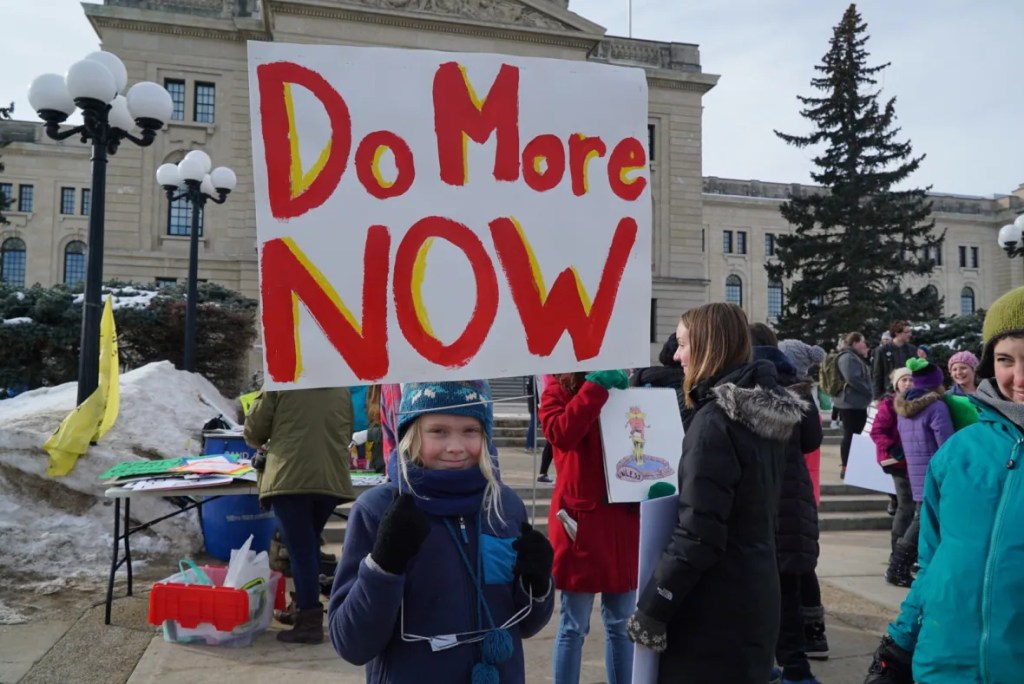
CBC reported on one protest here in Regina back in March of 2019 in the article “I’m not old enough to vote, but I’m marching against climate change.” There was a particularly good turnout in front of the legislative building for this “day of global action,” and as you can see from the photo of us in this article, I was proud to be a part of it, proud my son was a part of it.
Yes, I was proud of my son for holding up this placard. His dad and I raised him with the idea that he should be involved in this unfair fight, if not because it would get us anywhere than at least so he’d know he know to stand up and fight, and that ultimately, he did what he could for his age. I was pleased too for times when I’d get this issue in the news, thinking he’d know without a doubt that I didn’t just stand by idly while the house was on fire.
Still, I’ve realized that this awareness and participation can come at a cost for some kids, and this is increasingly on my mind these days. Jakob’s always been matter-of-fact about the reality that our species is causing problems; in fact, when he was five years old, he told me with a straight face that humans have evolved to create the next mass extinction as these things just have to happen every few million years. Lately, however, I can sense this scientific approach to the situation diminishing, or perhaps at least living alongside another perspective, one that involves worry, anger, shame, and fear.
For one thing, he’s started saying “I’m sorry” for no apparent reason up to hundreds of times a day. He’ll say it when you walk past him on the couch. He’ll say it at the breakfast table. He’ll say it when he’s brushing his teeth. When asked what he’s sorry about, he says “I don’t know, I just feel I should be sorry.” It’s a compulsion, and while we (including doctors) don’t know the cause, I have my own theory: he’s sorry for being alive.
It breaks my heart each time he utters these words.
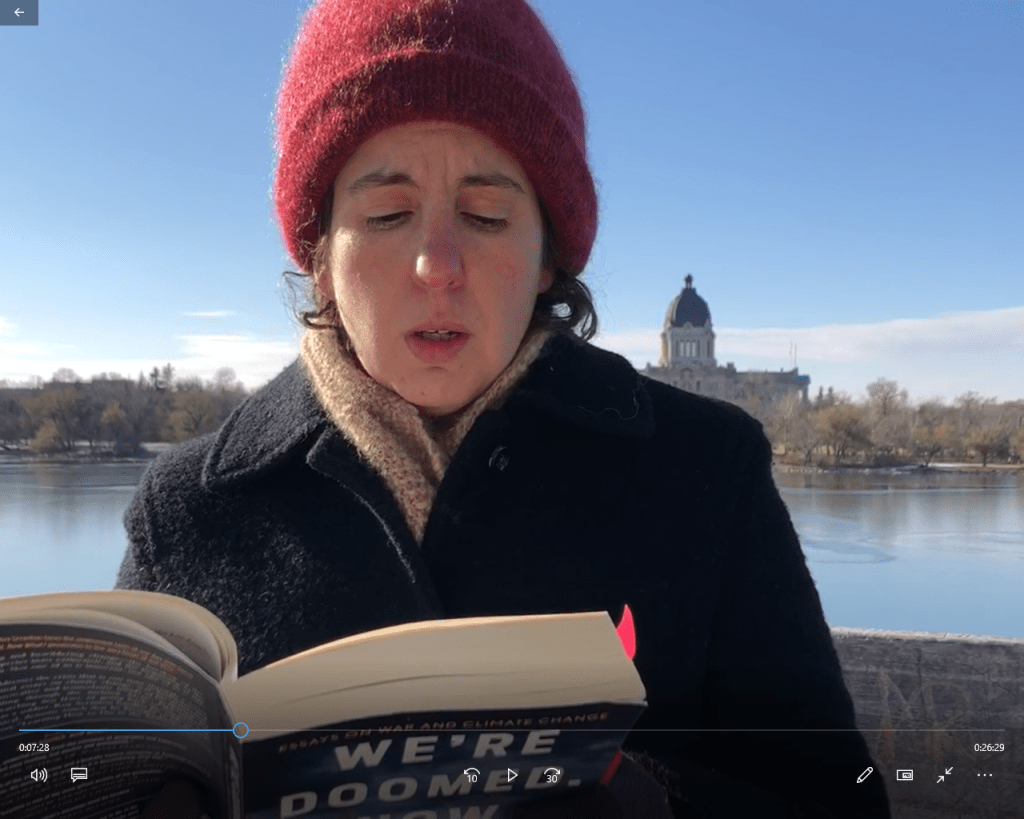
So, this is why I’ve started hiding certain things I do from him. For instance, I did not want him to know that at the start of my MFA, when I was experimenting with performance work, I read aloud Roy Scranton’s chapter of his book We’re Doomed; Now What?, “Raising a Daughter in a Doomed World” across from the provincial legislature on the election day. I try to hide books with titles like this one from his view.
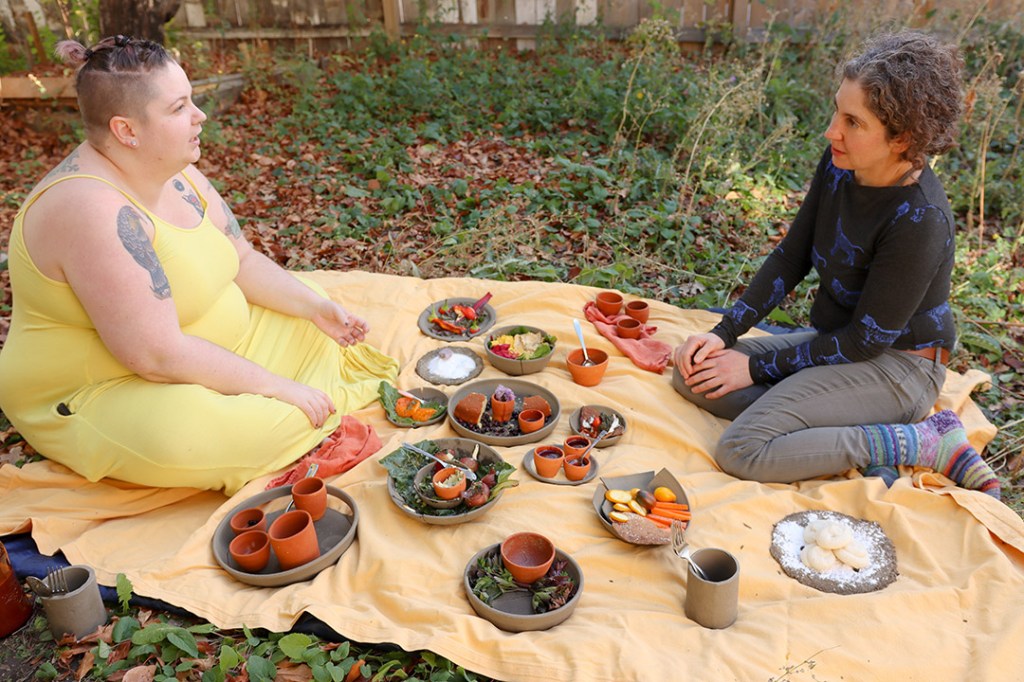
When he’s around, I also try not to talk much about my dust plates, which embody drought and as David says, a sort of “end of ceramics” tied to the end of humanity as we know it. Likewise, he was not invited to the picnic I had with Madeleine, at which we celebrated the abundance of life her garden creates while also grieving its imagined future loss.
I think that if Jakob weren’t the sort he is, clearly anxious and disturbed by what’s wrong with this world, I’d be more relaxed about it too. I’d feel less worry and guilt, at least. At the same time, I’m perfectly aware that the flip-side is also true: if I were more relaxed about all that’s wrong with this world, our son would very likely be more relaxed about it too. So really, we’re stuck being us, feeding off each others’ neuroses. Even our poor cat Toby is medicated, but still pees in our shoes over any slight shift in his daily routine. As Philip Larkin puts it so well,
They fuck you up, your mum and dad.
They may not mean to, but they do.
They fill you with the faults they had
And add some extra, just for you.
lines 1-4
I don’t want this to be true, just as I don’t want the world to be fucked up for my child. Who does? But — here’s my question — how do you raise a child in this world who knows what’s going on and can choose to participate in it, yet who isn’t entirely fucked up by it at the same time?
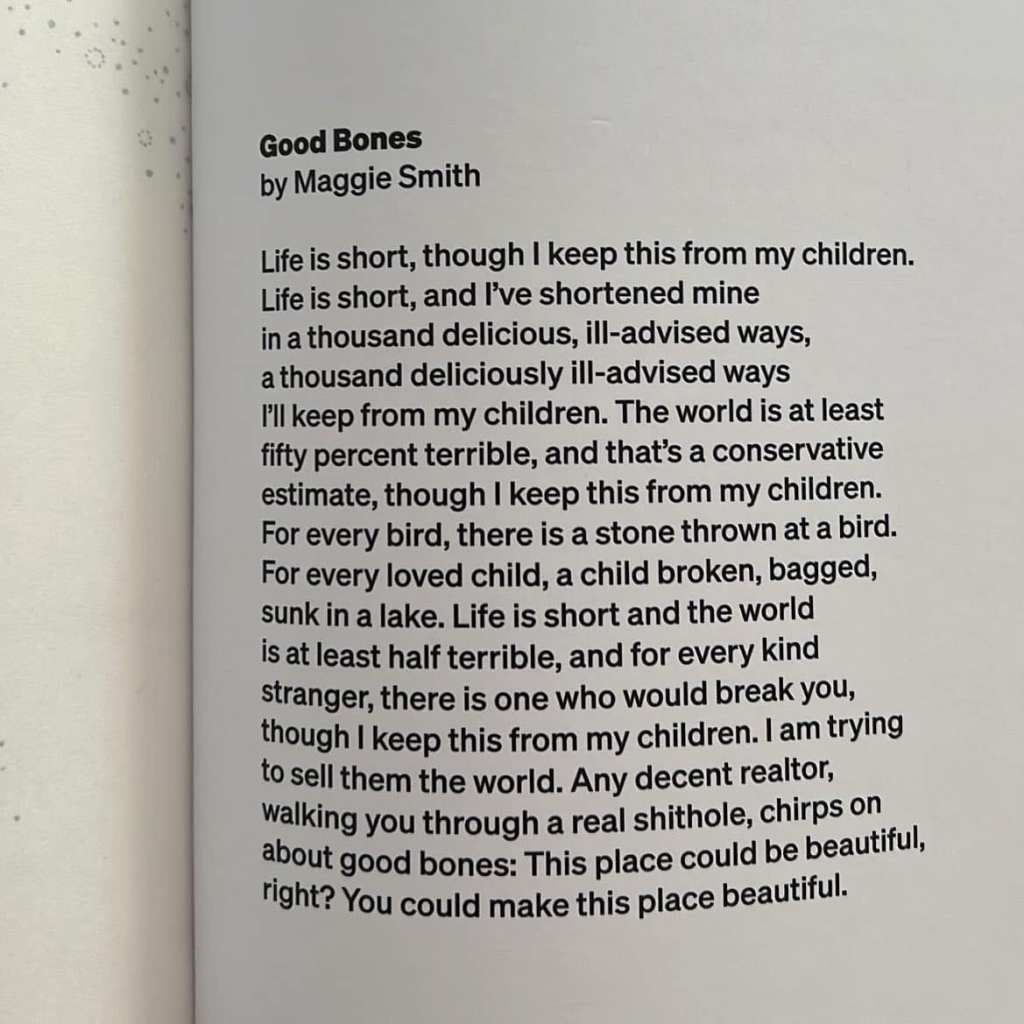
Karla McManus has generously been sharing some of her time and books with me lately, and just recently sent me this poem after a conversation we had in my studio:
I’m always trying to make this place beautiful for Jakob. It’s what every parent does. It’s what most of us try to do for ourselves as well, it’s just that some are better at it than others.
I’m realizing these days that Jakob’s place in this world is a key component of my art practice. While climate change is perhaps at the surface of my work, it’s also about larger core issues like my own anxiety and grief about the situation, which includes my anxiety and grief over my son’s anxiety and grief.
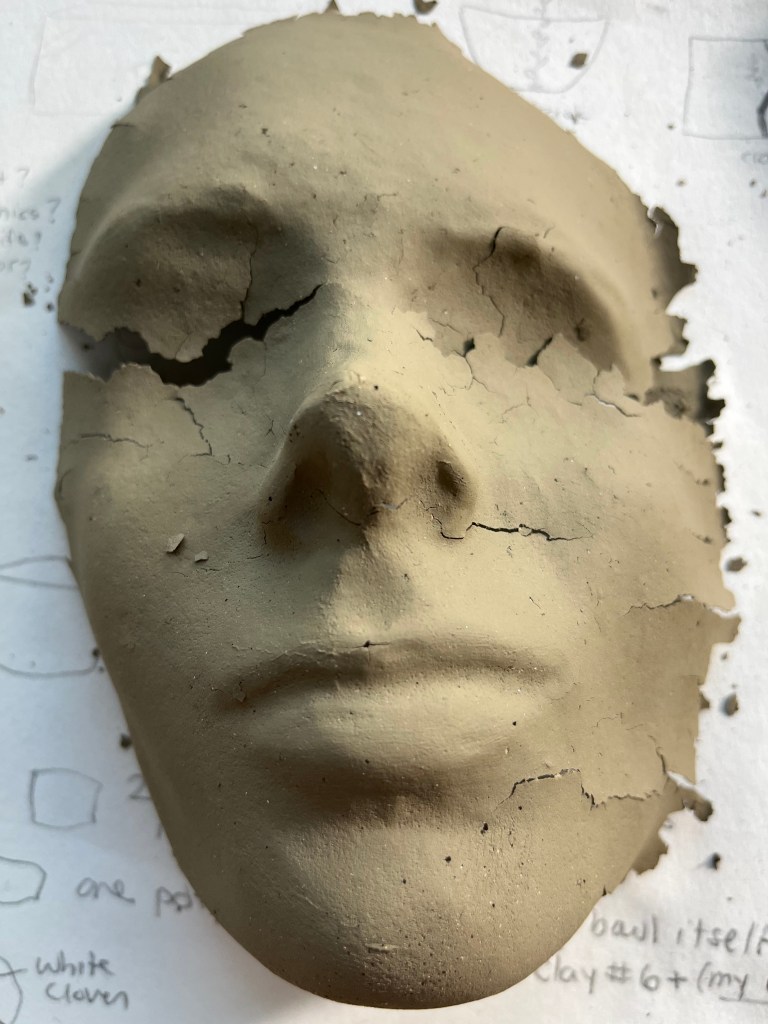
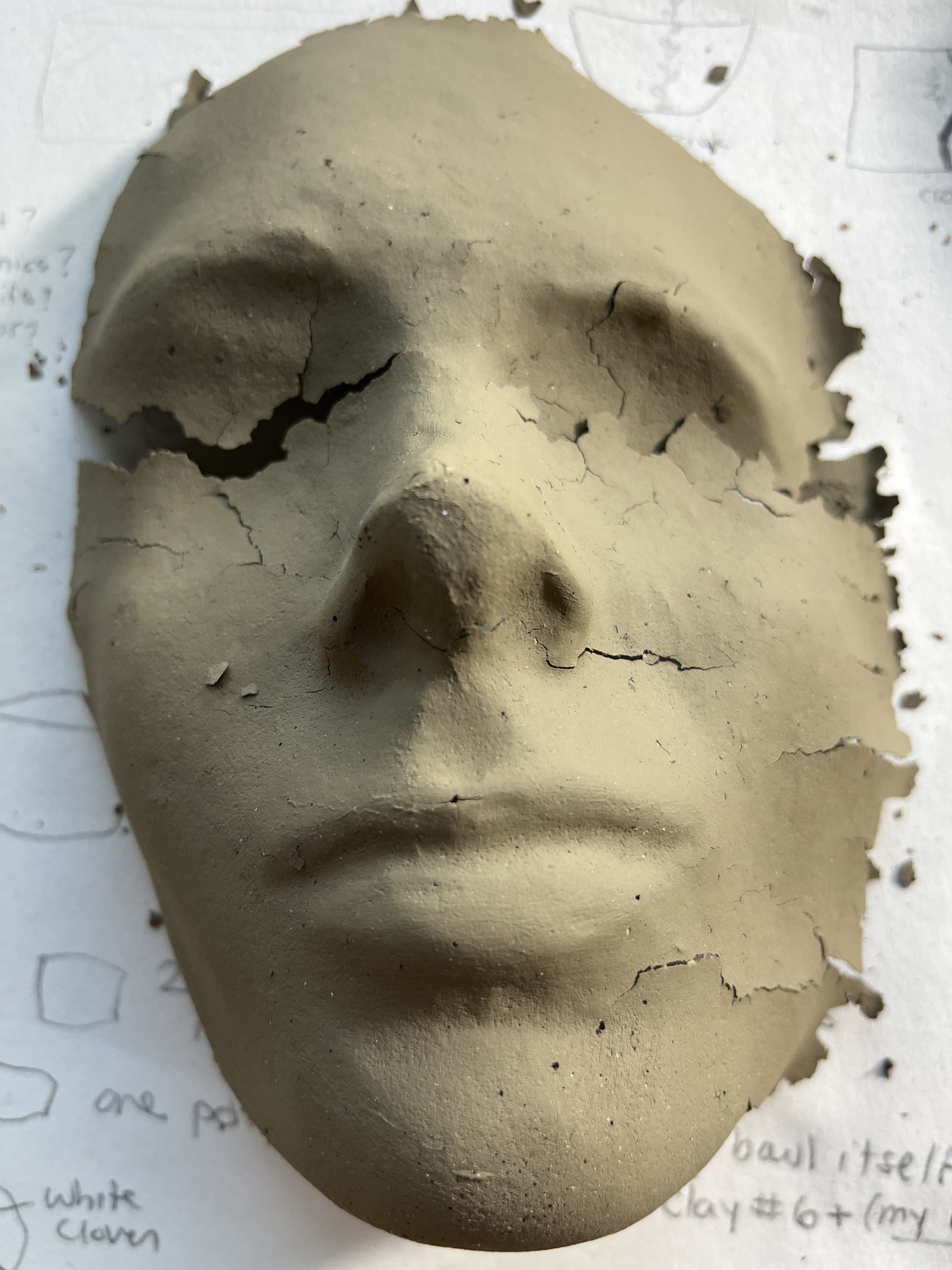
So, this must be why I immediately thought of Jakob when David asked me to consider other, more meaningful, vessels, and why this ultra thin and fragile version of his face makes complete sense to me.
The frailty of this piece aligns with the frailty I worry he has and will continue to have as climate change increasingly impinges on our lives. At the same time, I’m aware that this piece also speaks about the naturalness of this frailty. This material, this ancient clay, outlives us, and really, it is us. As I’ve written about before, the elements that comprise our bodies all come out of the ground, and back to the ground they’ll return.
I’ve explored this line of thinking by returning to an idea I had last fall while I was really, really struggling to make anything at all, and forcing myself to experiment with bringing *life* into my work with the hopes it would help shift the needle a tad from grief to hope. This idea involves planting seeds directly in the clay body and watching them germinate and grow. At the time, it worked! At least momentarily, the tiny seedlings coming from these cup forms gave me a jolt of joy, an experience of what Deborah Bird Rose refers to as “shimmer.” As I wrote in an end of semester summation that term,
Deborah Bird Rose uses the Australian Aboriginal aesthetic term bir’yuni to describe the brilliance of life as well as art: “the shimmer of life’s pulses and the great patterns within which the power of life expresses itself” (G61). She talks about how after drought, “the rains start to bring forth shiny green shoots. […] Shimmer comes with the new growth, the everything-coming-new process of shininess and health, and the new generation.”
Developing this more, I’ve added soil in the hollow of Jakob’s face to help the plants live longer.
I see this piece taking a turn towards other themes or ideas, ones about our connection to the land and the its cycles that I mentioned above. Paired with their uber-fragile compoent, I could frame these works as being about our struggle with oscillating on the grief—–hope spectrum, one I know many deal with from meetings of the EcoStress support group I recently created. Do I want to see my son’s face about to disintegrate into life-less clay dust, perhaps focusing on his anguish, fragility, and hopelessness, or do I wish to focus on its potential to sprout new growth from its process of decay, and what would that mean?
I feel that there’s potential here to explore one or both of these versions of Jakob’s face, but at the same time I’ve been asked by several people why I’ve chosen Jakob’s face. This is something I’ve been trying to work out.
To help me think about what faces mean, I first turned to the philosopher who’s written most on it, Emmanuel Levinas. (I owe a lot to having a husband with an enormous library). Levinas sees the face as the pinnacle expression of the Other, or what he calls Autrui. The face is the way we know someone.
In the concreteness of the world a face is abstract or naked. It is denuded of its own image. Through the nudity of face nudity in itself is first possible in the world. The nudity of a face is a bareness without any cultural ornamentation, an absolution, a detachment from its form in the midst of the production of its form.
Levinas 53
The face is the portal into our understanding of the Other. It is unique in this ability; unlike everything else, “the epiphany of the face is alive” (53). I think I was drawn to use the face because it is my entrance-way into my son’s being.
I’ve also bumped into the face in other reading I’ve done. In “On Transience,” it was serendipitous to me that Freud writes, “[t]he beauty of the human form and face vanish for ever in the course of our own lives, but their evanescence only lends them a fresh charm” (305-6). This idea of the face as something that vanishes is another possibility for what I’m on about with my paper-thin mask of Jakob; maybe my work is about our own ephemerality, regardless of climate change and eco-anxiety, just the fact that we all, including my son, are here for such a very short time.
Then, while experimenting with planting seeds in Jakob’s face, I was likewise pleasantly surprised to come across a chapter in a book Karla lent me in which Sabine Lenore Müller discusses “Environmental Modernism: Ecocentric Conceptions of the Self and the Emotions in the Works of R. M. Rilke and W. B. Yeats.” In this chapter, Müller analyzes Rilke’s poem Der Tod des Dichters, “Death of the Poet.” Here are a few of its lines:
Those who saw him alive knew not
How much he was at one with all this.
Because this: these depths, these
meadows
And these waters were his face.
Oh, his face was all this vast expanse
wanting even now still to be near him,
wooing;
And his mask, which now perishes, un-
certain, is tender, open as the inside
of a fruit, decaying in the air.
Rilke qtd in Müller 53
Wow, thank you Rilke, and thank you Müller for showing me this. The face, as an embodiment of our entire being, is really the landscape, nature itself. This is divergent from Paul Mathieu’s notion of the object. While for him, objects bridge the exterior and the interior, for Rilke, we are both of those spaces; we are everything.
As Müller points out, for Rilke,
“the face is described as a vast expanse, the environment itself, meadows and woods, to which the body, which used the human body as a mask for self-expression, yet, was obscured beneath it. In death the mask is wasting away, and the face is finally revealed — the poet’s face was the expanse of the natural world.
Müller 54
In other words, the poet in Rilke’s poem is an example of Heidegger’s Being, connected to everything else in existence. If I place this concept next to my mask of Jakob’s face, I see that through this work I am connecting Jakob to the world. Jakob becomes like Rilke’s poet he writes about, “tender, open as the inside / of a fruit, decaying in the air” (lines 16-17). Vulnerable, yet immortal. Dying, and yet alive.
I have to leave off for now. It’s been good to get all of this into writing, yet I feel like it’s still just a start. I’m not yet decided on if or how I’ll use these pieces, these faces of my son, or if I’ll find something less representational to embody him and what he/we are experiencing. It may be that I abandon the face entirely, but that it will still have informed my work, somehow.
Works Cited
Bird Rose, Deborah. 2017. “Shimmer When All You Love Is Being Trashed.” Arts of Living on a Damaged Planet, edited by Anna Tsing et al, 51-63. Minneapolis: University of Minnesota Press.
Larkin, Philip. “Your Parents.” High Windows. Faber and Faber, 1974.
Levinas, Emmanuel. Basic Philosophical Writings, edited by Adriaan T. Peperzak, Simon Critchley, and Robert Bernasconi, Indiana UP, 1996.
Matthieu, Paul. “Object Theory.” The Ceramics Reader, edited by Andrew Livingstone and Kevin Petrie, Bloomsbury, 2017.
Müller, Sabine Lenore, “Environmental Modernism: Ecocentric Conceptions of the Self and the Emotions in the Works of R.M. Rilke and W.B. Yeats.” From Ego to Eco: Mapping Shifts from Anthropocentrism to Ecocentrism. Edited by Sabine Lenore Muller and Tina-Karen Pusse. Brill, 2018.
Smith, Maggie. “Good Bones.” Good Bones. Tupelo Press, 2017.






 Amy Snider