I wrote last week about the connection between ephemeral art and mourning, reflecting on Mary O’Neill’s “Ephemeral Art: Mourning and Loss.” One of O’Neill’s citations that I found most helpful came from Freud’s essay “On Transience.” I figure that if I’m now going to cite Freud, I should do so from his original writing, so I went and picked up volume 14 of The Standard Edition of the Complete Psychological Works of Sigmund Freud. Thank god for libraries. After gobbling up “On Transience” (it’s only three pages), I moved onto Mourning and Melancholia. From it, I learned that according to Sigmund, surprise surprise, my melancholia (aka clinical depression) is indeed connected to narcissism, regression, an oral cannibalistic phase of libidinal development, mania, hysteria, sadism, and yes, anal erotism. I feel a whole lot better now, knowing this.
While I stand with many in not agreeing with everything Freud has to say, I have respect his intelligence and much of his understanding of the human condition. A few of his beliefs on melancholia are precise from my experience.
I’ve been concerned that this reading may be a sidetrack from my project for this term, but I’m pretty sure it make sense to spend time here. O’Neill (and many others) write that ephemeral art-making (often) stems from experiences of mourning. So, I’m confident in my reason for making ephemeral work, as I certainly believe I’ve been in a state of mourning over the loss of natural places I love since my trip to BC last summer. Why, though, am I experiencing this? I’m often asked why climate change affects me so strongly, and I don’t have any good, quick answers. People often tell me that this effect climate change has on me has more to do with my own weakness or illness—it’s some kind of psychosis—as to them it’s unnatural and unhealthy to care as much as I do about the situation (as if this existential threat should not be terrifying and tragic). How should I respond to them? More importantly, I need to sort this out for myself. So, it’s time to try a bit of psychoanalysis, as much as one can perform it on oneself, which may be not at all, to see if it will give me insight into my work.

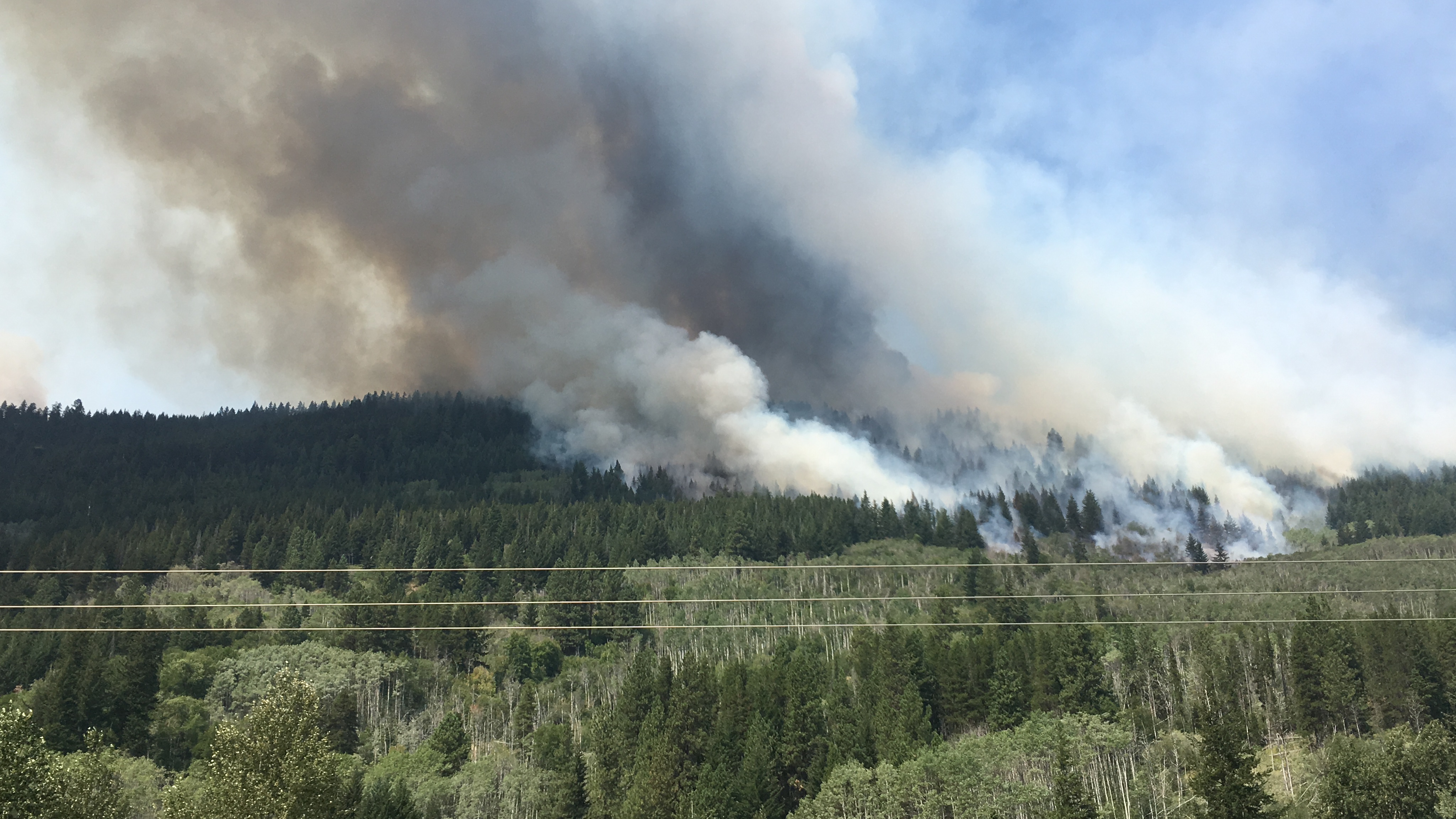
My son and I about to go for a swim on Gabriola Island (2015) (photo credit Michael Trussler); fire burning by a highway in BC (2021)
My first question is, why am I such a nature lover? In “On Transience,” Freud writes,
“We possess, as it seems, a certain amount of capacity for love—what we call libido—which in the earliest stages of development is directed towards our own ego. Later, though still at a very early time, this libido is diverted from the ego on to objects, which are thus in a sense taken into our ego. If the objects are destroyed or if they are lost to us, our capacity for love (our libido) is once more liberated; and it can then either take other objects instead or can temporarily return to the ego.
“On Transience,” 306
I’m not sure how convinced I am of this limit to one’s capacity for love, but relating the above to my own history is interesting. I grew up alone with my severely mentally ill mother. She couldn’t take care of either of us, and so I had to take care of us both. She had (and still has), among other things, extreme OCD. Hers manifested itself mostly in the form of rituals surrounding every minutia of daily living. Each task (dressing, closing a bottle lid, taking medications) had its own set ritual, always involving a vocalization of information (a visual description of each pill before swallowing it, for example) that would spill out of her in a kind of song she’d repeat in sets of four. Needless to say, it was a huge effort for her to leave the house (and she could never, ever, get anywhere remotely on time). She never held a job, and it’s only because of her parents generosity that she didn’t end up on the street. Our apartment was packed full with mail that would be too time consuming and stressful for her to open, and other clutter and filth too—laundry, bags of used Depends, breakfast dishes going moldy in the sink. We couldn’t cook because every surface of the kitchen was covered in stuff, so I grew up largely on McDonald’s and family restaurants open late. I gradually stopped going to school. The principal sent letters home, but my Mom rarely opened them. If she did and tried to tell me to go to school (or to do anything), I’d tell her to fuck off. She’d sometimes tell me she’d kill herself if I went out with my friends, and I’d still leave. (I always came home though, and always put my Mom to bed.) I said and did many awful things to her over the years that I regret, but I understand this period of my life now in a way I didn’t then, and I don’t blame myself. I was filled with rage and loneliness. I believe the rest of my family knew enough to at least have asked the right questions, but they never did. No one came to my rescue. I didn’t graduate with my class, and it’s really only because of my drive to travel that I got myself together enough to return to school and move out of that situation. It was one in which no child should be placed. I’ve been diagnosed with PTSD as a result of living in a state of trauma throughout my developmental years. I’m certain this trauma physically affected my brain’s development, and that my severe struggles with forming long-term memories is one result.
I could write more, but the point I’m getting at is this: for three weeks each summer between the ages of 10 to 15, I got to escape from all of the above and spend time at a hippy-loving summer camp on the gloriously beautiful Gabriola Island off the gulf of British Columbia; I believe I directed my libido (my love) to this place and all the world’s natural beauty that it showed me. Now, as I see this “object” being destroyed, I suppose that libido should be “liberated” and that I should, according to Freud, direct it towards something else. More on how that’s going, later.
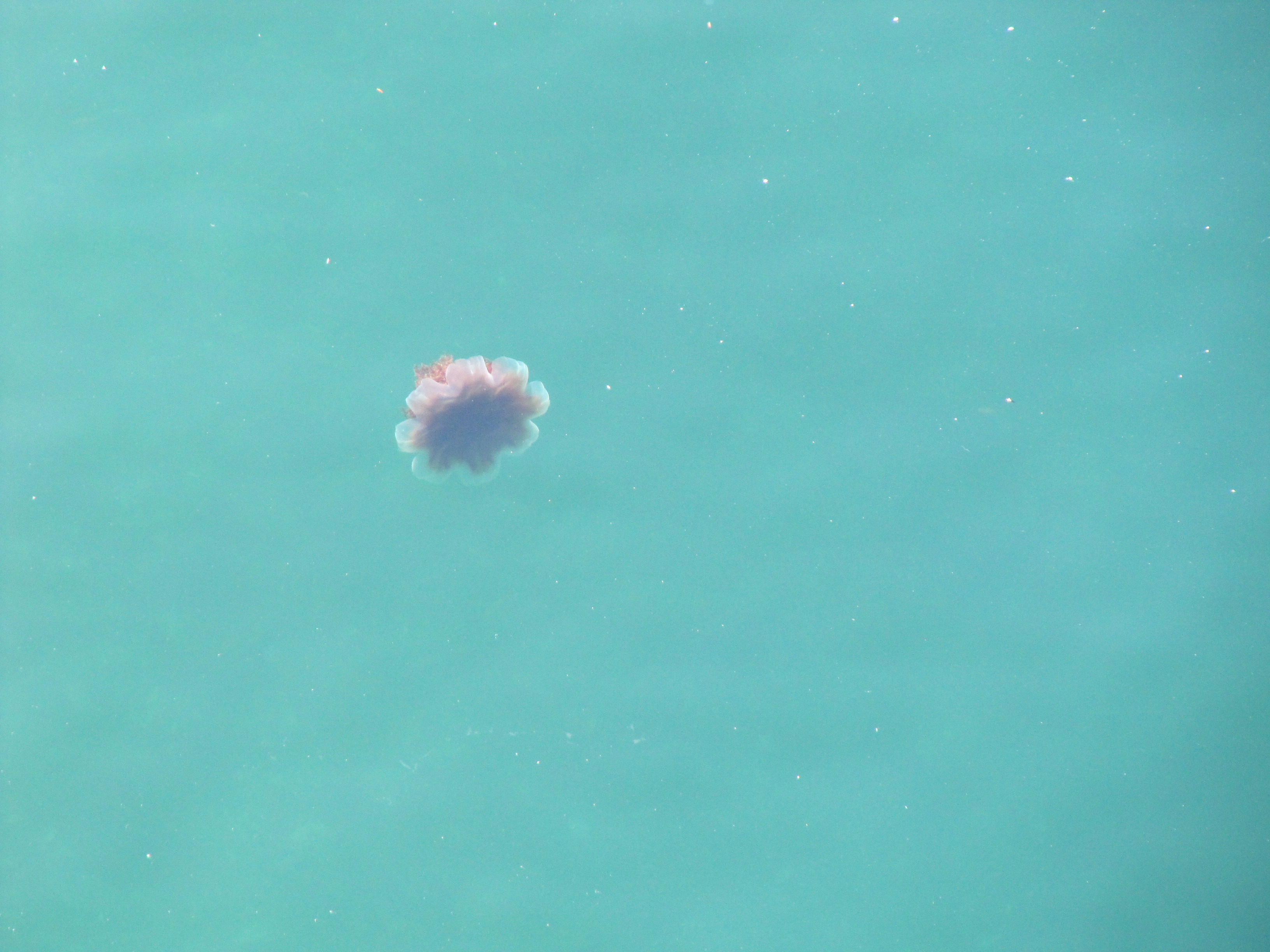
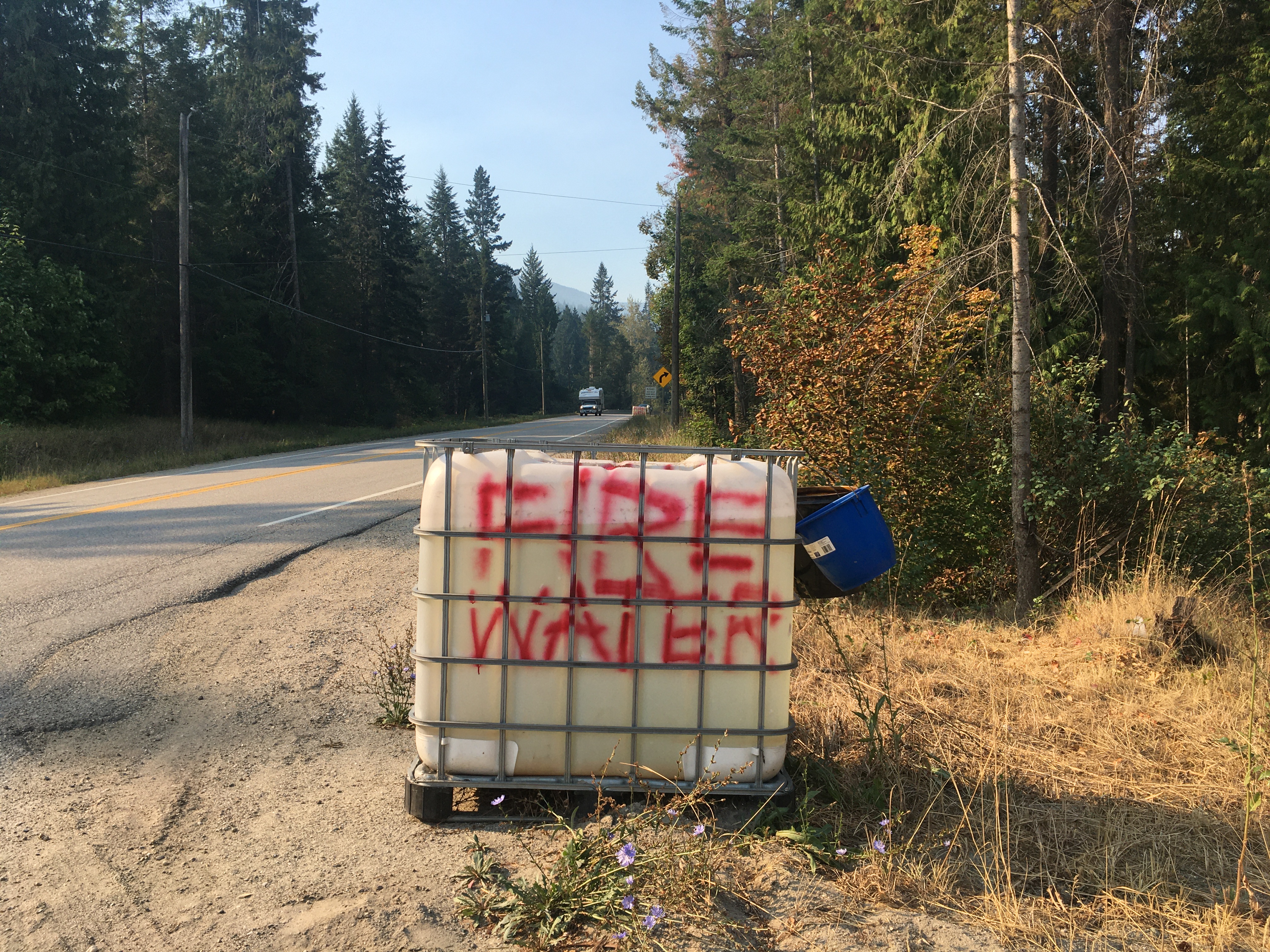
Jelly fish at Galiano Island (2015); water put out along a BC highway due to encroaching forest fires (2021)
One more part of “On Transience” that interested me was Freud’s mention of the war, and how
It destroyed not only the beauty of the countrysides through which it passed and the works of art which it met with on its path but it also shattered our pride in the achievements of our civilization […]. [It] let loose the evil spirits within us which we thought had been tamed for ever by centuries of continuous education by the noblest minds. […] It robbed us of very much that we had loved, and showed us how ephemeral were many things that we had regarded as changeless.
“On Transience,” 307
Some of what Freud’s saying here can also apply to anthropogenic climate change today. Climate change is, after all, an example of what Rob Nixon refers to as slow violence, “a violence that occurs gradually and out of sight, a violence of delayed destruction that is dispersed across time and space, an attritional violence that is typically not viewed as violence at all” (2). Thinking of this violence, this unseen and slow-moving war, I too feel let down by my species, and most especially (because not everyone is to blame), I feel let down by those in positions of authority. My pride in the “achievements of our civilization” was long ago shattered by my awareness of the disgusting history that led us here. To me, this is another instance of neglect and abandonment. Why aren’t our governments coming to the rescue? In this case, they (we) have abandoned ethics; they (we) have abandoned the right to life and freedom of others, and they (we) have abandoned the planet. The “strong moral compass” I’ve been told I have may stem from an intolerance I have of this behaviour. Why can’t we all just care?
A final point I’ll mention about my response to “On Transience” is less for the sake of a personal analysis and more to voice a point of disagreement I have with this text that I’d like to park here for future thought. Freud writes about the illogical assumption (of his poet friend who couldn’t enjoy their walk because of the knowledge that everything beautiful around them was going to die) that transience does not diminish beauty, in fact:
A flower that blossoms only for a single night does not seem to us on that account less lovely. Nor can I understand any better why the beauty and perfection of a work of art or of an intellectual achievement should lose its worth because of its temporal limitations. A time may indeed come when the pictures and statues which we admire to-day will crumble to dust, or a race of men may follow us who no longer understand the works of our poets and thinkers, or a geological epoch may even arrive when all animate life upon the earth ceases; but since the value of all this beauty and perfection is determined only by its significance for our own emotional lives, it has no need to survive us and is therefore independent of absolute duration.
“On Transience,” 306 (emphasis mine)
I balk at this idea that the “value of all beauty and perfection” exists only in “our own emotional lives,” and so do many others. Recent reading I’ve done challenges it, as many consider non-humans capable of autonomous value and consciousness. For instance, in “Environmental Modernism: Ecocentric Conceptions of the Self and the Emotions in the Works of R.M. Rilke and W.B. Yeats,” Sabine Lenore Müller focuses on “the conception of an environmental, communal self, and the understanding of emotions as centred within ecosystems rather than within the human self” (40) and “the relinquishment of the privilege of considering the human body as the prime seat of emotions, thought and memory” (44). Müller notes that “the re-conception of emotions as shared environmental phenomena, is central to Rilkes [sic] entire oeuvre” (49). For instance, she brings in Rilke’s poem, “Der Tod des Dichters” (Death of the poet), in which the face of the poet “is described as a vast expanse, the environment itself, meadows and woods” (53-54). (I keep saying this, but I do need to write more about faces and my reason for bringing my son’s into my recent work. Maybe in my next post.) Anyways, what I’m suggesting in response to this passage from Freud is that the transience of natural beauty may mean something to more than just the human, and certainly when I consider this extinction event we’re causing, I mourn not only for what this loss means to my species. Also, again, I see a difference between the death of a single flower, which is an integral a part of life’s beautiful cycle, and the human-caused obliteration of species and ecosystems.
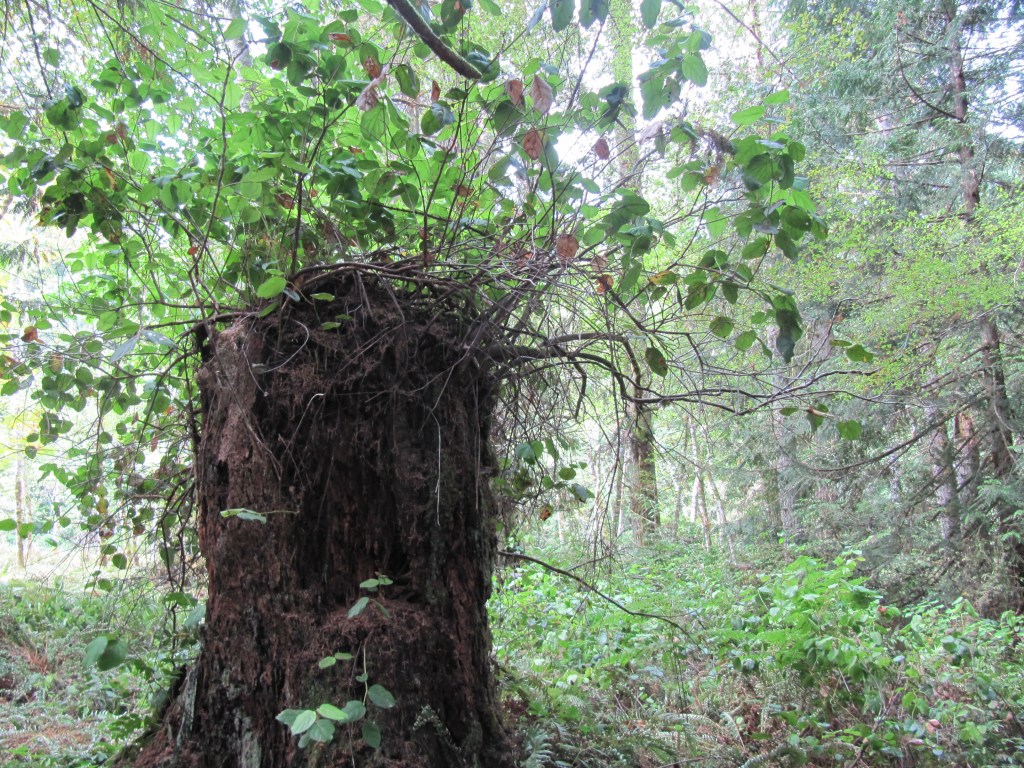
Dead tree sprouting new growth, Gabriola Island, 2015.
There is yet another way of conceiving of emotions that I’m considering these days. Glenn Albrecht, the Australian philosopher who coined the term solastalgia, introduces his book, Earth Emotions: New Words for a New World by saying,
Emotions are defined as “that which moves us” or affects us. Our universe is shaped by, and shapes with, powerful forces, and is the prime mover in both creating and destroying the conditions for life. In the most real sense, the universe is the source of all emotional force.
Earth Emotions, 1
He goes on to describe the key emotional forces that exist in the universe, namely terraphthora (Earth destoyer) and terranascia (Earth creator). These destructive and creative energies that exist in the universe are the same energies that exist in ourselves, leading to the range of feelings and behaviours from violence to love (2-3). As he puts it, seeing human life as an extension of the universe, we are “products of a larger system” and only “a tiny speck of life fighting against the entropic forces of destruction and decay” (3). There’s much here to think about, but what I’ll note for now is that these other writers (and I’ve named only two of so many) present arguments that at least appear to me to present challenges to Freud’s idea that “the value of all this beauty and perfection is determined only by its significance for our own emotional lives.”
Like I said, I don’t agree with everything Freud had to say, but at the same time there is much in his work that I believe is accurate, and I can certainly place myself into much of what I’ve just read. Take for example his description of the melancholic, next to which I wrote in the marginalia of my photocopy of “Mourning and Melancholia,: “Me!”:
The melancholic displays something else besides which is lacking in mourning—an extraordinary diminution of his self-regard, an impoverishment of his ego on a grand scale. In mourning it is the world which has become poor and empty; in melancholia it is the ego itself. The patient represents his ego to us as worthless, in capable of any achievement and morally despicable; he reproaches himself, vilifies himself and expects to be cast out and punished. He abases himself before everyone and commiserates with his own relatives for being connected with anyone so unworthy. He is not of the opinion that a change has taken place in him, but extends his self-criticism back over the past; he declares that he was never any better.
“Mourning and Melancholia,” 246.
In the fall, I fell into a state of severe depression that I’m still struggling to overcome. The above passage precisely articulates some of what I’ve been experiencing. I recall my supervisor, David Garneau, telling me that my belief that I’ve fooled my profs into giving me good grades in the past, and that I’ll never create anything again, was simply “a medical issue.” Fair enough (though I still believe some of what I believed then).
My next question is, why does the loss of beautiful places (and the broader issue of the climate emergency) affect me so much that it contributes to my experience of “a medical issue”? In other words, what is the cause of melancholia, according to Freud, and how is it distinct from mourning? To Freud, mourning is the absolutely clear and necessary process of redirecting one’s libido (love) from the lost person or object. This process takes time, but it always comes to an end. Where it becomes pathological is when this process does not end, and where it exhibits a few key differences from mourning, such as he describes in the following:
In one set of cases it is evident that melancholia too [as well as mourning] may be the reaction to the loss of a loved object. Where the exciting causes are different one can recognize that there is a loss of a more ideal kind. The object has not perhaps actually died, but has been lost as an object of love […]. In yet other cases, one feels justified in maintaining the belief that a loss of this kind has occurred, but one cannot see clearly what it is that has been lost, and it is all the more reasonable to suppose that the patient cannot consciously perceive what he has lost either. This, indeed, might be so even if the patient is aware of the loss which has given rise to his melancholia, but only in the sense that he knows whom he has lost but not what he has lost in him. This would suggest that melancholia is in some way related to an object-loss which is withdrawn from consciousness, in contradistinction to mourning, in which there is nothing about the loss that is unconscious.
“Mourning and Melancholia,” 245
This ambivalence of the loss, as he describes it later, is likely a key component of what I and others experiencing solastalgia are facing. It is perhaps partially connected to what Mary O’Neill refers to as “ambiguous loss” (iii), one for which society does not have social recognition, or what botanist Phyllis Windle describes in “The Ecology of Grief.” As I wrote in an earlier post, Windle “explains that one reason it’s difficult to rid oneself of the distress caused by environmental degradation is that this very type of loss, unlike the loss of a loved one, is ambiguous: ‘Environmental losses are intermittent, chronic, cumulative, and without obvious beginnings and endings’ (365). I understand her point that it feels impossible to move forward from this place of grief when the situation is still unfolding, and in fact worsening.” There is no clear beginning and certainly no foreseeable end to the climate catastrophe. This ambiguity can be a part of the experience of ambivalence regarding environmental loss. Is there still room for hope? Is the future going to be as bleak as scientists continually claim? Other causes for ambivalence may also exist, of course. As Freud puts it, I know whom I’m losing (nature), but perhaps not what I am losing in him (why this loss is so relevant to me). My loss is possibly “withdrawn from consciousness,” and thus inaccessible to me through my own psychoanalysis.
I wrote above that as I see my “love object” being destroyed, a healthy response would be to liberate my libido and then direct it towards something else. This would be mourning. Melancholia, on the other hand, involves a process wherein “countless separate struggles are carried on over the object, in which hate and love contend with each other; the one seeks to detach the libido from the object, the other to maintain this position of the libido against the assault” (256).
I’m aware that for me, love is complicated matter (I’m sure it is for most). Could it be that there’s something in me that needs my love-object to be destroyed, perhaps for fear of more abandonment, or perhaps out of anger? If so, am I actually, unconsciously of course, seeking to devote my libido to a doomed object? If so, why, and how does one fix that?
According to Freud, it’s likely a result of my trauma that I’m doing this to myself. It all comes back to the mother, of course:
traumatic experiences in connection with the object may have activated other repressed material [blocking mourning]. Thus everything to do with these struggles due to ambivalence remains withdrawn from consciousness, until the outcome characteristic of melancholia has set in. This, as we know, consists in the threatened libidinal cathexis [my placement of energy on objects other than myself] at length abandoning the object, only, however, to draw back to the place in the ego from which it had proceeded. So by taking flight into the ego love escapes extinction.
“Mourning and Melancholia,” 257
I like this phrase, that “love escapes extinction.” Maybe I cannot stand to lose that which I love (nature), so I’m harming myself instead to deny myself the proper acceptance of and mourning for that which I’m losing.
There are far too many possible reasons why I’m experiencing what Freud would call a pathological response to climate change to ponder here, but these have been a few I’ve found useful to put into words; importantly, to me, is also to think outside of this (in many ways outdated) viewpoint altogether and accept that a pathology may just be an appropriate response to the situation. Actually, to be fair to him, Freud asks in this essay, “why a man has to be ill to before he can be accessible to a truth of this kind” (246). If there is anything good that has come out of my illness, it’s greater awareness of a few “truths,” and I’m sure this will help me out eventually.

Works Cited:
Albrecht, Glenn. Earth Emotions: New Words for a New World. Cornell UP, 2019.
Freud, Sigmund. “On Transience,” The Standard Edition of the Complete Psychological Works of Sigmund Freud, Vol. 14. London, 1957, pp. 305-307
Freud, Sigmund. “Mourning and Melancholia,” The Standard Edition of the Complete Psychological Works of Sigmund Freud, Vol. 14. London, 1957, pp. 243-258.
Müller, Sabine Lenore, “Environmental Modernism: Ecocentric Conceptions of the Self and the Emotions in the Works of R.M. Rilke and W.B. Yeats.” From Ego to Eco: Mapping Shifts from Anthropocentrism to Ecocentrism. Edited by Sabine Lenore Muller and Tina-Karen Pusse. Brill, 2018.
Nixon, Rob. Slow Violence and the Environmentalism of the Poor. Harvard UP, 2013.
O’Neill, Mary. “Ephemeral Art: Mourning and Loss.” Doctoral Thesis, Loughborough University, June 2007.
Windle, Phyllis. “The Ecology of Grief.” BioScience, vol. 15, no. 5, 1992, pp. 363-366.
 Amy Snider
One thought on “Psychoanalysis of a climate change melancholic”