Throwing with local clay is an exercise in failure. Unlike commercially made clays, this material I dig up from Madeleine’s garden creates all sorts of issues for the potter. Perhaps to the benefit of the plants that grow from this clay-soil we have here, this clay does not give up its moisture easily. It takes a very long time to dry pieces thrown with it, and in that process, they warp and crack excessively.
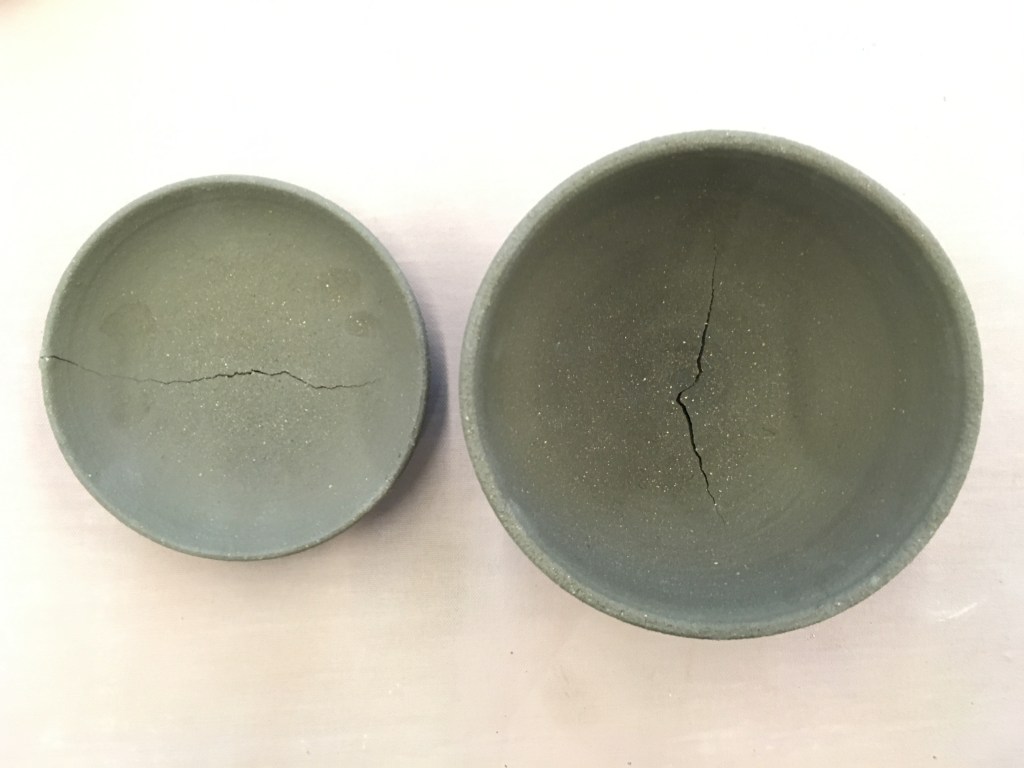
Of the several bowls, plates, and platters I’ve thrown over the last ten days, over half have cracked. There must be something in this clay’s chemical composition to blame for this.
Thinking about its composition leads me to thinking about its history. From where have its compounds originated, and how did they get here? Here I run up against my mind’s limitations of understanding the spans of time that created this land and landscape. I know from James Chappell’s The Potter’s Complete Book of Clay and Glazes that native earthenware clays like this one are what’s called “secondary clays,” meaning their materials “have been removed from the site of the parent rock by the forces of water, wind, or glacial action” (19). I love rocks, and have several pet ones. Holding them, they are entirely solid — rock-hard. I can’t fathom the process of erosion that leads such material to the fine particles of clay I also love to handle. I wonder what life on the planet will look like by the time our current mountains turn to clay. What life was here when this clay was solid rock? Clay reminds me that the world has not always been as human-centric as it is now. In other words, clay helps me understand that while human exceptionalism has led to the sixth mass extinction, it still exists as a blip in the scales of deep time.
Meanwhile, I’m here to make something, and I’m getting nowhere quick with Madeleine’s garden’s clay. Of course I realize that I’m the one causing these problems I’m having with it. I’m the one trying to control this substance, expecting it to behave as I want.
Here’s another example of how my plans for this clay are failing. This earthenware will not hold water. It’s not in its nature to do so. I’ve tested firing to different temperatures to see if I can get its pores to seal so it’ll be watertight, but it just doesn’t work. These cups and bowls continue to leak. My idea of leaving these pieces behind after the picnic to serve as bee homes and bird and bee baths is not going to come to fruition unless I alter this material somehow.
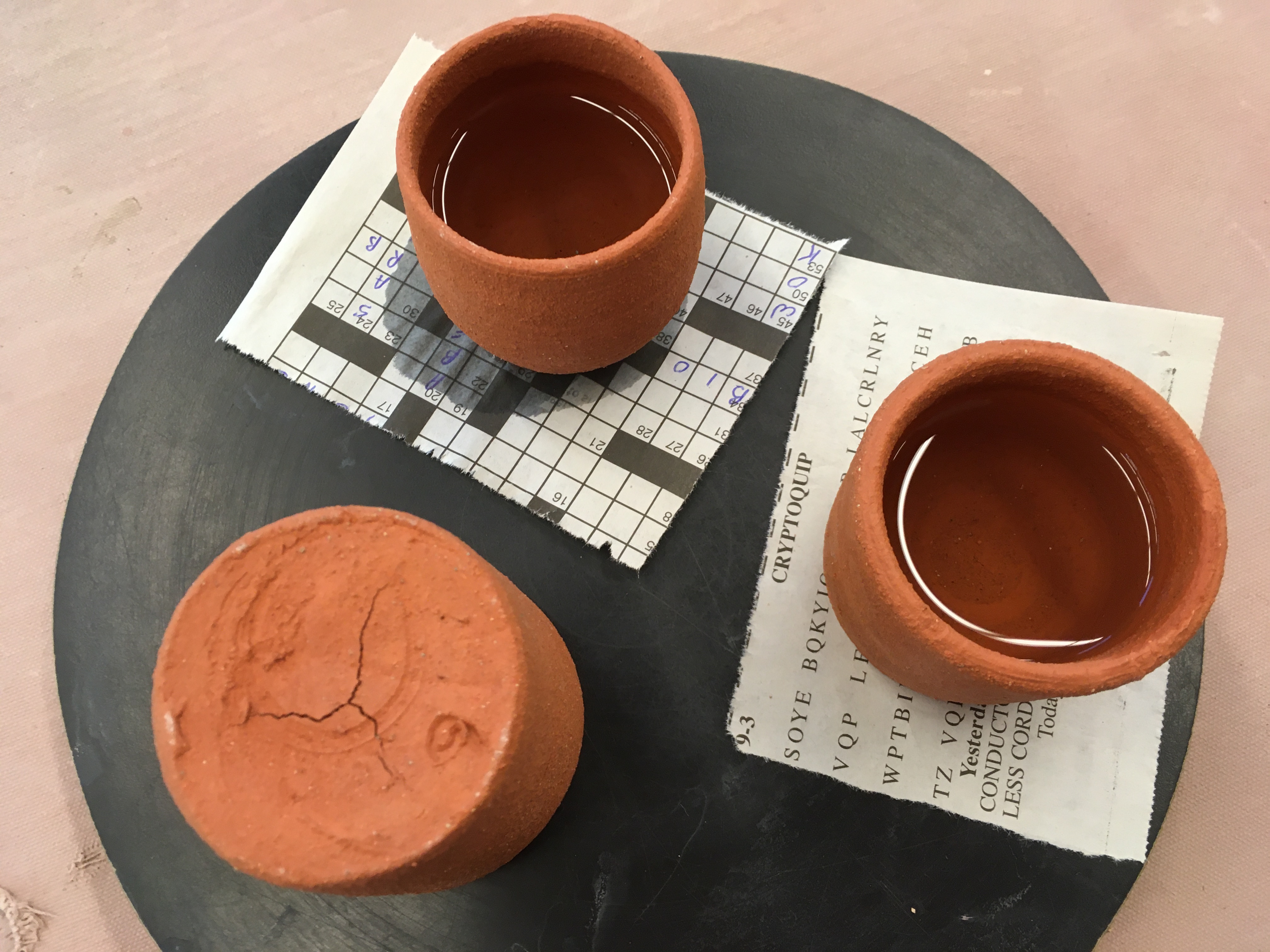
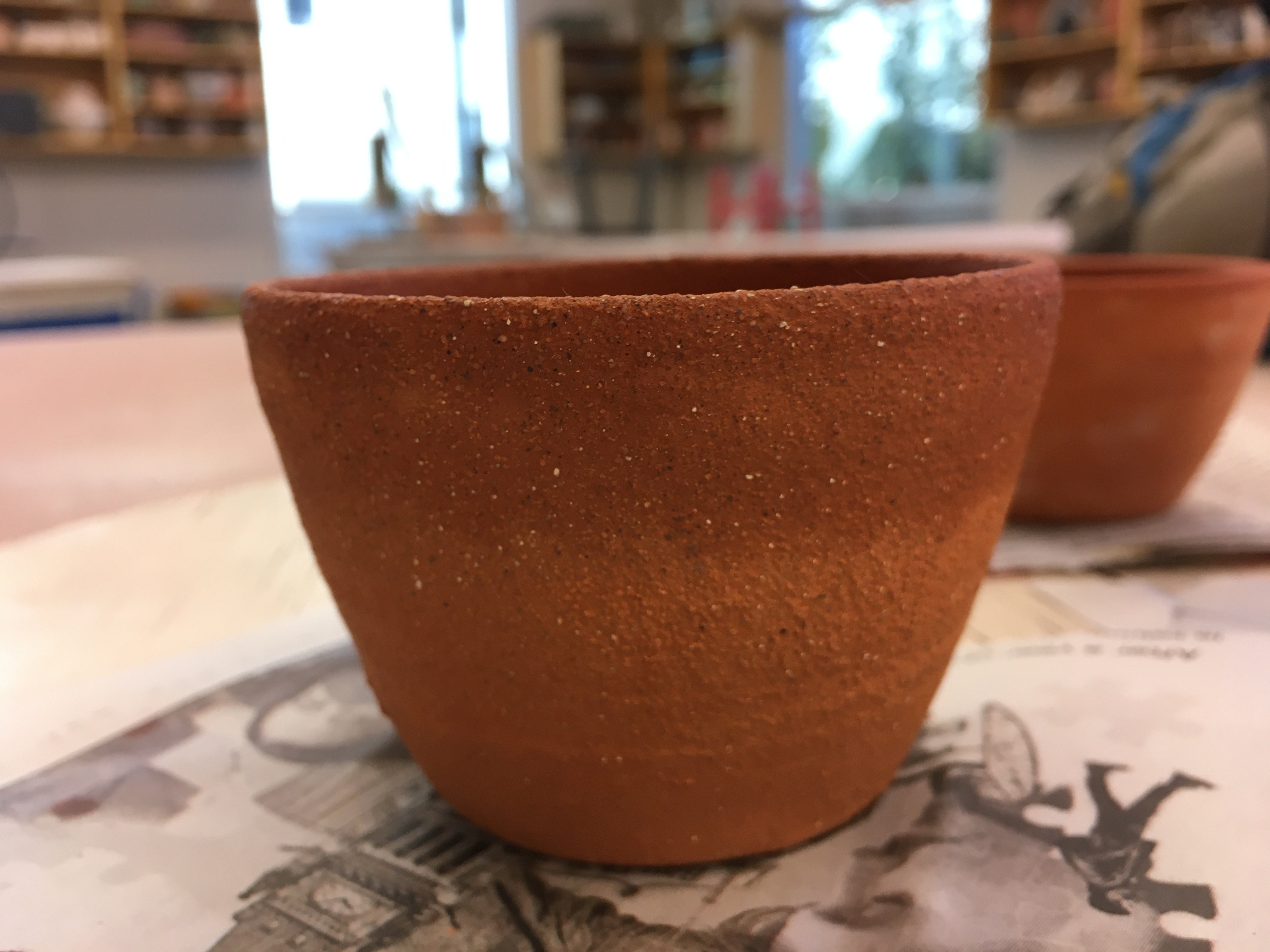

So, I’m faced with a decision about my work for this project. Should I embrace cracked and leaking bowls and plates because they say something about what I’m working through at the moment? After all, if these pieces are part of my response to environmental crisis, shouldn’t they be “broken”? Madeleine and I would need to drink our soup real fast before it disappears through the crack in its bowl.
Or, should I manipulate this material by adding other ingredients to it (such as frit to form a glaze). Doing so would then remove the element of using the land, pure, that I harvest from Madeleine’s garden, with all the meaning that has for us, but it would allow me to create pieces that could serve a purpose.
In other words, am I interested in creating work that is only really symbolic (“Amy Snider makes cracked bowls because, she says, the planet is cracked”), or do I want to make work that can be of some use, however small, to Madeleine’s garden? Am I willing to incorporate processed materials, with their own environmental footprints, to achieve the latter? (And really, isn’t it just a fool’s game to think we can help birds and bees at this stage?). Do I need to embrace the fact that there are no perfect solutions to the environmental problems we’ve created? I think, for example, of the problems with sourcing the materials needed for the batteries of electric vehicles that are supposed to be better for the planet. It often seems that our solutions cause further problems.
As my prof, Holly, has suggested that my primary focus for this semester should be to simply explore–try new thing, research, play with materials–I think it’s best if I not focus too much on having answers for all the questions above and just see what happens in the next two weeks before this picnic takes place (now set for October 15th). I’ll create a variety of pieces, some which will hold food better than others, and then consider how I feel about them after the event takes place.
One final question to myself for this post — can I actually convince myself that there is any way out of failure right now? Maybe failure is the invisible ingredient of this whole endeavor. Maybe I won’t feel right about anything I create these days, just because it doesn’t feel right to feel right right now… if that makes any sense at all. But here I may be walking into a paradox: if this work is about failure (ecosystem failure; failure of people to improve how we treat the planet; my own feeling of failure at coping with the situation; my failure at producing functional pieces out of only Madeleine’s garden clay), am I nonetheless trying to to perfect this failure somehow? What would good work about failure look like?
My brain hurts. I must be overthinking this. I’m not sure where to go from here.
Chappell, James. The Potter’s Complete Book of Clay and Glazes: A Comprehensive Guide to Formulating, Mixing, Applying, and Firing Clay Bodies and Glazes, 2nd ed., New York: Watson-Guptill Publications, 1991.
 Amy Snider