I love to throw on the potter’s wheel. It’s been a long time since my work involved much throwing, and I’ve missed it. For the picnic project with Madeleine, I’ve decided I’ll throw a few pieces in addition to creating a few “dust” plates and bowls. Plates and bowls made out of unfired clay dust will obviously not hold any water, and Madeleine’s list of dishes she plans to serve at this feast includes rather liquidy delicacies like crabapple rosehip pink lemonade and cream of celery soup.
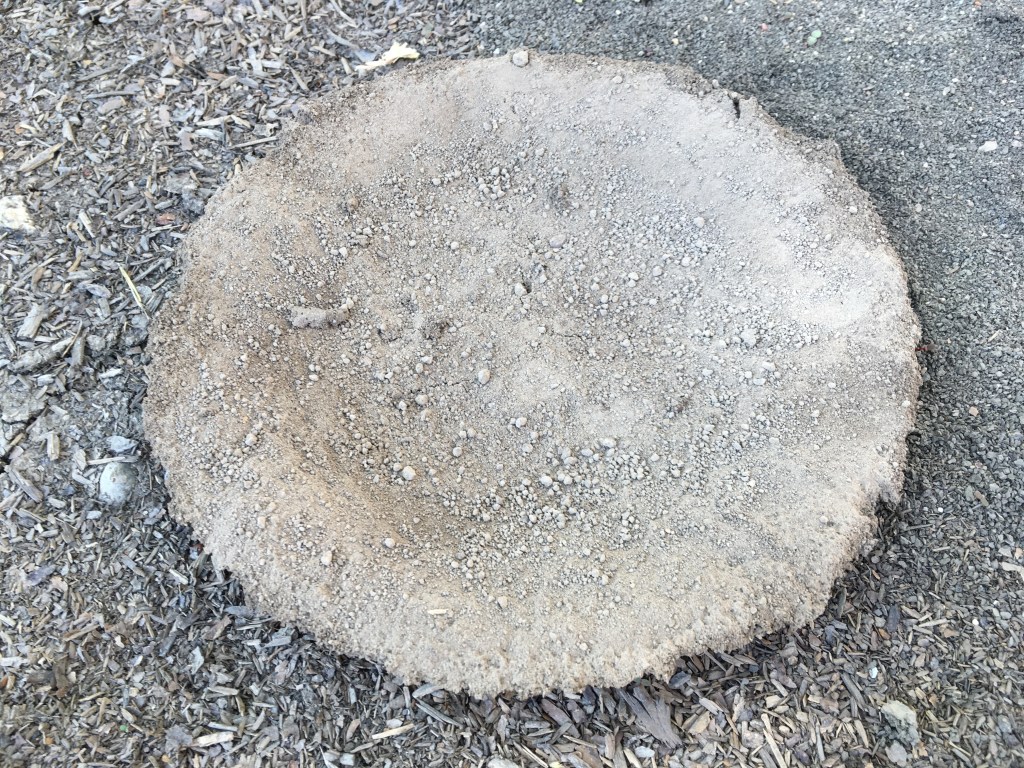
No, such treats need an impermeable vessel, and that means firing clay.
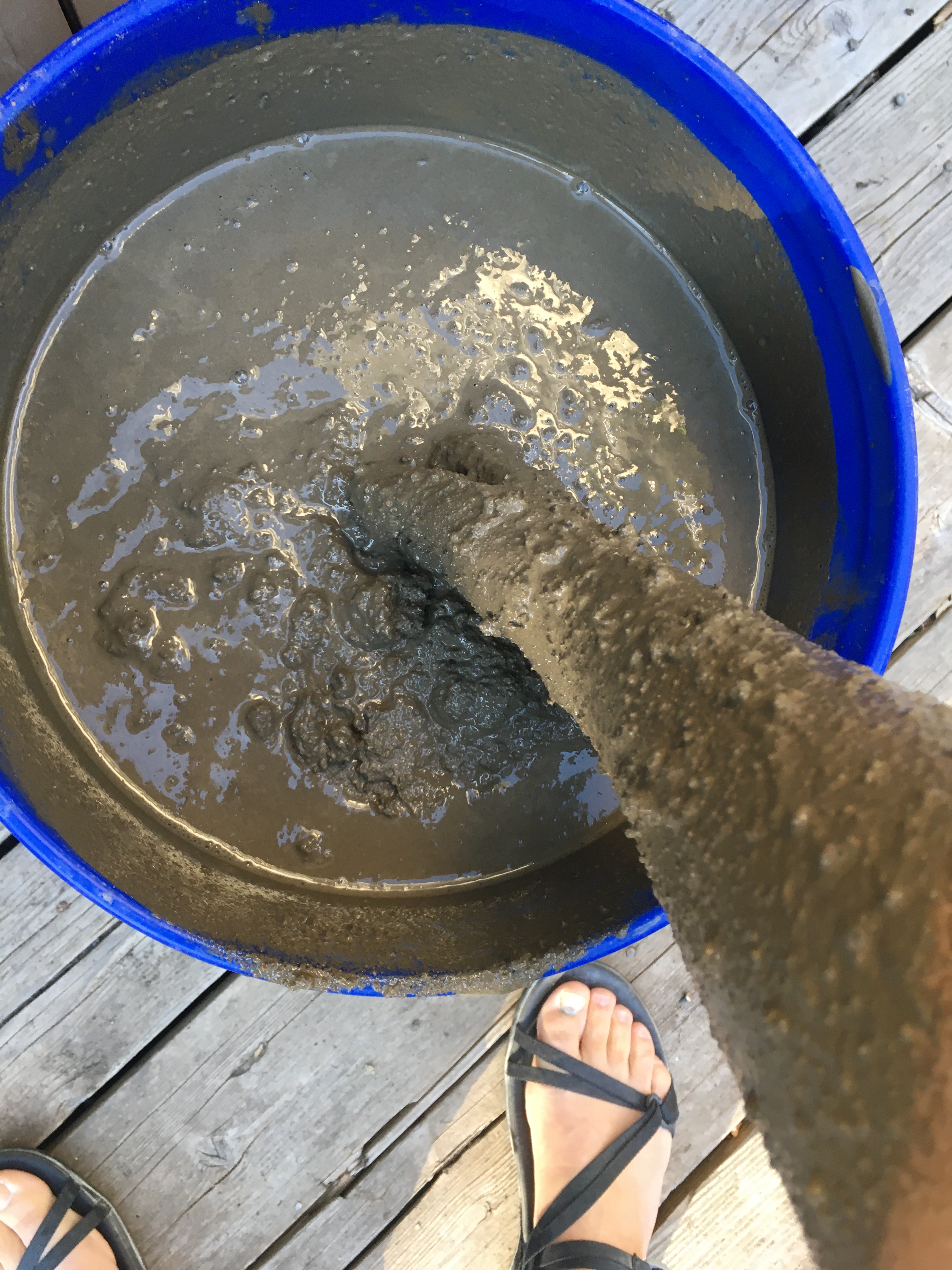
So, I’ve been preparing clay from Madeleine’s garden that can be thrown on a wheel and fired. It’s a bit of a process to get to this stage, but this week I got to start throwing with it, and it is well worth the work. It feels great on the hands.
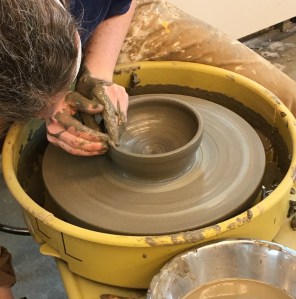
Madeleine’s idea of this project being as much about joy as it is about grief is a gift to me. Its allowed me to delight in the act of collecting this clay and working with it to create these pieces. Local clay, sometimes called “native” or even “wild,” gives one a real feeling of connection to this place, this land, this soil, and the forces of nature that allow us to derive life from it. As James Chappell writes in The Potter’s Complete Book of Clay and Glazes, a ceramicist’s bible really, “Hand-dug clay provides an extra thrill to the potter who can take immeasurable pride in experiencing the full challenge of forming a work directly from its natural source” (18).
For a class I took this spring titled Indigenous Land Art, I wrote in a paper about my “dust plates”:
“We are so accustomed to not asking from where the materials that compose the myriad of objects in our lives come. We take it for granted that we can, so long as we have the money, buy whatever we want. Capitalism requires that we not concern ourselves with the origins of everything we use and consume. We are hardly aware that “ultimately all aspects of capitalist society are nature-driven in some way, shape or form: the making, moving, selling, servicing, consuming and disposal of any and all commodities necessarily requires raw materials, energy sources, physical spaces and waste disposal opportunities” (Castree qtd. in Tuck and McKenzie 3). We give little thought to the ethical implications of the electronic devices, the furniture, or the plates that we have in our homes—the thousands of miles their components travelled nor the labour that went into their manufacturing—and even beyond that, the millennia that went into the creation of the raw materials that form them and went into their processing, packaging, and transportation. How often do we stop to recognize the eons involved in the making of our dinner plates? Handling local clay and considering its history has the potential to help us recognize every object we use in our daily lives comes from the finite resources on Earth. In other words, creating these pieces is a gesture of respect for this land, a respect we normally fail to have.”
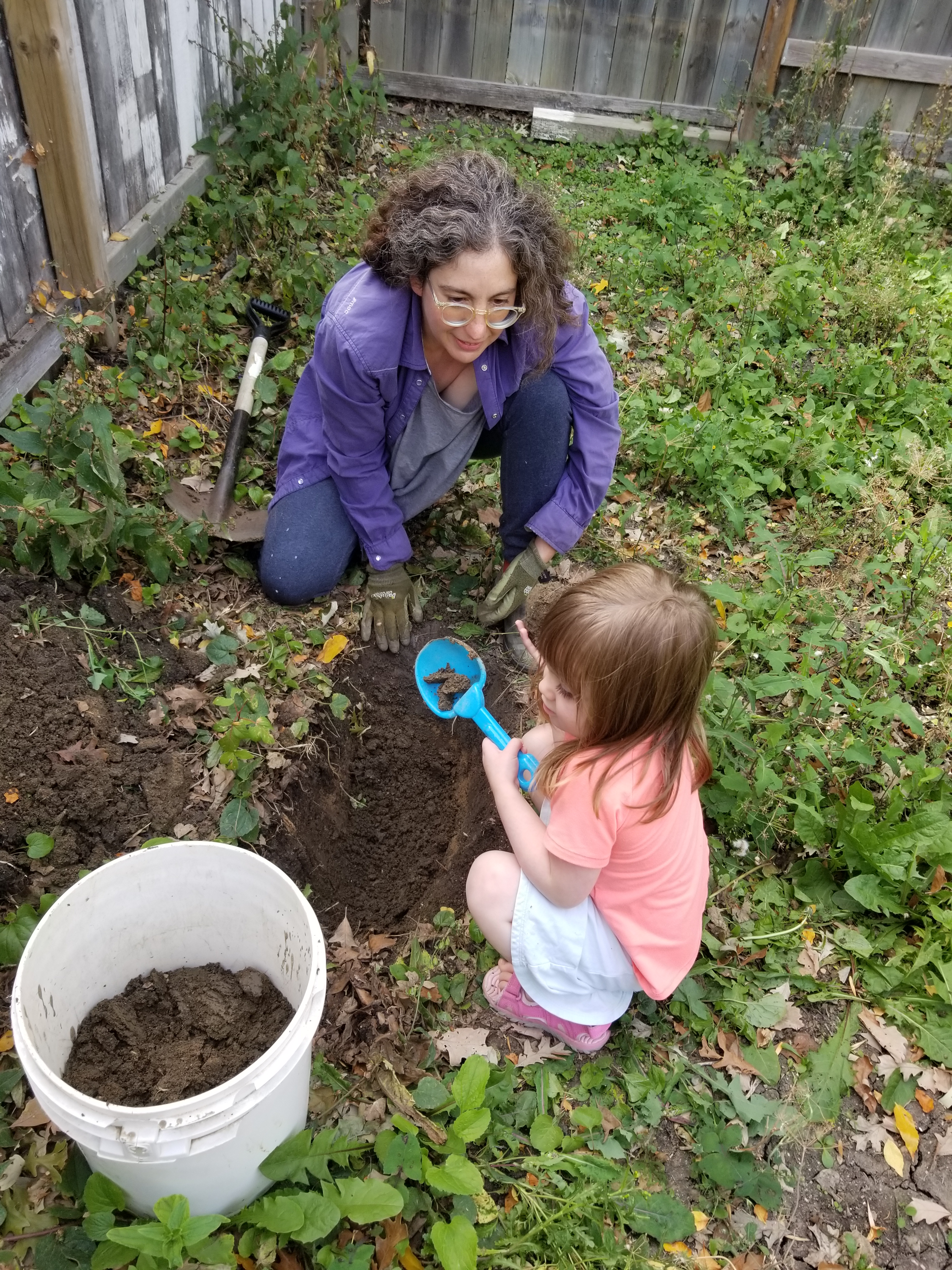
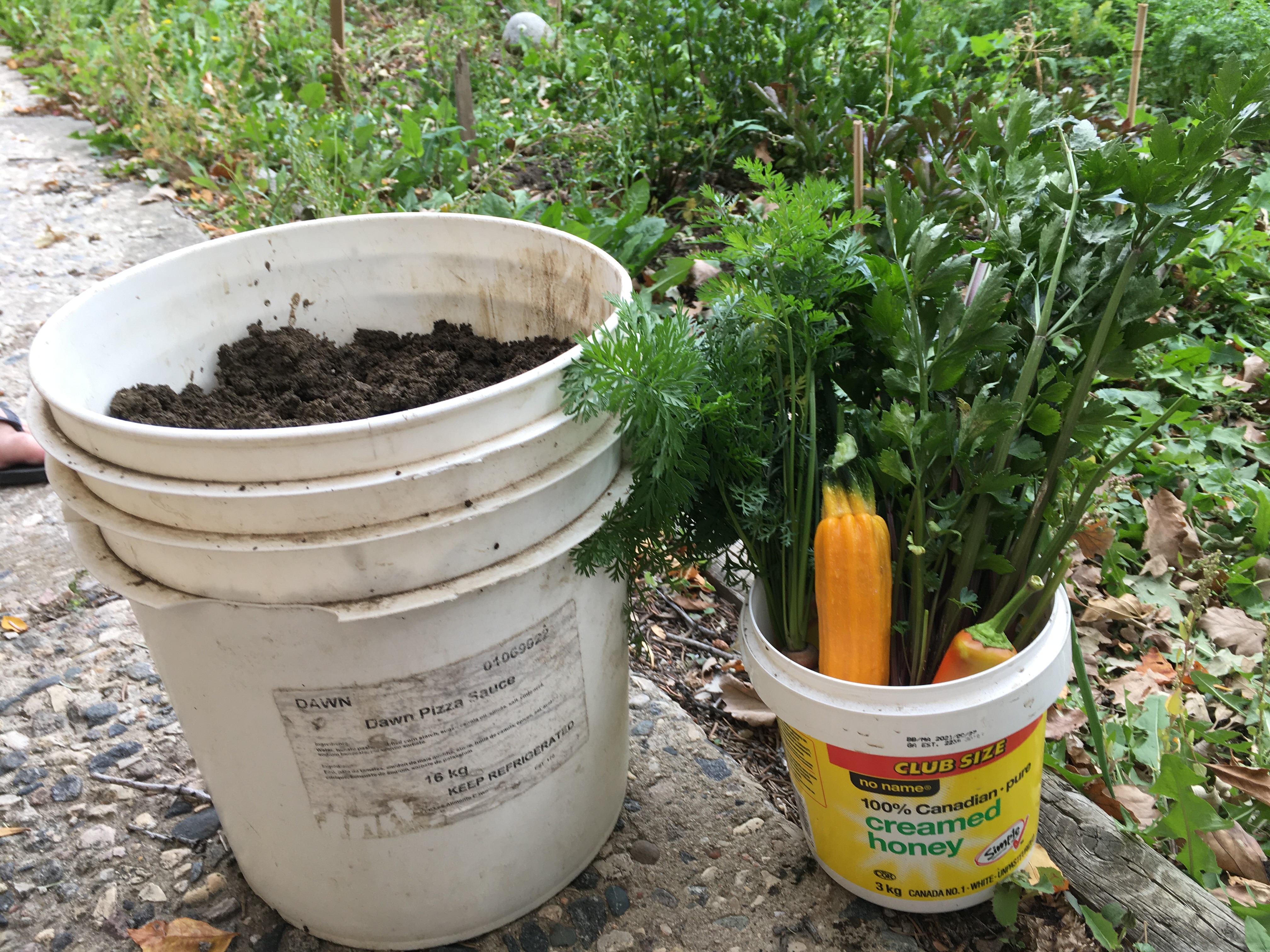
While all of that is still important to me, what matters to me most now, given how I’ve been feeling lately, is that I’m once again able to feel joy in making. Digging in the dirt with Madeleine’s daughter, physically clawing at it with my hands, dog-digging style, smelling it, feeling it, and being surrounded by the bounty of produce grown from it (and getting to take some home), was all joyful experience.
I’ve still been dealing with one dilemma that has been on my mind for the past few years: what it means to kiln-fire work that is about climate change. I know that we cannot live without creating any greenhouse gas emissions, and that the situation shouldn’t be viewed as all-or-nothing. Yes, I heat my home while being concerned about climate change (and reducing my emission footprint in several ways) — that doesn’t make me a hypocrite. Regardless, I still have major qualms about burning electricity for my climate change-related work. An example of the kind of thinking I have about this problem can be seen in this rough recounting of a conversation I had with Darcy, the U of R’s sculpture and ceramic technician, yesterday:
Amy: Can you remind me how long to keep the test kiln on low when firing? [“bisque firing” is firing to a low temperature, which is, fortunately, all that this clay can take]
Darcy: Overnight.
Amy: Oh. Or else the pieces may crack?
Darcy: Uh-huh.
Amy: Fffffffffff. Well, it’s only 3pm now. There’s no need to turn it on for the night yet, but….
Darcy: But if not you’ll need to drive your car back here later?
Amy: Yep.
Darcy: [scoffs]
(as an aside, I was able to ask a kind fellow ceramic student working late to turn the kiln on for me that night).
After that little conversation, I went to throw a few more pieces on the wheel, cognizant of the electricity I was using of course. Every single thing I do in the studio is somehow bad: the water I’m using to wash my hands, the plastic liquid soap dispenser, the soap in it; the lighting and central ventilation in this room; the rubber tread of the bike tires I partially wore down to ride here on; the clay-ed up clothes I’ll have to wash… It goes on and on. When we consider the footprint of every action we take and every object we use, we understand the scale of the problem we have with trying to get ourselves out of this mess, and this line of thinking just leads to deeper hopelessness.
(This blog is definitely contributing to the problem… the array of materials that went into making this computer, the factories that produced each of its components, the transportation of all of those objects, the coal-burning electrical grid I’m using to power it up, and the storage facilities housing the data that each word I type and each photo I attach requires. The first chapter in Tatiana Schlossberg’s Inconspicuous Consumption: The Environmental Impact You Don’t Know You Have is titled “Technology and the Internet.” She tells us that the Information and Communication Technologies sector globally produces more emissions than air travel, and that it’s expected to increase in size twenty-fold by the year 2030 (10). Still, she says, we have to get out of thinking that the consumer bears the responsibility: “the size of the problem and the narrative of personal responsibility is destructive! It makes us feel guilty about everything we do” (6).)
I understand this. Still, I see a problem with creating emissions specifically for the purpose of making art that speaks to the problems arising from burning emissions. Doesn’t that sound hypocritical? If not to you, certainly some will say so, and I need to have full confidence that it isn’t so I’m prepared to reply. I’m not there yet. This is a topic I need to delve into, and I may talk about it for my part in a panel presentation at National Council on Education for the Ceramic Arts (NCECA) in California next March (will I fly there???) titled “Environmental Engagement: Clay + Solistagia.”
One thing that has helped me with thinking about firing pieces for this project is what my directed studio course instructor, Holly, said to me in one of our weekly meetings — that perhaps the pieces I fire can remain in the garden and serve it somehow. Perhaps this work can contribute to nourishing the garden somehow, she said. This got me thinking about bowls becoming bee baths and cups turning into bee homes.
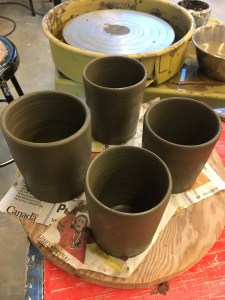
This is where I’m at for the moment — any fired objects needed for watery foods will serve some other garden purpose post-picnic. Solid foods will be served on “dust” plates made out of a mixture of unfired clay and compost that will erode and feed the garden.
Unfortunately, I haven’t yet figured out the temperature at which this clay becomes “mature,” or watertight. Water seeps through the test pieces I fired (yes, on low overnight). I also don’t know why it keeps cracking. These are the practical issues I need to overcome in the next week, otherwise we’ll be losing our soup very quickly … which may not be so bad. We are running out of time after all.
Works Cited:
Chappell, James. The Potter’s Complete Book of Clay and Glazes: A Comprehensive Guide to Formulating, Mixing, Applying, and Firing Clay Bodies and Glazes. New York: Watson-Guptill Publications, 1977.
Schlossberg, Tatiana. Inconspicuous Consumption: The Environmental Impact You Don’t Know You Have. Grand Central Publishing, 2019.
Tuck, Eve, and Marcia McKenzie. Place in Research: Theory, Methodology, and Methods, Routledge, 2015.
 Amy Snider