Way back on February 5th (feels like eons ago), I attended Nic Wilson‘s Art for Lunch . I was so enthralled by what he shared that I got in touch with him to chat some more. We met (via Zoom) to talk about art, being an MFA student, and writing. He also gave me a copy of the talk he’d written for this Art for Lunch, admitting that he’s the type to do that—to carefully write out a talk in advance. I asked him for this text because I wanted to look at what he’d shared again, and also because there were names they mentioned that I wanted to look up.
It’s taken me until now, April 11th, to finish writing up this response to Nic’s talk. Partially, I just got lost in other work in the meantime, but mostly it’s because I’ve wanted to process what he said and write a proper response. It’s now near the end of the semester, and deadlines are looming. I don’t feel I’ve had the time or mental space this term to do the processing I wanted to do, and nor have I had time to look up any of the writers Nic mentioned… though of course that opportunity doesn’t end with this semester’s classes. I look forward to July, when my teaching duties will be on pause and I’ll be less busy. For this assignment, I’ll post a bit of my response to Nic’s talk, as it stands right now, and mostly as documentation to jog my own memory down the road. Quotations are given in red (from the text Nic sent me).
This is Nic’s bio: “Nic Wilson (he/they) is an artist and writer who was born in the Wolastoqiyik territory now known as Fredericton, NB in 1988. He graduated with a BFA from Mount Allison University, Mi’kmaq territory, in 2012, and an MFA from the University of Regina, Treaty Four Territory, in 2019 where he was a SSHRC graduate fellow. He has shown work across Canada and internationally at Third Space Gallery, Art Mûr, the Remai Modern, Modern Fuel, and at Venice International Performance Art Week. Their work often engages time, queer lineage, and the distance between art practice and literature. Their writing has appeared in publications such as BlackFlash Magazine, Headlights Anthology, and Public.”
Near the start of their talk, Nic said the following:
There is a kind of hiccup when I try to talk about the fact that most of my activity as an artist is spent putting pen to paper to form words rather than images. I don’t often dwell on it because I know so many other people engaged in the same activities that I don’t feel I need to explain myself that often, but it is a bit of a pickle. How do I define myself as an artist? Why is it that I feel a pang of anxiety about placing my work in relation to ‘Literature’? Is it because hundreds of years ago some monks used to do the letter and others did the pictures? Is it because some dudes made the splatter paintings and other dudes wrote about them? If the one dude who makes the paintings is also writing about them, what does the one activity owe to the other? Which action begins and which follows. Can you make a painting about an essay? Can you make a sculpture or series of sculptures that functions as an essay? Thankfully, there remain many areas of ambiguity between the visual arts and literary practice.
I found Nic’s statements and questions particularly insightful because I have a background in English literature (a BA and an MA in it) and have dabbled in creative writing in the past. In fact, until 2015, I figured that if I were going to carve out some time for creativity, it would be writing, not visual art, that I’d give that time to. When I returned to ceramics later that year, I didn’t anticipate that clay—or visual art in general—would come to have such a large role in both my day-to-day life and my identity. Nic’s talk also interested me because I’ve noticed how I’m still hanging on to writing much more than I need to while taking this MFA. It’s as though the writing is a part of my art-making (which Nic would clearly understand). Keeping up this blog, for instance, is my own choice; no one told me to start blogging, and apart from these “Arts and Culture Journal” entries for one class, nothing else I write here is for a grade, yet I keep spending a lot of time on these blog posts despite being stupidly busy with other work and responsibilities. (WordPress recently informed me that I’d published my 50th post). At first, this was a good way to keep track of my readings (thank you, Risa Horowitz), but I soon realized that I also enjoy writing about what I’m doing for my course projects, and at times I feel nearly as good after writing one of these posts as I do after resolving an issue with a sculpture. This is my second semester as an MFA student, and I think that “growing” into/with this blog has a lot to do with the fact that I’m growing to accept myself as an emerging artist.
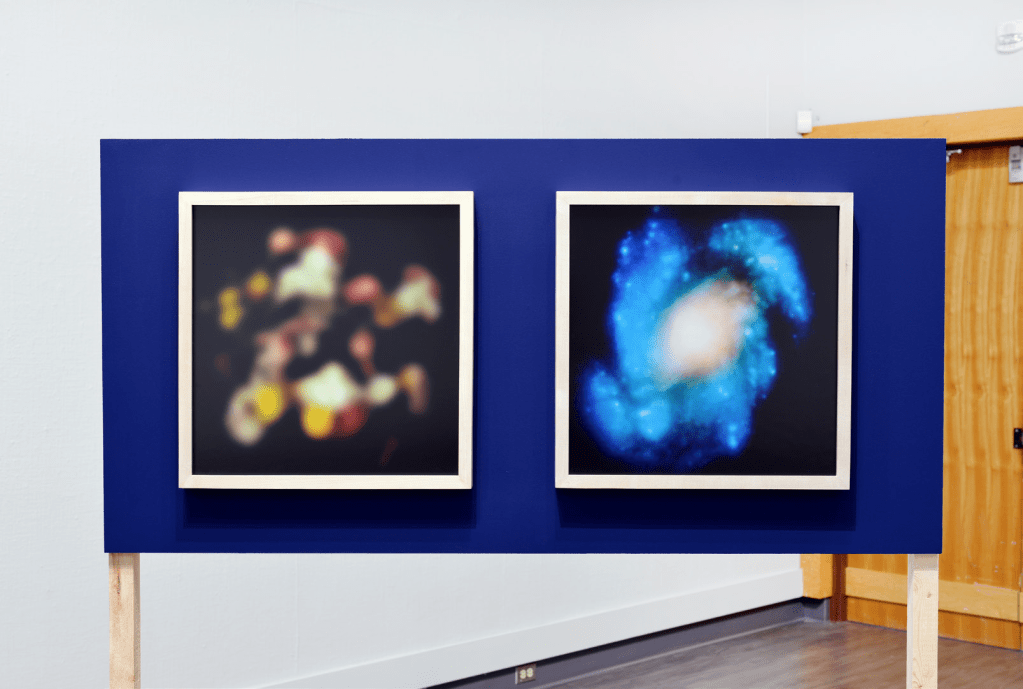
To record a bit more about Nic: Nic shared a work from his installation Pavilion of Shadows in which he was exploring the formal/aesthetic connections between his mother’s eyes and his eyes. He made this piece after his mother was diagnosed with glaucoma. In it, he shows an image of an eye with glaucoma next to an image taken from the Hubble space telescope when it briefly had a flaw that blurred its images. I’m interested in these types of connections between patterns as well. This piece reminded me of Holly’s work, especially in Floating Series, where she reflects on how “patterns of structure that are self similar can be observed over a wide range of scales.”
The piece also includes writing that he presented as computer print-outs pinned to a board:
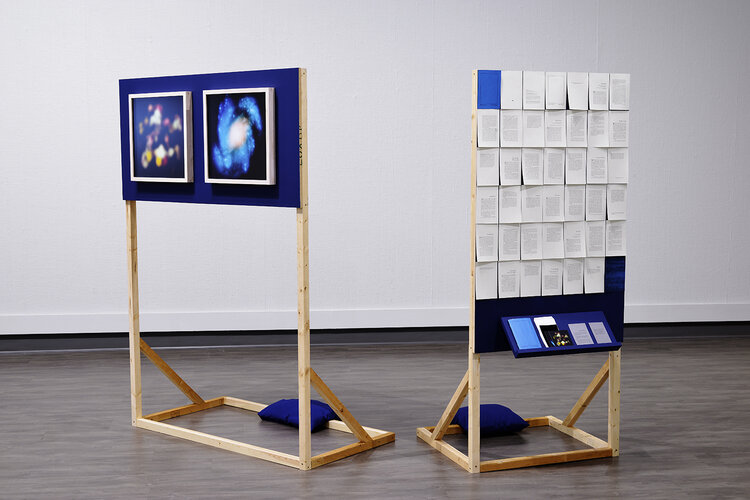
From Nic’s website: “Pavilion of Shadows is an ever-expanding database of mourning and decay. Marble, ashes, celebrity death merchandise, and photographs of distant galaxies create analogies, both personal and public, to the finite nature of bodies. Though many of the histories, anecdotes, and objects that make up this database are drawn from communal experiences, this work is seated in a particular body and subject-position. Wilson draws on their own embodied experiences and observations to wade through histories of life, death, and the distance between these two states.”
In this Art for Lunch lecture, Nic talked about including writing in a gallery, and how it is normally perceived as supplementary to the work:
There is undoubtedly a kind of privileged information in this work and in many other artworks. Many institutions use didactic panelling, guided tours, and publications as a way of supplementing work with this type of context. In my work I prefer to do the words part too and bring the ‘supplement’ into the realm of my art practice.
A point Nic made that I found interesting was about an obvious intersection of visual art and text: titles.
I once heard a curator say that if there was any artistic merit to be found in the work of Damien Hirst, it was in the titles of his work which include “Some Comfort Gained from the Acceptance of the Inherent Lies in Everything” and “The Physical Impossibility of Death in the Mind of Someone Living”. In some ways, I agree with this statement. These terse little poems do something for me, the way a great book cover might do something for me. There is a crisp quality to their use of language. When I think about the convention of naming in general, I am tempted to describe an artwork as the ‘main thing’ and the name as a ‘supplementary thing’ ascribing more value or weight to one ‘thing’ over the other but I know this is a loosing game. In my experience, art is always a social thing, a product of the stories we tell about it and what function it holds in a culture. How one refers to a thing, an image, an action, an object, is deeply imbricated with the supposed subject.

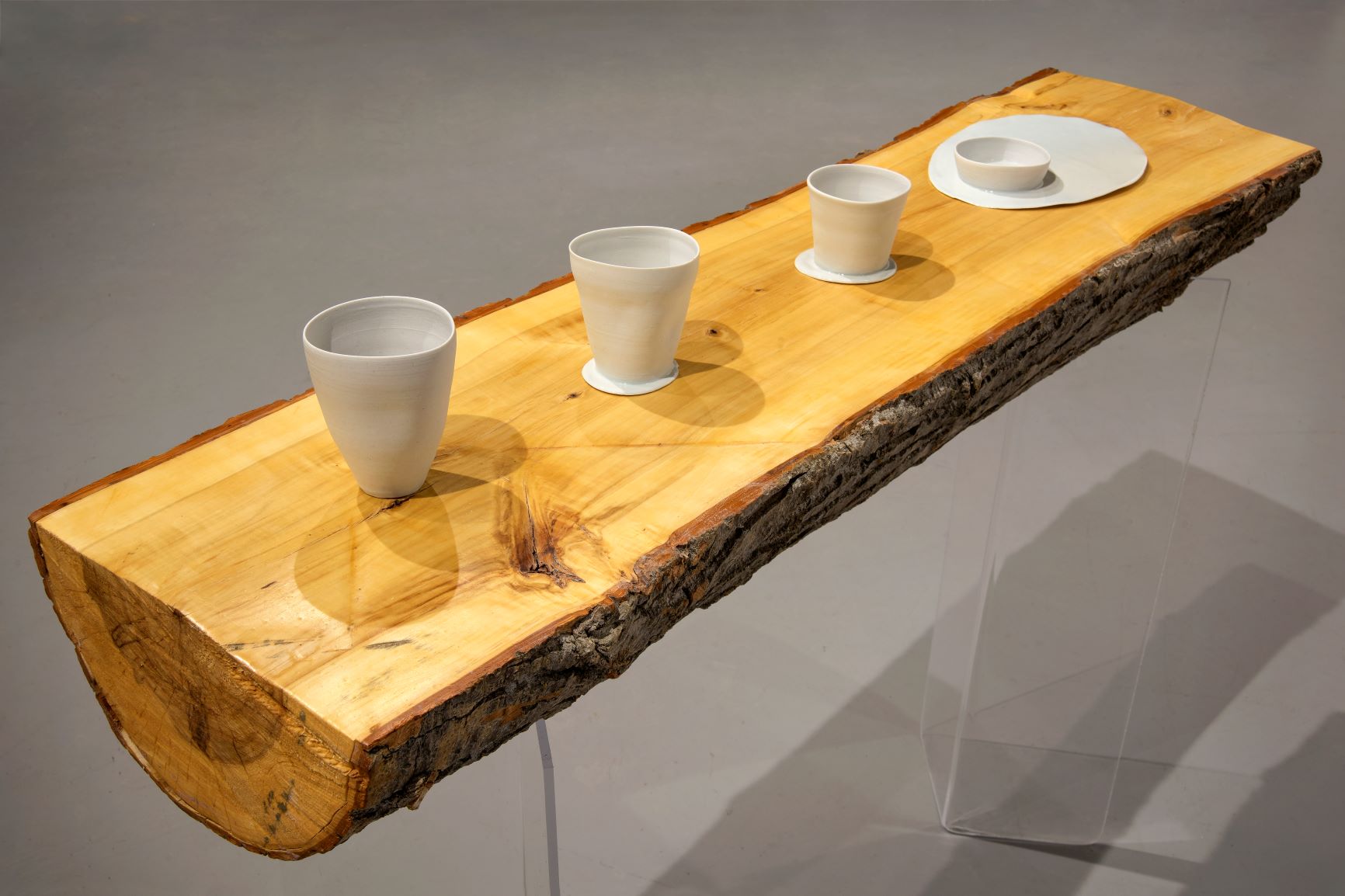
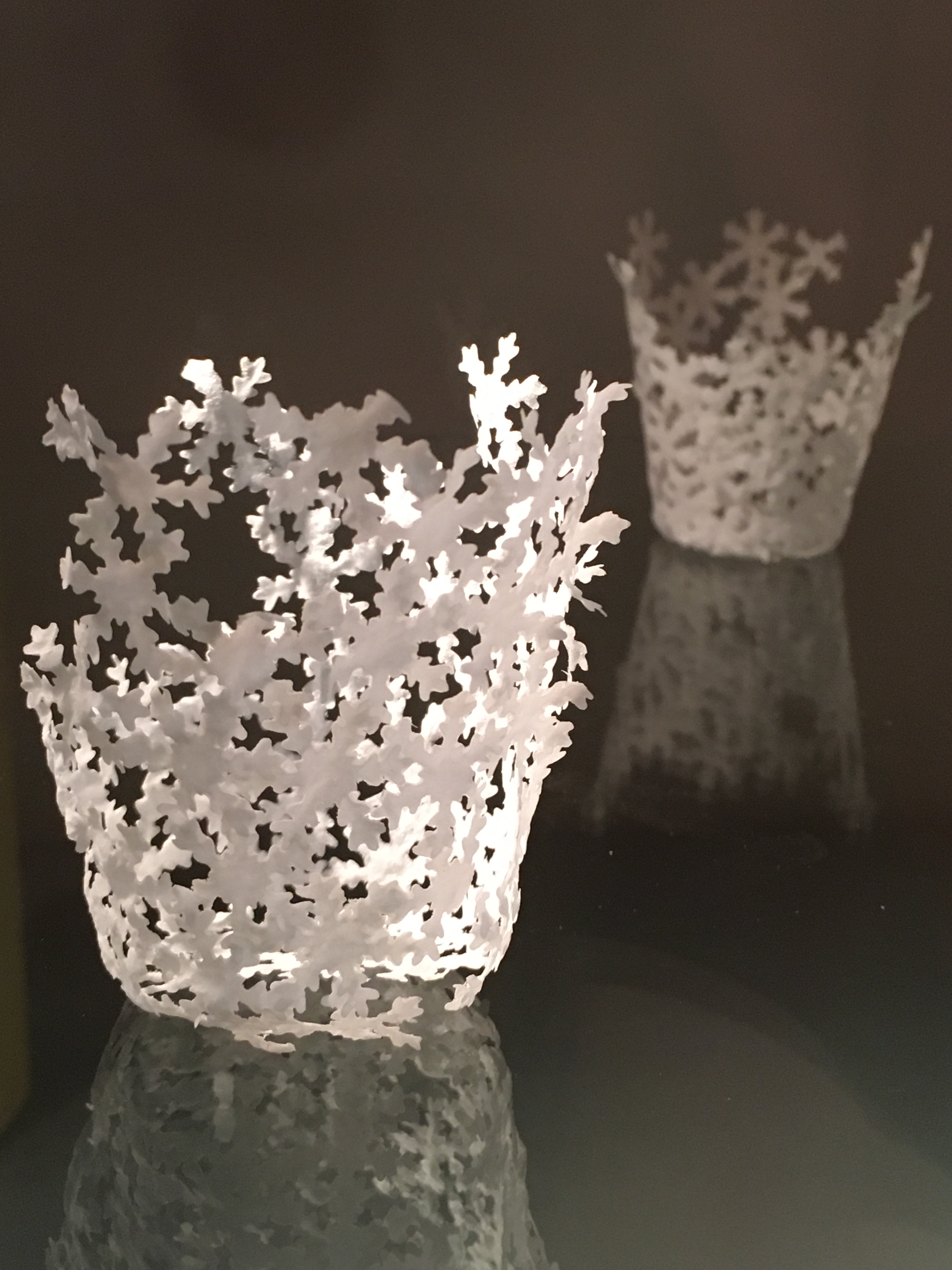
Titles of my work have been very important to me. I’ve often used them to convey the meaning I’m trying to get across. For instance, in “Athabasca Glacier: 2018-2019,” no one would likely know to associate that piece with a melting glacier were it not for the title. Likewise, with “Saskatchewan Glacier,” I suppose, which would just be “pretty snowflake cups” without those two words.
Another point of interest to me from Nic’s talk was the fact that he referred to several writers I know, such as Annie Dillard, Karl Ove Knausgård, Lydia Davis, and Sadie Smith. It was really something to hear someone referring to these people in the context of an artist talk. I came across these people either through my degrees in English or as a reader since completing them. It was/is kind of groundbreaking to think about the connections between literature and visual arts, and how I may be not as far from where I began (in English) by taking this MFA as I’d imagined. Nic asked,
What does it mean for a text to act like art? What is the ethos of art making? How and why do we have spaces that claim merely to comment on this activity, and is it possible for such spaces to remain unfettered by the subject they are purporting to comment on?
I was a bit of a hog in the question period. Maybe not just a bit. I asked Nic about W. G. Sebald (the writer on whom I wrote my MA research paper) and what it means to have art in writing or writing in art. You can tell I’m a keener; hence, I contacted Nic and the two of us chatted via Zoom. I hope to bump into him again; David (my supervisor) has suggested that he and I put on a kind of symposium of writers/artists. I shared the idea with Nic, and he seemed keen. I just don’t know when either of us would be able to find the time to organize such an event. If I could be a full-time MFA student and not also a full-time faculty member at the University (plus Mom, plus activist), I imagine I’d do all kinds of neat art-related things. For now, I’m happy just to be taking these classes and making the most of them that I can.
I was certainly delighted to meet Nic and get to chat with him.
 Amy Snider