Last night, I attended Dunlop Art Gallery’s “Date Night: Land Art Travel Tour,” led by their Education Assistant Sarah Pitman. The idea behind the “Date Night” series is to offer people a chance to view and discuss art in a virtual setting once a month. In a Carillon article about the series, Sarah says, “If you have nothing to do on a Friday night (due to the pandemic), there’s this idea of travel in our Date Nights. We try to pull artists or art works that are from around the world.”
This was my first time attending one of these events, and I’m glad I did. I was especially interested in last night’s event because its topic was land and environmental art. I wasn’t really aware of how the Date Nights run and was expecting a more indepth conversation around this type of art than what it turned out to be (it was more of a survey class), but it was still a great way to see examples from many artists’ works pulled together and discussed. Sarah did a great job of introducing us to a range of works, a few of which I didn’t know. I’m still a beginner in this world of land art and environmental art, so this was a good way for me to expand my knowledge on the topic.
Sarah started the talk by showing examples of historical land art, including Stonehendge in England, the Great Serpent mound in Ohio, and Nazca Lines in Peru. She then covered several contemporary artists, including Robert Smithson, Nancy Holt, Andy Goldsworthy, Walter De Maria, Ana Mendieta, Agnes Denes, Andres Amador, Niles-Udo, and the Red Earth Environmental Group.
I’ll say a bit about a couple of the works I was introduced to that really struck a chord.
Robert Smithson’s first large-scale earthwork Asphalt Runway (1969) is a piece I hadn’t known about before.
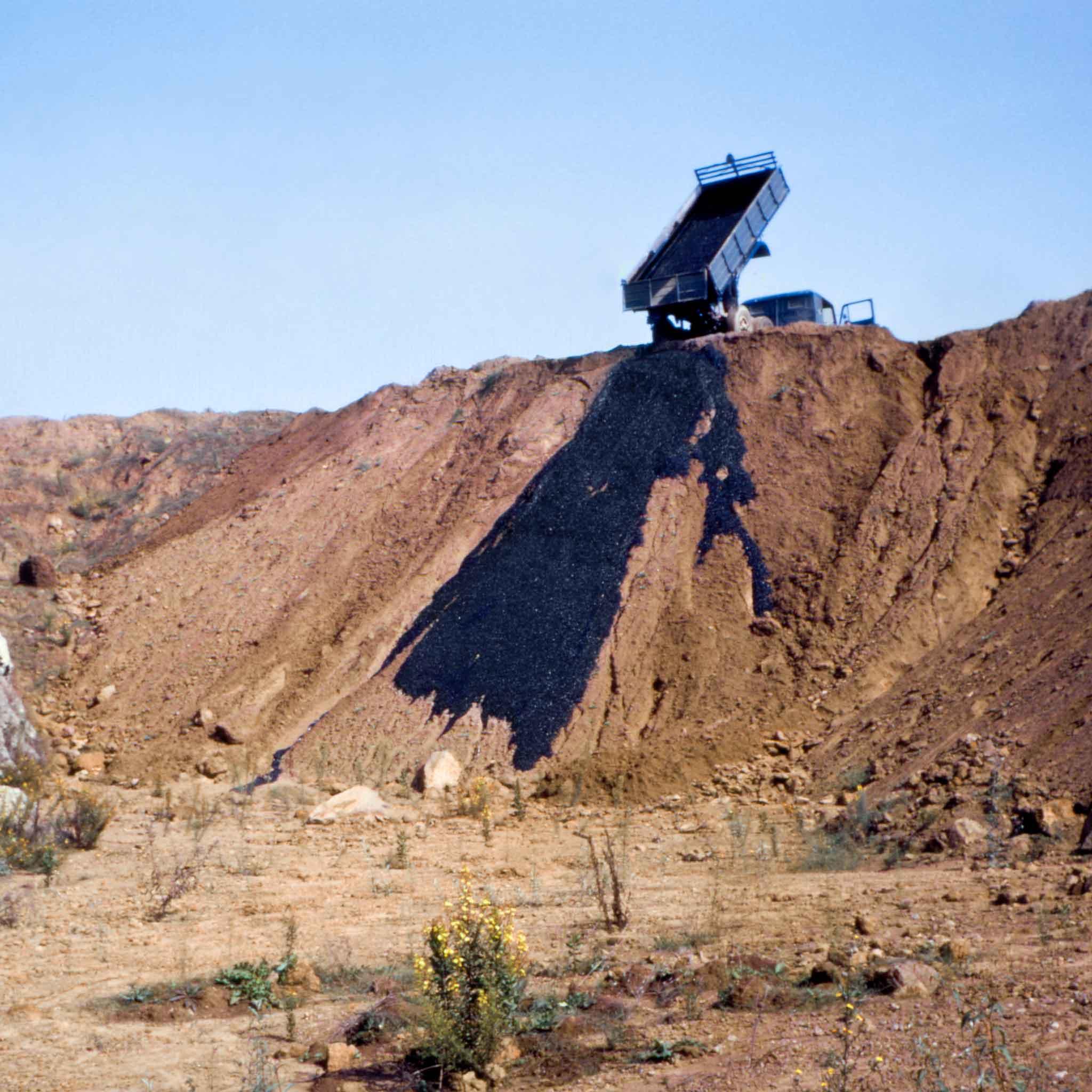
I was immediately convinced that this work was meant to say something about how we’re leaving negative impact on the planet with our industrial waste, pit mining, and elimination of natural habitats for our sprawling cities. I was surprised to find out from Sarah that Smithson was more trying to speak to time, that it is meant to be seen “as time frozen, mid-flow, or as yet another sedimentary layer in the infinite accumulation of time” (according to the Holt/Smithson Foundation). When another participant made a comment about how they didn’t like the piece because it was damaging the environment, I piped in and spoke about my interpretation. Reading up about this piece after the talk, I found that I am not alone in seeing the work as a statement about our environmental footprint. In a post for a website used for a grad course in Sweden titled Anthropocene: A History of the World, Lisa Martin writes that
Smithson’s “action” or performance, the act of pouring asphalt over the edge of an open-pit mine, further disrupts the landscape as well as functionally re-covering the exposed strata. This ambiguous act reflects the mutually destructive and conservationist forms that human impact may take in the Anthropocene.
I can’t find a lot about this work online, which surprises me given Smithson’s fame from other works such as Spiral Jetty. From everything else I’ve been able to find, the work really is about time and the earth, and what time does to the earth. For instance, in John Culbert’s blog I found a quotation which I believe to be from Smithson:
Each landscape, no matter how calm and lovely, conceals a substrata of disaster — a narrative that discloses “no story, no buoyancy, no plot” (Jean Cayrol: Lazare parmi nous). Deeper than the ruins of concentration camps, are worlds more frightening, worlds more meaningless. The hells of geology remain to be discovered. If art history is a nightmare, what is natural history? (Writings, 375)
I like the idea of how “the hells of geology remain to be discovered,” but I’m still stumped at how this piece, Asphalt Runway wasn’t meant to address the human imprint on the planet. This just makes me question (again) what role an artist’s intention plays/should play in how their work is viewed. I also became aware last night how tainted (and obsessed?) I am: how I viewed nearly every work shown as saying something about the negative impact of people on the planet, even when this wasn’t the artist’s intent for the work.
By the way, I also learned from the above blog that Smithson performed a version of this piece in Vancouver (my home!) three months after the one in Rome. This time, he poured a barrel of glue down a muddy slope in Glue Pour (1970).

It’s funny, I’ve been working with glue in one of my projects recently, trying to figure out if it’s the right medium for the job. It’s just neat to come across it being used by someone else.
The other piece I’ll mention as it was new to me was Anes Denes’s Wheatfield — A Confrontation(1982).

This piece comprised two acres of white that was hand planted and then harvested in Manhattan (on a landfill of rubble created by the building of the Twin Towers) in the summer of 1982. According to Denes’ website, the project took place “on land worth $4.5 billion dollars.” The grain produced became part of “The International Art Show for the End of World Hunger,” travelling to 28 countries. Sarah told us that to complete this project, Denes had 200 trucks of soil brought in, as well as fertilizer, pesticide, and irrigation system that used to grow the wheat.
Just as in the case with the Smithson piece, my mind immediately shouted consumption! man-made landscapes! destruction of native prairie grasslands! neonicotinoids and the insect apocalypse! industrial and capitalist catastrophe! the sixth mass extinction! (and it went on like that for a while, as Sarah took comments from people about how much they love gardening).
Denes did make this piece at least partially in response to climate change (at first I thought she was only reflecting on world hunger, based on the conversation last night), and I see her described as “ahead of her time” for it (“Agnes Denes’s Prophetic Wheatfield Remains as Relevant as Ever”). I guess the pessimist in me just sighs and says “well, if this huge of a project took place in ’82…. getting this much attention to the issue…. and we’re still where we are today…. fuuck.”
Denes’ website includes a description of the work and how it included a microfilm that was
desiccated and placed in a steel capsule inside a heavy lead box in nine feet of concrete. A plaque marks the spot: at the edge of the Indian forest, surrounded by blackberry bushes. The time capsule is to be opened in 2979, in the 30th century, a thousand years from the time of the burial. There are, still within the framework of this project, several time capsules planned on earth and in space, aimed at various time frames in the future.
It boggles the mind to imagine what will come of that steel capsule stuck in nine feet of concrete over millennia as the earth continues its movements that only appear slow because of our incapacity to imagine epochal time. In the nearer future, I don’t expect people to be opening it up in 2979, or for anyone to be around for there to actually be a “30th century.” At least, I doubt the water bears will know what time it is.
If anyone reading this is interested in another cool project of Denes’ and what she has to say about her work, check out Sheep in the Image of Man (1998).
I’m glad I attended this talk to learn about these and other works. Thanks, Dunlop Art Gallery, for the wonderful events you’ve hosted in these last few months.
 Amy Snider