Tonight, I attended the Art Gallery of Regina’s annual The Artist Is In talk. Sandee Moore, as curator, introduced the three guest speakers: KC Adams; Brenda Wolf; Carole Epp. All three gave a brief introduction to their work — they were each given eight minutes to summarize what they’re all about… tough to do! To my great fortune, the artists chosen for this talk are all ceramicists, and their ceramic work was the subject. They were meant to also tie their work to Ruth Chambers’ current show at this gallery, Tend.
I’ve still got a virtual stack of essays to grade from my last batch (for the day job), so I’ll have to keep this post brief (lord knows, I do like to ramble on). I’ll spend time here summarizing what I got out of listening to KC and Carole, as their work resonates with me most (though Wolf’s is incredible too).
To begin, here is KC’ bio from her website:
My nêhiyaw name is Flying Overhead in Circles Eagle Woman, my artist name is KC Adams and I am an artist, educator, activist and mentor. I specialize in social activist art and my focus is on the dynamic relationship between nature (the living) and technology (progress). I create work that explores technology and how it relates to identity and knowledge. My process is to start with an idea and then choose a medium that best represents that thought. I work in video, installation, drawing, painting, photography, ceramics, welding, printmaking, kinetic art, adornment art and public art.
I’m immediately interested in the fact that she does “social activist art” AND work on “the dynamic relationship between nature and technology.” This is right up my alley. I’m also interested in the fact that she puts the needs of the work first, finding the medium (or media) that suit it best. While I’ve been focusing (again) on clay/ceramics lately, I’m also planning on using building materials for “Cracked” and, well, dust for “Dust.” I’ve employed other media for previous works, using glass, wood, and water, for example. I’m not set on sticking with ceramics, though I imagine it’ll play a major role in my work for at least some time to come. All of this raises a question to me: at what point does one not get to call oneself a ceramicist?
KC showed images of a few of her pieces, including “Cyborg Chicken Eggs”:
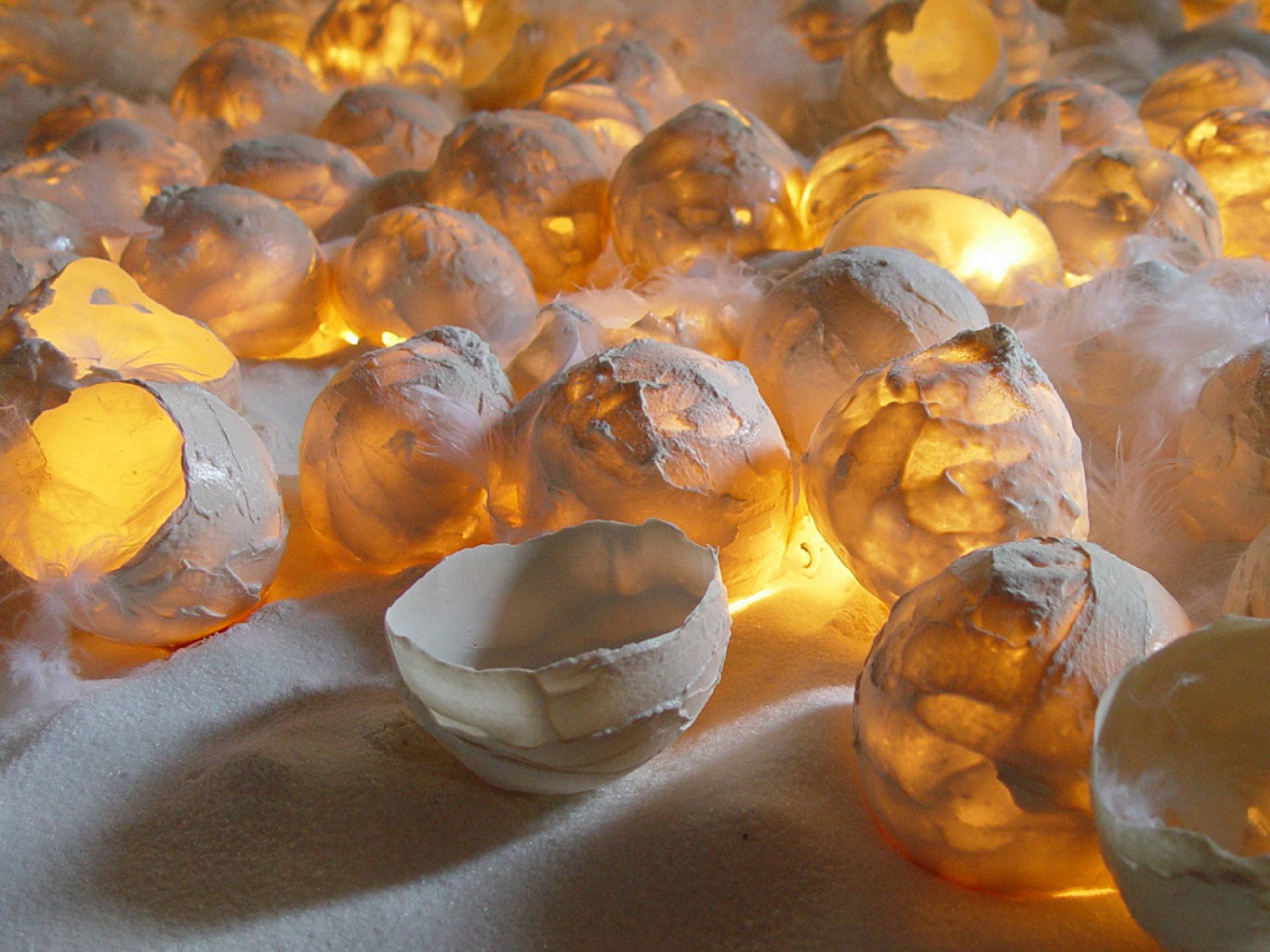
In this piece, she says she was working with the idea of genetically modified food. The piece has “a whole bunch of feathers and porcelain eggs, glowing, akin to nuclear chickens that have just hatched, and a sound in the background, sounds like hundreds of chickens clucking and scratching, talking about mutations and our body” (roughly quoted from this talk). This work is very appealing to me. Aesthetically, it’s interesting. It’s also deeply ironic (David), its title is important (Nic Wilson), and its subject matter is connected to issues I care about as well: how we are altering the lifeforms (and therefore the planet); how our health and the health of other organisms are connected; how fragile we and our systems are.
I was also very interested to hear her talk about leaving commercial clays to work with clay she harvests herself from this land. Being First Nations, she spoke about how this turn in her work was an attempt to connect to her ancestors. At first, however, she bemoaned the “new” clay she was attempting to work with. It was much, much more difficult. Yet she knew there was “no turning back.” She said it was “a whole other animal and I had to start all over again; I was like a toddler learning to walk; it connected me to my culture; it ignited my blood memory; it was like coming home” (quoting her talk). Later, during the question and answer period, she spoke about how little time her ancestors had to make their pots: the women were in charge of so much work, and with such a short summer season in Saskatchewan, they simply couldn’t spend a lot of time on their pots. She also said that unlike now, when we often see an artist as someone who devotes their life to making art, back then, being an artist was just a part of being alive. All of these understandings she’s come to are so fascinating to me. I’ll have to process all of this and see if it changes any part of my own path from here.
Carole Epp’s work amazes me, too. I admire her for creating both a functional and sculptural work, and I hope to get the chance to speak with her one day about how she views these two elements of her practice. In her introduction to Carole, Sandee quoted her, saying:
“None of us want to be confronted with the devastation that humanity can cause, but we cannot remain indifferent and inactive when so many suffer around us. Learning how to use my privilege to empower others, rather than to shield and protect my family, is going to be a lifelong journey of self-criticism and growth.” Carole Epp
(I asked, and Sandee pasted the exact quotation into the chat box on the Zoom call for me — thanks, Sandee)
As you can see, Carole is interested in “confronting” difficult topics in her work. While she claims that with her functional ware, “It’s simple really, I like to make things that make people smile,” she also spoke tonight about incorporating difficult subject material into her plates (she focused on her plates in this talk), pushing herself and people to confront harsh realities. She said that as a 42 year-old with children, she’s finding it harder to ignore the major issues that our world is facing (we have a lot in common):
“I was doing a lot of, I still do a lot of cats and unicorns and rainbows on my dishes and that kind of stuff, but a lot of this darker human condition stuff started coming through in the dishes and that’s what’s really been pushing me in the last couple of years is playing around with that idea of objects that we use every day that have that subject matter on them. People often say well this is great but you’re talking about the news and I want to turn off the news and look away. And I kind of want to force myself to look at these things but maybe also nudge others people to as well, so maybe through these handmade objects that they have in their lives, their coffee cup, they may start to look at the world in a different way” (quoted from the talk).
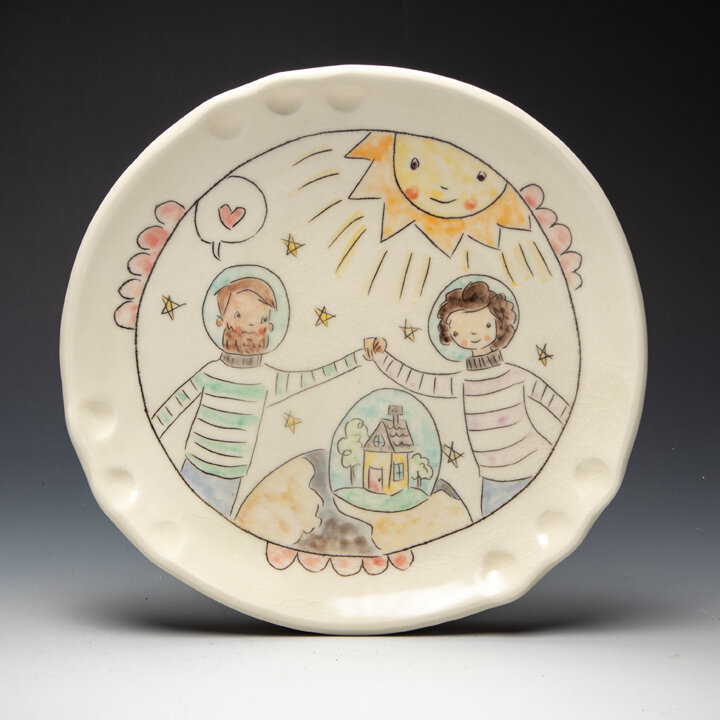
In this piece (above) in particular, Carole is reflecting on both Covid19 (our “bubbles”) and environmental catastrophe — look at the browns and greys of Earth, the house in its own bubble… Yet Carole said that the plate, to her at least, also shows hope. I suppose there’s still a bright smiling sun looking down on everyone, and one of her telltale hearts. There’s also the fact that these smiling characters, holding hands, cannot be anything but happy. We may not know why… but they just are. I’d love to chat with Carole one day about how she finds (or attempts to find) balance between the difficult subjects she’s working on and the pleasure she derives (presumably) from creating these pieces. (Look at those juicy finger imprints, “dimples,” on this plate… I can just feel the pleasure of creating them, of even just holding this plate in my hands). That’s a complexity that I’m facing in my own work right now.
I’m so glad I attended tonight’s talk.
 Amy Snider