On Feb. 4 2021, I “attended” (watched) a program put on by the Whitney Museum of American Art: “Art History From Home: Making Knowing.”
The objective of the talk was to:
“Explore how artists have used the materials, methods, and strategies of craft to challenge the power structures that determine artistic value and reclaim visual languages that have typically been coded as feminine, domestic, or vernacular. Some expand techniques with long histories, such as weaving, sewing, or pottery, while others experiment with textiles, thread, clay, beads, and glass, among other mediums. Featured artists include Mike Kelley, Miriam Schapiro, Marie Watt, and LaToya Ruby Frazier.”
The speaker was Grant Johnson, and this is his bio that accompanied the event post on Facebook:
“Grant Johnson is a Ph.D. candidate in the department of art history at the University of Southern California and a Joan Tisch Teaching Fellow at the Whitney. His dissertation, Sheila Hicks: Weaving to the World, traces the first critical history of the prolific American artist, weaver, and pioneer of global contemporary art. An active curator, critic, and writer, he has published work in Artforum, Frieze, The Brooklyn Rail, Garage, and Performa magazine, where he was a writer-in-residence from 2012 to 2014.”
I’ll quote from and summarize Johnson’s analysis of three of the works he showed during this talk, and I’ll respond to what he said by considering my own practice alongside the points he made. All quotations below are as direct (word for word) as I could type up while he was speaking.
Showing an image of a quilt by Rosie Lee Tompkins, Johnson made the comment that “craft is an opportunity for understanding ourselves in a larger world, in the way that the squares are pieced together in the cover quilt by Tompkins.” I find this idea beautiful: that for craft artists, craft-making provides a way to reflect on our own life and relation to others/the world. Not only through spending time on often monotonous and repetitive motions can craft artists have this space for reflection, but there is also something taking place in the action of making physical connections (between pieces of cloth, here) itself that somehow helps us elucify the non-physical connections that also make up a life. At least, this is what I thought about as I heard Johnson talk about Tompkins’ work.

The next piece he showed was a painting by Charles Sheeler — “Interior” 1926. I’m afraid I can’t find a colour image of it that I’m able to copy, so here it is in black and white:

Johnson described how “decorative arts have often been at the core of how we define American art – iconographic, material culture, one that doesn’t come from the so-called fine arts — but one that comes from craft arts.” By doing a reading of this painting, he showed us the place that handmade, “craft” objects have indeed long held in what has traditionally been defined as the fine-arts; within this painting which hangs on museum walls is the meticulously hand-built wooden table in the foreground; the ceramic pitcher and plate; the rugs and quilt that adorn the room.
Another work that Johnson talked about is Mike Kelley’s More Love Hours that Can Ever Be Repaid and The Wages of Sin 1987:
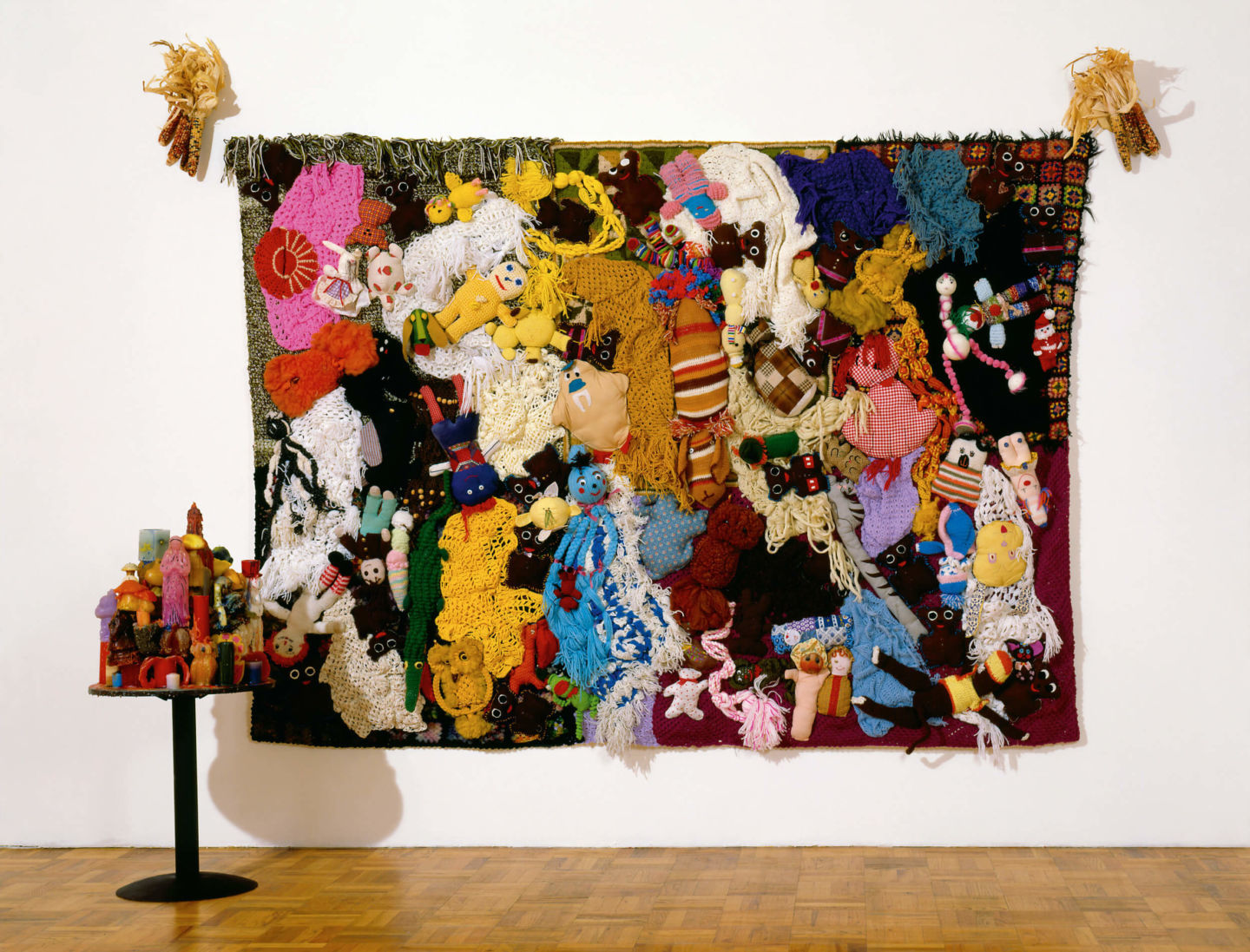
I especially appreciated listening to what Johnson had to say about this work. Forgive the long quotation, but I’d like to keep a record of this here so I can return to it and think with it again and again:
“There’s a value and a psychological weight and a kind of index in them of a gift and emotional economy (the love hours) but then also the aspect of trauma of the fact that that is a perpetual debt economy – the love hours will never be repaid in full, there’ll always be a kind of inequality there, and maybe also partially for Kelley to put them into an art object had to be found in a discarded context (good will store, Salvation Army) blankets, stuffed animal, clothing, thing that indicate a life previous to being in this context. You can tell that this is an original object, not something made in a factory – each one of these objects represents some real human individual life and a kind of investment we put into our objects, and that also is what the piece moors [?] — the eternal cycling of objects, material, things, that really does lead us to a melancholic place, especially if we think or question the ecological crisis and sustainability that have become more ever-present in everyone’s mind. In case anyone decides to question this further, the candles on the left-hand side and the corn husks on the corners sort of cue us into the idea that this is a ceremonial alter, that it has a religious or spiritual significance, the candle also signifies the kind of things you’d find in a teenager’s bedroom, moody broody spiritual. So there is something playful and ironic happening here that is typical a of Kelley and the 80s moment.”
I was taken in by what Johnson said about is piece because, despite he fact that its content is in most ways very different from the content of my work, I can see a few parallels between between what Kelley was doing here and what I’m attempting to do in my work. I too feel that I put “love hours” into the making of my pieces, and while the pieces themselves are not meant to be gifts to an individual in the way that a handmade teddy bear or a crochet blanket normally is, I’d like to think of them as something close to a gift all the same.
I also appreciate, of course, Johnson’s analysis of how each object in the piece “represents some real human individual life and a kind of investment we put into our objects.” These days, it’s hard to find anything that isn’t factory-made, and we generally have very few physical “investments.” I’m not sure if Johnson was speaking about the melancholy surrounding the loss that comes with no longer having hardly any such objects or the melancholy of the “ecological crisis” that is “ever-present in everyone’s mind” (as a side note: I only wish it were true that this crisis were on everyone’s mind). Maybe I missed something he said here on the melancholy point. I agree that handmade objects signify a return to that level of care and investments for the objects that adorn our lives.
I noted Johnson’s choice of the word “ironic” as the idea of art that works with irony is one that David and I recently chatted about. I definitely see at least a couple levels of irony here. Of course there is that the thrift-store sourced soft objects, usually relegated to the worlds of women and children, are here presented in a rectangle on a gallery wall, and with a title. Then there’s the title itself and the concept it communicates: that these objects represent countless hours of love, only to have been abandoned. Even that which we cherish the most (the love that went into these pieces) isn’t appreciated forever and always. In a sense, this should be devastating for me to consider as an environmentalist. If this Kelley piece shows us that even familial love simply fails to maintain for us the significance of objects for very long, who can expect us to care enough to “repay” our debt to that “mother” (nature) which is so far removed from us that we hardly acknowledge our reliance on it? In the context of environmental preservation, it makes sense that we take what we want and throw away what we no longer need of the planet’s resources — we don’t even maintain an appreciation for the investment that goes into objects our loved ones make for us by hand. Perhaps this is something Johnson was alluding to as well.
One last quotation from what Johnson said:
If you’re not able to get to a museum right now, take this example in mind and turn your attention to works of function, decorative art in your own home and appreciate them in the way you would in a museum. If we saw this as a piece on a white wall in the Whitney, we’d see it as art. What happens when we start to appreciate these arts [craft arts] in that way?
This reminded me of the post I made about my love of clay, and how the few cups, bowls, and plates of my own that I have at home have become more valuable to me in the last year that I have not been producing any new ones. I’m still not sure if I’d call these pieces of mine “art,” but I also wonder if that distinction doesn’t matter much — I can enjoy these objects and value them as investments just as much as if they’d been in a gallery and had a title.
 Amy Snider