Quarmby, Lynne. Watermelon Snow: Science, Art, and a Lone Polar Bear. Montreal: McGill-Queen’s UP, 2000.
Risa gave me several great book and article recommendations this past term. A book that I made sure to read over the December break is Watermelon Snow. In it, Quarmby intertwines journal-like entries from her time on the Arctic Circle Expeditionary Residency (28 artists and two scientists on a tall ship sailing the International Territory of Svalbard), her work as a biologist, and her work as a climate change activist (she quotes from this article in the book, page 123). It’s a beautifully written and heartfelt account of an attempt to maintain some sense of wellness while learning about and combating the existential crisis that climate change presents. Thank you, Risa, for telling me about the book. It was also very cool to see your name mentioned in it (Risa was a member of the 2017 residency that Quarmby was on).
Quarmby tells us about the dilemma she had regarding whether or not to cross an injunction line and risk arrest (see article linked above). She was involved in a protest that was blocking access to Kinder Morgan’s pipeline expansion. She writes in Watermelon Snow:
“If I violated the injunction, it most certainly would be flagrant, and criminal charges could mean jail time or a large fine, and a criminal record that could cause difficulty crossing into the US, where my son Jacob lives. Friends advised that I really did not need to do this. I had done enough already and others could now step up. But then I called Jacob. After all, it was he who stood to lose his financial safety net if I were to lose my condo and my retirement savings. ‘Do it, Mom,’ he said. ‘There is nothing you could do for my future that is more important than this'” (126).
I took this section of the book especially to heart. I haven’t risked arrest yet, but I’ve considered it. I’ve been starting to get involved with a newly formed (still at a nascent stage) Saskatchewan group of Extinction Rebellion. I nearly went ahead with an idea I’d had for an act of non-violent civil disobedience. I was shocked to read what is considered against the law in Canada in Direct Action Works’ A Legal Handbook for Civil Disobedience and Non-violent Direct Action in Canada.
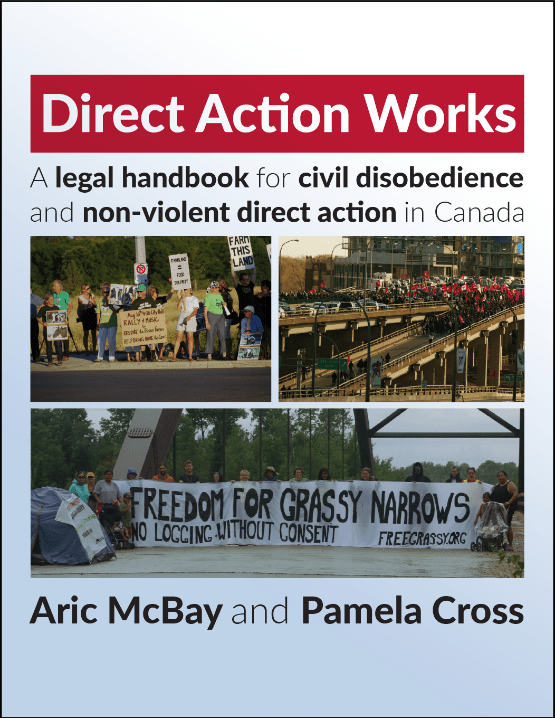
Even so much as singing or shouting (what I’d been planning to do for my action) is illegal: Causing a disturbance is a criminal offence, appearing in section 175(1) of the Criminal Code, and includes such actions in a public place as fighting, shouting, swearing, singing, using obscene or insulting language, obstructing people, or loitering” (81 Direct Action Works). I knew it was unlikely I’d be caught and charged, but this handbook did give me pause. Am I willing to be arrested for an act of protest in the name of climate change? The short answer is “no,” not now at least. I admire Quarmby very much for her courage and selflessness.
The following are several long citations from the last thirty pages of the book which I found most powerful and useful.
In our story so far [that of the evolution of complex life], some consider the emergence of consciousness to be the final grand leap. I wonder if the climactic grand leap in the dance of energy and life might have come when the most complex of the complex species discovered fossil fuels — carbon fixed into complex organic molecules by life that lived eons ago. The discovery of this energy source powered the development of industrialized civilization and simultaneously transformed Earth’s atmosphere. Will our dance with energy resolve with a beautiful pirouette and a surprising denouement? (138)
Sitting on the knoll, I wonder: which [artist] projects will come to fruition? What will the projects contribute? Who will be influenced? Much of what I am seeing perplexes and amuses me. I lack the knowledge or the vision to see where the work is going. […] Had I seen but not recognized Ai Weiwei lying on a pebble beach in Lesbos, in the pose of the now iconic image of the drowned Syrian child, Aylan Kurdi, would I have dismissed Ai as crass or frivolous? It seemed silly when the four artists “walked” the polar bear print around the ice floe while a fifth made a video recording. Yet, in a few months I will see Adam’s slow-motion video of this walk and be moved more deeply than by any photographs of the living bear encountered on our hike. […] I felt nothing but amusement when watching the action in real time, but the eerie slow-motion animation elicits a deep sadness. It grows in me as I contemplate the care with which the carcass was moved, oiled, and printed, the artists who conceived of the return of the “bear” to the sea ice, and of course, the bear that died of starvation. Sometimes, it takes an unusual and provocative shift to knock us out of a flat response to a pervasive iconic image, like the polar bear. It occurs to me that the risks involved in experimenting with unusual and provocative shifts are akin tot he risks at the leading edges of science. (141-2)
For a long time, the production of this pollutant [oxygen] wasn’t a problem becasue tehre were lots of sinks to soak up the oxygen — iron, for example, rusting to red iron oxides. But eventually the sinks filled and oxygen began to accumulate in the atmosphere. Now at this time, methane was abundant in the atmosphere, and, being a powerful greenhouse gas, methane was keeping the earth warm. When oxygen reacted with the methane, carbon dioxide, a much less potent greenhouse gas, was produced, and the earth began to coll. The earth cooled so dramatically it entered a global ice age known as Snowball Earth. […] And so it was that the discovery by cyanobacteria of an awesome new way to make a proton gradient ended up poisoning the atmosphere and triggering massive climate change. This was likely the first mass extinction of life on Earth. Some lineages, including the cyanobacteria, squeaked through. We have no idea what evolutionary inventions might have been lost, but life survived. The cyanobacteria couldn’t have known the consequences of their discovery, nor could they have changed course had they known. Now we are the species remodeling the planet by dumping carbon dioxide, the waste product of our energy consumption, into the atmosphere. We know what we’re doing and it’s within our abilities to change course. (143-4)
And yet, as I look at the eerily peaceful storybook depiction of a Yangtze River dolphin, I feel sick to my stomach. The dolphin in question is now extinct. I flip through the book and see science infused with [Douglas] Adams’s quirky humour. A world tour to see species on the cusp of extinction — to raise awareness, but also, I suspect, because it was something the authors wanted to do. The book was published in 1990. Does this make it okay in the way that, if one is so inclined, it can be easier to forgive an old man his misogyny? I am not in a forgiving mood. I am repulsed by the book — not by the authors or by a text I haven’t read, but by the extinctions we are causing, and by what has since become a thing: extinction tourism. And now I feel called out — by my own thoughts, by Brett handing me this book [Last Chance to See]. Here I am. Here we are. I close the book and hand it back to Brett, who has been watching all of this play out on my face. He smiles and says softly, “I knew you’d understand.” He gently reshelves the book. Has he just executed a small and personal act of art? (145-6)
I explain the greenhouse effect and then show the Keeling Curve, direct daily measurements of atmospheric carbon dioxide since 1958. (147)
The lens of cold fresh water off Greenland is contributing to a weakening of the critically important major Atlantic meridional overturning circulation (AMOC). If AMOC stalls, the implications are enormous, including extremely cold winters in Europe, hotter summers and extended droughts in Africa, and more-rapid sea level rise for the eastern US. We’re facing loss of species, especially in the oceans, but also on land, as climatic regions shift faster than species can migrate or adapt. (So far, the accelerated rate of extinctions is due to habitat fragmentation and pollution. Climate-related extinctions are just beginning.) Related to all of these things, we’re already seeing increased famine, human migration, and war. We’re facing radical changes in our weather systems, with severe impacts on human civilization. It’s happening now and it will continue to get worse. How fast it gets worse and how bad it gets is up to us. (149)
[Upon finishing a talk to the members of the residency about the science of climate change] I’ve presented the problem and its urgency. I’ve connected the dots from fossil fuels to carbon dioxide to consequences that affect us all. What comes next is important, but my confidence flags. People always want to know what to do. Sometimes, the awareness of all that I could be doing can weigh me down to the point of not being able to act at all. I refuse to be prescriptive — individual responses to different solutions vary dramatically. And that is okay because climate change is a complex problem — it requires us to pull together, towards the same goals, but not necessarily doing the same things. My approach is to open the floor at this point and allow solutions to emerge, as they always do. (149)
The conversations have fragmented and I pull us back together for a wrap-up. I emphasize that one of the most important things we can do is to talk about climate change. By working to reduce our own personal footprints, we inspire and motivate others to action, both personal and political. I emphasize that individual behavioural change, however diligent and widespread, isn’t enough. Nor is it necessarily something we should expect form everyone. It is only with regulatory changes, new policies, and cultural shifts that we can build a society where low carbon choices are the easy, appealing choices. If we don’t take back the power, corporations will continue to dictate environmental regulations and policy that favours pollution on a scale that wipes our all of the individual and community good we might do — pollution in service of enriching the rich. (151)
At the end of the day, politicians work for us. We hire them with our votes and with our votes they get to keep their jobs. The failure of our politicians is our failure. In her TED talk, climate scientist Katharine Hayhoe says that the most important action we can take is to talk about climate change. I think that she is right. The more of us who understand the urgency, the more likely we are to hire political leaders willing to pull with us instead of against us. Participatory democracy requires participation. (152)
For the past decade I’ve been, perhaps, a bit manic with fear. When I finally understood the magnitude and urgency of global warming, I panicked. I felt a tremendous weight of moral responsibility to act, to join the climate justice movement and do everything in my power to help humanity change course. I gave it everything I had until I had nothing left to give. Yet, the situation remains urgent and some days it feels not much has changed, or that some things are changing, but much too slowly. Gradually, I’ve become aware that global warming will define not just the present, but the entirety of my remaining life. (159)
I breathe and watch the water appear at the top of the ramparts and cascade down its short but spectacular life as a waterfall; the water bounces up briefly as it strikes the scree and then falls again and disappears underground. Only now do I see that this Arctic trip has been like a “celebration of life” for ice. I think of this new gang of mine, standing together on the deck of the Antigua listening to the bearded seals singing to one another under the fast ice of Raudfjorden. There was joy and celebration in our exclamations of surprise, laughter, and fellowship as we shared the astonishing experience of summer sea ice. Some of us shared sadness when we awoke to find ourselves tethered to a much smaller ice floe than we had played on the day before. We all delighted in the immensity of the glaciers, the ethereal sky-blue glow of some bergy bits, the tinkling sounds of a bay filled with ice from a crumbling glacier, the reverberating gunshot and splash of calving. Every day, we celebrated ice. And every day there was sorrow at how much a glacier had retreated, at the sight of a polar bear in distress. (160)
Change is motivated by connecting on values, not by sharing data. (163)
When I raise the issue of the carbon cost of air travel [at meetings back at work] and suggest alternatives, the room is quiet. I would like to see us shift from a financial budget to a carbon budget. I am politely listened to, there are a few murmers of “Good idea” and “Yes, we should think about that,” and then we are on to the next item on the agenda. Have I become the crone who is politely given space to speak, and then is ignored? I feel like screaming, “Wake up!” I think of my great-grandfather stuck in his cabin, “I am near crazy for being such a fool.” But then I let it go. I don’t choose to fight this battle. (166)
I thought my job was to take care of myself and recover from burnout so I could once again be my warrior self, defending polar bears, microbes, and the generations of humans that follow, but it isn’t as simple as that. In the process of reading my journals and assembling this chronicle, I became aware of my growing irritability, low-grade depression, and sense of separation from others. Burnout to be sure, but also a failure to process grief. How does one mourn something so big and abstract and at the same time profoundly personal: the world my son will inherit, the loss of the rich, old-growth forests of my youth, the loss of summer sea ice? What would healthy grief look like? Lately, I have found some peace — at least intermittently — and I’ve noticed a richer quality to life. But I can only do this a little at a time. I am terrified by the thought of opening myself to this grief. I’ve leaned heavily on an evolutionary perspective, an intelligent grieving that may not adequately release me. I am keen to turn my attention to a painting project because I am curious whether the more visceral experience of that form might take my grief to a new place, but that too, I know, is missing something important. (169)
There’s no denying the darkenss of what the cheater class has done to our planet. Acknowledging the constant pain that comes with that knowledge has been part of my healing. Letting go of my investment in particular outcomes has also been important. (169-70)
Hope and despair are ephemeral. What matters, is we have found a way to live well, however desperate the reality of our times. (170) (last page of the book)
 Amy Snider
One thought on “Reading: Watermelon Snow”