Visual Arts MFA students at the U of R receive an incredible amount of attention from the faculty. At least four times throughout their program, they must go through an “end of semester review” in which they give a 15-minute presentation about the work they’ve done over the term followed by a 45-minute Q&A session with the entire Visual Arts faculty. I had my first such review this past week, and it was an amazingly useful experience. The faculty asked me extremely apropos questions and made very insightful comments. Below are the questions that each faculty member asked me (I had a fellow student, Raegan Moynes, as my note-taker, and I’m grateful to her fast typing) with some further thoughts I’ve had in response since the review took place.
For some context, I ended my presentation with the following questions:
For myself:
- What am I trying to achieve through my art practice?
- What role do I want clay and performance to have in this practice?
For the committee:
- Is it feasible to attempt to become good at using two different media/approaches to art-making in a MFA program?
David Garneau’s question:
It seems to me that the performances were almost complete disasters… using plastic signs, to not being in shape for the hurdles, to not having any audiences, etc… you may say there are other ways to evaluate things, but if you’re going to be a successful performer, audience engagement is essential, unless its a solipsistic exercise for the sake of documentation for a talk or something.
In Group Studio, you cited at least two eloquent environmental practices as models, so how would you engage performance towards those models and how you would solve the problem you ask us: bring ceramics and performance together, or as separate activities? What have you come to in the last six weeks?
I’m still not fully able to answer this question, but I’m getting a sense of the type of performance ideas which are most successful: they are completely clear and very simple. Their point is succinct. As I mentioned when we chatted after class one day, thinking about Occam’s razor is useful. The idea should be so simple that at the most all one needs to say is “climate change” and viewers would get the work’s message. Ideally, even saying that should be unnecessary. Unless the work is interactive or dialogic, or unless the point is the follow-up media attention only, the message the performer is making should be immediately obvious to any viewer.
An idea such as Eve S. Mosher’s of drawing a line to show where water will rise to is almost immediately clear. Mosher’s objective was to spark questions about what she was doing while doing it that would invite conversation on climate change. By the way, it seems others have had the same idea of using a line to mark where water levels will rise to as an effect of climate change. At least two I’ve discovered this term are Lines (57° 59’N, 7° 16’W) (2018) and Chris Bodle’s Watermark (2009).

Performances that do not invite questions or conversation from viewers in this way need to have an even more obvious message unless the artist doesn’t mind there being ambiguity “on the street” because they expect media attention to spread the point they are making. Perhaps they figure that by becoming well known people will immediately associate their work with this issue. As Sherry said, if you’re the best at something, you can advocate for it. For instance, Stein Henningson’s performances are beautifully simple, yet not all are obvious enough to guarantee that all viewers would know the work is about climate change. A few are slightly more abstract, such as Guangzhao Live 2 (2017).

I don’t know if or how Henningsen informs viewers that his work is about climate change. There is no title up on a gallery wall, obviously. Unlike in Mosher’s piece, which is meant to engage people in conversation, in the examples of Henningson’s performances I’ve watched online, he just begins and ends them without explaining the work or inviting any dialogue. Would viewers chat among themselves… such as:
“what’s this all about?”
“I dunno. Maybe climate change?”
“Oh, yeah, must be.”
One performance I’ve come across that may be clear enough without any title, text, or conversation was a piece by a group of protesters in Germany who stood on ice blocks with a noose around their necks. I think that people would immediately understand what they’re doing, but I’m sure there are still some who wouldn’t.

It seems they encountered a few negative responses after the action that raise interesting issues with this type of work. I myself wouldn’t necessarily do something that is as “doom and gloom” as this, knowing what I know about how people respond to such messages (they don’t prompt viewers to take engage in this issue as much as works depicting solutions to it do). This piece, put on by student activists, also raises the question of deciphering which events are considered “performance art” and which are considered activist “actions,” a question that Sherry Farrell-Racette raised during my review.
Holoscene (2017) was an installation of a tank of water in Times Square in which performers would carry out everyday tasks, such as making a bed, as the tank filled and emptied with water.

Again, this installation would likely need to have some text or announcement telling viewers it’s about climate change, right? If not, people walking by think it’s speaking to a host of issues such as depression or anxiety, right? Or perhaps this could be interpreted as an artistic work without a “message.” So, basically, what I need to find out if and how all of the above mentioned works communicate that their point is climate change.
I’m also considering a few installation works that make their message in close to entirely black-and-white terms. For instance, in Reduce Speed Now (2019), Justin Brice Guariglia placed ten large solar powered LED highway message boards throughout the courtyard of London’s Somerset House that broadcast messages about the climate crisis in the words of Greta Thunburg, Bruno Latour, Timothy Morton and other concerned thinkers and writers.

What I find interesting about this piece is that it isn’t in the slightest afraid of bible-thumping of being “didactic.” On the contrary, it’s purposefully hitting us over the head with its message in the most direct way possible. These are highway signs — their sole purpose is to convey a message that is essential for our safety or the safety of others. What a perfect medium for conveying the dangers we are facing with climate change.

Another installation that broadcasts a very clear message is Climateclock (2020) — a large (60-foot wide) digital clock counting down how much time we have remaining before we’ll have burned through our “carbon budget” that would keep the world to “only” 1.5 degrees average warming. Photo source.
Here, scale is important to the work. In terms of aligning this to performance-type actions, I think of Extinction Rebellion’s projects where they scale buildings to drop banners with their logo or other messages. Once again, this is work that could be called art if the organizer wanted to…
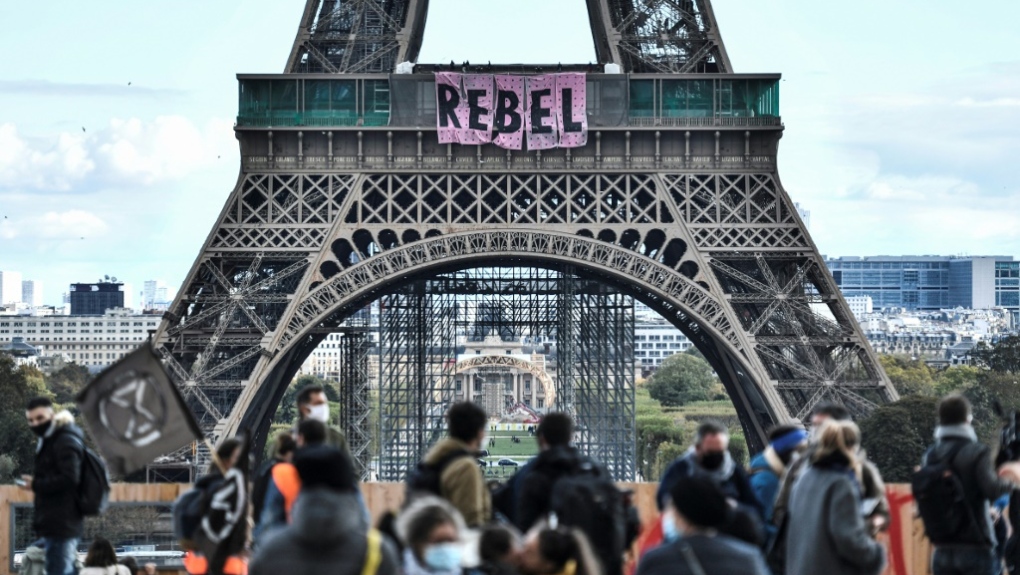

Olafur Eliasson’s Icewatch (2014), while problematic (carbon footprint), is also understood with very little-to-no explanation. but for those who don’t have climate change on their mind, I’m assuming that some text, even just the title, would be necessary for them to know the significance of the work. Photo source.
Again, these are very straightforward pieces to understand — a quality that I’d like to emulate in my work going forward. As for whether I’ll incorporate ceramics into performance, I’m not sure yet.
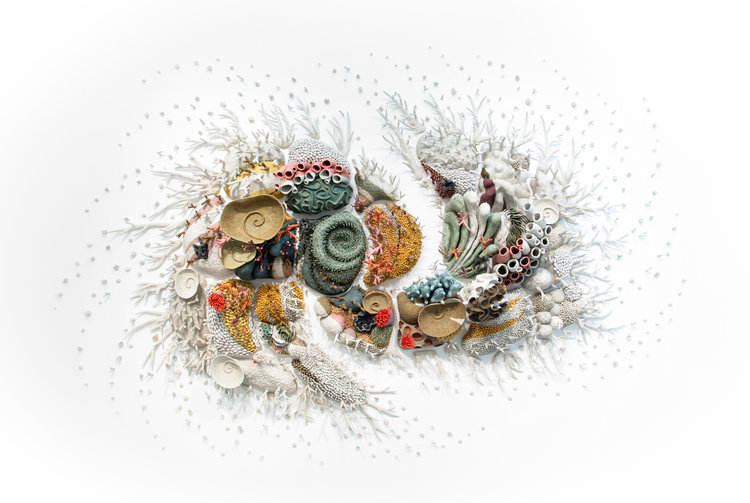
I can imagine ceramic installations on the subject of climate change, such as Courtney Mattison’s (written about in “5 Art Installations about Climate Change We Should Be Talking About”) more easily than I can imagine combining ceramics with performance on this subject, but I’m sure that’s just because I’m too exhausted right now to come up with any idea of what that could really be. Photo source.
All in all, this is a great question, David, and likely one that I’ll be considering for a long time.
Rob Truszkowski’s question:
I think you’ve started to address this…. it may possibly be on the minds of others. Is art the best way to reach a wider audience? How do you know?
This is an excellent question and one I’ve been thinking about for a while. I’ve asked myself if I should quit spending time doing art and devote all I’ve got to hardcore activism. If I had more time on my hands, I’d get things moving with Extinction Rebellion in Saskatchewan. (I’m one of a handful of people trying to do this, but there just isn’t the people-power at the moment to get it anywhere right now). Or perhaps I should become a politician? The founder of EnviroCollective just became a city Councilor because she believes this is the best way to make the most change one person can make.
So why devote so much time to building myself up as an artist? I have two parts to this answer. The first is simple: I enjoy making art, and I think I am good at it (or getting there at least). As I told the Grad Committee at my review, I especially miss making stuff. I don’t want to give that part of my life up.
My second answer is that art can be an effective form of activism. Throughout this semester, I’ve been gathering websites of organizations and artists who use art for activist purposes. I’ve come across the terms “artivist” and “craftivism.” I see this marriage of art + activism as not only a way for me to continue producing art, but also a way for me to affect some positive change in the world.
I’ve learned this semester that that the latter point is controversial. David asked me what my goal is with my art. Looking at my notes from my Group Studio class on October 23rd, I see he put it something like this: “If your goal is to fix climate change, you’ll fail.” He told me that art is futile at achieving a goal (example: reducing climate change). Instead, my goal should be participation (if I’m undertaking participatory art). I know, however, that others disagree (nothing new there). For instance, there is an organization called The Center for Artistic Activism:
The Center for Artistic Activism trains and advises organizations, artists and activists to help them increase the efficacy and affecacy of their artistic activism. We conduct innovative research to figure out what exactly efficacy and affecacy mean when it comes to artistic activist projects. And we share our trainings and research findings broadly, to provide the broadest possible access.
source: “What We Do” page
On their homepage, they list nine reasons “why artistic activism.” These are:
- Artistic activism mobilizes affect and effect
- Artistic activism thrives in the contemporary landscape
- Artistic activism has been used throughout history
- Artistic activism creates openings
- Artistic activism is accessible
- Artistic activism stimulates a culture of creativity
- Artistic activism energizes people and organizations
- Artistic activism is about the long game
- Artistic activism is peaceful and persuasive
I see value in these reasons they give for why art can be an effective form of activism. I understand that this doesn’t automatically mean that activism can be art or that all “artivism” is good art, but that’s an entirely different point.
Another group I’ve discovered is Artists and Climate Change. Their “about” page begins with this paragraph that sums up what I’ve been feeling is the reason why art should — must — be involved in the fight for greater climate change action:
In 2005, in an article titled “What the Warming World Needs Now Is Art, Sweet Art,” 350.org founder Bill McKibben wrote that although we knew about climate change, we didn’t really know about it; it wasn’t part of the culture yet. “Where are the books? The plays? The goddamn operas?” he asked. An intellectual understanding of the scientific facts was not enough – if we wanted to move forward and effect meaningful change, we needed to engage the other side of our brains. We needed to approach the problem with our imagination. And the people best suited to help us do that, he believed, were the artists.
source: “About” page
A group I’ve admired since I discovered them about a year ago is Project Pressure. I LOVE this group. It’s a non-profit designed specifically to support artists whose work represents or responds to melting glaciers. I’ve quoted from their “about” page in past presentations I’ve given:
Project Pressure is a charity with a mission to visualize the climate crisis. We use art as a positive touch-point to inspire action and behavioural change. Unlike wildfires and flooding, glaciers are not part of the weather system and when looking at glacier mass loss over time, one can see the result of global heating. This makes glaciers key indicators of the climate crisis and the focus of our work.
source: “about” page
There are so many other organizations I could list here, but the above three should suffice to show that there are certainly people out there who believe that art is an essential tool in the climate change action-inspiring toolkit. On top of such organizations are the many artists whose work is on this subject, of course. I’ve created a long list of artists whose statements or other writing on this topic I could quote here. I’ll just pick two.
I remember reading a New York Times article in the summer of 2019 (thanks, Mike) about the work of David Opdyke. The title of the paper edition, which I have up in my studio, was “Feeling Dismal? Do Something.” In it, Lawrence Weschler writes, quoting Opdyke:
“For years I’ve been feeling the need to do something about the dismal future into which we all seem to be sleepwalking. And yet,” he paused before continuing, “I’m constantly haunted by worry. Can such artistic gestures ever really make any difference, especially given the sheer scale of the challenge?” Reminded of Auden’s line to the effect that “Art makes nothing happen,” Mr. Opdyke seemed to rally, countering, “Yeah, but Eudora Welty says that ‘Making reality real is art’s responsibility,’ and maybe that’s what most needs doing now: making the stakes involved in our current crisis real and tangibly visible for people. One ends up hoping that pieces like this might propel the urgent changes in vision, one person at a time, necessary to provoke an appropriate mass response.”
source
In “Ice, Art, and Being Human” (2015), Olafur Eliasson writes about the potential of art:
All of us know the experience of being moved by a piece of music, a book, or a painting. Such works of art serve as an impulse that leaves its mark on us. Experiencing art is not a matter of learning something new; rather, it allows us to discover something in us with which we suddenly identify, and through the connection we establish, we are better able to express who we are.
source
I believe in this, and my guess is that nearly all artists do. In our Group Studio course on September 18th, David said (quoting directly): “most art makes us see things we already know in a new way.” Perhaps, then, he does see the potential for using art as a form of activism? I’m not sure. I’d also like to ask Rob more about his opinion on this subject.
In addition to these organizations and artists who view art as an effective means of activism, I’m also aware of a growing body of theory and criticism on this type of work, such as:
- “Climate Change and Visual Imagery” (2014) by Saffron J. O’Neill and Nicholas Smith
- “Climate Change and the Imagination” (2011) by Kathryn Yusoff and Jennifer Gabrys.
- “Representing, Performing and Mitigating Climate Change in Contemporary Art Practice” (2012) by Gabriella Giannachi
Just to list three articles.
There are also, of course, entire classes being taught on the psychology of climate change (I never did have a chance to speak with Dr. Katherine Arbuthnott this past term… perhaps in the next). There are so many resources out there for one such as my self who wants to know how to “use” art (but still actual art) to help with this cause, that I’ve just barely skimmed the tip of the iceberg.
Rob’s follow up comment:
I’m thinking through… is there a middle path? Is that a path you even want? Swing hard to activism that uses art/activism that uses art, to all the way to the other side — solitary practice, make things, that personal connection. Is there a middle path, or is that what you want? Not asking you for an answer. It’s just really clear, even in how you’re articulating what you’ve been doing and even what you want to do… it’s an ongoing struggle and one you’re going to have to contend with. I look forward to seeing the answer to this question in another semester from now.
That’s another great question/point, Rob. Actually, it’s the basis for the question I asked the committee myself: Is it feasible to become good at using two different media/approaches to art-making in a MFA program? Should I attempt to use more than one medium (ceramics and performance for now, perhaps others later) because I feel that it’s necessary to engage in different practices for different but equally necessary purposes (nourishing myself; spreading the word to as many people as possible)? I hope I’ll have an answer to this question soon — at least an answer that is sufficient to see me through this program, as I’m sure you’re right that it’s a question I’ll be asking for a very long time.
Larissa Tiggelers’ question:
You’ve talked about failure. Can failure itself be a subject for you? Rather than the question of escaping failure or if failure can be generative beyond creating more questions. Can failure be generative?
A very interesting question, Larissa. I answered during the review that I’ve thought about failure this semester, and that’s true — I’ve thought about the failure of my performances, but also about our collective failure to address climate change when we needed to (at least 50 years ago) or sufficiently in more recent time (and even now… we continue to fail). However, I hadn’t actually thought about making failure the explicit subject of my work. I think Stein Henningsen is also considering this subject when he attempts to create a glacier by bringing pieces of ice that have broken off of one back to their source (How to Build a Glacier (2014)). Thank you for the question — I’m going to hold onto it.
Holly Fay’s question:
I’m wondering if some of this is the need to give yourself permission to be an artist that is interested in making art.
As I said in the review, Holly, this is a very loaded question. The short answer is: yes. I’m someone who was raised to take care of others: I took care of my severely mentally ill mother in what was supposed to be my childhood. I still like to take care of people, and perhaps my environmentalism is connected to that impulse. Therefore, doing something just “for me” (throwing pots in this case) would go against that impulse. On top of that is the fact that I am sincerely very concerned about the state of our planet. Actually, I’m sickened by the situation. If I can make even a tiny move (“one inch”) towards changing it for the better, I’d rather do that than do nothing. The question is, how to be effective but also sustain myself at the same? Believing that I’m “doing good” may give me a boost (I don’t believe in altruism), but it’s frankly not nearly enough to make up for how terrible I feel about our environmental destruction, and facing that topic with all my energy is as exhausting emotionally as jumping hurdles is physically.
Sherry Farrell-Racette’s question:
A couple of things. One is I don’t think it’s a binary, not a question of two opposites that you need to choose or even that there’s a middle ground. You are a whole person and you have these expressions. When I was looking at performance art… as art maybe it wasn’t awesome, but as a performative action they were really interesting. The labels are important. I would encourage you to think about… I’m a beader… right? and being an activist… being an aware of the grim facts environmentalist in this moment … is very similar to being an Indigenous woman in this moment… it’s hard to hold onto hope. It’s hard to find the path hang onto hope… when we look backward we look to our ancestors… For me, making, is the way we put ourselves back together. It’s not one or the other. If this is how you are in the world… If you look at your making… it’s the way you put yourself back together. These things are related. When you showed inspiration photos… that communicates how you want to honour the earth. This is as important as attending a million meetings… if you can create an enhanced awareness… It’s like Georgia O’Keefe. I don’t see the split or it’s a choice. You are a whole person and this is how you are in the world…. I’d like to see you move forward. Don’t see making as “making.” Maybe making is what you need to do now. But you’ll never stop being environmentally concerned. It’s a cycle of creativity… out into the world, back into the clay, into the world, back to the clay.
We also have to look after ourselves. Throwing ourselves against the glass wall. Just move things over an inch. Think of different ways of doing it. Don’t underestimate the power of art to introduce ideas. It is often subtle and takes a long time. But I encourage you.
Wow. I was blown away by this feedback. I don’t know how to respond it it more than I did in the moment by saying that I agree we are complicated, and the situation (climate change) is complicated, so therefore neither can my response to it be simple.
More than anything, I felt a tremendous honour to be spoken to in this way, as though I really am an artist. When you said that we can’t constantly be “throwing ourselves against the glass wall,” I couldn’t really believe that you and I are in the same category as I’m still not able to consider myself an artist (not even close), but I definitely did feel encouraged. Thank you, Sherry.
Ruth Chamber’s comment:
Remember how long it took you to throw pots? If you put that time into performance, they will get better. I wouldn’t write off performance. I would draw that analogy between how long it took you to gain that skill…. That is also tied to your pairing with the material….. performance idea. The performance ideas are going to be as hard to arrive at without a lot of work. I just wanted to point that out. Not a question.
As I said in reply, (quoting Raegan’s notes of what I said), I don’t understand how you become good at performance… I feel like I could have a great idea that hits the mark, or I could have many ideas come to me that are not so great. Should I carry out those ideas? Is it like clay that you learn from doing… or is it futile to do so?
David’s follow-up comment:
Ruth has it exactly right. You have to do 500 performances to get as good as 500 pots. The idea is not the thing, its only part of the thing. I have pop song ideas…. Lol… However, you already have a strength you’ve worked up. You can parle that over. For instance, you could walk all the way to clay banks and you could come up with a solar kiln that doesn’t work… you can replace friends’ plastic with ceramics. That’s a life practice. It is not about the practice, it is a practice doomed to failure. It’s an enduring thought. Every artwork is failed project! The notion of modern art being failed projects… Climate change is the subject of your practice, not the point of practice. Blow yourself up if you want attention. That is not the subject of art. It’s just a possibility of art. If so, make it the documentation.
Your practice begins with ceramics. You have the therapeutic, you have the conceptual practice… It was never finished. It has extended life. It’s a performative object: it’s fragility; its domed failure. It was good conceptual art but bad pottery. Paul Mathieu was on about that. How to make something eloquent and also deconstruct at same time.
A robust practice here. You can separate them into good performance art and good activism and good pottery but by setting a task to bring together with different forms (object/performance/writing/broadcasting) it can be more holistic. It can be a more elegant problem to solve. The lead of the crafting is so important. Skill is important. And notion that skill is important. You can’t just go in with a good idea.
The truth is, David, I don’t really understand what you mean by saying that “every artwork is a failed project.” I’ve heard you all term nudging me to continue with ceramics as I’ve already developed some skill in that area (the soup kitchen analogy…). I think what you’re saying is that I need to have that same level of skill for each approach I take in my work, but also that I should see all of these approaches as one holistic practice. That’s all that I can get from this… and I hope to have the chance to speak with you more to better understand what you were saying.
Sean Whalley’s comment:
The most important thing is there is a real disconnect between your expectations, what you believe your art practice to be and the outcomes… These need to come together in a holistic way. Maybe the trips come in to the practice? Being in the space could be your practice. You have to acknowledge that that is enough. Living in a way that resists what you are raging against…. is an act in itself. All of those things are acts. You can’t separate those things out. You keep wanting to separate those things out.
Pick something that you really want to focus on. Ex. Another type of performance piece. You could try to cut Wascana park with scissors. Polluters… lawnmowers. Maybe you need an objective to focus on.
As Sherry said, the best ways to garner attention is to get attention. If you become the best at something, you can advocate for it. Don’t re-invent your practice or your thinking. Really big challenge.
A very good bit of wisdom, Sean. I think there are parts of what you’ve said that I don’t fully understand. I think that in some way at least your point is similar to David’s — to understand myself and my practice as interwoven and holistic. I would love to get the chance to speak with you some day in the near future. Regarding the disconnect between my expectations and my outcomes… I know. I have much to work ahead of me.
Risa Horowitz’s question:
We’ve been working very closely together. We began conversations in summer. You your original studies had nothing to do with art…. did the Post Bac on ceramics, and where you go to after House on Fire was — I can’t extract more from earth for art. I put a strategic challenge to you which was, well, what if you didn’t? You hadn’t thought about performance before that. I challenged you to try something immaterial, and you rolled with it with courage and rigor/vigor. no one has said, why are you don’t performance. Question – do you have regrets trying these immaterial practices?
How could I (MUFFLED)
Strategic challenge: to try something that was immaterial. You did it with courage… So, you’ll notice no one has said why are you doing performance?
My answer, which I hope you predicted, Risa, is “no.” I don’t regret trying performance.
 Amy Snider
One thought on “End of Semester Review questions ~ further reflections”