End of Semester Review questions ~ further reflections

Visual Arts MFA students at the U of R receive an incredible amount of attention from the faculty. At least four times throughout their program, they must go through an “end of semester review” in which they give a 15-minute presentation about the work they’ve done over the term followed by a 45-minute Q&A session with the entire Visual Arts faculty. I had my first such review this past week, and it was an amazingly useful experience. The faculty asked me extremely apropos questions and made very insightful comments. Below are the questions that each faculty member asked me (I had a fellow student, Raegan Moynes, as my note-taker, and I’m grateful to her fast typing) with some further thoughts I’ve had in response since the review took place.

For some context, I ended my presentation with the following questions:

For myself:

  • What am I trying to achieve through my art practice?
  • What role do I want clay and performance to have in this practice?

For the committee:

  • Is it feasible to attempt to become good at using two different media/approaches to art-making in a MFA program?

David Garneau’s question:

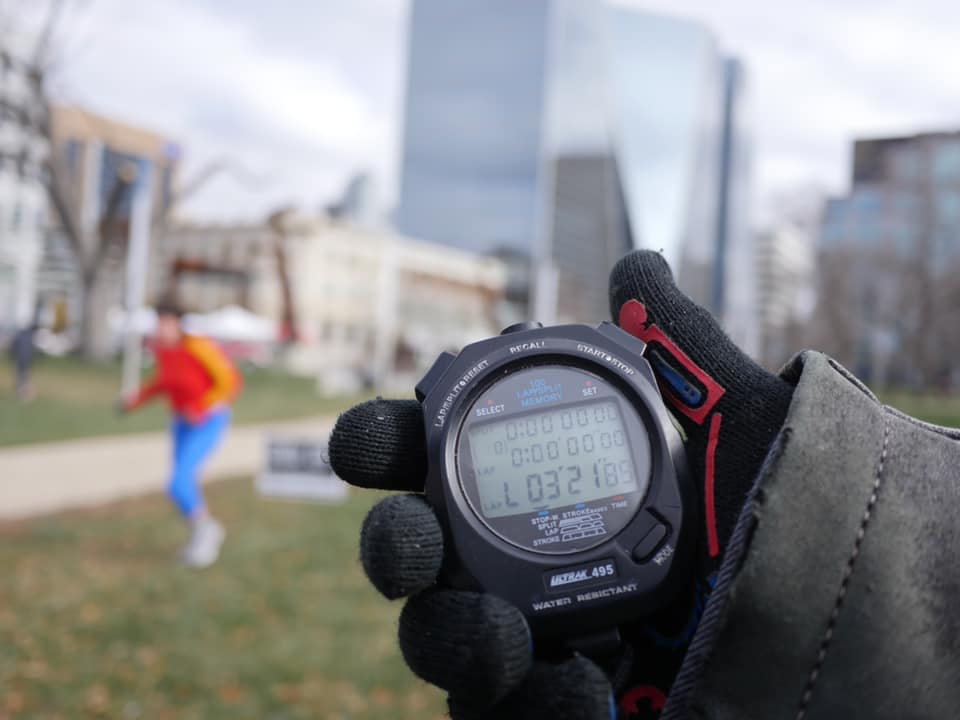
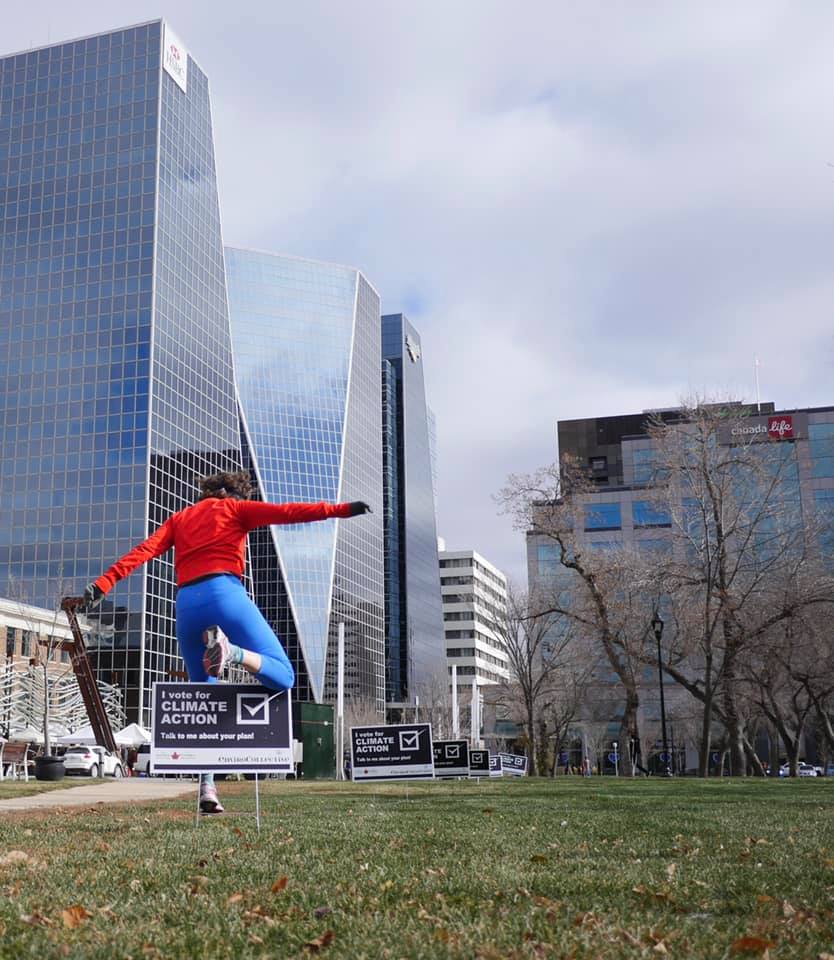
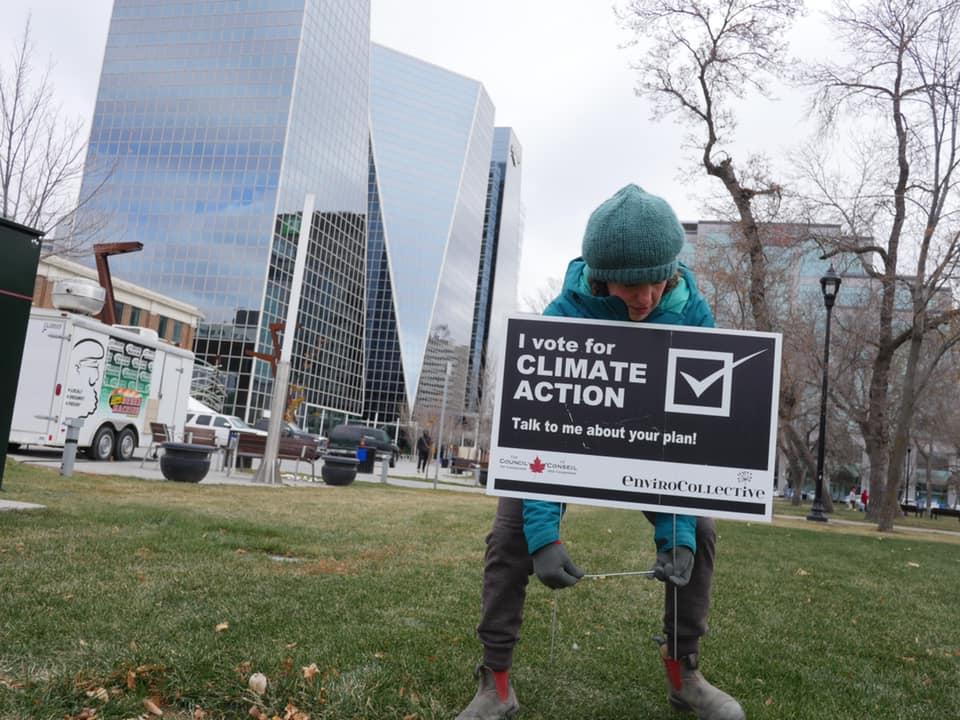
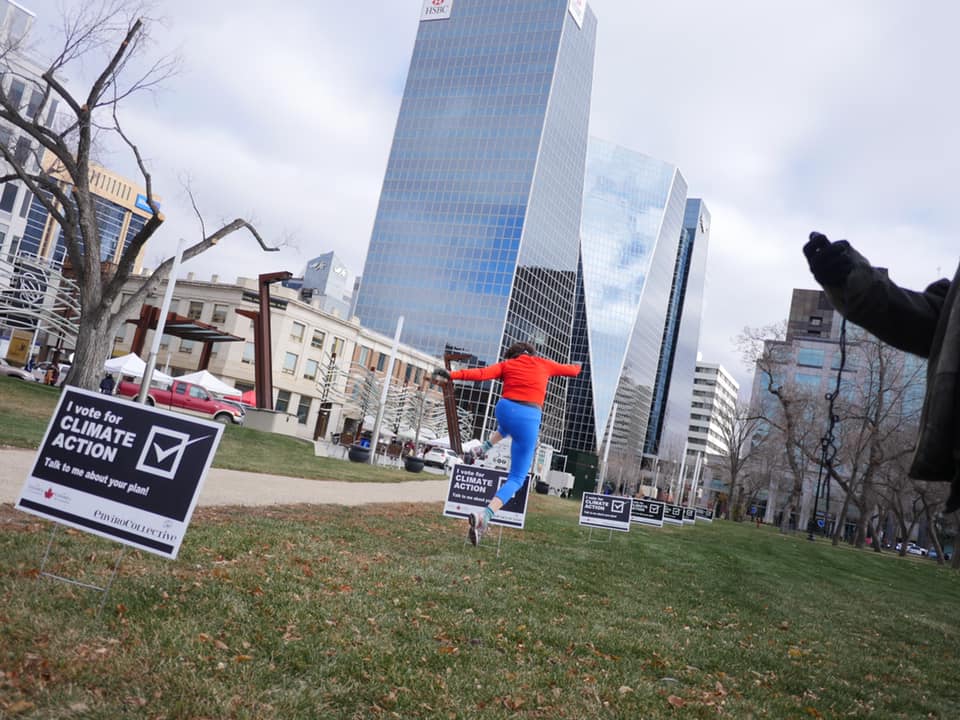
It seems to me that the performances were almost complete disasters… using plastic signs, to not being in shape for the hurdles, to not having any audiences, etc… you may say there are other ways to evaluate things, but if you’re going to be a successful performer, audience engagement is essential, unless its a solipsistic exercise for the sake of documentation for a talk or something.

In Group Studio, you cited at least two eloquent environmental practices as models, so how would you engage performance towards those models and how you would solve the problem you ask us: bring ceramics and performance together, or as separate activities? What have you come to in the last six weeks?

I’m still not fully able to answer this question, but I’m getting a sense of the type of performance ideas which are most successful: they are completely clear and very simple. Their point is succinct. As I mentioned when we chatted after class one day, thinking about Occam’s razor is useful. The idea should be so simple that at the most all one needs to say is “climate change” and viewers would get the work’s message. Ideally, even saying that should be unnecessary. Unless the work is interactive or dialogic, or unless the point is the follow-up media attention only, the message the performer is making should be immediately obvious to any viewer.

An idea such as Eve S. Mosher’s of drawing a line to show where water will rise to is almost immediately clear. Mosher’s objective was to spark questions about what she was doing while doing it that would invite conversation on climate change. By the way, it seems others have had the same idea of using a line to mark where water levels will rise to as an effect of climate change. At least two I’ve discovered this term are Lines (57° 59’N, 7° 16’W) (2018) and Chris Bodle’s Watermark (2009).

Performances that do not invite questions or conversation from viewers in this way need to have an even more obvious message unless the artist doesn’t mind there being ambiguity “on the street” because they expect media attention to spread the point they are making. Perhaps they figure that by becoming well known people will immediately associate their work with this issue. As Sherry said, if you’re the best at something, you can advocate for it. For instance, Stein Henningson’s performances are beautifully simple, yet not all are obvious enough to guarantee that all viewers would know the work is about climate change. A few are slightly more abstract, such as Guangzhao Live 2 (2017).

I don’t know if or how Henningsen informs viewers that his work is about climate change. There is no title up on a gallery wall, obviously. Unlike in Mosher’s piece, which is meant to engage people in conversation, in the examples of Henningson’s performances I’ve watched online, he just begins and ends them without explaining the work or inviting any dialogue. Would viewers chat among themselves… such as:

“what’s this all about?”

“I dunno. Maybe climate change?”

“Oh, yeah, must be.”

One performance I’ve come across that may be clear enough without any title, text, or conversation was a piece by a group of protesters in Germany who stood on ice blocks with a noose around their necks. I think that people would immediately understand what they’re doing, but I’m sure there are still some who wouldn’t.

Ice blocks gallows
photo source

It seems they encountered a few negative responses after the action that raise interesting issues with this type of work. I myself wouldn’t necessarily do something that is as “doom and gloom” as this, knowing what I know about how people respond to such messages (they don’t prompt viewers to take engage in this issue as much as works depicting solutions to it do). This piece, put on by student activists, also raises the question of deciphering which events are considered “performance art” and which are considered activist “actions,” a question that Sherry Farrell-Racette raised during my review.

Holoscene (2017) was an installation of a tank of water in Times Square in which performers would carry out everyday tasks, such as making a bed, as the tank filled and emptied with water.

Again, this installation would likely need to have some text or announcement telling viewers it’s about climate change, right? If not, people walking by think it’s speaking to a host of issues such as depression or anxiety, right? Or perhaps this could be interpreted as an artistic work without a “message.” So, basically, what I need to find out if and how all of the above mentioned works communicate that their point is climate change.

I’m also considering a few installation works that make their message in close to entirely black-and-white terms. For instance, in Reduce Speed Now (2019), Justin Brice Guariglia placed ten large solar powered LED highway message boards throughout the courtyard of London’s Somerset House that broadcast messages about the climate crisis in the words of Greta Thunburg, Bruno Latour, Timothy Morton and other concerned thinkers and writers.

Reduce-Speed-Now-by-Justin-Brice-Guarigl
photo source

What I find interesting about this piece is that it isn’t in the slightest afraid of bible-thumping of being “didactic.” On the contrary, it’s purposefully hitting us over the head with its message in the most direct way possible. These are highway signs — their sole purpose is to convey a message that is essential for our safety or the safety of others. What a perfect medium for conveying the dangers we are facing with climate change.

climate clock

Another installation that broadcasts a very clear message is Climateclock (2020) — a large (60-foot wide) digital clock counting down how much time we have remaining before we’ll have burned through our “carbon budget” that would keep the world to “only” 1.5 degrees average warming. Photo source.

Here, scale is important to the work. In terms of aligning this to performance-type actions, I think of Extinction Rebellion’s projects where they scale buildings to drop banners with their logo or other messages. Once again, this is work that could be called art if the organizer wanted to…
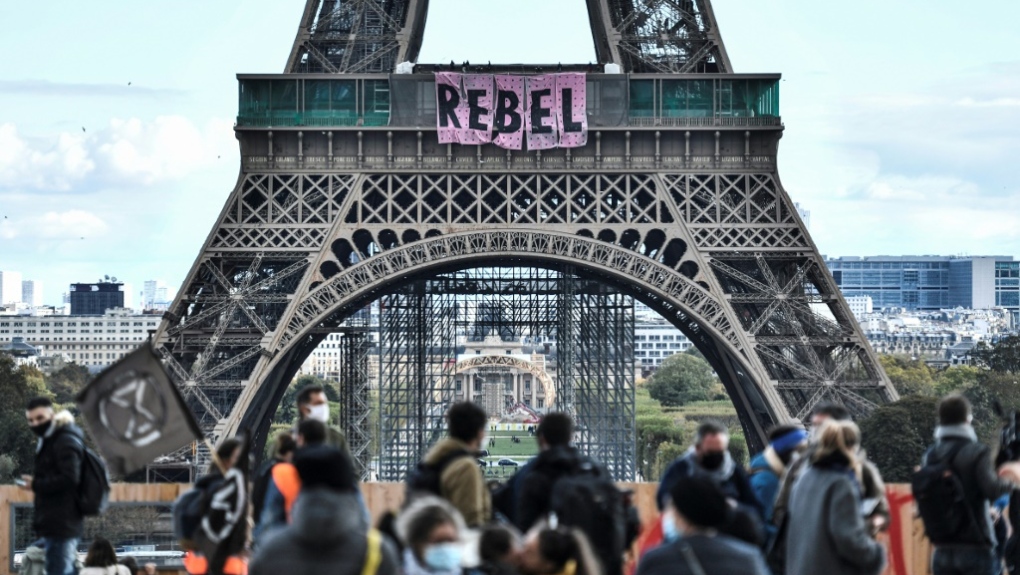
Extinction Rebellion
image source

Olafur Eliasson’s Icewatch (2014), while problematic (carbon footprint), is also understood with very little-to-no explanation. but for those who don’t have climate change on their mind, I’m assuming that some text, even just the title, would be necessary for them to know the significance of the work. Photo source.

Again, these are very straightforward pieces to understand — a quality that I’d like to emulate in my work going forward. As for whether I’ll incorporate ceramics into performance, I’m not sure yet.
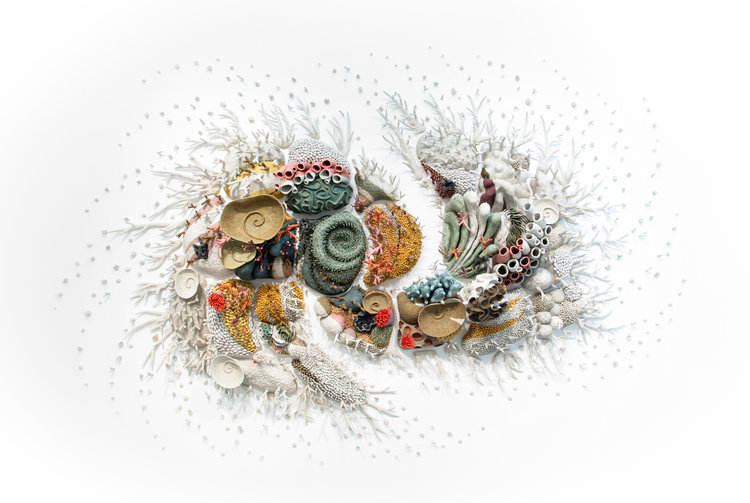
our changing seas IV

I can imagine ceramic installations on the subject of climate change, such as Courtney Mattison’s (written about in “5 Art Installations about Climate Change We Should Be Talking About”) more easily than I can imagine combining ceramics with performance on this subject, but I’m sure that’s just because I’m too exhausted right now to come up with any idea of what that could really be. Photo source.

All in all, this is a great question, David, and likely one that I’ll be considering for a long time.

Rob Truszkowski’s question:

I think you’ve started to address this…. it may possibly be on the minds of others. Is art the best way to reach a wider audience? How do you know?

This is an excellent question and one I’ve been thinking about for a while. I’ve asked myself if I should quit spending time doing art and devote all I’ve got to hardcore activism. If I had more time on my hands, I’d get things moving with Extinction Rebellion in Saskatchewan. (I’m one of a handful of people trying to do this, but there just isn’t the people-power at the moment to get it anywhere right now). Or perhaps I should become a politician? The founder of EnviroCollective just became a city Councilor because she believes this is the best way to make the most change one person can make.

So why devote so much time to building myself up as an artist? I have two parts to this answer. The first is simple: I enjoy making art, and I think I am good at it (or getting there at least). As I told the Grad Committee at my review, I especially miss making stuff. I don’t want to give that part of my life up.

My second answer is that art can be an effective form of activism. Throughout this semester, I’ve been gathering websites of organizations and artists who use art for activist purposes. I’ve come across the terms “artivist” and “craftivism.” I see this marriage of art + activism as not only a way for me to continue producing art, but also a way for me to affect some positive change in the world.

I’ve learned this semester that that the latter point is controversial. David asked me what my goal is with my art. Looking at my notes from my Group Studio class on October 23rd, I see he put it something like this: “If your goal is to fix climate change, you’ll fail.” He told me that art is futile at achieving a goal (example: reducing climate change). Instead, my goal should be participation (if I’m undertaking participatory art). I know, however, that others disagree (nothing new there). For instance, there is an organization called The Center for Artistic Activism:

The Center for Artistic Activism trains and advises organizations, artists and activists to help them increase the efficacy and affecacy of their artistic activism. We conduct innovative research to figure out what exactly efficacy and affecacy mean when it comes to artistic activist projects. And we share our trainings and research findings broadly, to provide the broadest possible access.

source: “What We Do” page

On their homepage, they list nine reasons “why artistic activism.” These are:

  1. Artistic activism mobilizes affect and effect
  2. Artistic activism thrives in the contemporary landscape
  3. Artistic activism has been used throughout history
  4. Artistic activism creates openings
  5. Artistic activism is accessible
  6. Artistic activism stimulates a culture of creativity
  7. Artistic activism energizes people and organizations
  8. Artistic activism is about the long game
  9. Artistic activism is peaceful and persuasive

I see value in these reasons they give for why art can be an effective form of activism. I understand that this doesn’t automatically mean that activism can be art or that all “artivism” is good art, but that’s an entirely different point.

Another group I’ve discovered is Artists and Climate Change. Their “about” page begins with this paragraph that sums up what I’ve been feeling is the reason why art should — must — be involved in the fight for greater climate change action:

In 2005, in an article titled “What the Warming World Needs Now Is Art, Sweet Art,” 350.org founder Bill McKibben wrote that although we knew about climate change, we didn’t really know about it; it wasn’t part of the culture yet. “Where are the books? The plays? The goddamn operas?” he asked. An intellectual understanding of the scientific facts was not enough – if we wanted to move forward and effect meaningful change, we needed to engage the other side of our brains. We needed to approach the problem with our imagination. And the people best suited to help us do that, he believed, were the artists.

source: “About” page

A group I’ve admired since I discovered them about a year ago is Project Pressure. I LOVE this group. It’s a non-profit designed specifically to support artists whose work represents or responds to melting glaciers. I’ve quoted from their “about” page in past presentations I’ve given:

Project Pressure is a charity with a mission to visualize the climate crisis. We use art as a positive touch-point to inspire action and behavioural change. Unlike wildfires and flooding, glaciers are not part of the weather system and when looking at glacier mass loss over time, one can see the result of global heating. This makes glaciers key indicators of the climate crisis and the focus of our work.

source: “about” page

There are so many other organizations I could list here, but the above three should suffice to show that there are certainly people out there who believe that art is an essential tool in the climate change action-inspiring toolkit. On top of such organizations are the many artists whose work is on this subject, of course. I’ve created a long list of artists whose statements or other writing on this topic I could quote here. I’ll just pick two.

I remember reading a New York Times article in the summer of 2019 (thanks, Mike) about the work of David Opdyke. The title of the paper edition, which I have up in my studio, was “Feeling Dismal? Do Something.” In it, Lawrence Weschler writes, quoting Opdyke:

“For years I’ve been feeling the need to do something about the dismal future into which we all seem to be sleepwalking. And yet,” he paused before continuing, “I’m constantly haunted by worry. Can such artistic gestures ever really make any difference, especially given the sheer scale of the challenge?” Reminded of Auden’s line to the effect that “Art makes nothing happen,” Mr. Opdyke seemed to rally, countering, “Yeah, but Eudora Welty says that ‘Making reality real is art’s responsibility,’ and maybe that’s what most needs doing now: making the stakes involved in our current crisis real and tangibly visible for people. One ends up hoping that pieces like this might propel the urgent changes in vision, one person at a time, necessary to provoke an appropriate mass response.”

source

In “Ice, Art, and Being Human” (2015), Olafur Eliasson writes about the potential of art:

All of us know the experience of being moved by a piece of music, a book, or a painting. Such works of art serve as an impulse that leaves its mark on us. Experiencing art is not a matter of learning something new; rather, it allows us to discover something in us with which we suddenly identify, and through the connection we establish, we are better able to express who we are.

source

I believe in this, and my guess is that nearly all artists do. In our Group Studio course on September 18th, David said (quoting directly): “most art makes us see things we already know in a new way.” Perhaps, then, he does see the potential for using art as a form of activism? I’m not sure. I’d also like to ask Rob more about his opinion on this subject.

In addition to these organizations and artists who view art as an effective means of activism, I’m also aware of a growing body of theory and criticism on this type of work, such as:

  • “Climate Change and Visual Imagery” (2014) by Saffron J. O’Neill and Nicholas Smith
  • “Climate Change and the Imagination” (2011) by Kathryn Yusoff and Jennifer Gabrys.
  • “Representing, Performing and Mitigating Climate Change in Contemporary Art Practice” (2012) by Gabriella Giannachi

Just to list three articles.

There are also, of course, entire classes being taught on the psychology of climate change (I never did have a chance to speak with Dr. Katherine Arbuthnott this past term… perhaps in the next). There are so many resources out there for one such as my self who wants to know how to “use” art (but still actual art) to help with this cause, that I’ve just barely skimmed the tip of the iceberg.

Rob’s follow up comment:

I’m thinking through… is there a middle path? Is that a path you even want? Swing hard to activism that uses art/activism that uses art, to all the way to the other side — solitary practice, make things, that personal connection. Is there a middle path, or is that what you want? Not asking you for an answer. It’s just really clear, even in how you’re articulating what you’ve been doing and even what you want to do… it’s an ongoing struggle and one you’re going to have to contend with. I look forward to seeing the answer to this question in another semester from now.

That’s another great question/point, Rob. Actually, it’s the basis for the question I asked the committee myself: Is it feasible to become good at using two different media/approaches to art-making in a MFA program? Should I attempt to use more than one medium (ceramics and performance for now, perhaps others later) because I feel that it’s necessary to engage in different practices for different but equally necessary purposes (nourishing myself; spreading the word to as many people as possible)? I hope I’ll have an answer to this question soon — at least an answer that is sufficient to see me through this program, as I’m sure you’re right that it’s a question I’ll be asking for a very long time.

Larissa Tiggelers’ question:

You’ve talked about failure. Can failure itself be a subject for you? Rather than the question of escaping failure or if failure can be generative beyond creating more questions. Can failure be generative?

A very interesting question, Larissa. I answered during the review that I’ve thought about failure this semester, and that’s true — I’ve thought about the failure of my performances, but also about our collective failure to address climate change when we needed to (at least 50 years ago) or sufficiently in more recent time (and even now… we continue to fail). However, I hadn’t actually thought about making failure the explicit subject of my work. I think Stein Henningsen is also considering this subject when he attempts to create a glacier by bringing pieces of ice that have broken off of one back to their source (How to Build a Glacier (2014)). Thank you for the question — I’m going to hold onto it.

Holly Fay’s question:

I’m wondering if some of this is the need to give yourself permission to be an artist that is interested in making art.

As I said in the review, Holly, this is a very loaded question. The short answer is: yes. I’m someone who was raised to take care of others: I took care of my severely mentally ill mother in what was supposed to be my childhood. I still like to take care of people, and perhaps my environmentalism is connected to that impulse. Therefore, doing something just “for me” (throwing pots in this case) would go against that impulse. On top of that is the fact that I am sincerely very concerned about the state of our planet. Actually, I’m sickened by the situation. If I can make even a tiny move (“one inch”) towards changing it for the better, I’d rather do that than do nothing. The question is, how to be effective but also sustain myself at the same? Believing that I’m “doing good” may give me a boost (I don’t believe in altruism), but it’s frankly not nearly enough to make up for how terrible I feel about our environmental destruction, and facing that topic with all my energy is as exhausting emotionally as jumping hurdles is physically.

Sherry Farrell-Racette’s question:

A couple of things. One is I don’t think it’s a binary, not a question of two opposites that you need to choose or even that there’s a middle ground. You are a whole person and you have these expressions. When I was looking at performance art… as art maybe it wasn’t awesome, but as a performative action they were really interesting. The labels are important. I would encourage you to think about… I’m a beader… right? and being an activist… being an aware of the grim facts environmentalist in this moment … is very similar to being an Indigenous woman in this moment… it’s hard to hold onto hope. It’s hard to find the path hang onto hope… when we look backward we look to our ancestors… For me, making, is the way we put ourselves back together. It’s not one or the other. If this is how you are in the world… If you look at your making… it’s the way you put yourself back together. These things are related. When you showed inspiration photos… that communicates how you want to honour the earth. This is as important as attending a million meetings… if you can create an enhanced awareness… It’s like Georgia O’Keefe. I don’t see the split or it’s a choice. You are a whole person and this is how you are in the world…. I’d like to see you move forward. Don’t see making as “making.” Maybe making is what you need to do now. But you’ll never stop being environmentally concerned. It’s a cycle of creativity… out into the world, back into the clay, into the world, back to the clay.

We also have to look after ourselves. Throwing ourselves against the glass wall. Just move things over an inch. Think of different ways of doing it. Don’t underestimate the power of art to introduce ideas. It is often subtle and takes a long time. But I encourage you.

Wow. I was blown away by this feedback. I don’t know how to respond it it more than I did in the moment by saying that I agree we are complicated, and the situation (climate change) is complicated, so therefore neither can my response to it be simple.

More than anything, I felt a tremendous honour to be spoken to in this way, as though I really am an artist. When you said that we can’t constantly be “throwing ourselves against the glass wall,” I couldn’t really believe that you and I are in the same category as I’m still not able to consider myself an artist (not even close), but I definitely did feel encouraged. Thank you, Sherry.

Ruth Chamber’s comment:

Remember how long it took you to throw pots? If you put that time into performance, they will get better. I wouldn’t write off performance. I would draw that analogy between how long it took you to gain that skill…. That is also tied to your pairing with the material….. performance idea. The performance ideas are going to be as hard to arrive at without a lot of work. I just wanted to point that out. Not a question.

As I said in reply, (quoting Raegan’s notes of what I said), I don’t understand how you become good at performance… I feel like I could have a great idea that hits the mark, or I could have many ideas come to me that are not so great. Should I carry out those ideas? Is it like clay that you learn from doing… or is it futile to do so?

David’s follow-up comment:

Ruth has it exactly right. You have to do 500 performances to get as good as 500 pots. The idea is not the thing, its only part of the thing. I have pop song ideas…. Lol… However, you already have a strength you’ve worked up. You can parle that over. For instance, you could walk all the way to clay banks and you could come up with a solar kiln that doesn’t work… you can replace friends’ plastic with ceramics. That’s a life practice. It is not about the practice, it is a practice doomed to failure. It’s an enduring thought. Every artwork is failed project! The notion of modern art being failed projects… Climate change is the subject of your practice, not the point of practice. Blow yourself up if you want attention. That is not the subject of art. It’s just a possibility of art. If so, make it the documentation.

Your practice begins with ceramics. You have the therapeutic, you have the conceptual practice… It was never finished. It has extended life. It’s a performative object: it’s fragility; its domed failure. It was good conceptual art but bad pottery. Paul Mathieu was on about that. How to make something eloquent and also deconstruct at same time.

A robust practice here. You can separate them into good performance art and good activism and good pottery but by setting a task to bring together with different forms (object/performance/writing/broadcasting) it can be more holistic. It can be a more elegant problem to solve. The lead of the crafting is so important. Skill is important. And notion that skill is important. You can’t just go in with a good idea.

The truth is, David, I don’t really understand what you mean by saying that “every artwork is a failed project.” I’ve heard you all term nudging me to continue with ceramics as I’ve already developed some skill in that area (the soup kitchen analogy…). I think what you’re saying is that I need to have that same level of skill for each approach I take in my work, but also that I should see all of these approaches as one holistic practice. That’s all that I can get from this… and I hope to have the chance to speak with you more to better understand what you were saying.

Sean Whalley’s comment:

The most important thing is there is a real disconnect between your expectations, what you believe your art practice to be and the outcomes… These need to come together in a holistic way. Maybe the trips come in to the practice? Being in the space could be your practice. You have to acknowledge that that is enough. Living in a way that resists what you are raging against…. is an act in itself. All of those things are acts. You can’t separate those things out. You keep wanting to separate those things out.

Pick something that you really want to focus on. Ex. Another type of performance piece. You could try to cut Wascana park with scissors. Polluters… lawnmowers. Maybe you need an objective to focus on.

As Sherry said, the best ways to garner attention is to get attention. If you become the best at something, you can advocate for it. Don’t re-invent your practice or your thinking. Really big challenge.

A very good bit of wisdom, Sean. I think there are parts of what you’ve said that I don’t fully understand. I think that in some way at least your point is similar to David’s — to understand myself and my practice as interwoven and holistic. I would love to get the chance to speak with you some day in the near future. Regarding the disconnect between my expectations and my outcomes… I know. I have much to work ahead of me.

Risa Horowitz’s question:

We’ve been working very closely together. We began conversations in summer. You your original studies had nothing to do with art…. did the Post Bac on ceramics, and where you go to after House on Fire was — I can’t extract more from earth for art. I put a strategic challenge to you which was, well, what if you didn’t? You hadn’t thought about performance before that. I challenged you to try something immaterial, and you rolled with it with courage and rigor/vigor. no one has said, why are you don’t performance. Question – do you have regrets trying these immaterial practices?

How could I (MUFFLED)

Strategic challenge: to try something that was immaterial. You did it with courage… So, you’ll notice no one has said why are you doing performance?


My answer, which I hope you predicted, Risa, is “no.” I don’t regret trying performance.

Reading: “Object Theory” by Paul Mathieu

Quotations from: Mathieu, Paul. “Object Theory.” In The Ceramics Reader, edited by Andrew Livingstone & Kevin Petrie, 268-76. London: Bloomsbury, 2017.

Object making is probably the oldest making activity of humankind and we can speculate that it preceded the development of language and the making of images. (268)

Yet the history of art is still largely the history of images, of things that are visually experienced, or visual art. Objects are quite simply ignored. (268)

An image, in the narrow yet specific definition I am using here, is a cultural (as opposed to natural) phenomenon experienced through sight alone, visually. A painting is an image, a photograph is an image, a sculpture is also an image, a tridimensional image but an image nonetheless. (269)

In the world of material/visual culture (all those things humans do to nature), there is another category of things that are not experienced solely through sight, visually, and which do not necessarily necessitate language either, but which require other senses, primarily but not exclusively touch, for a complete experience and full understanding. These things are what I call here “objects.” (169)

If there is a remaining place where ignorance, prejudice, discrimination, segregation and censorship still exist within the experience of art, it is specifically where handmade objects are concerned, and although this is slowly changing but there is still a significant way to go for parity. (269)

This visual experience is one of distanciation, of removal, of separation. Sight establishes difference as rupture, as an oppression. This is even more truth within representation. (270)

Objects are of two main types: TOOLS, which are active (the conceptual aspect of tools is function) and CONTAINERS, which are receptive (the conceptual aspect of containers is containment; that is to say, they establish a transition between interior and exterior, but it is important to keep in mind that this transition does not imply an opposition but a continuity). (270)

What is the main characteristic shared by all objects (with the exception of those objects which are primarily tools) in whatever form they take, independent of materials, of the process, tools, equipment and technologies used in their making, or even when and by whom they where [sic] made? My answer is that at the CONCEPTUAL level, all objects are CONTAINERS. They are articulated around the transition between exterior and interior. Containment has to do with the relationship between the object and its environment. Containment bridges an object with its environment. (270-71)

Objects are always inherently material, inherently abstract and inherently conceptual and these three aspects are equally important and thus, they resist hierarchisation conceptually, beyond market value and consumerism. Of all material practices, ceramics is the most intimately informed by this theoretical and conceptual framework, in its conflation of a volumetric form with a distinct surface. (271)

Here again ceramics is particularly sensitive to this relation to time, in its amazing permanency as possibly the best archival material ever devised, as the memory of humankind. (274)

Handmade objects contest the contemporary and void the apparent cultural consensus. In handmade objects we find the last traces of what we use to call “work” (beyond agriculture, yet for reasons as vital as producing food) and the last place where effort in use still exists, non-mechanical and non-mediated. And the last place where contestation and subversion is still possible in the cultural sphere. To make an object by hand is a profoundly political act. (275)

[Objects] imply a complexity that exists beyond language and beyond theory, this beyond the reach of those who are confined by language and by theory. Images are complicated, they need to be explained, to be fictionalized and they are thus the privileged domain of theory. Objects are much less complicated but much more complex. And this complexity resists language and resists theory. Yet a theory of objects, and object theory remains essential if we are to reexamine and reevaluate , reassess and reposition the important role played by objects within culture. (275)

Reading: “Craftivism: Reevaluating the Links Between Craft and Social Activism”

Quotations from: Burisch, Nicole. “Craftivism: Reevaluating the Links Between Craft and Social Activism” In Contemporary Ceramics Practice, edited by Ruth Chambers, Amy Gogarty & Mireille Perron, 155-172. Vancouver: Ronsdale Press, 2008.

Recent writing about craft theory and history includes references to historical connections between craft and social justice issues, suggesting ways in which contemporary craft practices can continued to be considered this way. (156)

The growing number of people using the term “craftivism” also suggests that it is time to consider what this new movement might mean for contemporary craft practices as well as its effectiveness as an activist strategy. (156)

[…] craftivism has encouraged something of a democratization of craft, creating a situation in which anyone can participate and in which distinctions between “high” and “low” craft are purposely subverted or ignored. (157)

I have chosen to take the most inclusive view possible of what constitutes activism. Calgary activist Grand Neufeld suggests that activism can take place in many different forms and can also involve many small actions. […]: “someone who encourages their neighbor not to put pesticides on their lawn is an activist, someone who calls up their city councilor and says they would rather see more money go to bicycle paths than to roads, their an activist. People doing what they’re able to do … buying local, fair-traded objects, voting with your dollars, slowing down” (Neufeld Interview). (158)

William Morris wrote extensively about the conditions of workers and the rights of all people to have “work to do which shall be worth doing, and be of itself pleasant to do; and which should be done under such conditions as would make it neither over-wearisome nor over-anxious” (Morris “Art and Socialism). (159)

By practicing craft, people could work outside the dehumanizing effects of factory labour […]. Hand-crafted objects and those who make them could thus be seen as opposing machine-made goods and the factories that produced them. In this model, fine craft objects and an important symbolic role: they represent the possibility of work that is not “over-wearisome,” that is creative and fulfilling and nothing like the drudgery of working in factories. (159)

This symbolic view of craft, though significant, has little to offer in the way of actual tools or strategies for how to use craft practices to remedy problems of the factory system. (159)

Notes the example of Gandhi “using spinning as a way to protest British control over the Indian textiles economy at the turn of the twentieth century.” (160)

[…] craft’s suitability as a tool for opposing and critiquing the dominant capitalist/consumerist model. (161)

[…] it is perhaps more useful to think of the voting-with-your dollars strategy as one possible component of an activist approach, and to acknowledge the enormous significance of proactive hands-on involvement with other political or humanitarian actions. (163)

Alternatively, reducing overall consumption and waste by investing in high-quality reusable goods — using a ceramic mug instead of Styrofoam, for example — is both cost-effective and sustainable. (163)

The idea of voting-though-spending places the power — and the responsibility — with the consumer. Although it involves the participation of the crafts producers, it does so indirectly, and it still does not answer the question of how craft producers themselves can respond to issues of responsible/conspicuous consuming. (163)

Lisa Barry: “Random Acts of Pottery” (163-64)

While Barry sees these muggings as an excellent opportunity to introduce people to the aesthetic merits of handmade objects, they also represent a way of subverting the values of the current consumption model […]. (164)

The face-to-face interactions created through these muggings provide a space for dialogue and education. Barry has found a powerful tool with these muggings, a form of ceramics-activism that positions her mugs to address issues ranging from over-consumption to ecologically sustainable products to ways we value objects. (164)

One important question that remains about viewing ceramics through the lens of activism is the ecological impact of making things in this way. Granted, reusing a ceramic mug is a far better choice than using Styrofoam, but what are the ecological costs associated with mining clay and glaze ingredients, using gas to fire kilns and using water as it is often used? (165)

Regardless of whether ceramics is to be included as an activist activity, ceramics — and all craft producers — must consider how their materials are obtained and processed and the cumulative impact of their studio practices. (165)

Although I do not have the space to address the issue fully here, there is undoubtedly a need for further investigation of the ecological impacts and concerns of working with clay.

Mary Ann!

Robert Lyon — “mixes dextrine, a starch derivative adhesive, into his clay so that he does not have to fire his pieces (Joiner 31). His work addresses issues of recycling and natural processes, and he aims through his work “to foster an awareness” of ecological concerns (Joiner 32). (165)

About an ethical consideration of “fine craft”: “There is a great discrepancy between the economic and cultural value of a basket made by a craftsperson in the West functioning within an arts marketplace and a basket from an anonymous maker in the developing world (equally labour intensive) purchased for a few dollars at a dollar store or local market” (40). *Ingrid Bachmann — “New Craft Paradigms.” (166)

Although Matt Nolen uses traditional ceramic forms, the surfaces of these forms are covered with images addressing various political and social issues from credit card debt to depletion of the ozone layer. (167)

[…] Canadian First Nations artist Judy Chartrand, whose ceramic lard pails and spray cans reference stereotypes in advertising and labelling in order to critique the portrayal and treatment of Native Americans. (167)

[…] Adelaide Paul‘s mixed-media ceramic works subtly question how we treat and view animals […] (167)

I would suggest that the use of ceramics as a vehicle for analyzing, discussing, critiquing and subverting particular social issues by certain artists qualifies them as activists in the broad sense of the word. The emphasis in their work in terms of activism, however, is less on the materials of their craft and more on the messages they communicate. (168)

While some fine crafters engage in craftivism through the content of their work, many activist crafters focus instead on how their work is deployed. (168)

These creative approaches can bring an element of fun and theatre into what often ends up being “quasi-militaristic marches culminating in placard waving outside locked government buildings” (Klein Fences, 125) (168) *Klein, Naomi. Fences and Windows: Dispatches from the Front Lines of the Globalization Debate. New York: Picador, 2002.

Grant Neufeld points out that when he is knitting, and people approach him to ask him what he is doing, he is able to initiate dialogue about activist issues outside of a protest context. (168)

Parallel’s Eve S. Mosher’s statement about Highwaterline.

Many of these textile-based craftivists rely on the suitability of their particular material or process to help promote their cause. Textile work seems to be one of the most easily transportable, affordable, teachable and accessible forms of craft to use for public protests, teach-ins and discussion groups. I have yet to encounter any examples of ceramics being used in a similar way, although I would not dismiss the possibility. (169)

Clay has been used to subversive ends in Lost in the Supermarket project. […] to recreate in clay various standard supermarket items like bottles of dish soap and cans of dog food. The asymmetrical and distorted recreations were snuck back onto the shelves of the store. (169) […] Possibly, they prompt a moment of shock or surprise or an increased awareness of the packaging, marketing and production of these commodities. (170)

Reading: Introduction to Utopic Impulses: Contemporary Ceramics Practices

Introduction to Utopic Impulses: Contemporary Ceramics Practice, edited by Ruth Chambers, Amy Gogarty & Mireille Perron, ix-xiv. Vancouver: Ronsdale Press, 2008.

The spirit of this anthology derives from the editors’ shared belief that craft practices — in this case, ceramics — contribute to the development, support and diffusion of speculative models and creative endeavors that envision a better world. By framing particular ceramic practices as “utopic impulses,” we hope to foster new and stimulating conceptions of their contribution to the social and political fabric of their time. (ix)

Example of Cedric Price’s proposed project, “The potteries Thinkbelt” (1964-65) — “converting the declining English Potteries into a comprehensive, high-tech hands-on think tank, a visionary model for learning, living and working in a post-industrial society.” (x)

Medalta is another example of a socially conscious pottery project: “It similarly recycles and redeploys the apparatus of a bygone industrial era, making it available to the public […].” (xi)

The renowned cultural critic and theorist Peter Dormer (1949-1996) argued passionately for the value of craft practice as a living archive of tacit knowledge. Dormer distinguished tacit knowledge, acquired through the hands-on experience of doing things, from explicit knowledge, which allows one to talk and write about those things (147). *Dormer, Peter, ed. The Culture of Craft: Status and Future. Manchester: Manchester University Press, 1997.

The French curator Nicholas Bourriaud argues that all works of art produce “models of sociability.” Those works exhibiting relational aesthetics invite viewers to dialogue with the work in order to “learn to inhabit the world in a better way (13).* While encouraging participation, a number of these essays and projects advance pressing agendas and political perspectives, challenging stereotypeical notions that craft should comfort or placate. (xiii) * Relational Aesthetics 1998.

Quoting Claire Bishop: “[…] without the concept of utopia there is no possibility of a radical imaginary (66). (xiii)

The essays and projects in Utopic Impulses participate in a wider critique of aesthetic, political, ethical and social impulses worldwide. Echoing Jacques Ranciere, they call for new forms of participation and spectatorship modelled on viewers who are active interpreters, who “link what they see with what they have seen and told, done and dreamt.” Ranciere calls for “spectators who are active as interpreters, who try to invent their own translation in order to appropriate the story for themselves and make their own story out of it.” *Ranciere: “The Emancipated Spectator.” Keynote address, 5th International Summer Academy, Frankfurt, 20 August 2004. Online. 30 March 2007. http://www.v2v.cc/node/75 [page not found]

Note: I can’t believe I found a book on ceramics that brings in Bourriaud, Bishop, and Ranciere. Obviously, their ideas need not only apply to “participatory art” practices…

Reading: “Metamorphosis: The Culture of Ceramics”

Quotations from: Margetts, Martina. “Metamorphosis: The Culture of Ceramics.” In The Ceramics Reader, edited by Andrew Livingstone & Kevin Petrie, 215-17. London: Bloomsbury, 2017.

The choice of materials and techniques, fusing exposed elements with covert messages, has poetically reconnected art to nature, inviting a metaphysical rather than a literal response.  (217)

Human aspirations and nature can be related to alchemy, to the notion of transforming nature’s prosaic elements and our prosaic selves into a condition of harmony and fulfillment: in this respect, the choice by these artists to use clay is especially appropriate, since it, too, involves the transformation of raw earth through fire into special things of permanence. (217)

The unique versitiality of the material, which is able to interpret a great range of styles and ideas whilst retaining its own intimate identity, imbues ceramic works with a particular resonance through time. (217)

Reading: Brad Evan Taylor’s “Environment, Art, Ceramics, and Site Specificity”

Quotations from: Evan, Brad. “Environment, Art, Ceramics, and Site Specificity.” In The Ceramics Reader, edited by Andrew Livingstone & Kevin Petrie, 512-16. London: Bloomsbury, 2017.

Works which incorporate environment and site specificity have additional tools to inspire thought and emotion about connectivity.  (513)

Art, at least “good art” inspires contemplation, consideration, conversation, and sometimes debate. The intent is often to trigger thought or emotion which is not always explicable in rational, everyday language.  […] I hold the belief that the emotional transformation induced within a viewer, I am speaking about the inexplicable one, is the direct result of the artist’s ability to metasomatize [or transform] matter. The artist might be a painter, sculptor, or a ceramist. When an artist has the ability to seemingly transform matter in a magical way, the resulting art inherits some of this ability to communicate on an emotional level.  (513)

Ceramic materials have history as old as the earth. The rocks we use to make our work are bound to the history of the planet. (515)

Clay may very well turn out to be critical matter in the formation of life. It’s [sic] link to the history of life, and earth, and it’s [sic] natural ability to focus interaction on an atomic level, make it an idealistic choice for use in environmental works when one wishes to incorporate and utilize the intrinsic history of the material. Because of clay’s integral history, it has an ability to speak through eons. (515)

Reading: Claire Bishop’s Artificial Hells: Participatory Art and the Politics of Spectatorship

Quotations from: Bishop, Claire. Artificial Hells: Participatory Art and the Politics of Spectatorship. London: Verso, 2012.

This expanded field of post-studio practices currently goes under a variety of names: socially engaged art, community-based art, experimental communities, dialogic art, littoral art, interventionist art, participatory art, collaborative art, contextual art and (most recently) social practice. (1)

[…] to the extent that art always responds to its environment (even via negativa), what artist isn’t socially engaged? (1-2)

But regardless of the geographical location, the hallmark of an artistic orientation towards the social in the 1990s has been a shared set of desires to overturn the traditional relationship between the art object, the artist and the audience. To put it simply: the artist is conceived less as an individual producer of discrete objects than as a collaborator and producer of situations; the world of art as a finite, portable, commodifiable product is reconceived as an ongoing or long-term project with an unclear beginning or end; while the audience, previously conceived as a ‘viewer’ or ‘beholder’, is now repositioned as a co-producer or participant. (2)

“As the chapters that follow will make clear, these shifts are often more powerful as ideals than as actualised realities, but they all aim to place pressure on conventional modes of artistic production and consumption under capitalism.” (2)

From a Western European perspective, the social turn in contemporary art can be contextualised by two previous historical moments, both synonymous with political upheaval and movements for social change: the historic avant-garde in Europe circa 1917, and the so-called ‘neo’ avant-garde leading to 1968. The conspicuous resurgence of the participatory art in the 1990s leads me to posit the fall of communism in 1989 as a third point of transformation. Triangulated, these three dates form a narrative of the triumph, heroic last stand and collapse of a collectivist vision of society. Each phase has been accompanied by a utopian rethinking of art’s relationship to the social and of its political potential — manifested in a reconsideration of the ways in which art is produced, consumed and debated. (3)

Some of the key themes to emerge throughout these chapters are the tensions between quality and equality, singular and collective authorship, and the ongoing struggle to find artistic equivalents for political positions. (3)

One thing is clear: visual analyses fall short when confronted with the documentary material through which we are given to understand many of these practices. To grasp participatory art from images alone is almost impossible: casual photographs of people talking, eating, attending a workshop or screening or seminar tell us very little, almost nothing, about the concept and context of a given project. They rarely provide more than fragmentary evidence, and convey nothing of the affective dynamic that propels artists to make these projects and people to participate in them. (5)

Debord’s critique strikes to the heart of why participation is important as a project: it rehumanises a society rendered numb and fragmented by the repressive instrumentality of capitalist production. Given the market’s near total saturation of our image repertoire, so the argument goes, artistic practice can no longer revolve around the construction of objects to be consumed by a passive bystander. Instead, there must be an art of action, interfacing with reality, taking steps — however small — to repair the social bond. (11)

Instead of supplying the market with commodities, participatory art is perceived to channel art’s symbolic capital towards constructive social change. Given these avowed politics, and the commitment that mobilises this work, it is tempting to suggest that this art arguably forms what avant-guard we have today: artists devising social situations as a dematerialised, anti-market, politically engaged project to carry on the avant-garde call to make art a more vital part of life. […] While sympathetic to the latter ambition, I would argue that it is also crucial to discuss, analyse and compare this work critically as art, since this is the institutional field in which it is endorsed and disseminated, even while the category of art remains a persistent exclusion in debates about such projects. (13)

From I. Creativity and Cultural Policy

What emerges here is a problematic blurring of art and creativity: two overlapping terms that not only have different demographic connotations but also distinct discourses concerning their complexity, instrumentalisation and accessibility. (16)

Artists and works of art can operate in a space of antagonism or negation vis-a-vis society, a tension that the ideological discourse of creativity reduces to a unified context and instrumentalises for more efficacious profiteering. (16)

From II The Ethical Turn

All of this is not to denigrate participatory art and its supporters, but to draw attention to a series of critical operations in which the difficulty of describing the artistic value of participatory projects is resolved by resorting to ethical criteria. (19)

This emphasis on process over product — or, perhaps more accurately, on process as product — is justified on the straightforward basis of inverting capitalism’s predilection for the contrary. (19)

(On curator Maria Lind‘s judgement of Thomas Hirschhorn‘s and Oda Projesi‘s work) The visual, conceptual and experiential accomplishments of the respective projects are sidelined in favour of a judgement on the artists’ relationship with their collaborators. […] Hirschhorn’s (purportedly) exploitative relationship is compared negatively to Oda Projesi’s inclusive generosity. In other words, Lind downplays what might be interesting in Oda Projesi’s work as art — the achievements of making social dialogue as medium, the significance of dematerialising a work of art into social process, or the specific affective intensity of social exchange triggered by these neighbourhood experiences. Instead her criticism is dominated by ethical judgements on working procedures and intentionality. (22)

In Conversation Pieces, Grant Kester argues that consultative and ‘dialogic’ art necessitates a shift in our understanding of what art is — away from the visual and sensory (which are individual experiences) and towards ‘discursive exchange and negotiation’. (23)

At the centre of opposition to this trend have been the philosophers Alain Badiou, Jacques Ranciere and Slavoj Zizek who, in different ways, remain sceptical of the jargon of human rights and idenitarian politics. […] In insisting upon consensual dialogue, sensitivity to difference risks becoming a new kind of repressive norm — one in which artistic strategies of disruption, intervention or over-identification are immediately ruled out as ‘unethical’ because all forms of authorship are equated with authority and indicted as totalising. (25) — the politically correct.

Kester criticises Dada and Surrealism for seeking to ‘shock’ viewers into being more sensitive and receptive to the world — because for him, this position turns the artist into a privileged bearer of insights, patronisingly informing audiences as to ‘how things really are’. He also attacks post-structuralism for promulgating the idea that it is sufficient for art to reveal social conditions, rather than to change them. (26)

From III. The Aesthetic Regime

[…] a tension and a confusion between autonomy (the desire for art to be at one remove from means-ends relationships) and heteronomy (that is, the blurring of art and life). (27)

The aesthetic regime of art, as inaugurated by Schiller and the Romantics, is therefore premised on the paradox that ‘art is art to the extent that it is something else than art’: that it is a sphere both at one remove from politics and yet always already political because it contains the promise of a better world. (27)

(to be continued)

Reading: “Representing, Performing and Mitigating Climate Change in Contemporary Art Practice”

Quotations from: Giannachi, Gabriella. “Representing, Performing and Mitigating Climate Change in Contemporary Art Practice.” Leonardo (Oxford) 45, no. 2 (2012): 124-31.

This is a great article for me to read and return to later to consider. It introduces several artists and projects I should know about as well as a summary of a few approaches to responding to climate change in art.

While artists have dealt with the growing realization that our climate is changing in different ways, it is noticeable that, among the types of works analyzed in this article, artists have tended to adopt one or more of three strategies:

1. Representations – emphasizing visualization and communication

2. Performance environments – emphasizing immersion and experience

3. Interventions – emphasizing mitigation and behavioral change. (125)

I propose here that each of these strategies has so far led to important and efficacious works and that each of them is of aesthetic, social and political value. (125)

Cape Farewell, an organization aiming to communicate the realities of climate change within the artistic and educational contexts, tends to generate work belonging to the first category, although, as an organization, it also operates through the other two categories. Its primary objective is the communication of climate change through art (hence the title of their world-touring exhibition Art and Climate Change [2006]), which they achieve by organizing expeditions (emphasizing experience) (Fig. 1) intended to encourage interdisciplinary debate on climate change and to affect artists so that they may create inspiring work on this topic (emphasizing behavioral change). The organization states as its mission “to develop the production of art founded in scientific research,” “by exposing artists to the world’s climate tipping points” and incorporating scientific collaboration into artistic practice. (125)

Among the most interesting works generated through Cape Farewell was Antony Gormley’s Marker 1 (2005), an imposing ice statue with human contours, which brought together in one image the causes and effects of climate change [10]. The statue, which stood on the frozen sea of the Qord until it melted the following spring, was finally reclaimed by the sea. (125)

David Buckland’s video Sinking Ice (2004), showing the top of an iceberg hanging precariously over the ocean and finally sinking into it. The video, playing on the notion of the sublime, was watched, according to Julian Knebusch, for over 40 minutes by a number of visitors to the Cape Farewell touring exhibition, almost as if they were waiting for the accident and the catharsis it offered to the tragedy of climate change – to happen (2008). (125-26)

[…] German art collective artcircolo. The group, consisting of artists, technologists, curators and scientists, has worked for a number of years specifically on the theme of water, developing transdisciplinary research, talks involving the general public, commercial products and artwork. (126)

Participants in events curated by artcircolo are often encouraged to consider their behavior and to imagine change. This was particularly noticeable in work developed as part of their collaboration with Dutch artist Wapke Feenstra, who often transforms spectators into participants by asking them to reflect about local histories in an attempt to tie particular environments to the socioeconomic conditions that generated them. (126)

Other examples of works curated by artcircolo are German sound artist Kalle Laar’s Calling the Glacier (2007) (Fig. 5), an interactive installation that allowed people who dialed a given telephone number to listen live to the sound of a melting glacier, and Icelandic artist Rúrí’s gigantic video projections showing waterfalls in Iceland, such as Tortimi/Fall – Passage (2009), in which a metal framework supports a very long photograph of a waterfall on a roll, the end of which continually disappears into a machine to symbolize how waterfalls are vanishing from the Icelandic landscape. (127)

As is typical for artists curated by artcircolo, both Laar and Rúrí’s works focus on water, and both attempt to sonify and visualize the unfolding of environmental catastrophe. Laar’s work, which broadcasts a live phenomenon succeeds in bringing a remote occurrence close by, thus also dealing with one of the biggest difficulties in climate change communication: the rendering of something occurring over time, often in remote environments, to diverse and distributed audiences. (127)

YES — see Rob Nixon Slow Violence

Other examples of artworks belonging to the first category – art that facilitates communication on climate change – include dystopian works, often using shock, such as Petko Dourmana’s Post Global Warming Survival Kit (2008). (127)

[…] Chris Bodle ‘s The Watermarks Project (2009), a public art project visualizing the effects of climate change on the British coastline through a series of large- scale “flood marks” showing potential future high-water levels projected onto the facades of buildings across Bristol.

I’m confused: Eve S. Mosher’s Highwaterline project in Bristol did the same thing, basically.

While all these works variously engage the public in what climate change may mean to different communities around the globe, often utilizing icons of climate change in shocking ways, they tend to be grounded in representation and privilege visualization over a haptic, multi-sensory and performative experience. (127)

Examples of work belonging to the second category – art facilitating the experience of climate change – are numerous and often adopt performance strategies, as we have seen with artcircolo and Cape Farewell, to generate immersive environments, so that climate change may be experienced directly as well as analyzed. (128)

Andrea Polli ‘s powerful Sonic Antarctica project (2007-) (Article Frontispiece), a radio broadcast, live performance and sound and visual installation featuring recordings of the Antarctic soundscape made during Polli ‘s 7-week National Science Foundation residency in Antarctica. (128)

Crucially, Polli draws attention to one of the most important aspects of interdisciplinary work addressing climate change, namely, the translational work involved in presenting data to the public within an artistic context. (128)

Polli has been able to generate evocative and compelling works that operate as representations – effectively communicating climate change by translating dataas well as events, since the sonifications are reconstituted as performances and installations that allow for an immersive, multi-sensory experience. (128)

The third strategy entails works that encourage behavioral change. While all art may generate some level of change, these works operate by producing change in a particular community as part of the work (128).

(About Sustainable Bandung) This hybrid work entailed research, community work, the development of a new ecology and an artwork, operating ecologically, environmentally and aesthetically to effect change. (129)

(About a project by architect Uzman Haque) Among their numerous important projects is Natural Fuse (2008-), which “harnesses the carbon-sinking capabilities of plants to create a city-wide network of electronically assisted plants that act both as energy providers and as shared ‘carbon sink.'” (129)

As noted by Bruno Latour, contemporary environmental problems are “hybrid” and involve both nature and culture [20] . Culture therefore is not only a means to represent, perform and understand nature but also a way of changing nature. Likewise, nature is a fundamental axis for cultural change. A change in nature is a change in culture. (129)

To understand what this means more precisely, I return to Ingold and his definition of nature. For him nature is not opposed to landscape – although it is not the same either – and neither is it space, but rather “it is the world as it is known to those that dwell therein, who inhabit its places and journey along the paths connecting them” [21]. (129)

Look up Ingold, T. (2000), The Perception of the Environment: Essays in Livelihood, Dwelling and Skill, London and New York: Routledge, p. 41. Read what he says about “taskscapes”

The use of a taskscape as an artistic process, as is evident, for example, in Francisco’s Agua Benita and Iskandar’s Babakan Asih Water Story, which use performance as a task to effect environmental change, then becomes a direct engagement, or, to use Ingold’s words, a “mutual interlockingbetween humans and their environment. Environment here is not only seen but is experienced as process and encountered in its performance – with the participants, in the case of Babakan Asih Water Story, generating societal change.

We have seen how in order to address climate, and its encompassing of cultural and physical factors, some of the most interesting works in this area utilize inter- disciplinary methodologies, usually drawing from art and science. This has often generated aesthetically hybrid works. (130)

Furthermore, a number of works have simultaneously offered insight into climate change as a “natural” phenomenon (occurring in nature) and a “cultural” one (generated by and modifiable through cultural behavior) . This has frequently led to the simultaneous presentation of climate change in nature and in culture, which has required a repositioning of the viewer from spectator to participant, thinker, citizen scientist or even activist. (130)

Finally, a number of intertextual and intermedial forms are often utilized concurrently, pairing, for example, modernist uses of “shock” with romantic notions of the “sublime” and postmodernist discourses on trace and erasure. Some of the artists privilege representation, others generate performance environments and a few aim to effect behavioral change, at either an individual or a community level. A number of works utilize these strategies concurrently to provoke instinctive reactions and encourage analysis. (130)

Reflecting on the work of The Climate Project (TCP), Buontempo noted that their strategies can be read in conjunction with those discussed by Nassim Nicholas Taleb in The Black Swan (2007), where he describes two systems: (1) “the experiential” and (2) “the cognitive,” in which emotions fall within the former. System 1, for Taleb, is “effortless, automatic, fast, opaque (we don’t know that we are using it)” and constitutes an “intuition.” System 2, on the other hand, is what we call “thinking.” It is “slow, logical, serial, progressive, and self-aware.” Mistakes, Taleb notes, occur when we use System 1 when in fact we should use System 2 [28] . Buontempo suggests that to make decisions on scales (both spatial and temporal) that we cannot grasp directly, as is necessary in climate analysis, we need to switch off our emotional reaction and relay to the cognitive system, bringing into play System 2. The best way to bridge the gap, for him, in order to then communicate findings to the public, is to identify a narrative that is understood by System 1 in an instinctive way but can also convey the results obtained by System 2 while offering the opportunity for further analysis and debate. (130)

By juxtaposing Systems 1 and 2 through the identified strategies, a number of the artworks described in this article are able to capture attention and produce strong instinctive reactions while also being informative and generating important and possibly impactful debates on one of the most controversial and pressing imperatives of our time. (130)

Look up Carlo Buontempo, senior scientist at the Met Office Hadley Centre for Climate Prediction and Research (MOHC) and Nassim Nicholas Taleb‘s The Black Swan (2007)

(Aspirational) “Civilian” Artist Statement

After much revising (thank you, David), this is my “civilian” artist statement… aspirational as it may be. (Again, for our class, David asked us to write what he calls a “civilian artist statement,” by which he means “a clear, non-poetic, communication. It explains your art work and practice to an intelligent reader who knows nothing about your art and little about the art world or theory. It is the base for longer, specialized, and creative versions.”)

My artistic practice is an elegiac response to ecological devastation, an act of self-preservation, and a call to action. The work includes ceramic sculptures that document the effects of climate change, a pottery practice which sustains me and offers an alternative to our throwaway culture, and performances through which I express the sense of urgency needed in order to address this global emergency.

My recent conceptual ceramic work is a series of cup-shaped porcelain sculptures that represent glaciers facing climate change (2018-19). One set of these cups, “Athabasca Glacier 1918-2018,” appears to be melting. Another, “Calving,” comprises unfired cups that disintegrate in water while calving particles of clay. The third set, “Saskatchewan Glacier,” is constructed of snowflake shapes that barely hold together in the form of the cup. The pieces are so fragile that a draft could destroy them. Many break during installation. Their destruction results in porcelain snowflakes on the gallery floor, further indicating the ephemerality of the glaciers they represent. In this sense, these works are performances as much as they are physical objects: the care needed to prevent their demise replicates the present state of our glaciers. I mourn their loss, and this work is my tribute to them.

I also create ceramic functional ware for everyday use. While less explicitly conceptual, even this practice reflects a concern for ecology. The act of creating these works out of clay puts me in touch with the sustaining effect that being in places of natural beauty gives me, and the pieces communicate this reverence for nature through their soft, irregular, and organic forms and surface treatments. Handmade pots offer a counterbalance to our disposable culture, and the practice of creating them enables me to recoup the energy I need to continue responding to the crisis we are facing.

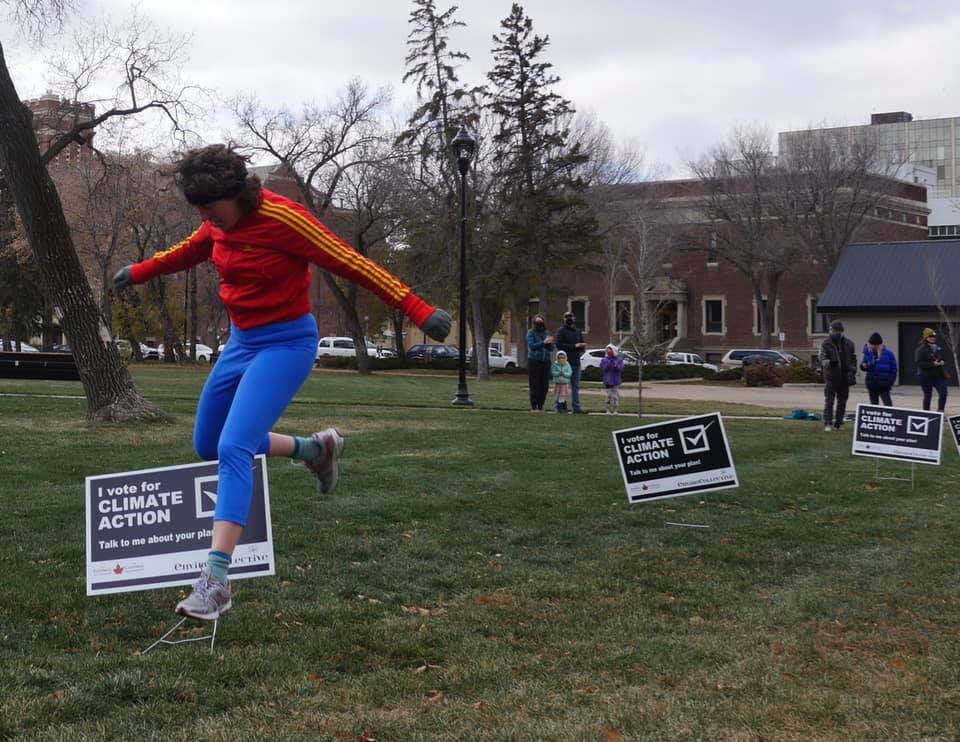
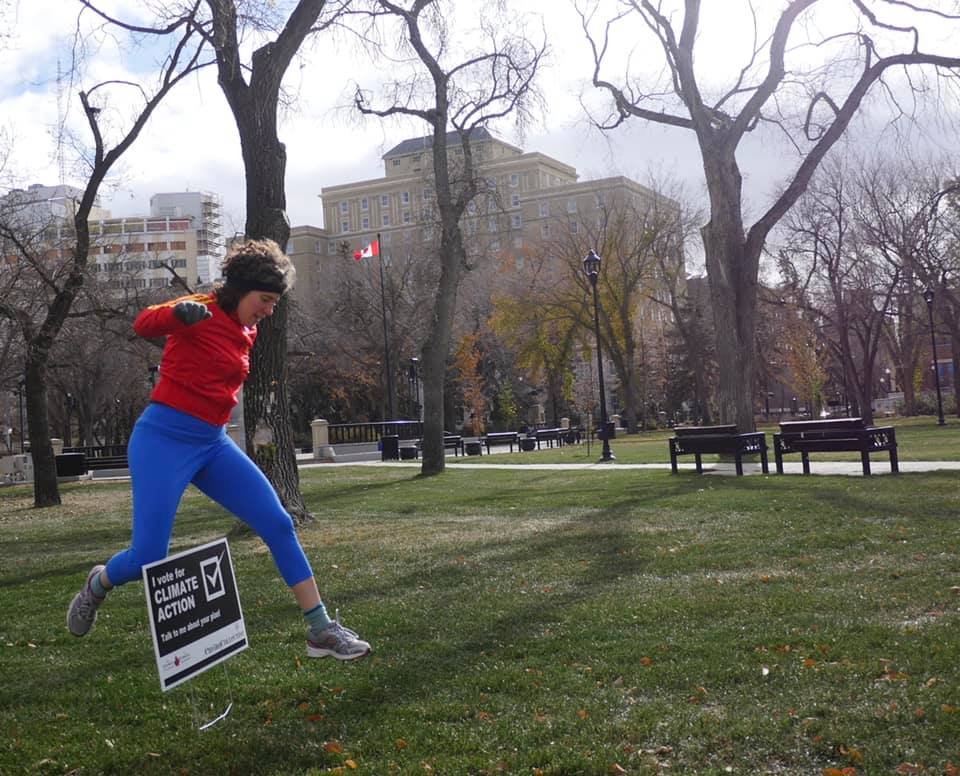
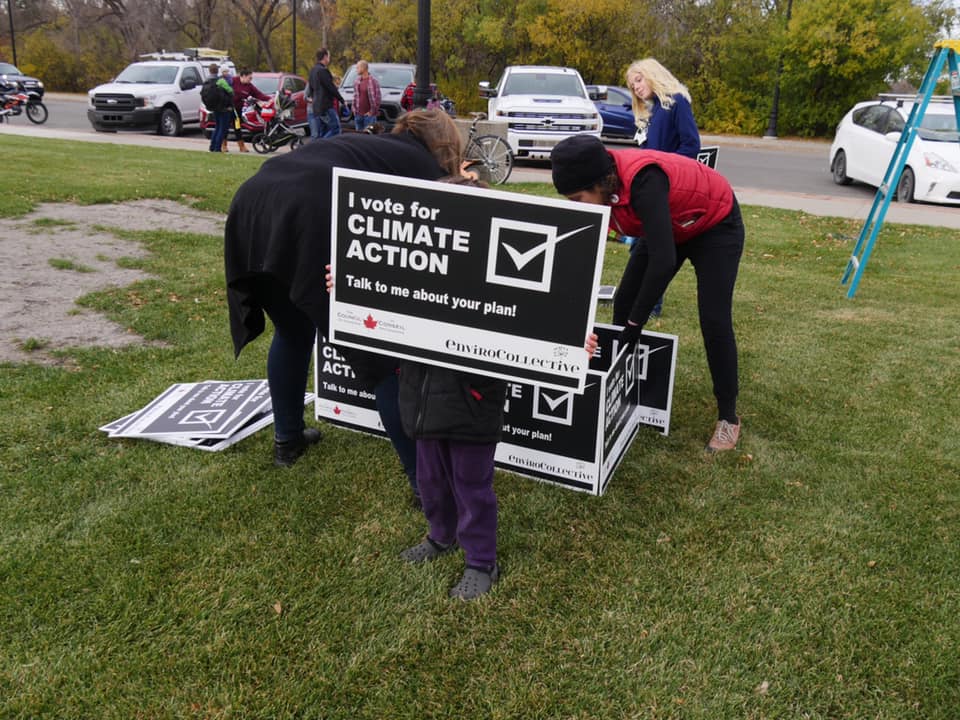
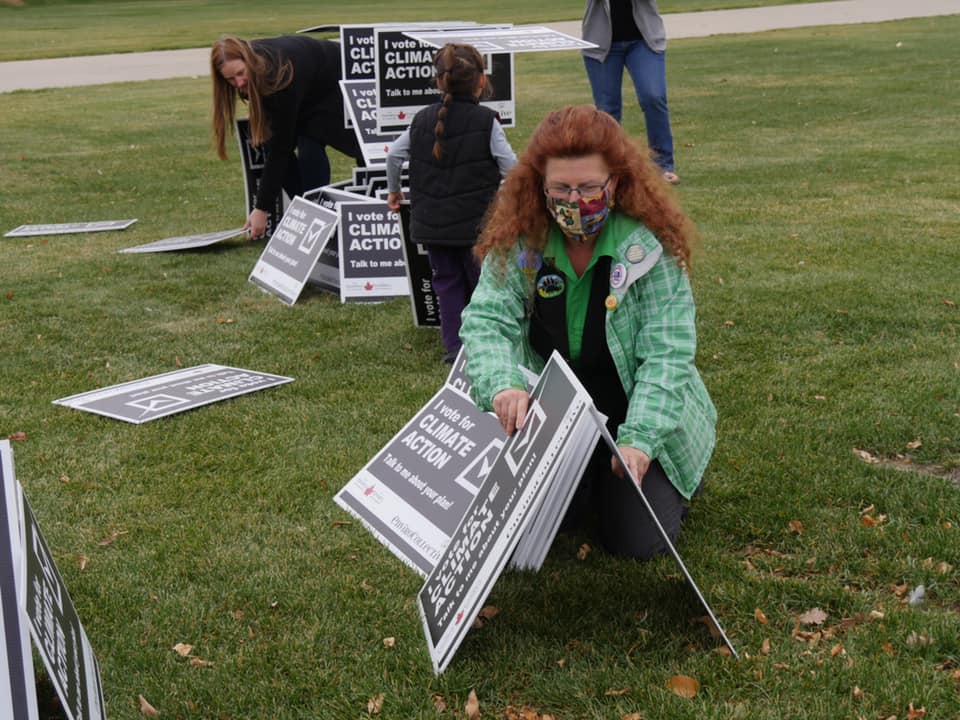
In my performance work, I explore ways to reach a broader audience. I choose to perform in public to draw attention to climate change by taking people by surprise in places they would not expect art. Apathy towards this issue has catastrophic consequences, and my work conveys this urgency while also offering ideas of how to take action to reduce the damage we are causing. Despair, detachment, and passivity can go hand in hand. To counter this, I often use humour. For instance, in Hurdles (17 Oct. 2020), I jumped over “I vote for climate action” lawn signs in a garish tracksuit in freezing weather. Other performances include participation that encourages meaningful engagements with the subject matter and exemplifies, via the cooperative nature of the events themselves, how we can work together to lessen and mitigate the coming challenges.

Climate change is the most complicated threat our species has encountered, and I feel the need to respond to it in a multifaceted way. In moving between the physicality of ceramics and the ephemerality of performance, between a quiet reflection on the beauty of nature and an outward communication of a sense of urgency to protect it, my practice explores how each medium can respond to my concern for our planet with such diverse methods and results.

Conversation: Taiwo Afolabi

Taiwo Afolabi is a new faculty member in the Theatre Department at the University. On his website, he describes his interests as including:

Taiwo’s research interests include Performance and Pedagogy; Socially-Engaged Arts; Applied Theatre; Devised Theatre; Creative Practice; Intercultural Communication; Ethics; African Theatre; Community-Based Practice, Participation, Decolonization; Film Studies, Art Management; and Cultural Entrepreneurship. Within these research areas, he has co-edited 1 volume (Lexington, forthcoming), and published over 7 book chapters and more than 15 refereed articles in journals such as Research in Drama Education, Applied Theatre Research,  African Performance Review etc.

Taiwo Afolabi – Research Interests

Ken Wilson gave me Taiwo’s name when we met, and I was grateful that he was able to make the time to meet with me on October 22nd. He’s very new to Regina, having just moved here with his wife and toddler.

The following are my notes from our meeting.

My question for Taiwo: What do you see as art’s role in contributing to social change? Should art try to teach people something or should it not?

It’s not “art for art’s sake” or “didactic art”; for Taiwo, it’s somewhere in between.

The art should challenge. It should leave room for both teaching/learning and aesthetics.

It’s a viable tool to create dialogue.

Look up “humanitarian performance” – using theatre to do something / intervention-based

Taiwo sees “participation” as a noun, not a verb: it’s being used by developed countries as a development discourse (to do something) in developing countries.

People have the capacity to engage – it’s an ability – a noun

Look up Linda Smith.

Defining participatory art is problematic because people have different ideas/definitions.

This is the beauty of it — it stretches the boundaries

The definition depends on WHO is defining it.

A key characteristic is leaving a space for others / a non-hierarchical space where people share the power

Artists can create techniques to do this, such as “breaking the fourth wall” (in theatre) or “immersion theatre”

Look up “Cardboard theatre” in the UK — used a technique to get people in

My question for Taiwo: What do I want people to get out of these engagements?

The point is for people to leave the room with a question in their head or with an idea or a conversation.

Always ask: what is the artist’s intention?

About incorporating First Nations’ culture… it’s not enough to incorporate it; one has to know it to make that incorporation meaningful. It’s about internalizing it. We should learn it to know it. Have a personal monologue with the knowledge.

My question for Taiwo: How to get attention if I’m just reading something out loud? How to get participation?

Taiwo: do something at the same time that gets people’s attention. He gave the example of having a table set up outside (downtown) where I could occasionally pretend to water an invisible plant. People would stop and stare and perhaps engage.

Idea: “Found Poems” – get several poems and select lines or words from them. Make a “found poem” that I and/or others can recite.

Look up Wangari Maathai, and African climate activist.

If I go with the Nicolle Flats reading out loud idea, make it a mini-documentary.

Taiwo would consider orchestrating a social engagement event with me.

Inventory of Posts for End of Semester Review (Fall 2020)

For the Fall 2020 semester, my first in the MFA program, I experimented with performance art. Below are links where you will find documentation and writing about three performances I made.

Photos and videos of performances:

Blog posts with reflexive writing about each of the three performances:

Personal Essay “On Clay”

Bibliography

Bibliography (in progress*)

*Works in bold are ones I read from this term, Fall 2020; others are ones I’ve read in the past or plan to read in the future.

On Art (theory and criticism) & Art and Politics

Art in the Anthropocene: Encounters Among Aesthetics, Politics, Environments and Epistemologies. Edited by Heather Davis and Etienne Turpin. Open Humanities Press, 2015.

Art of the Encounter: Antagonism and Relational Aesthetics. Claire Bishop Source: Circa, Winter, 2005, No. 114 (Winter, 2005), pp. 32-35 Published by: Circa Art Magazine

Bishop, Claire. Artificial Hells: Participatory Art and the Politics of Spectatorship. London: Verso, 2012.

Bourriaud, Nicolas. Relational Aesthetics. 1998. Trans. Simon Pleasance and Fronza Woods. Dijon: Les presses du reel, 2002.

Chambers, Ruth, Amy Gogarty & Mireille Perron, eds. Utopic Impulses: Contemporary Ceramics Practice. Vancouver: Ronsdale Press, 2008.

Dormer, Peter, ed. The Culture of Craft: Status and Future. Manchester: Manchester University Press, 1997.

Jelinek, Alana. This is Not Art: Activism and Other ‘Non-Art’. London: I. B. Tauris & Co Ltd, 2013.

Bishop, Claire. Introduction to Participation. Edited by Claire Bishop. Edited by Claire Bishop. London: Whitechapel Gallery, 2006.

Kwon, Miwon One Place After Another: Site-specific Art and Locational Identity. Massachusetts: MIT Press, 2004.

Letters and Responses / Author(s): Liam Gillick and Claire Bishop / Source: October , Winter, 2006, Vol. 115 (Winter, 2006), pp. 95-107 / Published by: The MIT Press

Livingstone, Andrew and Kevind Petrie, eds. The Ceramics Reader. London: Bloomsbury, 2017.

Loveless, Natalie. How to Make Art at the End of the World: A Manifesto for Research-Creation. Durham: Duke UP, 2019.

McKee,Yates. Strike Art: Contemporary Art and the Post-Occupy Condition. London: Verso, 2017.

Mesch, Claudia. Art and Politics: A Small History of Art for Social Change since 1945. New York: I. B. Tauris & Co. Ltd, 2013.

Stoneman, Rod. Seeing Is Believing: The Politics of the Visual. London: Black Dog Publishing Ltd, 2013. 

On Art and the Environment

Blanc, Nathalie and Barbara L. Benish. Form, Art and the Environment: Engaging in Sustainability. New York, Routledge, 2017.

Burtynsky, Edward, Jennifer Baichwal, & Nicholas De Pencer, eds. Anthropocene. Art Gallery of Ontario and Goose Lane Editions, 2018.

Davis, Heather & Etienne Turpin, eds. Art in the Anthropocene: Encounters Among Aesthetics, Politics, Environments and Epistemologies. London: Open Humanities Press, 2015.

Edwards, David. Creating Things that Matter: The Art and Science of Innovations that Last. New York: Henry Holt and Company, 2018.

Giannachi, Gabriella. “Representing, Performing and Mitigating Climate Change in Contemporary Art Practice.” Leonardo (Oxford) 45, no. 2 (2012): 124-31.

Mockler, Kathryn, ed. Watch Your Head: Writers and Artists Respond to the the Climate Crisis. Toronto: Coach House Books, 2020.

O’Neill, Saffron J., and Nicholas Smith. “Climate Change and Visual Imagery.” Wiley Interdisciplinary Reviews: Climate Change, vol. 5, no. 1, 2014, pp. 73–87.

Quarmby, Lynne. Watermelon Snow: Science, Art, and a Lone Polar Bear. Montreal: McGill-Queens UP, 2020.

Sandilands, Catriona ed. Rising Tides: Reflections for Climate Changing Times. Halfmoon Bay: Caitlin Press, 2019.

Sommer, L. K., and C. A. Klöckner. “Does Activist Art Have the Capacity to Raise Awareness in Audiences?—A Study on Climate Change Art at the ArtCOP21 Event in Paris.” Psychology of Aesthetics, Creativity, and the Arts. Advance online publication, July 1 2019, http://dx.doi.org/10.1037/aca0000247. Accessed 25 September 2020.

Tanahashi, Kazuaki. Painting Peace: Art in a Time of Global Crisis. Boulder: Shambhala, 2018.

Yusoff, Kathryn, and Jennifer Gabrys. “Climate Change and the Imagination.” Wiley Interdisciplinary Reviews: Climate Change, vol. 2, no. 4, 2011, pp. 516–534.

On the Environment

Hamilton, Clive. Requiem for a Species. Routledge, 2015.

Henson,Robert. The Thinking Person’s Guide to Climate Change. Boston: American Meteorological Society, 2014.

Latour, Bruno. Facing Gaia: Eight Lectures on the New Climate Regime. Medford: Polity Press, 2017.

Nixon, Rob. Slow Violence and the Environmentalism of the Poor. Cambridge: First Harvard UP, 2011.

McKenzie-Mohr, Doug and William Smith. Fostering Sustainable Behaviour: An Introduction to Community-Based Social Marketing. Gabriola Island: New Society Publishers, 1999.

Morton, Timothy. Hyperobjects: Philosophy and Ecology after the End of the World. Minneapolis: University of Minnesota Press, 2013.

Ripple, William J et al. “World Scientists’ Warning to Humanity: A Second Notice” Bioscience, December 2017, Vol. 67(12), pp.1026-1028.

 Scranton, Roy. Learning to Die in the Anthropocene: Reflections on the End of a Civilization. City Light Books, 2015.

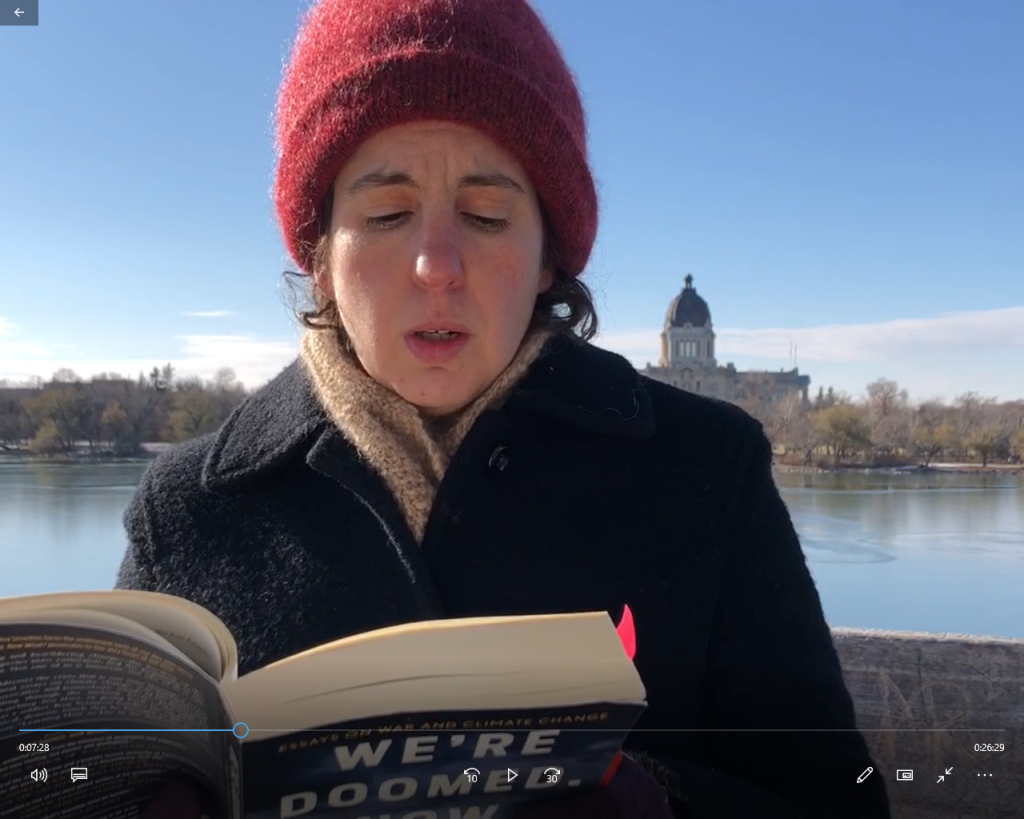
Ibid. We’re Doomed. Now What?: Essays on War and Climate Change. Soho Press Inc., 2018.

Schlossberg, Tatiana. Inconspicuous Consumption: The Environmental Impact You Don’t Know You Have. Grand Central Publishing, 2019.

Thunberg, Greta. No One Is Too Small to Make a Difference. Penguin, 2019.

Theory

Benjamin, Walter. Reflections: Essays, Aphorisms, Autobiographical Writings. Edited by Peter Demetz Harcourt Brace Jovanovich Inc, 1978.

Haraway, Donna J.. Staying with the Trouble: Making Kin in the Chthulucene. Durham, Duke UP, 2016.

Psychology (Dr. Arbuthnott’s readings lists)

Science denial:

Bjornberg, K.E., Karlsson, M., Gilek, M., & Hansson, S.O. (2017). Climate and environmental science denial: A review of literature published in 1990-2015. Journal of Cleaner Production, 167, 229-241.

Motivated reasoning:

Hennes, E.P., Ruisch, B.C., Feygina, I., Monteiro, C.A. & Jost, J.T. (2016). Motivated recall in the service of the economic system: The case of anthropogenic climate change. Journal of Experimental Psychology: General, 145, 755-771.  Doi: 10.1037/xge0000148

Trust in science:

Hendriks, F., Kienhues, D., & Bromme, R. (2015). Measuring laypeople’s trust in experts in a digital age: The Muenster Epistemic Trustworthiness Inventory (METI). PLoS one 10(10): e0139309. Doi: 10.1371/journal.pone.0139309

Battiston, P., Kashyap, R., & Rotondi, V. (2020). Trust in experts during an epidemic. files.de-1.osf.io

Kraft, P.W., Lodge, Milton; Taber, C.S., 2015. Why people “don’t trust the evidence”: motivated reasoning and scientific beliefs. Ann. Am. Acad. Polit. Soc. Sci. 658 (1), 121e133.

Media use:

Stecula, D.A., Kuru, O., & Jamieson, K.H. (2020). How trust in experts and media use affect acceptance of common anti-vaccination claims. The Harvard Kennedy School Misinformation Review, 1(1). Doi: 10.37016/mr-2020-007

Huber, B., Barnidge, M., de Zuniga, H.G., & Liu, J. (2019). Fostering public trust in science: The role of social media. Public Understanding of Science, 28(7), 759-777

Strategies:

Chan, M.S., Jones, C.R., Jamieson, K.H., & Albarracin, D. (2017). Debunking: A meta-analysis of the psychological efficacy of messages countering misinformation. Psychological Science, 1-16. Doi: 10.1177/0956797617714579

Cook, J. (2017). Understanding and countering climate change denial. Journal & Proceedings of the Royal Society of New South Wales, 150, 207-219.

Schmid, P., & Betsch, C. (2015). Effective strategies for rebutting science denialism in public discussions. Nature Human Behaviour. Doi: 10.1038/s41562-019-0632-4

Wong-Parodi, Gabrielle & Feygina, Irina (2020). Understanding and countering the motivated roots of climate change denial. Current Opinion in Environment Sustainability, 42, 60-64.

Required text: Stoknes, P. E. (2015). What we think about when we try not to think about global warming: Toward a new psychology of climate action. White River Junction, VT: Chelsea Green Publishing

Other readings: 

Obradovick, N., Migliorini, R., Pulus, M.P., & Rahwan, I. (2018). Empirical evidence of mental health risk posed by climate change.  PNAS, 115 (43), 10953-10958. Doi: 10.1073/pnas.1801528115

Medimorec, S., & Pennycook, G. (2015). The language of denial: Text analysis reveals difference in language use between climate change proponents and skeptics. Climate Change, 133, 597-605.

Griskevicius, V., Cantu, S.M., & van Vugt, M. (2012). The evolutionary bases for sustainable behavior: Implications for marketing, policy, and social entrepreneurship. Journal of Public Policy and Marketing, 31, 115-128.

Arbuthnott, K.D., & Dolter, B. (2013). Escalation of commitment to fossil fuels. Ecological Economics, 89, 7-13. Doi: 10.1016/j.ecolecon.2013/02.004

Tam, K.-P., & Chan, H.-W. (2018). Generalized trust narrows the gap between environmental concern and pro-environmental behavior: Multilevel evidence.  Global Environmental Change, 48, 182-194. Doi: 10.1016/j.gloenvcha.2017.12.001

Swim, J.K., Gillis, A.J., & Hamaty, K.J. (2020). Gender bending and gender conformity: the social consequences of engaging in feminine and masculine pro-environmental behaviors. Sex Roles, 82, 363-385. Doi: 10;1007/s11199-019-01061-9

Nolan, J.M., Schultz, P.W., Cialdini, R.B., Goldwtein, N.J., & Griskevicius, V. (2008). Normative social influence is underdetected. Personality and Social Psychology Bulletin, 34, 913-923.

Capraro, V., Jagfeld, G., Klein, R., Mul, M., & van de Pol, I. (2019). Increasing altruistic and cooperative behaviour with simple moral nudges. Scientific Reports, 9:11880.  Doi: 10.1038/s41598-019-48094-4

Kuo, M., Barnes, M., & Jordan, C. (2019). Do experiences with nature promote learning? Converging evidence of a cause-and-effect relationship. Frontiers in Psychology, 10:305. Doi: 10.3389/fpsyg.2019.00305 

Bastian, B., Brewer, M., Duffy, J., & van Lange, P.A.M. (2019). From cash to crickets: the non-monetary value of a resource can promote human cooperation. Journal of Environmental Psychology, 61, 10-19. Doi: 10.1016/j.jenvy.2018.11.002

Cunsolo, A., & Ellis, N.R. (2018). Ecological grief as a mental health response to climate change-related los. Nature Climate Change, 8, 275-281.  Doi: 101038/s41558-018-0092-2

Marlon, J.R., Bloodhart, B., Ballew, M.T., Rolfe-Redding, J., Roser-Renouf, C., Leiserowitz, A., & Maibach, E. (2019). How hope and doubt affect climate change mobilization. Frontiers in Communication, 4: 20.  Doi: 10.3389/fcomm.2019.00020

Misc.

Cooper, David E.. Convergence with Nature: A Daoist Perspective. Totnes: Green Books, 2012.

Performance 3: Now What? (26 October 2020)

On October 26th 2020, still recovering from my October 17th performance (Hurdles), I decided to make a quiet gesture of my desperation. On that day, the people of the province in which I live were voting in a conservative government that would continue doing as little as possible to mitigate climate change. With Wascana Lake and the Legislative Building behind me, I read a chapter titled “Raising a Daughter in a Doomed World” from Ray Scranton’s book, We’re Doomed. Now What?: Essays on War and Climate Change. To read more about this performance, please see my post in which I reflect on how I felt about it the day that it took place.

Photo and video credits: Esperanza Sanchez Espitia

Performance 2: Hurdles (17 October 2020)

On October 17th 2020, I once again (see “House of Cards”) put on a performance involving EnviroCollective‘s “I vote for climate action: talk to me about your plan” election lawn signs. This time, I decided to set up a line of seven of the signs in Victoria Park, next to the Farmers’ Market, and jump over them for seven minutes straight. For more information about this performance, please see a post I made explaining it beforehand and a post I made with my reflections on it after it took place.

Photo and video credits: Esperanza Sanchez Espitia

Performance 1: House of Cards (11-12 October 2020)

On October 11th and 12th 2020, I organized a participatory event on the lawn in front of the Legislative Building. Participants were invited to attempt to build the largest “house of cards” they could out of pre-made lawn signs that read “I vote for climate action: talk to me about your plan.” A local environmental organization that I volunteer for, EnviroCollective, ordered 1000 of these lawn signs ahead of the two elections we had here (provincial and municipal) this fall. The purpose of the signs was to get more people to consider climate change as an election issue. Candidates out door-knocking would also note that they had constituents who care about this issue. The signs were also meant as a way to spread knowledge of EnviroCollective, and they were supposed to be a fundraiser for this organization (as well as The Council for Canadians, who also contributed to their purchase).

Sign sales were disappointing. I decided to think of ways I could incorporate them into a performance. My goals were to get more people thinking about climate change and help EnviroCollective spread awareness of their lawn sign campaign. To know more about how the event went over the course of these two days, please see a posts I made before and after the first day it took place.

Photo and video credits: Esperanza Sanchez Espitia