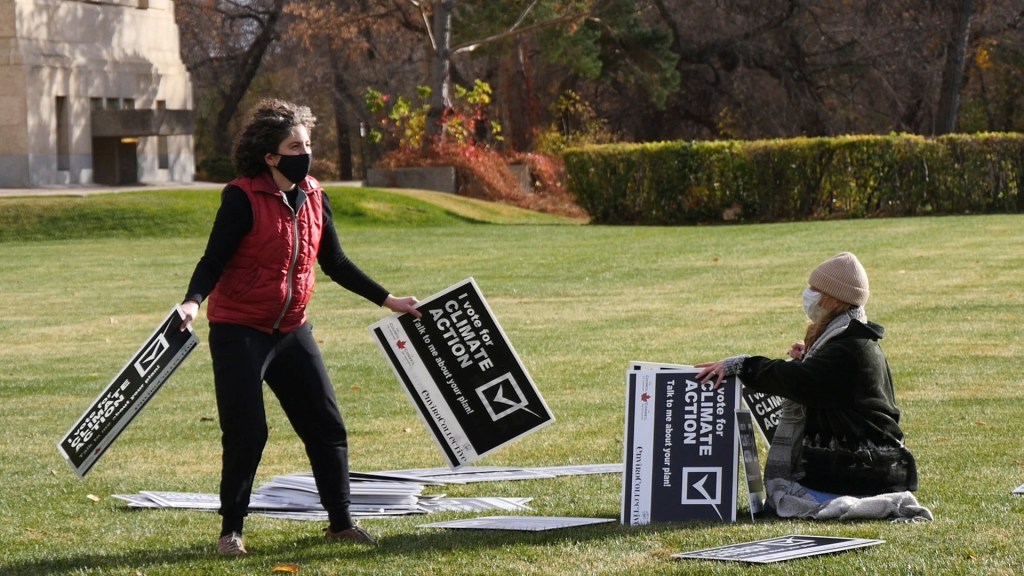
It’s (fourteen minutes past) October 26th 2020, and today was the day of Saskatchewan’s Provincial election. For this week’s exploration of non-material art-making, I chose to read a chapter of Roy Scranton’s We’re Doomed. Now What? across from the Legislative Building across Wascana Lake.
Video still credit: Esperanza Sanchez Espitia
This chapter is titled “Raising a Daughter in a Doomed World,” and it spoke to me when I read it a few weeks ago. Scranton articulates a lot of what I’d like to say in this moment, on this day when the people I live among are locking in another term with the Sask Party, complete with their near Trump-like dismissal of climate change.
I also feel like reading a book like this is itself a performance these days; Rob Nixon puts it concisely in Slow Violence and the Environmentalism of the Poor:
one of the most pressing challenges of our age is how to adjust our rapidly eroding attention spans to the slow erosions of environmental injustice (8)
Who reads a book like Scranton’s today? Is anyone reading it who isn’t already converted? Would my reading this chapter out loud here in Regina actually invoke an interest in this topic in anyone who isn’t already interested? I doubt it. Meanwhile, the clock is ticking, the people are voting (literally as I read out loud) and honestly, it’s hard not to focus on the “we’re doomed” rather than the “now what?”
Once again, today was cold, and Wascana Park was sparsely populated. A few people went by. No one said anything to me, which was actually what I was expecting. I didn’t make eye contact, as I kept focused on reading the text; all I know is people passed in my peripheral view of the area in front of me. What they took from seeing me there will remain a mystery to me, but I know for certain that I didn’t invoke an urge in anyone to go to the polls and vote Green. The geese in the lake behind me got more out of this show than anyone else.
David asked me in class last Friday: “What are my goals? If my goals are to solve climate change, I’ll fail. If my goals are to engage participation…?”
What were my goals with today’s performance? (It wasn’t participatory, so there goes that goal). They weren’t really to convert anybody — I knew I wouldn’t. My goal was just to express how I was feeling today and in the lead-up to this election, and really, I knew ahead of time that this was a pointless objective.
I’m starting to feel a real crisis set in; I’m not enjoying what I’m doing, I don’t see much purpose in it, and I don’t know how to change these facts. Today was the third time I’ve tried to create non-material art for my work in this semester of my MFA, and I’m not very happy with any of these attempts. While I don’t feel I have the means to assess their success or failure, I know “in my gut” that they aren’t doing what I want them to be doing.
I’m grateful to Esperanza for documenting this attempt at doing something. She’s sent me the video she took of the entire 33+ minutes I stood there reading, and I’ll need to figure out if or what I’ll do with it. Is there any point in uploading it to the cyber-world? I don’t know if the one or two views it would get would be worth its carbon footprint, honestly. Should I turn the video into a documentary “film” of sorts? Esperanza and I wandered around the lake, and she photographed and videoed scenery, birds, a bunch of ducks telling a few good jokes. She’s offered to produce a short film using this material. I just don’t know at this point.
My first attempt at performance art took place on October 17th, and I’m not quite sure how to think about it.
One thing that surprised (and disappointed) me was the lack of people around. The farmers’ market was a ghost of its summer self with only a few diehard vendors and nearly no customers. Victoria Park, nearby the market, where I set up, was void of human life… I suppose I shouldn’t have expected to have an audience on a cold autumn day in Regina. Stil, it was disappointing that I didn’t give out (via Jakob — this was his role) any of the 120 small slips of paper I’d printed with information about the climate action signs on one side, and this on the other:
I’ll have to consider projects/events I plan for the near future and how integral having live viewers, or participants, should be. I can’t really do much indoors these days either due to Covid19. I really have to think about how these facts of my reality (winter; Covid) will impact my work over the next few weeks.
If no one was there to really observe or experience this event in person, at least it was “put out there” via the media. A local radio station, Regina 980 CJME was out to interview me, and I while I didn’t hear myself on the radio, I was pleased to see that they also printed a summery of it. I’m pretty okay with how the reporter presented was I was doing.
Photo credit: Esperanza Sanchez Espitia
Global TV also interviewed me, though again I didn’t get to see the interview when it happened on the 6pm and 10pm news that day. (I gather from friends that it was a decent interview). Like every other aspect of this new (for me) art practice, I need to think more about how to assess what I’m doing with the media. Do I consider it a good thing as far as my art work goes to get this type of attention? It has no real connection to the actual event itself — the immediacy the moment, the feeling it creates, is lost. I’ll have to ask Risa about this.
About the performance itself: it was hard. Physically hard. This was how I felt immediately after: tired and having trouble breathing.
There are real consequences to every action in which one engages. Any action affects one both physically and psychologically. It is happening by and to one’s body, and its impact cannot be discounted simply because it is called art.
Performance art requires risk. The artists take physical risks using their bodies. The artists take psychic risks as they confront their limits.
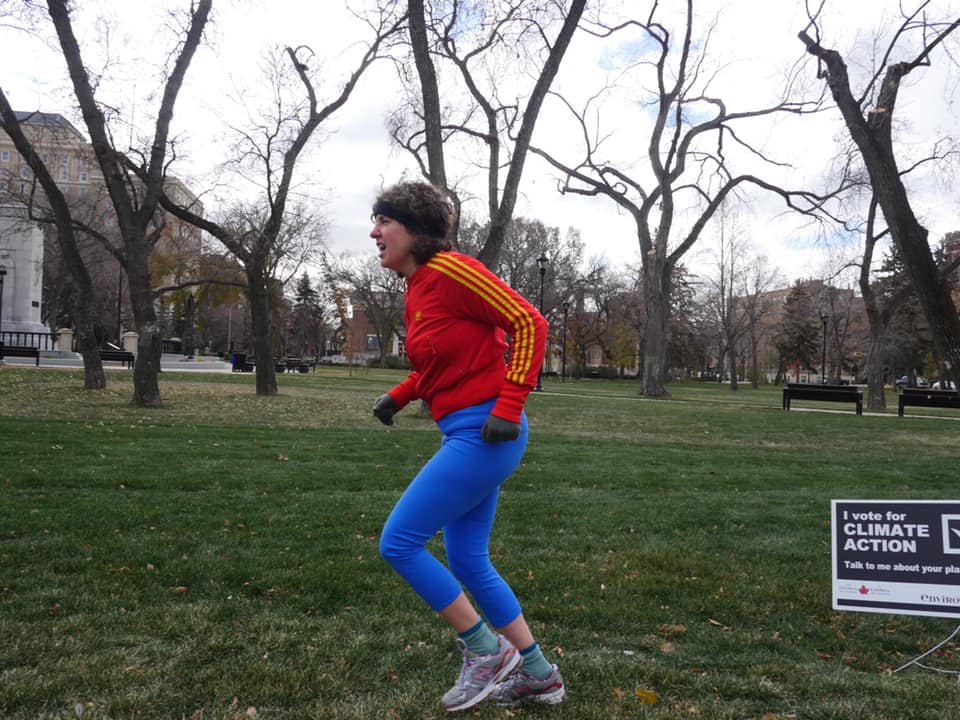
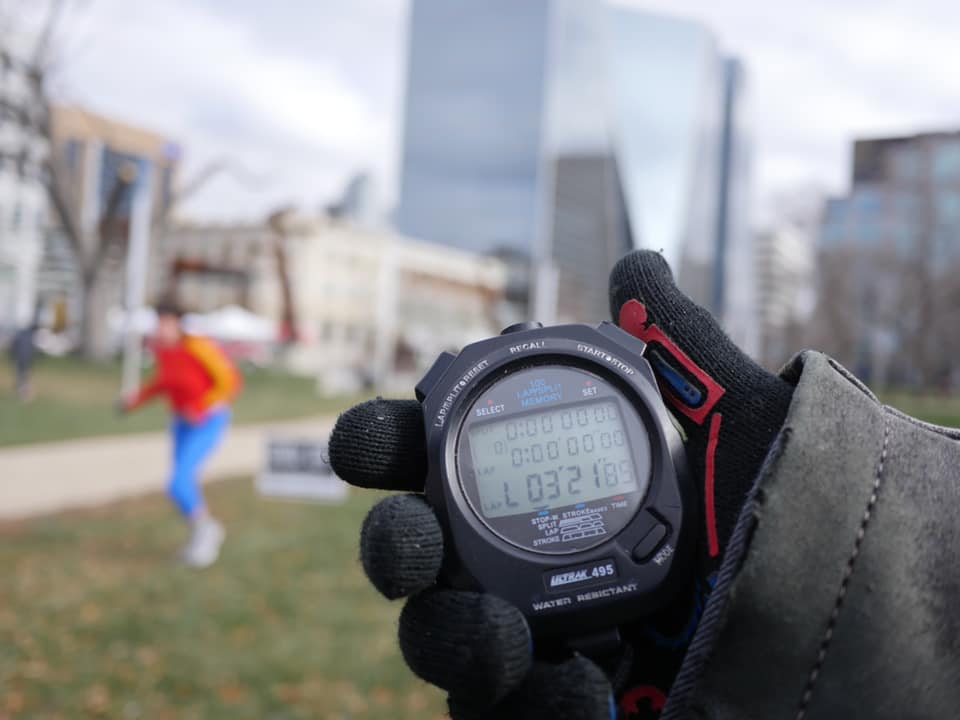
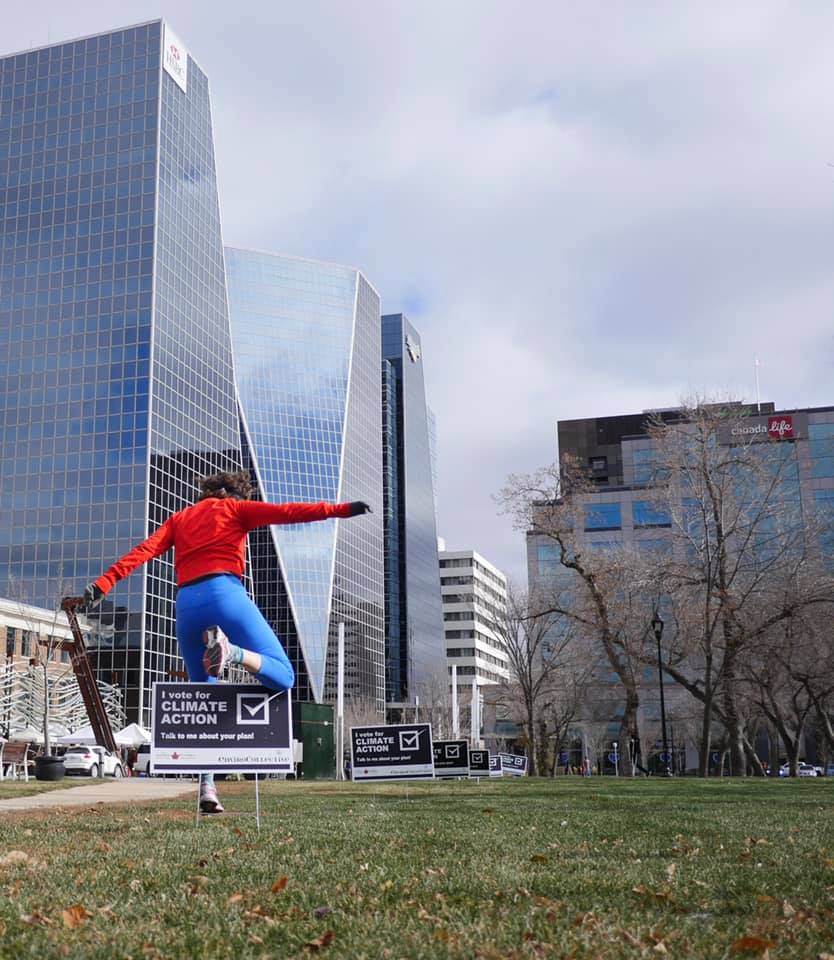
Physical risks: I had an asthma attack immediately after my seven minutes of jumping hurdles in -10 degrees. It was my first attach in over two decades, the thought hadn’t crossed my mind to bring the old (expired) Ventolin inhaler I keep at home for “just in case.” I had to rush home to take several puffs, and it took me three days before I was able to speak normally and a week before I wasn’t wheezing and hacking. Who would have thought that suddenly running in freezing temperatures without any warm-up would be such a shock to the lungs? Really! Also, in one particularly graceful hoist over a lawn sign, I snapped its metal stand, and in a subsequent effort to haul my 125 pounds over this object, I scraped my leg. That was no big deal; I didn’t even notice it until that evening. Still, these physical effects of the performance gave me a glimpse into just how unpredictable this type of work is.
Psychological risks: I’ll get to that in another blog post.
As far as getting feedback from viewers, there really isn’t a lot to report. My husband said that night as I wheezed and coughed, “Jakob saw, I saw, and God saw.” We’re devout atheists, so what he meant by the latter was really that I did something he considered a good thing to do. Period. Everyone else who’s said anything about this performance (feedback from friends after seeing my Facebook post or the radio/tv news about it) just said it was “amazing.” Of course, that’s what friends are for, right?
As an aside, I have received more feedback from the “happening” I organized for the previous weekend (the “house of cards” event). Naomi Hunter, leader of the Saskatchewan Green Party, told me that she felt rejuvenated for a week following the event. Florence Stratton, a well-know local activist, told me she felt great after participating too. A stranger who got in touch after reading the Leader Post article about what I was doing said, “your performance helps promote the environmental cause. Good job.”
Good job? I really don’t know. Overall, I’m feeling lost, and it’s hard to say if this is feeling is just a sign that I’m doing what Arsem says students of performance art must do (“I believe it is critical for artists to learn to assess the progress of their work, and challenge themselves to develop it further”), or if this type of work just isn’t me.
Photo credits: Esperanza Sanchez Espitia
I’ll end by quotoing from Arsem again (thanks for introducing me to her, Risa!):
Artists need to find ways to sustain their practice without becoming too reliant on validation by outside authority figures, who rarely have the same focus or agendas as the artist. The more clarity that one has about one’s goals, the clearer the avenues of options become.
This is what I really need the most: to have clarity about my goals.
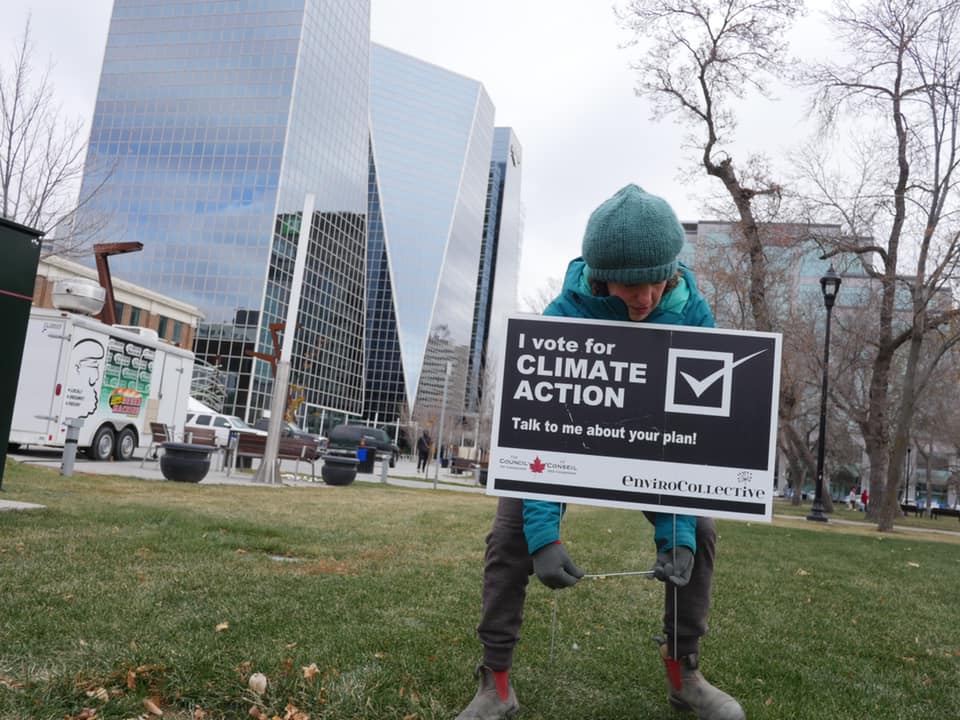
Tomorrow at noon, I will put on my first ever “performance art” piece.
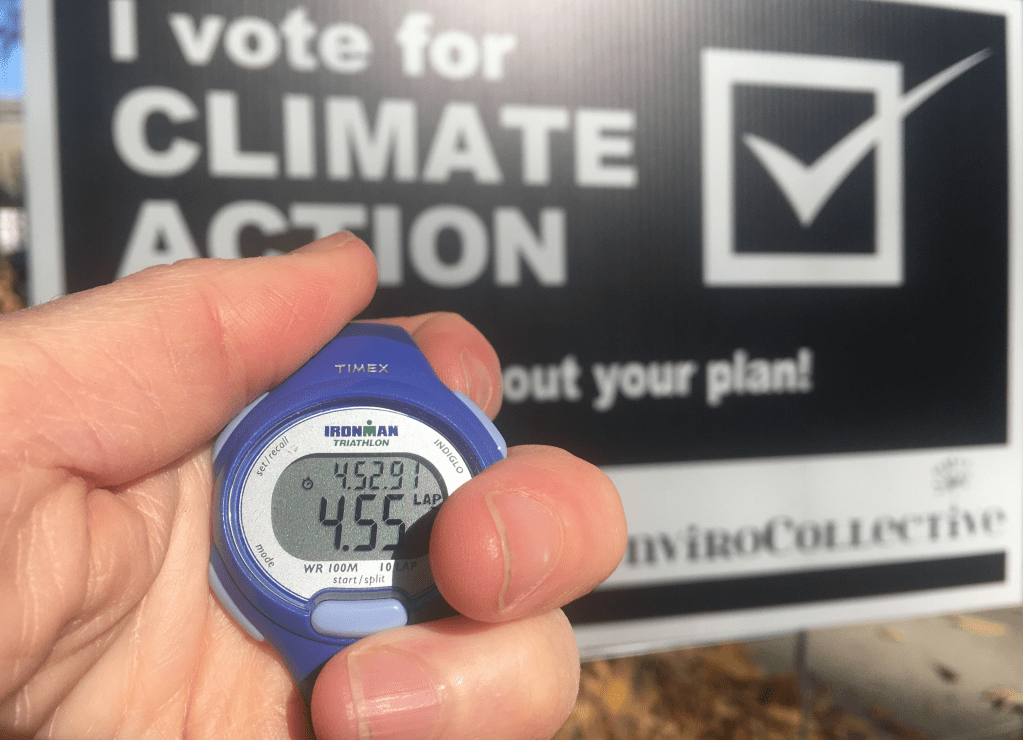
I will set up several of the “I vote for climate action: talk to me about your plan” lawn signs on the lawn near the Farmers’ Market in Victoria Park, downtown Regina. My husband will blow a whistle and start a stopwatch. Wearing an exceptionally bright red-orange and yellow tracksuit jacket and bright blue leggings I found at Value Village, I will run and jump (hurdle style) over the lawn signs for 7 minutes without stopping. My son will hand out small flyers to anyone who wanders by wanting to know what I’m doing. One side of the flyer will be EnviroCollective’s mission “to build networks and share resources to support environmental and climate action” and website (where people can order one of these signs).
The other side will say the following:
In 2018, the UN’s Intergovernmental Panel on Climate Change reported that we had 12 years remaining to make drastic reductions to our greenhouse gas emissions in order to maintain a global heating temperature increase of 1.5◦ Celsius. Global warming beyond that point would have catastrophic results.
Aligning with the IPCC’s data, Mercator Research Institute on Global Commons and Climate Change (in Berlin) keeps a running tally of how much time we have left before we will exceed 1.5◦ Celsius and 2◦ Celsius global warming. Due to increased emissions in the past two years, they now predict we have only a bit over 7 years and 2 months to make these radical cuts to greenhouse gas emissions (at current emission rates).
For 7 minutes, I will hurdle “I vote for climate action signs” to express the urgency of voting in candidates in this fall’s elections who will take climate change as seriously as it needs to be taken.
Search for the MCC Carbon Clock to see how much time we have left.
For some reason, I had the figure of eleven years in my head when this idea came to me. I knew the IPCC had reported on 12 years a while ago… I didn’t realize that it was 2018 when they came out with that figure. I’d also heard the figure of 7 years floating around, and in fact Tanya Dahms suggested I should use that figure instead. I wanted to stick with the IPCC’s number as they carry some clout (as they should…). However, looking into it further, I’ve learned what the situation is: In 2018, the IPCC based their prediction of when the world’s “carbon budget” to keep us at 1.5 degrees Celsius would run out. Two years ago, this window was 12 years.
“The Special Report of October 2018 presents new figures: The atmosphere can absorb, calculated from end-2017, no more than 420 gigatonnes (Gt) of CO2 if we are to stay below the 1.5°C threshold. However, since around 42 Gt of CO2 is emitted globally every year—the equivalent of 1332 tonnes per second—this budget is expected to be used up in just over nine years. The budget for staying below the 2°C threshold, for its part, of approximately 1170 Gt, will be exhausted in about 26 years.”
I have Tanya to thank for knowing about this resource. She sent me a message tonight saying “I think the installation piece in Manhattan is logging 7-8 years…”
I did a quick Google search for “Manhattan installation art climate change” and read about this piece in a New York Times article:
A New York Clock That Told Time Now Tells the Time Remaining
Metronome’s digital clock in Manhattan has been reprogrammed to illustrate a critical window for action to prevent the effects of global warming from becoming irreversible.
I’m in awe that such a piece exists — that artists created it, but also that it’s come to this.
And also, that life is going on as usual just below this 62′ wide clock that’s spelling out our doom.
The truth is, the “hurdle” I’m jumping tonight as I do some final preparations for tomorrow is dealing with my son. He hasn’t been sleeping well for months, predating Covid19. While my husband and I don’t talk a lot about climate change in front of him, and we certainly avoid the “doom and gloom,” he definitely knows more about it than the average ten year-old in Saskatchewan. He’s heard us say enough. He’s seen the books we have lying around (even though I try to hide the worst titles, such as We’re Doomed. Now What?). He’s been to the Fridays for Future climate strikes and other rallies. He’s heard people shout out really horrific things — “There’s no Planet B” and “You’ll die of old age. We’ll die of climate change.” He even participated in a “die in” in front of the Legislative Building last year. He’s smart, and he knows that we believe in science, and that the science says the shit is going to hit the fan. I wondered tonight, as he burst into tears when I pointed out that his (long) hair is tangled, how much climate-related anxiety he’s unconsciously experiencing. I wonder about this when he’s so upset because he can’t stick with a story idea long enough to write it (he’s a young writer). Why are his stories not worth writing to him? Is it at all connected to the overall anxiety that’s in the world right now about the ending of our own story? This really worries me.
How is a concerned parent supposed to act?
I want my son to know that I’m doing what I can to help the world realize that drastic change is needed for this drastic situation. At the same time, if he’s handing out flyers for me tomorrow, of course he’s going to read one. Do I change the wording to take off the edge? Perhaps remove the part that says, “Global warming beyond that point would have catastrophic results.” Do I try to add some level of “hope.” Apparently, “hope” and “solutions” is what sells people on the idea of making behavioural (and political?) change in the right direction.
I’ll have to give this some more thought tomorrow morning and when planning my following events. For now, the clock’s ticking, and I better get to bed to have the energy to face tomorrow.
The CTV crew set up to interview me right at 3pm, and this threw me off. I hadn’t predicted them being there. In hindsight, maybe I should have ignored them or asked them to come back after 4:30 so as not to take up any time of the actual happening. I’m not sure.
No one could build a “house” in 70km/hr winds, obviously. It didn’t seem like there was any real competition to do so, either. People just made an attempt for a while, stopped, tried again, and then left. There wasn’t any real opportunity to award anyone a free sign, of if there was, I missed it.
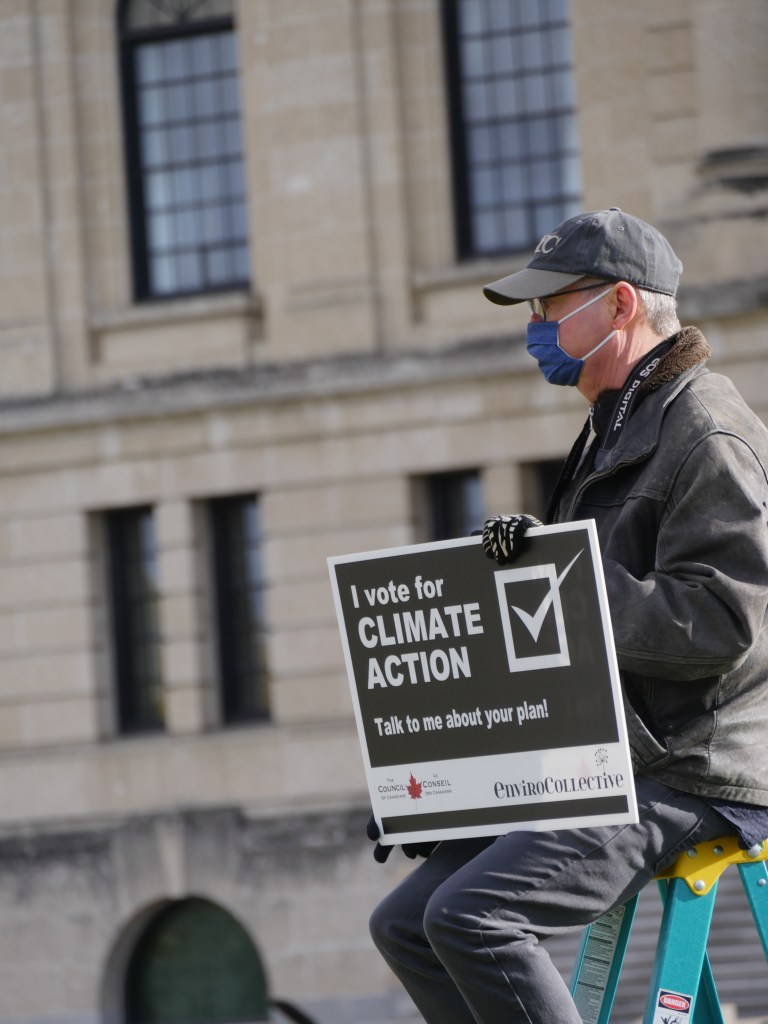
I’d brought a ladder as a prop, knowing that with the wind we wouldn’t need to use it. One of the best parts of the event was Mike sitting on it, holding a sign — that was a great performance.
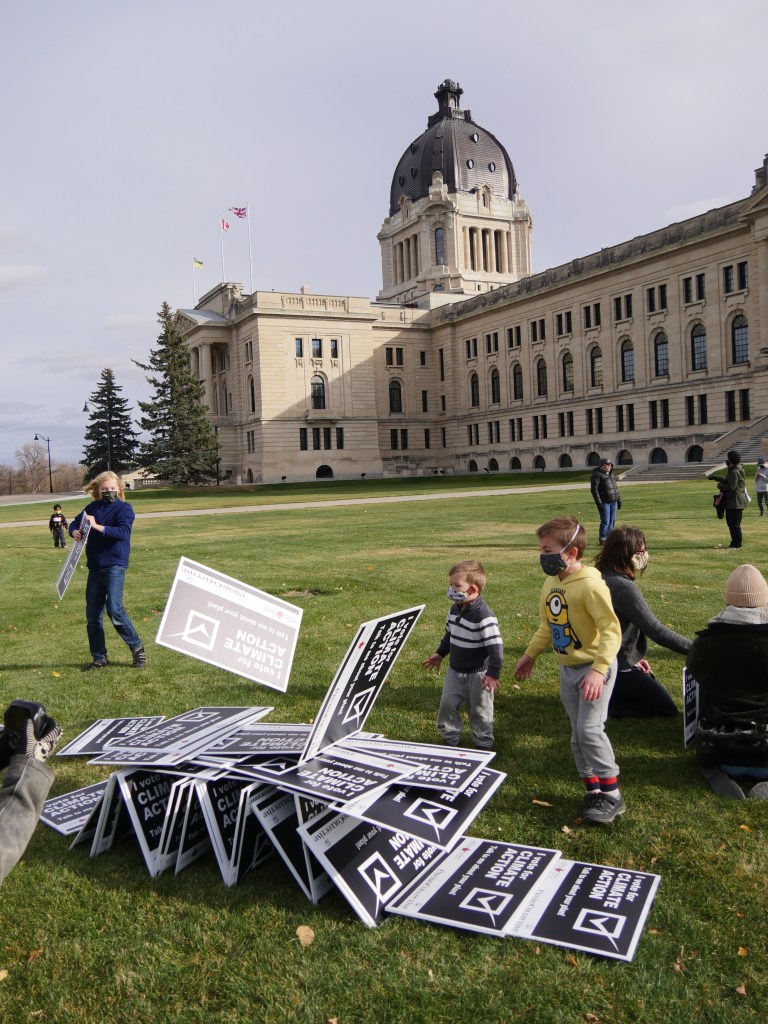
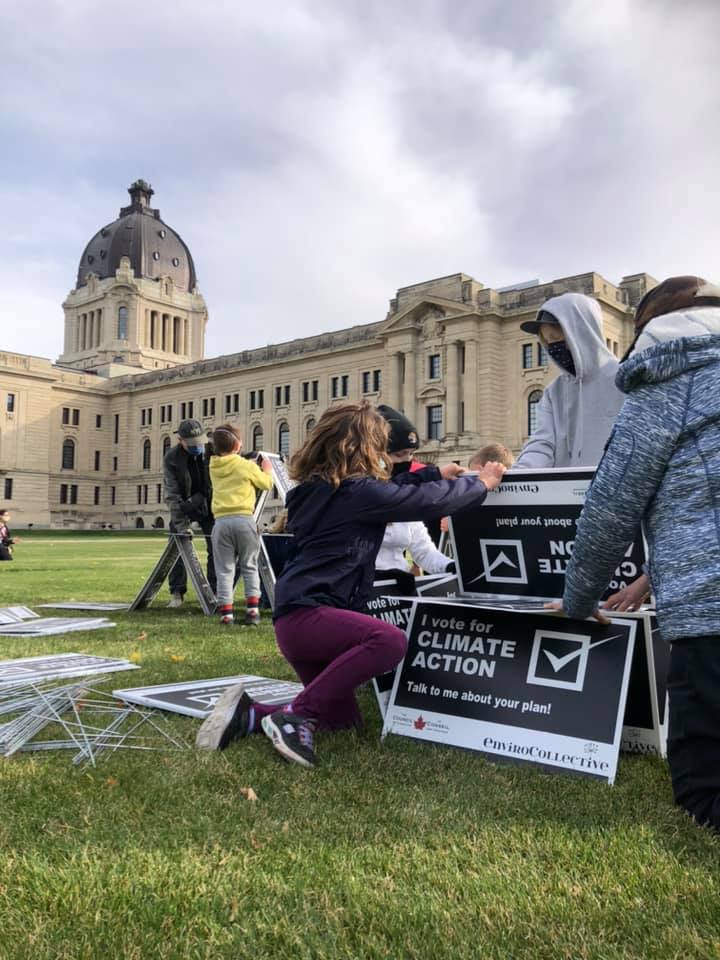
Kids! I hadn’t really anticipated how having kids present would drastically affect the feeling/tone of the event. In some ways it was great having them there — they helped maintain a level of energy for building a house of cards despite the fact that it was clearly pointless. In other ways, though, it made the event feel more like a family event than I’d predicted it would be. There isn’t anything wrong with that per se, and in fact kids are a big part of why I’m doing what I’m doing. At the same time, it felt a bit like the adults were there to help the kids do an activity that was solely for their entertainment, and that’s just different from how I’d imagined things would feel.
Another way to put it is this: kids are used to doing things that may appear silly or pointless to grown-ups; to them, it’s fun and games. In a way, this was great, but in another way, I’d wanted the struggle we were going through to be serious at the same time as it was ridiculous, and I don’t feel like that came through. Maybe it did for others though.
I’m questioning what my position should be at an event like this. Should I have persisted on trying to build a house of cards alone instead of mostly with others? Should I have acted more theatrically? It was hard to know what my role was or how I should act, and I was aware of this through the event, which felt awkward. Then again, this is a new medium for me, so I guess it makes sense that I don’t feel confident about what I’m doing.
You know, thinking about it now, it actually felt like it didn’t matter what I was doing. People there were busy doing their own thing, and that was entirely fine. Great, actually. I wasn’t the happening, the participants were.
I had a number of brief exchanges with participants. People noted the metaphor of what we were trying to do… building a “house” despite the extreme challenges the environment around us (the weather) presented. I think one of the best moments was when one little boy said “we built it once, we can build it again!” after the wind collapsed a “house” we’d spent time building. Later he said “we can do this if we work together!” What a great attitude, dude!
I was too busy trying to build a house of cards (and running after signs) to really see if there were any passersby who stopped to ask about what was happening, but my guess is that there weren’t. It was a bit too blustery for many people to be out, and it was also many people’s Thanksgiving. So, it really felt like “my people” came out but no one else, and while I’m entirely grateful that they were there, I’ll have to think about how to change this for the next time if I want to attract the “unconverted.”
I didn’t get the chance to talk to anyone who was there to argue.
On the other hand, at least we were subjected to any violence.
Another EnviroCollective board member suggested that I hold upcoming happenings/performances in different locations, and I think that’s a great idea. I’ll try to pick places where there would be more people walking by. Perhaps I’ll set up in front of City Hall next time, and maybe on Friday afternoon when there’s more foot traffic. I just need to finalize what I’ll actually be doing …
We’ll see if things are any different tomorrow, and what else I can learn from this experience.
Again, I’m grateful to all the people who took time out of their Thanksgiving Sunday (including Risa), and I’m also grateful to Esperanza for playing the role of documentarian.
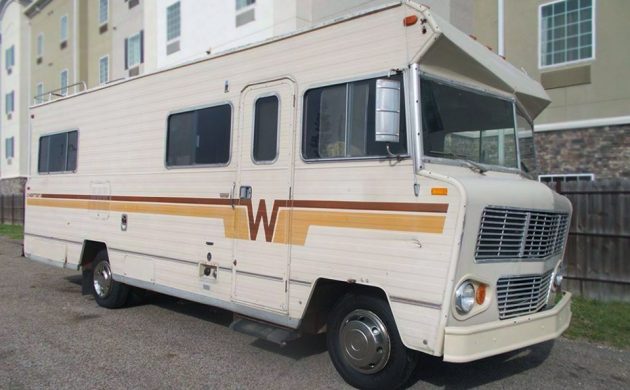
Last night, as I was putting my ten year-old son, Jakob, to bed, he was telling me about the model Winnebago Cheiftain he’d just built in Minecraft. He knows a lot about RVs as dreaming about owning one is new “thing” these days, and he’s being doing research on all of the makes and models that are out there, new and used. We’re big on camping, but we’re all getting a bit tired of tenting, and owning an small camper van is moving from the realm of dream to ambition. Jakob’s research may inform this major decision that we could potentially be making in the next year or two.
In bed last night, we chatted about his recent Minecraft creation:
This is the RV that Jakob’s dad’s family had back in the 70s. (It also happens to be the same RV that the crew in The Walking Dead use to avoid zombies in the early seasons of the post-apocolyptic show.) We were talking about how un-aerodynamic its design was, and how much gas it must have burned. Being raised as a young environmentalist, fuel efficiency is one of the key considerations Jakob is making when doing this research into camper vans.
At this point in the conversation, Jakob said how he wishes he could be having a childhood “like Daddy’s.” Mike grew up in a small town, spent days “running wild” (Jakob’s words) through the woods that backed his family home, and spent weeks on the road in the family’s Winnebago without any knowledge of climate change.
I can’t express how sad I am that Jakob, and all the kids of his generation, have this existential problem looming over their childhood. It’s a real dilemma for me as I raise Jakob: part of me doesn’t want him to know anything at all about climate change; part of me wants him to know that his parents are doing what they can to spread awareness of the need for urgent action to mitigate and reduce its effects. Today will be an example of big a part of my life climate activism has become.
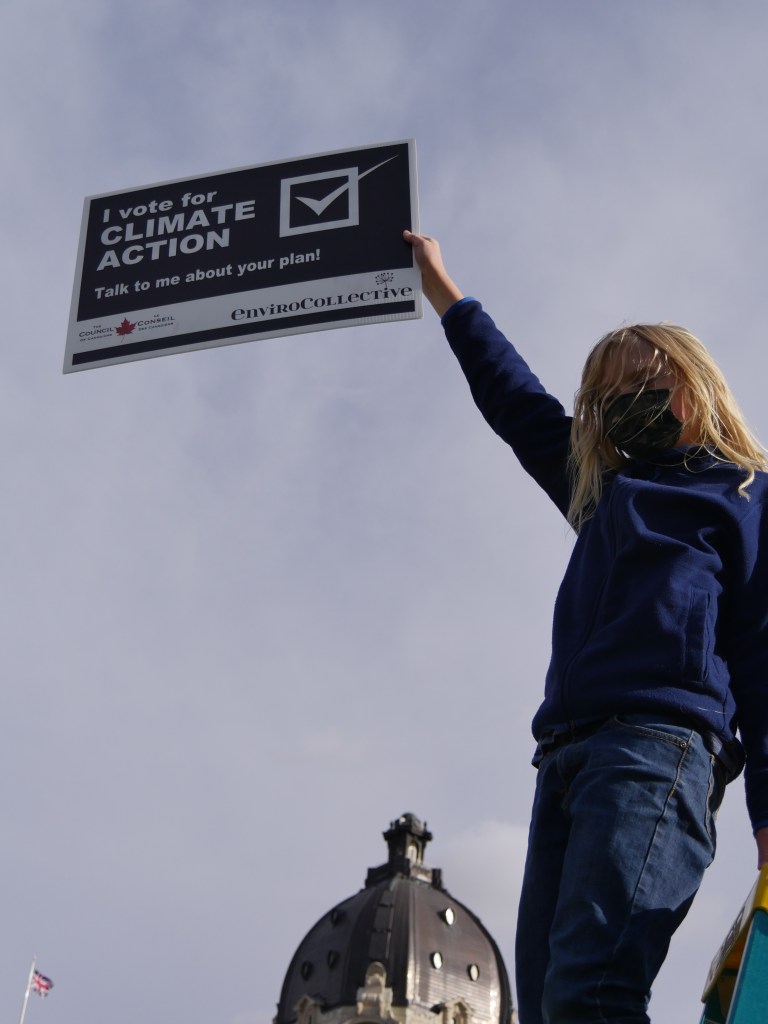
Today and tomorrow, I’m going to make my first attempt at performance art. I’m going to spend an hour and a half attempting to build a “house of cards” out of the “I vote for climate action: tell me about your plan” lawn signs that EnviroCollective, Regina’s environmental initiative “hub,” has produced.
These non-partisan lawn signs are meant to be a way to get more people thinking about climate change as they go to the polls for the upcoming provincial and municipal elections. EnviroCollective ordered 1000 of them. They are plastic, unfortunately, but they are completely reusable for future elections. We are selling them for just a bit more than cost as a fundraiser for EnviroCollective and a sponsor non-profit organization, The Council of Canadians.
As a board member of EnviroCollective, I’ve been trying to get these signs “out there.” We’d hoped to have a table at the Farmer’s Market, but this plan fell through. I’ve tried asking a few local and sustainability-minded shops to consign them for us, but most small business owners I’ve approached have politely declined. Our provincial election is just over two weeks away, and we’ve only sold about 100 signs.
Four days ago, disappointed at how slow our sales have been, I decided to find a way to use these signs in a performance art piece with the hopes of getting more publicity for this initiative, and to say something about the ridiculousness of the situation we’re in: that the most important issue of our time is not being treated seriously enough.
What immediately came to mind was the idea of trying to build a house of cards out of them on the lawn of the Legislative Building.
Looking at different types of performance art online, I came across the term “happening.” I read about how “Happenings were the forerunners of performance art and in turn emerged from the theatrical elements of dada and surrealism” (Tate). I read how Allan Kaprow coined the term in 1959, and how “Kaprow emphasized the importance of artist’s action and the process of creation above the finished work” (Widewalls).
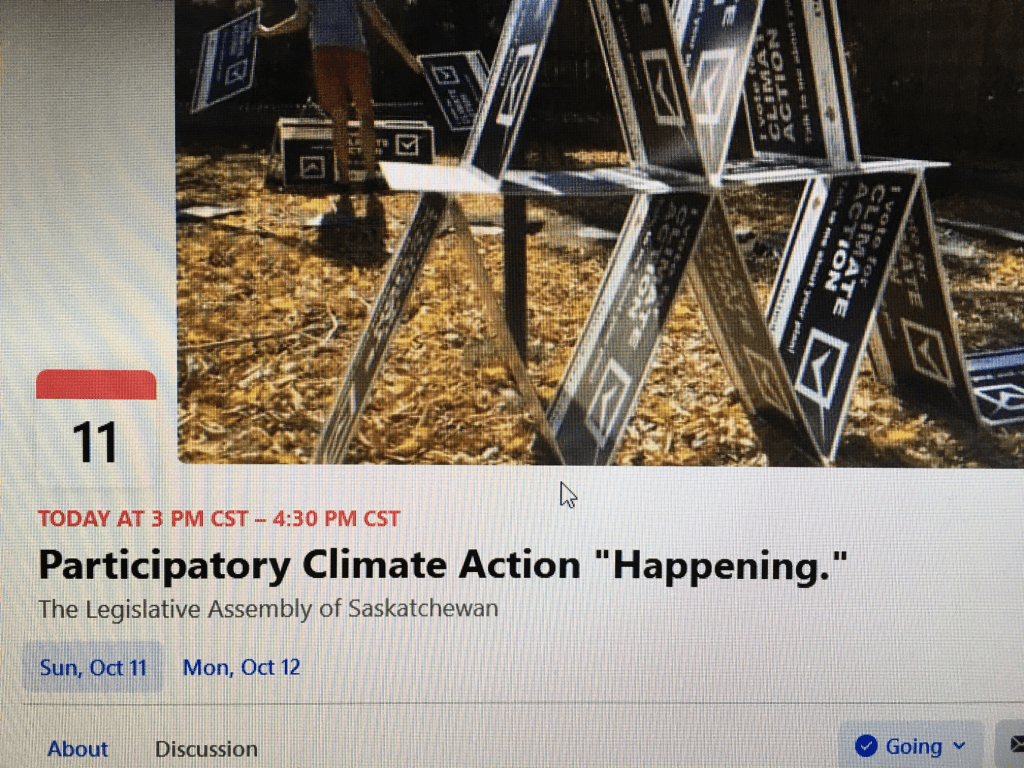
Honestly, I wanted to get an event “out there” asap, and so I decided to post to Facebook that I would be putting on a “happening” today and tomorrow, attempting to build a “house of cards” out of these hundreds of “I vote for climate action” signs that we haven’t yet sold, even though I’m still trying to understand the semantics of the terms “happening,” “participatory art,” “social practice art,” “community-based art” and others that refer to art performances that involve the public in one way or another.
Jakob and I do a trial in our back yard in advance of today’s performance.
The event description is as follows: “Reginans: Join me on the lawn of the Legislative Building between 3:00-4:30pm this Sunday and Monday (Oct 11/12) for a participatory climate action “happening.” I will attempt to build the biggest “house of cards” possible out of these “I vote for climate action” signs, and I’m challenging supporters of this campaign as well as passersby to beat me. I’ll be giving away free signs to the winners! Masks are required.”
Amazingly, Ashley Martin of the local newspaper found out about this performance and EnviroCollective’s climate action sign initiative, and within two days of posting about my event, I was on the front page of Friday’s Regina Leader Post.
In a way, this means I’ve already achieved my objective of using my performance to gain attention to the fact that climate change needs to be considered a major election issue. Now, I’ll just see who shows up to participate in this event today and tomorrow. The Leader Post reaches a wide audience in what is a very conservative and “pro oil” town/province; I’m curious to know if anyone will show up wanting to pick a fight.
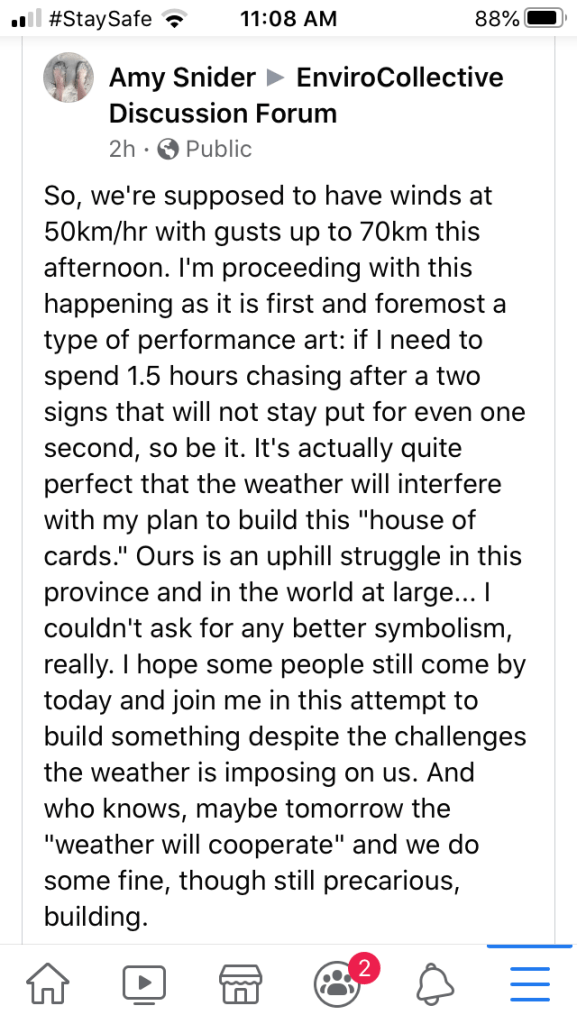
Somewhat ironically, the weather will be a major participant in today’s performance. I posted the following update to this event:
I’m looking forward to this performance and all of the unexpected situations it will produce. I hope a few people are out there chasing after climate action with me. And I hope we will all, but Jakob especially, get a laugh out of what is actually a very dismal situation.
Quotations from: Latour, Bruno. Facing Gaia: Eight Lectures on the New Climate Regime. Medford: Polity Press, 2017.
“It doesn’t stop; every morning it begins all over again. One day, it’s rising water levels; the next, it’s soil erosion; by evening, it’s the glaciers melting faster and faster; on the 8 p.m. news, between two reports on war crimes, we learn that thousands of species are about to disappear before they have even been properly identified. Every month, the measurements of carbon dioxide in the atmosphere are even worse than the unemployment statistics. Every year we are told that it is the hottest since the first weather recording stations were set up; sea levels keep on rising; the coastline is increasingly threatened by spring storms; as for the ocean, every new study finds it more acidic than before. This is what the press calls living in the era of an ‘ecological crisis’.
Alas, talking about a ‘crisis’ would be just another way of reassuring ourselves, saying that ‘this too will pass,’ the crisis ‘will soon be behind us.’ If only it were just a crisis!” (7)
“But here we are: what could have been just a passing crisis has turned into a profound alteration of our relation to the world. It seems as though we have become the people who could have acted thirty or forty years ago — and who did nothing, or far too little.” (9)
“Just imagine: hidden behind the profusion of world wars, colonial wars, and nuclear threats, there was, in the twentieth century, that ‘classic century of war,’ another war, also worldwide, also total also colonial, that we lived through without experiencing it.” (9) (See Scranton’s “slow violence”)
“We can’t say that we didn’t know. It’s just that there are many ways of knowing and not knowing at the same time.” (9)
“This view is much more widespread in the world at large, however, in the form of a low-level madness that can be characterized as quietist, with reference to a religious tradition in which the faithful trusted in God to take care of their salvation. Climate quietists, like the others, live in a parallel universe, but, because they have disconnected all the alarms, no strident announcement forces them up from the soft pillow of doubt: We’ll wait and see. The climate has always varied. Humanity has always come through. We have other things to worry about. The important thing is to wait, and above all not to panic.’ A strange diagnosis: these people are crazy by dint of staying calm! Some of them don’t even hesitate to stand up in a political meeting and invoke the covenant in Genisis where God promises Noah that He will send no more floods…” (11)
“There is no cure for the condition of belonging to the world” (13)
Quotations from: Nixon, Rob. Slow Violence and the Environmentalism of the Poor. Cambridge: First Harvard UP, 2011.
“By slow violence I mean a violence that occurs gradually and out of sight, a violence of delayed destruction that is dispersed across time and space, an attritional violence that is typically not viewed as violence at all. Violence is customarily conceived as an event or action that is immediate in time, explosive and spectacular in space, and as erupting into instant sensational visibility. We need, I believe, to engage a different kind of violence, a violence that is neither spectacular nor instantaneous, but rather incremental and accretive, its calamitous repercussions playing out across a range of temporal scales. In so doing, we also need to engage the representational, narrative, and strategic challenges posed by the relative invisibility of slow violence. Climate change, the thawing cryosphere, toxic drift, biomagnification, deforestation, the radioactive aftermaths of wars, acidifying oceans, and a host of other slowly unfolding environmental catastrophes present formidable representational obstacles that can hinder our efforts to mobilize and act decisively. The long dyings — the staggered and staggeringly discounted casualties, both human and ecological that result from war’s aftermath or climate change — are underrepresented in strategic planning as well as in human memory.” (2-3)
“Politically and emotionally, different kinds of disaster possess unequal heft. Falling bodies, burning towers, exploding heads, avalanches […] have a visceral, eye-catching and page-turning power that tales of slow violence, unfolding over years, decades, even centuries, cannot match.” (3)
“In an age when the media venerate the spectacular, when public policy is shaped primarily around perceived immediate need, a central question is strategic and representational: how can we convert into image and narrative the disasters that are slow moving and long in the making, disasters that are anonymous and that star nobody, disasters that are attritional and of indifferent interest to the sensation-driven technologies of our image-world? How can we turn the long emergencies of slow violence into stories dramatic enough to rouse public sentiment and warrant political intervention, these emergencies whose repercussions have given rise to some of the most critical challenges of our time.” (3)
How can I take this problem and turn it into a piece… how to represent the notion of “slow violence” in art?
“This book’s second, related focus concerns the environmentalism of the poor, for it is those people lacking resources who are the principle casualties of slow violence.” (4)
Yes, and After the Storm was able to draw attention to this tragic unfairness. It’s just so hard to represent this situation without risking being viewed as the “white saviour” or tourist.
“…this books’ third circulating concern — the complex, often vexed figure of the environmental writer-activist.” (5)
“In this book, I have sought to address our inattention to calamities that are slow and long lasting, calamities that patiently dispense their devastation while remaining outside our flickering attention spans—and outside the purview of a spectacle-driven corporate media. The insidious workings of slow violence derive largely form the unequal attention given to spectacular and unspectacular time. In an age that venerates instant spectacle, slow violence is deficient in the recognizable special effects that fill movie theaters and boost ratings on TV” (6)
“Consequently, one of the most pressing challenges of our age is how to adjust our rapidly eroding attention spans to the slow erosions of environmental injustice? (8)
~about how short-sighted politicians are, and the “yes, but not now, not yet” attitude. “How can leaders be goaded to avert catastrophe when the political rewards of their actions will not accrue to them but will be reaped on someone else’s watch decades, even centuries, from now?
Note: So true — reminds me of the conversation I just had with Conservative MP Warren Steinley.
We need to make the effects of climate change relevant to people today. How do we do this? Many use the “do it for your children” claim, but even that doesn’t work well. We are procrastinating ourselves to extinction. How can I show that to my viewers, and how can I do so with some level of “hope” built in as well?
“To address the challenges of slow violence is to confront the dilemma Rachel Carson faced almost half a century ago as she sought to dramatize what she eloquently called ‘death by indirection'” (9)
“Carson herself wrote of ‘a shadow that is no less ominous because it is formless and obscure'” (10)
It’s really time I read the Carson…
“So, too, feminist earth scientist Jill Schneiderman, one of our finest thinkers about environmental time, has written about the way in which environmental degradation may ‘masquerade as inevitable.'” (11)
“The explicitly temporal emphasis of slow violence allows us to keep front and center the representational challenges and imaginative dilemmas posed not just by imperceptible violence but by imperceptible change whereby violence is decoupled from its original causes by the workings of time.” (11)
Paul Crutzen (coined the term “Anthropocene”), Will Steffen, and John McNeill coined the term “The Great Acceleration, a second stage of the Anthropocene Age that they dated to the mid-twentieth century. [They] noted how ‘nearly three-quarters of the anthropogenically driven rise in CO2 concentration has occurred since 1950 (from about 310 to 380 ppm), and about half of the total rise (48 ppm) has occurred in just the last 30 years.'” (12)
So, since I was 13 years old, we’ve seen levels rise 48 ppm (actually more than half of the increase since 1950). People have caused this massive spike in my adulthood.
“If an awareness of the Great Acceleration is (to put it mildly) unevenly distributed, the experience of accelerated connectivity (and the paradoxical disconnects that can accompany it) is increasingly widespread. In an age of degraded attention spans it becomes doubly difficult yet increasingly urgent that we focus on the toll exacted, over time, by the slow violence of ecological degradation.” (13)
“So to render slow violence entails, among other things, redefining speed: we see such efforts in talk of accelerated species loss, rapid climate change, and in attempts to recast “glacial” — once a dead metaphor for “slow” — as a rousing, iconic image of unacceptably fast loss.” (13)
Yes! So how can I do that…?
“It is here that writers, filmmakers, and digital activists may play a mediating role in helping counter the layered invisibility that results from insidious threats, from temporal protractedness, and from the fact that the afflicted are the people whose quality of life — and often whose very existence — is of indifferent interest to the corporate media.” (16)
From “The Environmentalism of the Poor and Displacement in Place”:
official landscape vs. vernacular one
“More than material wealth is here at stake: imposed official landscapes typically discount spiritualized vernacular landscapes, severing webs of accumulated cultural meaning and treating the landscape as if it were uninhabited by the living, the unborn, and the animate deceased.” (17)
“I would argue, then, thaat the exponential upsurge in indigenous resource rebellions across the globe during the high age of neoliberalism has resulted largely from a clash of temporal perspectives between the short-termers who arrive (with their official landscape maps) to extract, despoil, and depart and the long-termers who must live inside the ecological aftermath and must therefore weigh wealth differently in time’s scales” (17)
“refugees in place” and “displacement without moving” (19)
“…the resistance posed by nature itself should not be overstated. The recent turn within environmental studies toward celebrating the creative resilience of ecosystems can be readily hijacked by politicians, lobbyists, and corporations who oppose regulatory controls and strive to minimize pollution liability. Coopting the ‘nature-and-time-will-heal’ argument has become integral to attempts to privatize profits while externalizing risk and cleanup, both of which can be delegated to ‘nature’s business.'” (21).
If I want to give a positive “spin” to the situation, I need to ensure I’m not in any way inadvertently furthering this “nature can heal itself” idea.
Sommer, L. K., and C. A. Klöckner. “Does Activist Art Have the Capacity to Raise Awareness in Audiences?—A Study on Climate Change Art at the ArtCOP21 Event in Paris.” Psychology of Aesthetics, Creativity, and the Arts. Advance online publication, July 1 2019, http://dx.doi.org/10.1037/aca0000247. Accessed 25 September 2020.
In this post, I will contemplate this study’s findings and then post (for my own reference) citations from the article that I may wish to use in the future.
My thoughts on this study
How a piece of artwork dealing with climate change is likely to cause viewers is an essential consideration for me to take when I’m deciding what to create. I don’t want my work to make most people say “we’re fucked” and walk away. I want my work to raise people’s awareness of the seriousness of the climate crisis we’re facing, yes, but I also want them to take action to do something about the situation.
Therefore, when I came across this article, I was excited to find some concrete data on how climate change-related artwork affects viewers. However, before drawing too heavily form this study’s findings in any work or writing I’ll be doing this semester, it is important that I know a bit about the works that were the basis of the study (thanks, Risa, for making this point) and determine how relevant its findings really are to my own practice.
The following is a chart I’ve put together (via lots of copying and pasting from tables 1 and 5) of the 36 art pieces and their creators with hyperlinks to the artworks or the artists body of work added wherever I able to find them:
Description: Illustrating technical or artificial objects Dystopian Topic: Destruction and/or death or social oppression Dark colors and use of metal Mostly exhibited in art museum/gallery settings
Description: Illustrating interconnectedness Depicting the world as a whole Themes drawing on methodology Colorful, mixed materials Mostly exhibited in museum/gallery settings
Description: Showing solutions Making cause and effect of human behavior visible Depicting “sublime” nature Colorful Mostly exhibited outside
“Our Vision of the Future” Participatory work, painted by spectators
(Note: The 37th artwork, “Sertella Septentrionalis,” by Laura Sanchez Filomeno, is not included in table 5 because it “was always the last artwork added to a cluster, hence treated as an outlier and excluded from analysis” (6))
Looking at the sample artists, taking into consideration the limitations noted in the paper (below), I feel as though the “clusters” chosen for this study are sometimes ambiguous, or in other words, that the relation of the works to the these “clusters” is sometimes vague.
For instance, the works in “Cluster 3” are supposed to show/be: “Illustrating interconnectedness; Depicting the world as a whole; Themes drawing on methodology; Colorful, mixed materials.” However, when I look at a sample from this cluster, Gideon Mendel’s series of photographs titled “Drowning World,” I see work that seems to belong more to “Cluster 2: The Challenging Dystopia.”
This work consists of several photographs of people living in places that have experienced flooding as a result of climate change.
Similarly, I don’t see how Cicia Hartmann’s “Mur Vegetal” clearly depicts a “solution” (this work is in the “Awesome Solution” cluster). She’s taken what she claims to be found objects she is “upcycling” (I’m suspicious due to their uniformity and how many of the pieces are identical) and presented them as a relief mural of “flowers.”
What is the “awesome solution” here?
The authors of the study say that the works in this cluster were not “just depicting the problem, but by offering solutions to the participants as part of the artwork.” I wasn’t at this show in Paris, so I can’t know for certain if Hartmann had some sort of solution to the issue of climate change along with this work. I also can’t see how it depicted “the sublime beauty of certain animals, making cause and effect of human behavior visible” (12). Perhaps the actual work she showed was different from what I’ve been able to find.
Another issue that this article raises is the definition of “climate change art.” Many of these pieces used for this study do not directly connect to the issue of climate change per se, but simply “environmental issues.” For example, I don’t see how “Manthan” by Manjiri Kanvinde addresses climate change:
“A landscape painting inspired by the milk revolution of India. Where the women dairy farmers were able to sell the milk produced directly to the consumers without middlemen. By reducing malpractices, it had helped the women of gujrat to prosper, placing control of the resources they create in their own hands.” Source
These are great pieces by Matthew Brandt, but I don’t know how they specifically represent climate change either. Bee populations are declining, but largely this is due to agricultural practices such as the widespread the of neonicotinoids and crop monoculture (ex. almond). Image source
This raises the point of what exactly is or is not climate change related art. As another example of this issue, the “Blue Whale” piece that is listed as part of “Cluster 4: Awesome Solutions” is a life-size whale that, according to artcop21.com, represents biodiversity:
The blue whale, flagship of biodiversity
“The objective of the Blue Whale Project is to provide the keys to understanding the challenges facing the planet and act for the environment. The public can enter the bowels of the Blue Whale to discover a sensory multimedia exhibition. The voice of the Blue Whale, speaking on behalf of all living beings, alerts visitors to the deterioration of the oceans and more broadly our biodiversity. It will focus on the positive contributions and tracks used to save it. The focus will be on positive and concrete messages to everyone, recalling that it is primarily the addition of good behavior and eco-citizen gestures, multiplied by thousands, millions will be a blessing… for our planet. This project is the culmination of four years of work by many stakeholders involved in the preservation of biodiversity; it has the COP21 official label and part of the operation COP21 Solutions at the Grand Palais.” (source)
Yes, climate change is absolutely having an impact on ocean biodiversity, but so does over-fishing, pollution, and plastic. It seems like some of the works shown at the Cop21 event did not immediately concern climate change but rather a broader set of “environmental issues.”
As for the three works in the “Awesome Solution” cluster overall, I don’t really see how they live up to the author of this study’s description of works that are of “sublime nature,” are “hopeful,” “give viewers a sense of awe,” or would leave viewers “significantly more ‘inspired or hopeful'” (12). I just don’t get it. Maybe I had to be there?
So, these are a couple of the issues I’ve found with this study, and so I’m going to take its conclusions with a grain of salt.
This article aside, I’m looking forward to reading a few of the texts that Katherine Arbuthnott uses in her courses on the psychology of climate change. I know that this is an area of study that will be very relevant to how I proceed with art-making for this MFA. I’m grateful that Katherine shared her syllabi with me, and I’m looking forward to chatting with her about this topic in the near future.
Quotations —
Abstract
The goal of this study was to investigate whether activist art can have a stimulating psychological effect on its spectators. This question is examined in art specifically related to climate change. With the aim of inspiring public engagement and communicating environmental issues to spark a climate change movement, ArtCOP21 is a global festival that took place simultaneously to the United Nations climate change negotiations (Conference of the Parties [COP21]) 2015 in Paris. Eight hundred seventy-four spectators responded to a questionnaire on their perception of 37 selected artworks. In an explorative study using cluster analysis, characteristics of the artworks were connected with emotional and cognitive audience responses. The analysis of the artworks assigned them to four clusters: “the comforting utopia,” “the challenging dystopia,” “the mediocre mythology,” and “the awesome solution.” As suggested by the name, the “awesome solution” was the cluster of artworks that caused the highest emotional and cognitive activation. Artists and environmental campaigners can use the commonalities of the artworks in this cluster in their own creative work and contribute to our understanding of the impact of activist art. (1)
Environmental activism through art serves thus as a case of “activism through art” in this study, with which we aim to examine the effect activist art has on its audience. Environmental artists have risen to the challenge to address climate change. Nurmis (2016) outlines how climate change art has established itself as a genre that has developed alongside, but separate to, environmental activism. She makes the claim that such art can convey cultural meaning to global warming beyond the current reach of scientific discussions and political discourse. In the present paper, we propose that environmental psychological theory can assist in determining through which psychological mechanisms climate change art affects audiences, and guide artists who care about the impact of their work. (2)
[W]e aim to find commonalities in environmental artworks and relate them to emotional and cognitive variables that have been shown in environmental psychological research to be relevant as predictors of environmentally friendly behavior. (2)
There is much to be gained from such research, especially for campaigners against climate change, creative practitioners, and politicians interested in bringing change to their community. (2)
[W]e assume that emotional reactions can be key in making climate change personally relevant to people and may be an important driver of change. Emotions, such as happiness, have also shown to promote intrinsic motivation and interest, and thereby contribute to create engagement. (2)
Apart from emotions, cognitive responses can be triggered by art experiences (Silvia, 2005) and can become relevant as determinants for environmental behavior. Cognitions and emotions do not exist separate from each other and the order in which they are triggered is often hard to define. (2)
In the case of art, a shocking piece of visual art can, for example, cause people to react with anxiety, anger, or guilt, dependent on their personal background and state. Thereby, emotions can be conceived as episodes, which change cognitive processing (“What does this artwork mean/tell me?”), motivational aspects (“Does the artwork motivate me to a certain action?”), physiological reactions (sweat, chest tightness, etc.), and maybe even actual behavior (“I will cycle to work tomorrow”). To conclude, we expect that emotions have a key role in the activating process. (3)
Climate change-related cognitions can be of many different kinds. Hulme (2009) argues that climate change is not just a physical entity that shapes our present and future weather conditions, but also holds meaning for culture. Making culture and climate interact “and mutually shape each other” thereby triggers contemplation and reflection in people. Art can, for example, make people aware of the impact of their own behavior (Marks et al., 2017) and reflect on their role within climate change (Curtis et al., 2014). (3)
Moreover, art can illustrate to people why environmental topics are relevant for them in their daily lives, without sounding “preachy” (Neal, 2015, p. 18). (3)
Moreover, art can illustrate to people why environmental topics are relevant for them in their daily lives, without sounding “preachy” (Neal, 2015, p. 18). (3)
His results were that art experiences help to:
(a) improve proenvironmental beliefs, values, and attitudes;
(b) raise awareness of the consequences of certain actions;
(c) form a proenvironmental self-concept;
(d) unfreeze ingrained habits;
(e) form proenvironmental social norms;
(f) build community involvement in proenvironmental activities;
(g) reduce some situational constraints and physical barriers to adopting pro- environmental behavior.
(3)
Research questions (3):
1. Do environmental artworks (as a case of activist art) trigger different profiles in emotional reactions by the audience, which can be grouped in homogeneous clusters?
2. Do these clusters also correspond to differences in climate change-related cognitions and artist perception?
3. To which emotional and cognitive patterns do different characteristics of activist artworks relate? (3)
Artworks in Cluster 1—“The Comforting Utopia” (7)
In order to name the clusters, we combined the emotional and cognitive reactions the participants showed, together with the common characteristics we could identify in the clusters.
Regarding the emotional variables, the “comforting utopia” shows, in comparison to the other clusters, positive emotions values ranging between the highest and lowest cluster, which means the artworks make people relatively “happy,” “hopeful,” and “inspired.” For the negative emotions, the comforting utopia displays the lowest scores, which means the artworks make people feel only a little “guilty,” “sad” and even less “angry” and “anxious.”
For the cognitive variables, the comforting utopia was rated lowest on the perceived quality of the artwork. Participants reported a low level of activation in nearly all cognitive variables, with lowest mean scores for the variables “confrontational,” “reflect,” and “awareness of impacts.” Furthermore, they think of the artists represented in this cluster as “expressing the view of the public,” more than in the other clusters.
Artworks in Cluster 2—“The Challenging Dystopia” (7)
The “challenging dystopia” is the cluster with the weakest positive and the strongest negative emotional reactions reported on average by the participants. Artworks in this cluster make participants the least happy and hopeful, but manage still to “surprise” them. They make the participants feel most guilty, “apathetic,” “sad and disappointed,” “angry,” and “anxious”.
Regarding the cognitive variables, the challenging dystopia was rated third on the perceived quality of the artwork. It stands out by reaching the highest value on the variable “confrontational and shocking,” which is in alignment with the negative emotions the artworks in this cluster are causing. It also reaches high mean values for “challenging social norms,” “art has something unusual and made me stop,” “relevance for daily life,” and “awareness of impact.” Regarding the perception of the artist, the challenging dystopia rated lowest or among the lowest for all the perception of the artist items, indicating that the participants did not identify with the values or intentions of the artists.
Artworks in Cluster 3 —“The Mediocre Mythology” (7-8)
The artwork in the “mediocre mythology” show a relatively “flat” emotional pattern, causing neither strong positive nor negative emotions. The highest mean values for emotional responses in the mediocre mythology are reached for the emotions “sense of
awe” and “sadness and disappointment,” but even these emotions remain second lowest among all clusters.
For the cognitive responses, the pattern is similar, meaning that artworks in the mediocre mythology do not seem to reach explicitly high or low values on any of the cognitive variables, even though the cluster was rated second on perceived quality of the artwork. The highest value was found for the variable “the art has something unusual and made me stop”, which is in alignment with the emotion “sense of awe”. In addition, “showing personal consequences of climate change” scored second highest among clusters, which could be connected to the emotion sadness and disappointment. Concerning the perception of the artist, “the artist has values similar to me” scored second highest among the clusters.
Artworks in Cluster 4—“The Awesome Solution”(8)
The emotional response pattern to the artworks in the “awesome solution” presents the highest values for all positive emotions, while at the same time showing negative emotions ranging between “the dystopian future” and the comforting utopia. The only exception is a peak in “sadness and disappointment”. Regarding the cognitive variables, the artworks in the awesome solution have the highest values for the variables “perceived quality of the artwork,” “the artwork has something unusual and made me stop,” “the artwork highlights personal consequences,” and “highlighting one’s own role within the climate situation.” For the variables describing the perception of the artist, artists behind the works in the awesome solution reach the highest values for “the artist is like me,” “the artist is thinking and living differently than most people,” and “the artist has similar values as me.” This indicates that participants in this cluster perceived themselves to be different from the general population, and similar to the artist.
Characteristics of Artworks “In order to answer Research Question 3 (To which emotional and cognitive patterns do different characteristics of activist artworks relate?), we looked for similarities among the artworks that constitute the clusters in the final step of the analysis. In order to identify similarities, we used the artwork characteristics rated by the researchers when the survey was conducted. As a method to avoid identifying random characteristics that only one or two artworks in a cluster have, we decided that at least three artworks per cluster (2 in the case of Cluster 4, consisting of only 3 artworks) needed to exhibit a commonality in order to assign it to the cluster. Table 5 gives an overview of the artworks in the clusters and their commonalities.” (5)
Discussion
With this study, we aimed at identifying emotional reaction profiles triggered by activist environmental art and related cognitive responses. We grouped the artworks based on these profiles and studied the common characteristics within each cluster, which might have led to the psychological effects on its audience. We hope to uncover which aspects of activist artworks have the potential to motivate people (to act in a more climate friendly manner). (9)
Limitations of the Study and Further Research
“The selection of the clustering method is based on the resulting dendrograms and theoretical assumptions, and it can be argued that a different clustering method would lead to slightly different clusters. However, the differences between cluster solutions were not substantially different as, for example, artwork No. 25 (Sertella Septentrionalis) was an outlier across all methods. The other possible cluster solutions have been added as online supplementary material to this study (available online). We chose the clustering method, which had the most interpretable cluster solution according to the emotional reactions the participants had to the artworks.” (13)
“Moreover, the postclustering characterization of the artworks and the assignment of common attributes are also qualitative, even though we tried to reduce subjectivity through the standardized artwork characteristics sheet. In addition, the researchers and their assistants were more trained in psychology than in art or art history. Possibly, a description of the artworks by people from the art field could have led to a characterization based on art theory and history of the artworks and the clusters. Future research should prefer such expert classification. Most research on the perception.” (13)
Conclusion
“Based on the clusters of artworks and, accordingly, the reactions of the participants, we suggest that activist art including environmental art should move away from a dystopian way of depicting the problems of climate change, toward offering solutions, and emphasizing the beauty and interconnectedness of nature. The use of dystopian elements to initially catch attention, but with the remaining solution focused and hopeful, may be even more promising in encouraging action. Moreover, it is important to move out of the institutional space of museums into the public, in order to reach out to a bigger audience, and to avoid the connotation that art is something reserved for the educated part of the population.” (14)
“On the contrary, the fact that only three out of 37 artworks were grouped into the awesome solution deserves some attention. It is not easy to reach an audience, even if the intention of the artist and activist is to do so. It is not enough to simply show the problem in an aesthetic way, but according to characteristics of the awesome solution, it is essential to create a personal connection to the causes and consequences and offer solutions. “Painting things black” and inducing fear is also not the best way to go, since it induces more fear, which reduces motivation (O’Neill, Hulme, Turnpenny, & Screen, 2010). Artists can be positive and negative voices, which emphasize the creative or destructive potential of people and societies. We were able to identify similarities between artworks that can explain why an artwork engages its audience in a positive way. The commonalities of artworks, especially in the awesome solution, can be used by artists as guidelines for creating works, which have the potential to retell the stories of climate change in a way that activates the slumbering potential in our societies. Environmental psychology contributes by revealing the underlying emotional and cognitive mechanisms and helps to address environmental challenges, among them climate change. In order to do that, it is essential to bring together natural, social sciences and humanities, since “we cannot detach the stories we tell about climate [change] from the stories we tell about societies” (Hulme, 2009, p. 33).” (14)











 Amy Snider