Risa Question: At what point are ideas in germination, unfixed and in flux (and, thus, worthy of exploration), and at what point are ideas so developed as to abandon them altogether? This question is about your ability and willingness to experiment and explore unencumbered by perfection; vs. being frozen (?) from doing/making with attempting an exploration?
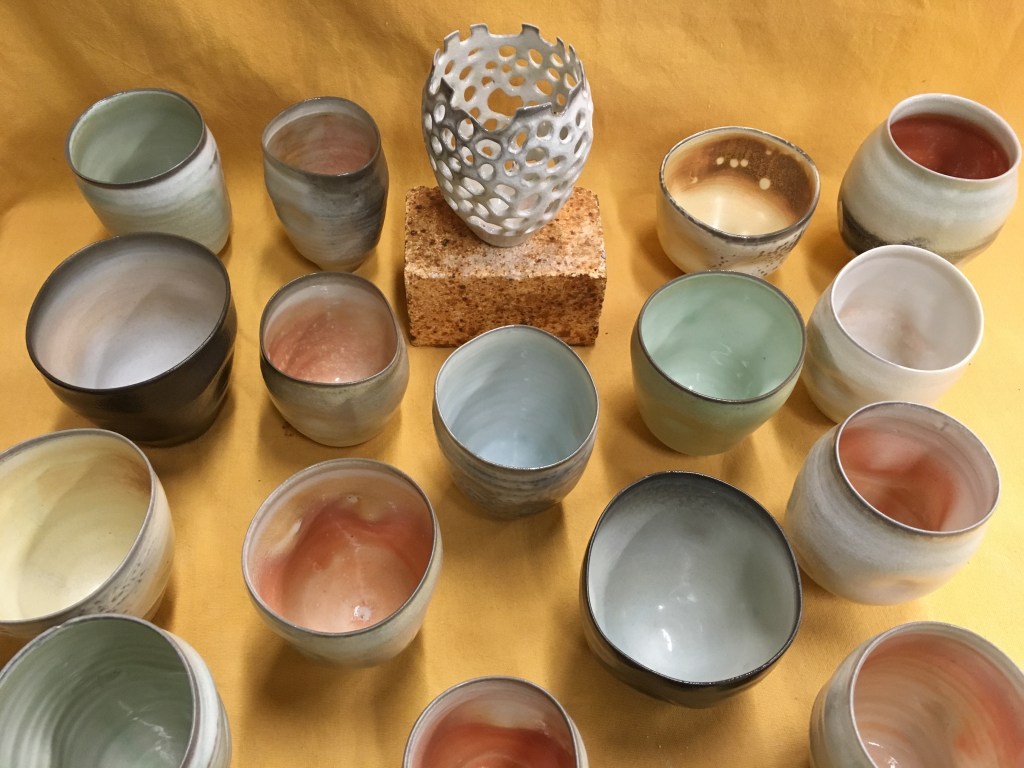
It’s hard for me to answer this question in general terms at this stage in my development as an artist, as I’m just beginning to learn about my practice. Most of the work I’ve done until now was what I would call “low-stakes”: my projects have largely been series of ceramic functional wear pieces, and my learning curve with them only involved solving formal and technical challenges to get the “look” that I wanted these pieces to have. I didn’t need to deal with the extra layer of complexity that conceptual artwork entails.
The only other time that had an idea for a project that I dropped was for a Senior Undergrad Group Studio class I took with David in the winter of 2018, and it was also my first time attempting to do anything conceptual. This was my first time attempting to bring a topic (also climate change) into my practice. I spent most of the semester trying to make an idea work — this included trying very hard to understand David’s feedback on the piece that it wasn’t conveying what I wanted it to convey, and trying to find ways to justify to myself and do David/my classmates why it was a worthwhile idea to continue working on. It eventually got through to me that the core of the idea had problems that were likely irresolvable, and I was completely stressed out about what to do with my work for this class.
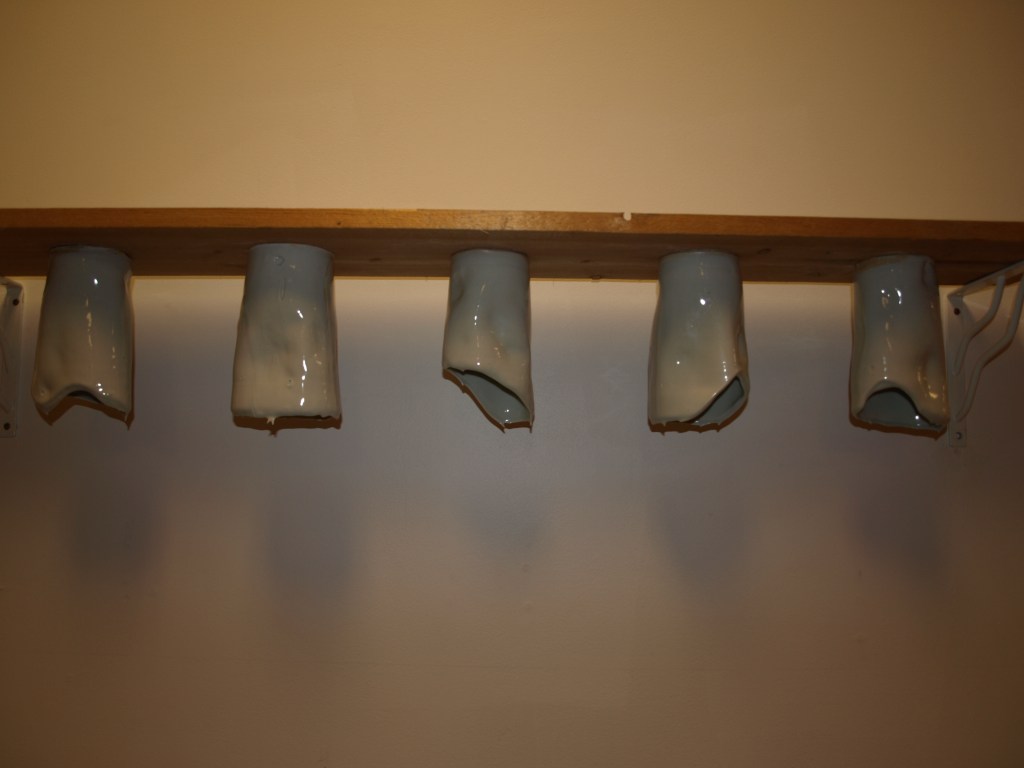
Feeling the melting glacier, anybody?
Yeah-no.
Luckily, I was able to take a break from focusing on this problem. Near the end of the term, I had the great fortune of going to Pittsburgh for a ceramics conference, NCECA. For three days in a row, I wandered around the city by foot, ignoring the free shuttles that conference attendees could make use of, opting instead to walk for hours each day from studio to studio across the city. I think that the combination of walking and viewing so many awesome examples of ceramic artwork was precisely what I needed at that moment.
Just after boarding my return flight, a idea just popped into my head, and I immediately started sketching it in my travel diary. I knew instantly that this idea would convey the meaning I wanted my work to convey in a much clearer way than my original idea. It was at that point that I ditched my original idea, and about two intense weeks later, I was very happy with what I had for that class’ final crit.
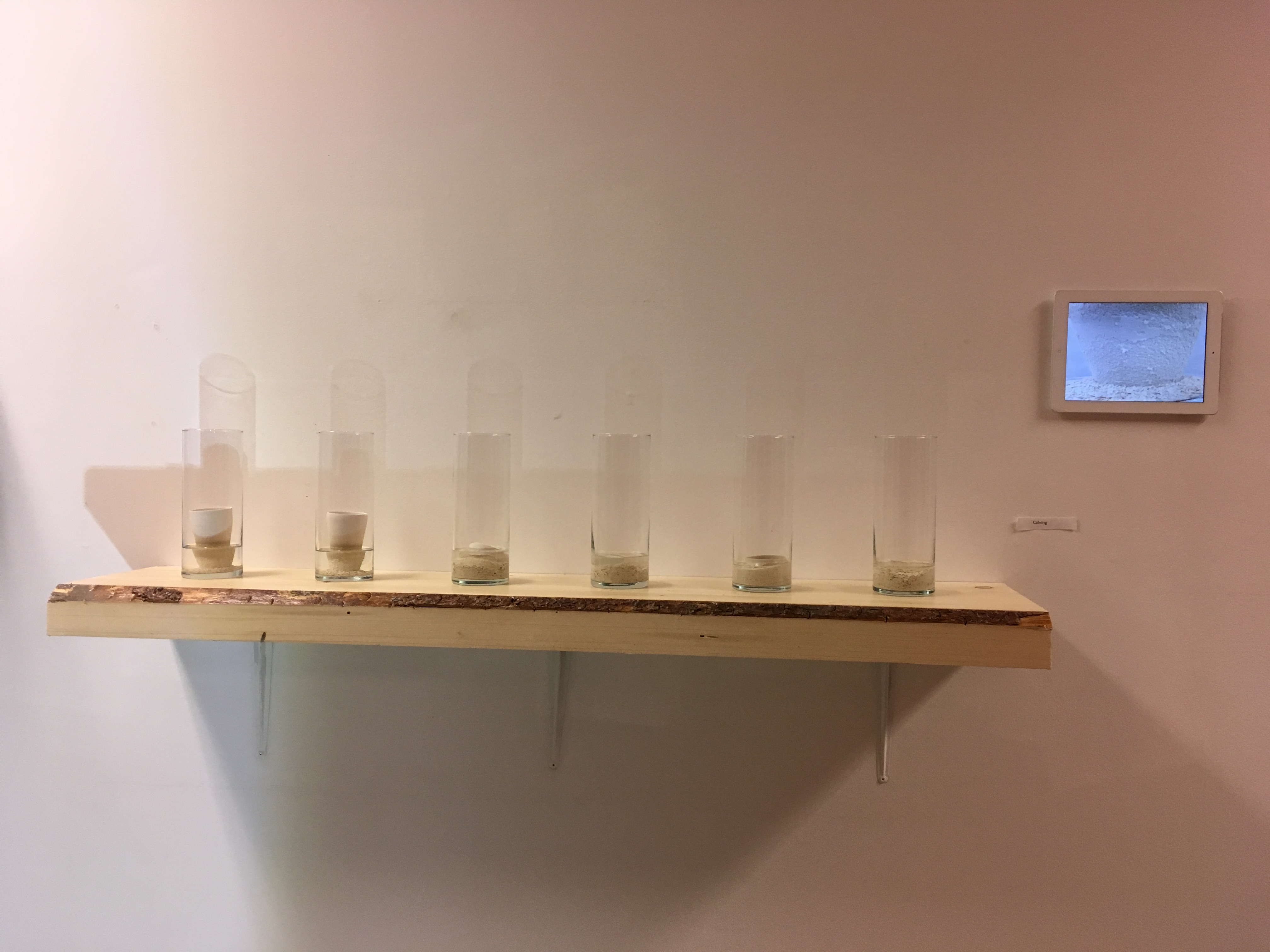
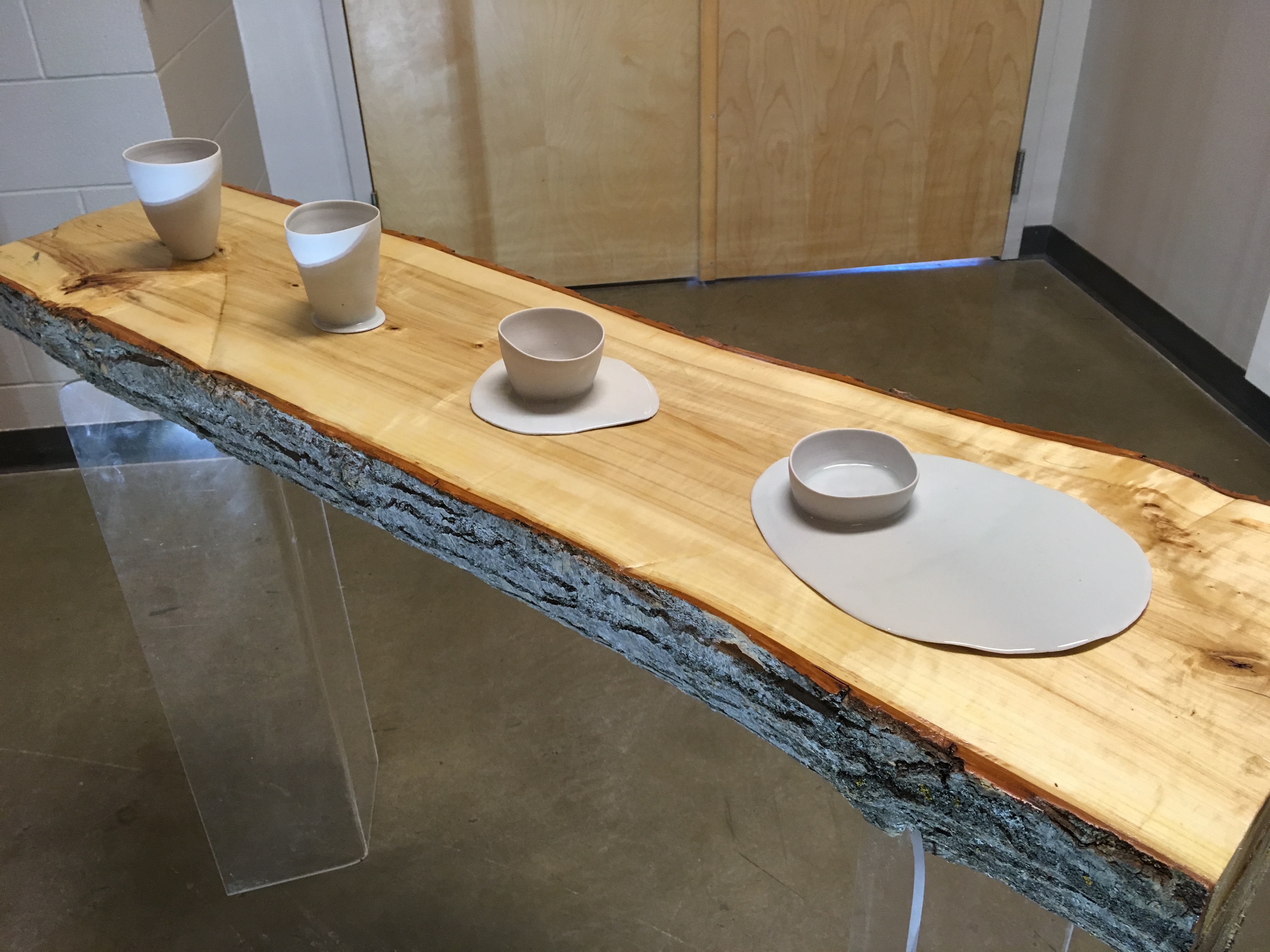
(The pieces above are titled “Calving” and “Athabasca Glacier, 1918-2018,” and they’re part of a series of pieces using a tool use to drink (the cup) to demonstrate glacial loss. In the crit, and subsequently in a show, I’ve been told that the pieces get my point across very clearly.)
I understand that project ideas often need tweaking or even larger-scale revisions. Thinking about this now, I realize that I’ve never been very good at doing the latter; when I used to fancy myself a writer, I found it very hard to make major revisions to any story or poem I’d written. The best feeling ever was when the idea for a piece came to me “out of the blue,” complete and just about ready to go. I could make minor revisions to it, but I’d quickly lose interest in an idea if it needed significant or structural changes in order for it to work. It was easier for me to just start again from scratch.
Is this something I need to work on? For how much time should an artist stick with an idea when she knows that it is fundamentally problematic? At what point is it best to return to the drawing board? These are great questions, and I don’t have any great answer for them. For my original project in Risa’s class this term, I can see parallels to the project idea I’d originally had in David’s class back in 2018: the work I was going to produce would not clearly convey what I wanted it to. In a way, a “seed” of the original idea helped me get to where I eventually ended up, but most of it had to go.
This reminds me of something Annie Dillard says in The Writing Life that was very important to me years ago when I was trying to become a writer. She writes about the way a writer needs to be ruthless at times with her writing, and not pause before destroying what must be destroyed for the project to reach fruition:
The line of words is a hammer. You hammer against the walls of your house. You tap the walls, lightly, everywhere. After giving many years’ attention to these things, you know what to listen for. Some of the walls are bearing walls; they have to stay, or everything will fall down. Other walls can go with impunity; you can hear the difference. Unfortunately, it is often a bearing wall that has to go. It cannot be helped. There is only one solution, which appalls you, but there it is. Knock it out. Duck.
Annie Dillard, The Writing Life
It seems clear to me right now that there is not much I can salvage from the idea I originally proposed to Risa. Perhaps some “brick” from it will become part of a future project, but I don’t want to feel tied down to building a building that I am already convinced isn’t the right one.
I don’t believe that this means I’m being “encumbered by perfection,” and I certainly have a “willingness to explore” in this early early stage in my MFA without any delusions of grandeur that I will produce a masterpiece in the next few months (or years… or ever ). I just feel at this stage that my original idea has already taught me what it can, and I’m ready to move onto exploring and learning from something else.
 Amy Snider